Most employees assume "confidential" means no one can trace their survey response back to them. Usually, that's not what it means. That gap between what employees believe and what the platform actually does is why so many listening programs collect polished answers instead of honest ones. The mode you choose determines the quality of every data point that follows.
TL;DR: A confidential survey records who responded but restricts who can see that information. An anonymous survey collects no identity at all. The link between person and response never exists in the system. Which mode you use determines whether you can segment your data by department or demographic, follow up on specific responses, and satisfy regulatory reporting requirements.
Key Takeaways
- What is a confidential survey?
- What is an anonymous survey?
- Confidential vs anonymous surveys: key differences
- When to use a confidential employee survey (4 use cases)
- When to use an anonymous employee survey (4 use cases)
- Are employee surveys really confidential?
- How Vantage Pulse handles both survey modes
- Conclusion
- FAQs
What is a confidential survey?
A confidential employee survey collects respondent identity but restricts who can access it. The survey tool records who responded, and that information stays with a defined group, typically HR administrators, under strict access controls. Managers and leaders see only aggregated results: team scores, department averages, category breakdowns by tenure or location. They don't see who said what.
Here's the part most people miss: "confidential" does not mean "anonymous". When an employee submits a confidential survey, someone in HR can connect that response to a specific person. The trust rests on an organizational commitment and platform access controls, not on a technical separation of the two records.
That distinction shapes how honestly people answer, more than most HR teams want to acknowledge. Employees who suspect they can be identified will soften their feedback. Not because they're dishonest, but because they're rational.
Some modern platforms sit between these two modes with a semi-anonymous configuration. HR sees results by department or team segment but can't drill down to individual responses, even with full admin access. The employee's identity is captured so the data can be segmented, but individual answers stay hidden.
Confidential surveys are the right tool when you need the demographic detail to act on the data. DEI measurement, manager-level action planning, and regulated compliance reporting all depend on knowing which department, tenure band, or location a response came from. That segmentation isn't possible with anonymous data. If you want to see how that segmentation looks inside a real dashboard, take a look at Vantage Pulse here.
What is an anonymous survey?
An anonymous employee survey collects no identifying information. Individual response data can't be linked to a specific employee by anyone, including the platform administrator.
The difference from a confidential survey is technical, not just procedural. In a properly built anonymous survey, the link between who submitted and what they said doesn't exist anywhere in the system. There's no promise to keep. There's no data to breach.
This is the mode most employees expect when they see the word "confidential". That mismatch is one of the reasons many listening programs fail to collect reliable data on the topics that actually matter.
Confidential vs anonymous surveys: key differences
The right choice depends on what you need to do with the data after the survey closes.
| Dimension | Anonymous | Confidential |
|---|---|---|
| Identity collected? | No | Yes, stored with HR-restricted access |
| Who sees identity? | No one | HR admin group only |
| Response honesty | Highest: no identity risk | High, when trust in HR is strong |
| Action planning | Aggregate totals only | Broken down by dept, tenure, location |
| Follow-up possible? | No | Yes, within HR protocols |
| Best use cases | Pulse check-ins, sensitive culture topics, post-merger periods, idea collection | DEI analysis, manager coaching, regulated reporting, lifecycle tracking |
Most HR teams should default to anonymous for regular employee listening and move to confidential only when specific outcomes require demographic detail.
When should you use a confidential employee survey?
Confidential surveys trade a degree of response honesty for demographic action-planning power. Use confidential mode when the follow-up action depends on knowing which group the feedback came from.
DEI baseline measurement
When you're measuring diversity, equity, and inclusion metrics that require demographic tagging, gender, ethnicity, tenure, pay band, or level, confidential mode is usually necessary. Aggregate anonymous data tells you there's a problem somewhere in the organization. Confidential data with proper access controls tells you where it is, how significant it is, and which groups are most affected.
The Great Place to Work India × Vantage Circle Recognition Effect report found that 92% of employees in high-recognition cultures express an intent to stay. Building that kind of culture requires knowing which groups are underrecognized or disengaged. Anonymous surveys can't surface that.
Without demographic segmentation, you can respond to a problem but not target it. An organization-wide score of 58 on recognition tells you something is off. A confidential survey that shows recognition scores at 38 for employees in their first two years, and 71 for those past the three-year mark, tells you exactly where to start.
Manager-level action planning
When survey results will drive specific manager- or team-level action plans, you need confidential mode. Anonymous data can show that engagement scores are low across the organization. It can't show which manager needs coaching, which team is at attrition risk, or where a targeted intervention would have the most impact.
Mercer's Global Talent Trends 2026 report found that only 41% of executives believe HR effectively advises them on people risks. If your survey data can't tell you which team, which manager, or which location is struggling, you're walking into leadership meetings with averages. Executives don't act on averages.
Getting the data is one thing. Knowing what to do with it is another. Here's how to run a proper employee engagement survey analysis that turns scores into decisions.
Regulated reporting and compliance
For surveys supporting regulated reporting requirements, Sarbanes-Oxley (SOX) whistleblower channels, EEOC compliance, or GDPR-compliant analytics, confidential mode is often required by the regulation itself. When regulations require you to act on specific complaints or track responses over time, you need to know who said what.
One thing worth knowing before your next survey launch: under GDPR Article 4, truly anonymous data falls outside the definition of personal data entirely. That means no retention limits, no cross-border transfer restrictions, no erasure requests. Confidential survey data doesn't get that pass. Because identity is stored somewhere in the system, even under restricted access, it's still personal data in the eyes of the law. If your organization operates across multiple countries, that distinction has real compliance implications.
Lifecycle and onboarding tracking
Employee lifecycle tracking depends on identity. Onboarding surveys, 90-day check-ins, and work anniversary surveys are designed to track how a specific person's experience evolves over time. Not to expose responses, but to know which cohort a respondent belongs to and how their sentiment at 30 days compares to where it stood at 90.
An anonymous onboarding survey can tell you that new hires in their first month are scoring low on clarity and belonging. A confidential one with proper access controls can show you which team those new hires are in, which manager they report to, and whether the pattern repeats across multiple cohorts. That's the difference between noticing a problem and diagnosing it.
Onboarding, 90-day check-ins, work anniversaries. These are the moments when confidential mode does its best work. See how to build a proper employee lifecycle survey program that tracks people through every stage.
When should you use an anonymous employee survey?
Anonymous surveys are the right default for most employee listening because response honesty determines data quality. According to Gallup's State of the Global Workplace report, actively disengaged employees cost US businesses $483 billion to $605 billion a year in lost productivity. You can't accurately measure what drives that disengagement through a survey where employees are quietly calculating how honest it's safe to be.
Recurring pulse check-ins
For regular engagement surveys, anonymous mode is almost always the right call. Pulse cadence matters, but the mode matters more. Employees respond more honestly when they know identity is technically separated, not just promised by policy.
Run a confidential pulse and some employees will answer for the record. Run an anonymous one and you start to see what they actually think. The difference in data quality isn't subtle.
Psychological safety, harassment, and ethics topics
If your survey touches psychological safety, harassment, retaliation risk, ethics concerns, or workplace conflict, anonymous is non-negotiable. Employees won't give you accurate data on sensitive topics through a confidential survey when there's any perceived risk of identification.
The practical test is simple: would someone in a high-risk situation answer this honestly if HR could identify them? If the answer is uncertain, anonymous is the only mode that produces usable data.
Post-merger and culture change periods
During M&A integration, restructuring, or significant culture change, employee trust in leadership is often fragile. That's exactly when you most need honest data, and it's exactly when employees are most likely to self-censor through a confidential survey.
You can't measure a trust deficit accurately through a survey where employees know HR can see who said what.
Innovation and idea collection
Organizational hierarchies suppress honest contribution. When employees know their name won't be attached, ideas surface from people who'd otherwise stay quiet or quietly credit a senior colleague for safety. For suggestion boxes, innovation contests, and town hall idea submissions, anonymous mode consistently produces better signal.
Choosing anonymous mode is only half the job. The questions you ask determine whether you get honest answers or polished ones. Here's a full guide to writing anonymous employee survey questions that surface what employees actually think.
Are employee surveys really confidential?
This is the question most employees want answered before they decide how honestly to respond. The direct answer: it depends on the platform, and employees are right to be skeptical.
In many organizations, "confidential" is an organizational promise, not a technical constraint. An HR administrator with full system access can, in principle, connect a specific employee to their response. The commitment not to do so is real and typically honored. But the data linkage exists. Employees who know how survey tools are built aren't being paranoid when they hesitate. They're reading the situation accurately.
Three platform features close the gap between a confidential promise and a genuine technical guarantee.
- Technical separation. Response data is stored separately from participation tracking. Even with full admin access, the system doesn't hold a single record that connects a specific employee to a specific response. The two pieces of information exist separately and are never joined.
- Minimum response thresholds. Results only display after a minimum number of responses have been submitted. A manager can't infer individual opinions from a team of five when the platform requires eight responses before any data appears.
- Mode locking. Once a survey launches in anonymous mode, no one can go back and attach names to those responses. The privacy setting chosen at launch is permanent. This matters because it removes any possibility, intentional or accidental, of identifying respondents after the fact.
When these features are in place and communicated clearly to employees before the survey opens, participation rates, response rates, and the overall quality of feedback all improve.
When AccessOne launched with Vantage Pulse, they made the system-level anonymity protections visible to employees upfront, before the first question. By addressing privacy skepticism directly rather than hoping employees would take the promise on faith, they hit 67% participation in their first month. The industry benchmark for an initial pulse survey is 30 to 50 percent. When employees know the platform physically blocks identification, they stop self-censoring.
Communicating your privacy controls clearly is the single biggest lever for participation. See what else drives (and kills) employee survey participation rates, with benchmarks to measure against.
How Vantage Pulse handles both survey modes
Source: Vantage Pulse
Vantage Pulse supports both survey modes with technical enforcement at the platform level, not just a policy promise. In anonymous mode, individual response data is separated from participation data at the storage layer. Super Admins can't access individual results. Minimum response thresholds apply by default before any results display.
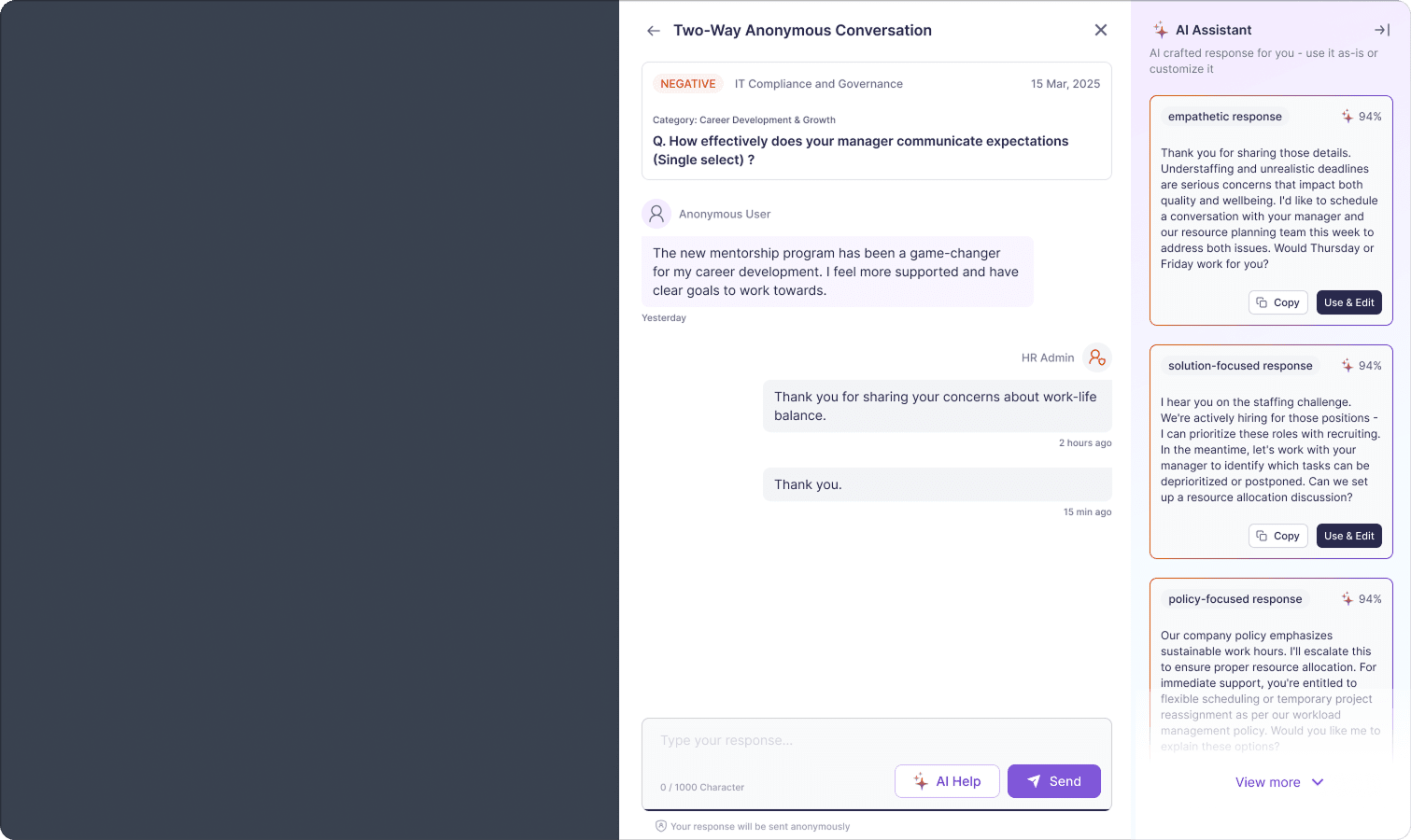
The Two-Way Anonymous Conversation feature lets HR follow up on any employee feedback without seeing who submitted it. HR can reply to a concern, ask a clarifying question, or close the loop on an action taken. The employee can respond throughout the thread. Their identity is never exposed during the exchange.
When HR opens a response and enters the reply interface, an AI Assistant panel appears with drafted responses, each tagged as an empathetic reply at 94% confidence. HR can use a draft, edit it, or write their own. The anonymity footer confirms at each step that the employee can't be identified.
For employees, the survey attempt screen shows trust signals before the first question: "Your identity is protected" and "No name or email tracking." For HR teams running programs across departments, the Heatmap view shows category scores by team, location, and demographic group without exposing individual responses. You can see that a specific department has a critical engagement score, know exactly where to direct your attention, and act without knowing which person submitted which response.
Conclusion
The choice between confidential and anonymous isn't about which sounds better. It's about what you need to do with the data. Anonymous mode gives you the most honest signal. Confidential mode gives you the demographic detail to act on it precisely. Most HR teams should default to anonymous for regular listening and switch to confidential only when the use case demands it: DEI measurement, manager-level action planning, regulated reporting, or lifecycle tracking.
Get the mode wrong and the data suffers. Employees either soften their feedback or the results lack the segmentation you need to take meaningful action. Neither outcome helps anyone.
If you're not sure which mode your current platform actually uses, or whether "confidential" in your tool is a technical guarantee or just a policy promise, that's the first question worth asking.
FAQs
1. What is the difference between a confidential and an anonymous survey?
An anonymous survey collects no identifying information. A respondent's answers can't be traced back to them by anyone, including the platform administrator, because the data link doesn't exist. A confidential survey collects identity but restricts who can see it. HR can identify who responded but commits to keeping that information separate from results visible to managers and leadership. The trust in a confidential survey rests on policy and access controls. The trust in an anonymous survey rests on technical design.
2. Are employee surveys really confidential?
It depends on the platform. In many survey tools, "confidential" means HR has made an organizational commitment not to share individual responses. The technical link between employee and response still exists. On platforms with technical separation, minimum response thresholds, and mode locking, confidentiality is enforced by the system itself rather than by policy alone. Ask your survey vendor which of those three features their platform has before describing your surveys as confidential to employees.
3. Is an anonymous employee survey legal under GDPR and CCPA?
Yes. Truly anonymous data is excluded from personal data definitions under GDPR Article 4, and from most CCPA scope. The platform must be able to demonstrate that responses can't be re-identified. Pseudonymized data, where a hidden key could theoretically be used to re-link responses back to individuals, still counts as personal data under GDPR and carries full data subject rights. If you're unsure which category your survey data falls into, the question to ask your platform is whether a re-identification key exists anywhere in the system.
4. What should a confidential survey disclaimer say?
A confidential survey disclaimer should cover four points: who has access to individual response data (HR administrators only, not managers); that individual responses won't be shared with leadership or line managers; the aggregation threshold before results are shown; and how long the data will be retained. Employees need to see this in the survey invitation and again on the first screen of the survey. A disclaimer that appears only in a policy document no one reads doesn't build trust.

People, culture, and what makes employees genuinely engaged, I write about it all, with practical insights HR teams can actually use.
Connect with Sahil on LinkedIn.