
Most engagement surveys ask the right questions, but few organizations ever answer the one that matters most to the people filling them out, which is what happens to their answers afterward. Employees rate their manager, name what's broken, and submit their responses, and for most of them that's the last they hear of it, since the feedback disappears into a dashboard that nobody outside HR ever opens.
That silence carries a cost, because employees who never hear back once tend to answer less honestly the second time, and eventually decide it isn't worth answering at all, which is how so many of them arrive at the belief that their voices don't matter inside their own organization. The listening programs that struggle are rarely the ones that ask too little; they're usually the ones that ask, collect the data, and then go quiet before anyone sees a result.
An employee listening strategy exists to break that pattern, turning the act of asking into something that actually produces recognition, change, and follow-through employees can see for themselves. What follows are 10 practical ways to build one that does exactly that.
Key Takeaways
- What Is an Employee Listening Strategy?
- Why It Matters for Employee Trust and Business Outcomes
- Case Studies: How Uber and Microsoft Act on What They Hear
- 10 Actionable Strategies to Build One
- Common Challenges You'll Need to Plan For
- The Tools That Make Listening Programs Work
What Is an Employee Listening Strategy?
An employee listening strategy is an organization's plan or framework to collect, analyze, and act on employee feedback across the entire employee lifecycle, not a one-off survey.
It's a distinct concept from active listening, which is a personal communication skill for one conversation at a time. An employee listening strategy is the organizational system that turns many individual moments of being heard into a consistent, company-wide practice.
It involves creating channels for employee feedback and analyzing and interpreting that data to identify what actually needs to change. The strategy's focus is to implement changes that improve employee engagement, productivity, and well-being.

Now that we've covered the definition, here's why building one actually matters.
Why an Employee Listening Strategy Matters
An employee listening strategy matters because employees who feel heard invest more in their work, take more ownership of their responsibilities, and collaborate more openly with their colleagues.
- Employee listening is not just a feel-good exercise; it's a continuous process between a manager and team members throughout the entire employee lifecycle.
- Continuous employee listening can drive real results for your business, including increased productivity, improved employee retention, and higher customer satisfaction.
- Leaders get an undiluted and unbiased view of where the company actually needs to improve.
- It helps create a culture of trust and transparency, and fosters an engaged, committed workforce.
- It helps organizations identify and address issues before they escalate into bigger problems.
- By listening to employee feedback, employers gain valuable insight into where improvement is needed and can act on it directly.
Case Studies: How Uber and Microsoft Act on What They Hear
Uber and Microsoft both prove the same point: continuous listening only works when it's paired with a visible, standing commitment to act on what surfaces, not a one-off survey push.
Uber: The Crew Program
Uber's clearest recent proof point is its Crew program, where drivers and couriers apply to sit down directly with the company and shape product and policy decisions. In 2025 alone, Uber ran more than 60 Crew sessions with over 100 team members, gathering hundreds of hours of direct feedback on everything from product design to policy changes.
When we act on this feedback, we build better products.
- Dara Khosrowshahi, CEO, Uber
This builds on a broader shift Uber made toward continuous listening, moving away from relying solely on annual engagement surveys.
Tracking feedback throughout the year helps us reduce recency bias. Due to its ongoing nature, timely feedback also ensures that there are no surprises in terms of how the teams are performing.
- Divya Garg, Head of HR, Uber India
Uber is already recruiting its 2026 Crew cohort, which means this isn't a one-off listening exercise. It's a standing program built directly into how the company operates.
Microsoft: Viva Glint at Scale
Microsoft runs its own employee listening on Viva Glint, deployed internally across more than 190,000 employees. The setup layers three listening channels: Employee Signals, a twice-yearly company-wide survey; daily lifecycle surveys tied to specific moments in an employee's tenure; and ongoing manager feedback surveys.
Employee Signals is our flagship channel for listening to our employees. It's how we mobilize our entire company.
- Dante Myers, Director, HR Business Insights Employee Listening team, Microsoft
After its most recent Employee Signals cycle, nearly 5,000 Microsoft managers used the platform's built-in Copilot AI to analyze their own team's results, turning survey data into action at the manager level instead of leaving it sitting in a company-wide dashboard.
Uber and Microsoft got here from opposite directions, which is what makes the agreement between them worth noting. Uber built a standing program around direct conversations, while Microsoft leaned into structured, always-on surveys, yet both ended up treating listening as infrastructure they maintain year-round rather than an annual checkbox to clear and forget. The 10 strategies below are what that infrastructure looks like in practice, scaled to whatever size the organization happens to be.
10 Actionable Employee Listening Strategies
Effective employee listening strategies do more than give employees a voice. They give organizations a competitive edge by unlocking the potential of their most valuable asset: their people.
Listening strategies are often mistaken for just employee surveys, but they're much broader than that. What works for one team may not work for another, which is exactly why having a clear strategy in place matters. After all, if you don't listen to your employees, how can you expect them to listen to you?
Here are 10 of the most effective employee listening strategies you can put to work in your organization.
1. Align People and Business Strategy
Aligning people and business strategy means making sure your employee-listening efforts feed directly into the organization's actual goals, not into a generic satisfaction score.
UKG research found that 74% of employees are more effective in their work when they feel heard, and 71% feel confident enough to keep sharing feedback and ideas going forward. That confidence only holds up if the feedback loop visibly connects to real business priorities.
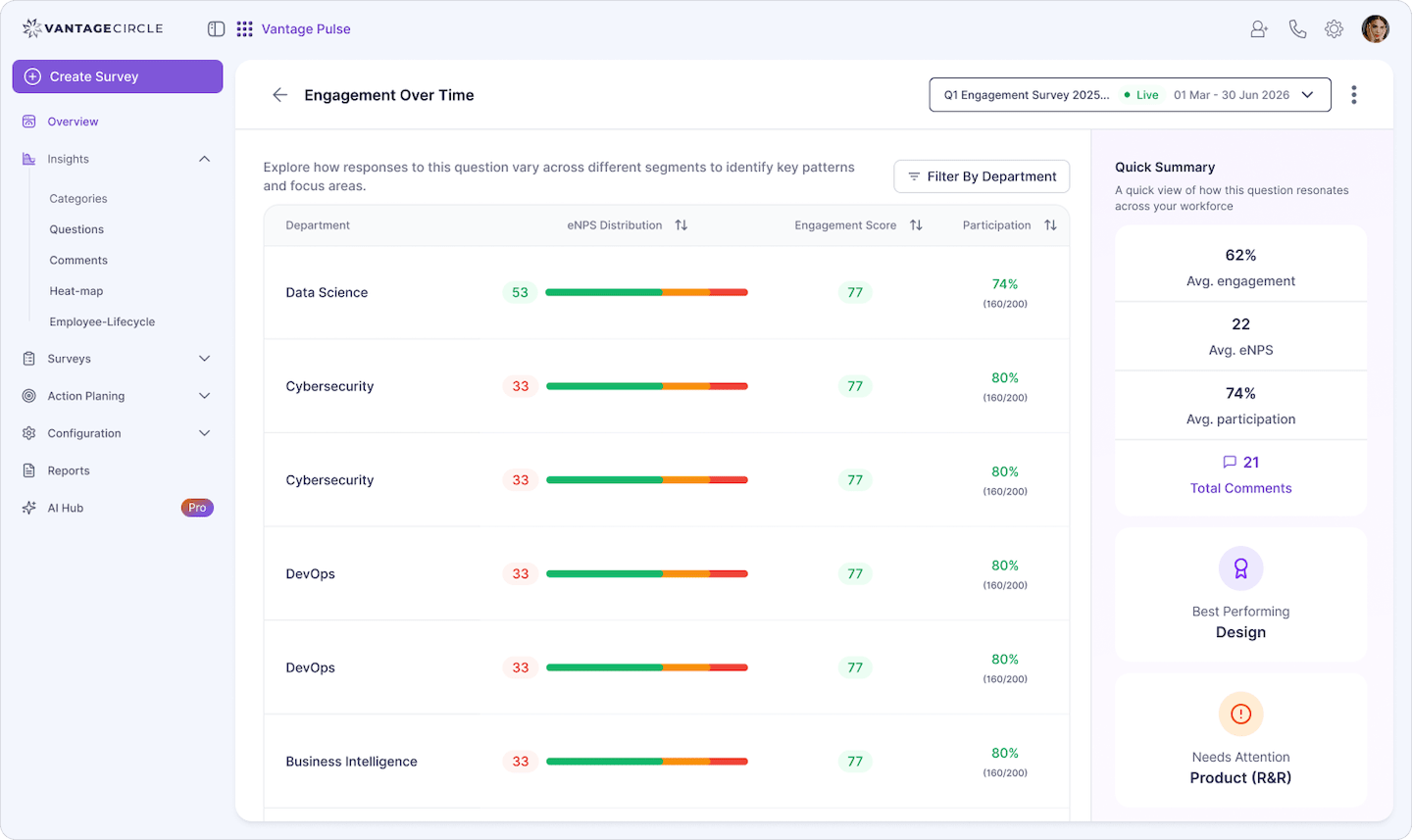
This is easier when listening data is already broken down by team. A department-wise view, like the one built into Vantage Pulse, shows exactly where feedback and sentiment diverge by department, so it's obvious which part of the business needs attention first instead of averaging everyone's input into a single number that tells you nothing actionable.
This involves collecting and analyzing feedback from employees and other stakeholders in a way that supports your strategic priorities, so the two reinforce each other: new opportunities for growth on one side, a more resilient and adaptable business on the other.
To put this into practice:
- Review your business goals first, so the feedback and data you gather through listening stays relevant and actionable.
- Use that alignment to push progress toward your strategic objectives.
- Act on the insights you gather to drive the organization forward, grounded in an engaged and motivated workforce.
2. Hold Town-Hall Meetings
Town-hall meetings work as a listening strategy when they're run as an open forum, not a one-way briefing. They're regular, company-wide gatherings where employees can ask questions, share opinions, and hear updates directly from senior leaders and executives, with the floor genuinely open in both directions.
Here's how to run one well:
- Step 1: Plan and prepare an agenda. Determine the meeting's purpose and outline the topics to be discussed.
- Step 2: Communicate in advance. Inform employees about the meeting details, allowing them to prepare and participate.
- Step 3: Facilitate open dialogue. Create an environment that encourages employees to share their thoughts and concerns.
- Step 4: Use visual aids. Utilize visuals to enhance communication and help convey key messages effectively.
- Step 5: Moderate and manage time. Ensure a smooth flow of the meeting and allocate sufficient time for each topic.
- Step 6: Encourage participation. Actively involve employees by inviting questions, opinions, and suggestions.
- Step 7: Provide transparent responses. Respond honestly and openly to employee inquiries, addressing their concerns.
- Step 8: Follow up with a summary. Share a brief overview of the meeting's discussion and any actionable steps.
- Step 9: Collect feedback for improvement. Seek input from employees to enhance future town-hall meetings.
3. Use Skip-Level Meetings
Skip-level meetings work as a listening strategy because they let senior leaders hear directly from people who don't normally have their ear, without a manager filtering what gets said.
Skip-level meetings let you engage with people in the organization who don't report to you directly. In a skip-level meeting, a manager's own superior meets directly with that manager's team, bypassing the usual chain, so employees can speak more freely and leadership gets a more unfiltered read on how things are actually going. These meetings are particularly useful for senior leaders or key decision-makers with large teams.

By conducting skip-level meetings, you gain insight into how the organization actually operates, spot areas for improvement, and show employees that their ideas are valued. One-on-one conversations like these reveal both what's working and where there's room to grow. Listening actively to what people share can help you:
- uncover solutions to challenges,
- improve organizational performance,
- and build a culture of open communication and transparency.
4. Choose the Right Listening Tool
Choosing the right listening tool matters because running several disconnected ones creates confusion, data overload, and inconsistent results, while a single, well-chosen platform avoids all three.
Listening tools can be a valuable asset for any organization looking to improve employee engagement, gather feedback, and enhance performance. Selecting the right one is still a genuinely difficult decision, which is exactly why understanding its importance matters.

- It's essential to choose the right listening tool because the choice has a real impact on employee engagement, communication, and organizational performance.
- Using multiple listening tools tends to create confusion, data overload, and inconsistent results. A single, well-chosen tool avoids all three.
- Consolidating around one tool creates a consistent approach to listening, lets you analyze data more effectively, and helps you develop targeted solutions for the issues you actually find.
Running employee surveys and separately tracking recognition data in different systems is exactly the fragmentation this section is warning against. A platform like Vantage Pulse keeps the feedback data and the follow-through action in the same place instead of two disconnected tools, so listening and acting stop being separate workflows.
Explore: See how Vantage Pulse works
It also helps establish trust and transparency with employees by demonstrating that their opinions and feedback are valued and taken seriously.
Ultimately, choosing the right listening tool helps create a workplace where ideas are shared and opinions are respected, which shows up directly in a stronger work culture.
5. Build in 360-Degree Feedback
360-degree feedback works as a listening mechanism because employees hear from everyone they work with, not just their direct manager, and on an ongoing basis rather than once a year.
Imagine a workplace where employees receive feedback not just from their direct supervisors but from everyone they work with, and not just once a year but continuously throughout it. That's the power of 360-degree feedback.
- Employees gain a deeper understanding of their strengths and areas for improvement.
- Managers can use the 360-degree appraisal method for performance reviews and to identify training opportunities.
- Employees feel heard and valued, knowing their opinions and feedback are genuinely sought after, not just collected.
- The workplace becomes a collaborative environment where everyone has a voice, and success is a shared effort.
To put 360-degree feedback in place:
6. Focus on Employee Voice
Recognizing the importance of employee voice is vital if you want to facilitate prolonged and sustainable company growth. Encouraging an open, honest, and transparent environment within your business is a prerequisite to creating a more positive and productive workplace. Champion your team, and they will champion you.
- Will Murray, CEO of Oak Engage
Employee voice matters because it gives people a real channel to express opinions, ideas, and concerns about their work, and it signals that their input is genuinely valued, not just collected.
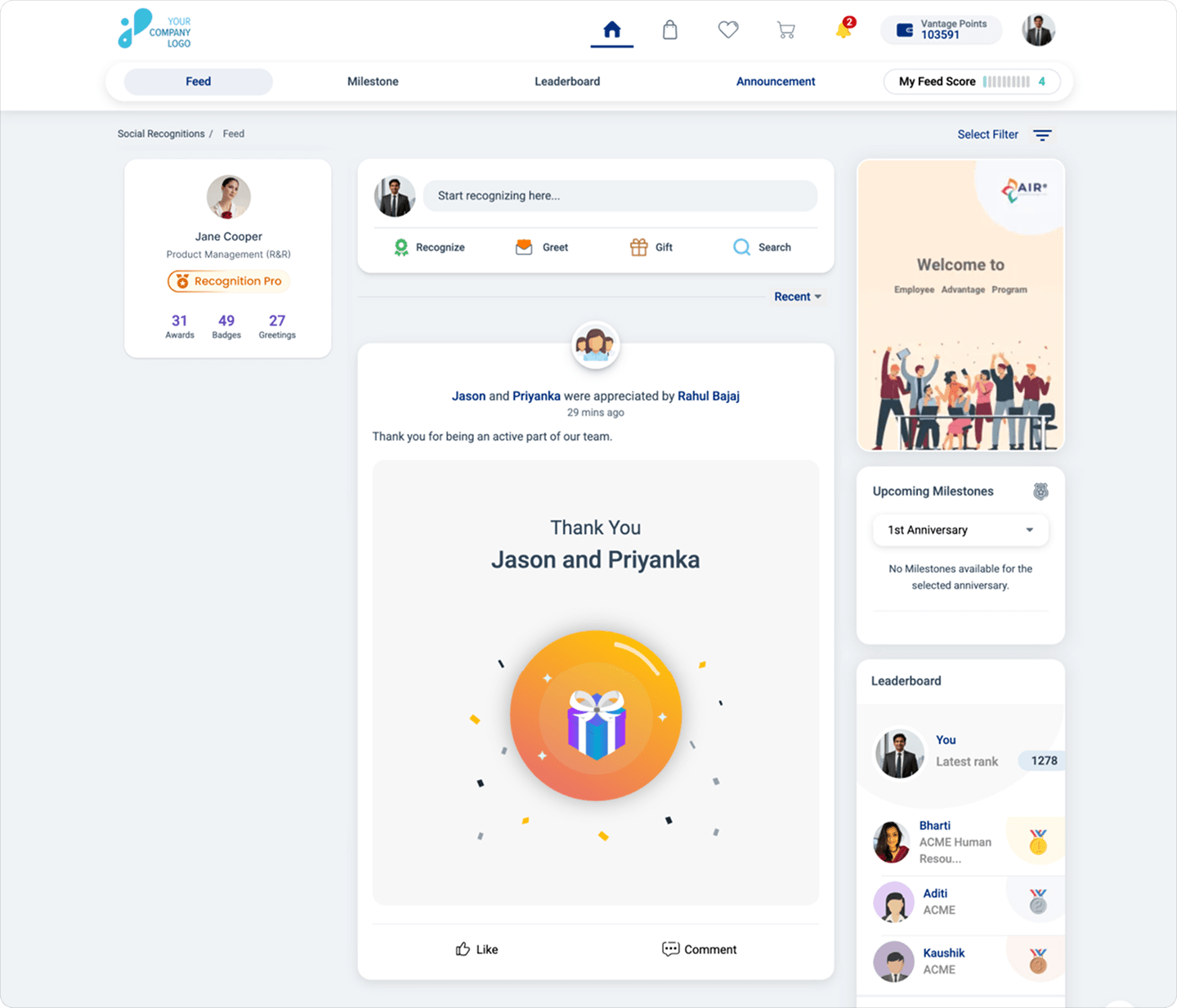
Employee voice isn't proven by a survey response rate. It's proven by whether people can see their input change something. A visible recognition feed, where feedback that gets acted on turns into visible peer recognition through something like Vantage Rewards, closes that loop in a way a private survey dashboard never can.
Ineffective communication is genuinely costly, and active listening is a real part of fixing it. Giving employees a real voice can take many forms, including:
- Employee surveys: Regularly soliciting feedback from employees through surveys can provide insight into their experiences and identify areas for improvement.
- Focus groups: Holding focus groups with employees can provide a more in-depth understanding of their perspectives and experiences.
- Employee suggestion boxes: A suggestion box or similar mechanism lets employees share ideas and concerns anonymously, which encourages honest feedback.
- Employee feedback sessions: A dedicated session gives employees the space to speak openly about their work experience, responsibilities, and overall satisfaction.
- Anonymous employee engagement surveys: Soliciting feedback anonymously gives organizations a more honest read on how employees actually feel.
- One-on-one meetings: Regularly meeting with employees to discuss performance and concerns shows that their voice is heard and valued.
- Annual engagement surveys: A standardized, once-a-year tool that measures satisfaction across areas like job satisfaction, work-life balance, communication, leadership, and recognition.
By giving employees a real voice, organizations create a workplace where people feel empowered to help drive the outcomes the business needs.
7. Protect Privacy and Confidentiality
Protecting privacy and confidentiality matters because employees only give honest, detailed feedback when they trust it won't be traced back to them.
Privacy and confidentiality are critical components of an effective employee listening strategy. When employees feel safe and comfortable sharing their thoughts, a genuine environment of trust follows.
Confidentiality only works if employees trust the mechanism, not just the policy. An anonymous response channel that's structurally incapable of identifying respondents, like the one built into Vantage Pulse, removes the guesswork employees otherwise do about whether "anonymous" really means anonymous.
Explore: See anonymous Vantage Pulse surveys in action
When employees trust that their responses stay confidential, they're more likely to give honest, detailed feedback, which helps the organization spot what actually needs to change.
SHRM's research on employee survey confidentiality found that participation and honesty both improve when employees trust their identity won't be exposed, and that the more identifying detail a survey collects, the less candid the responses tend to become.
Transparency matters here too. Employees need to know how their personal information is used and protected, and how their feedback will be collected, analyzed, and reported. Being open about these details builds trust and creates a safe environment for people to share what they actually think.
To encourage data security and confidentiality:
- Implement strong access controls: Limit access to personal data to authorized personnel, such as HR or IT staff, based on job responsibility, and review that access regularly.
- Secure records: Use encryption, password protection, and restricted access to protect employee records, whether paper or electronic, and update these measures regularly.
- Encrypt data: Data encryption protects information in transit and at rest, so intercepted or stolen data stays unreadable without the decryption key.
- Run regular security audits: Audits help organizations catch and fix vulnerabilities before they can be exploited.
- Stay compliant: Follow relevant data privacy regulations, including the GDPR and the CCPA.
Implementing these measures protects employee data privacy and keeps their trust and confidence in the organization intact.
8. Use Multiple Listening Channels
Using multiple listening channels matters because no single method captures the full picture of how employees actually feel.
Multiple listening channels means using several different methods to gather feedback and insight from employees, rather than relying on just one. These can include traditional methods such as surveys and focus groups, alongside newer methods like social media monitoring, online chat forums, and suggestion boxes. Companies may also run internal channels for employees to give feedback anonymously, including:
- suggestion boxes
- anonymous suggestion forms
- town halls
- exit interviews
- internal social platforms
- hotlines
City National Bank is a good example: it expanded beyond traditional surveys by adding an AI-powered conversation intelligence platform, which let it capture not just responses but insights that a traditional survey would have missed entirely. It's a useful illustration of what a multi-channel approach paired with AI can surface.
Overall, multiple listening channels give a more complete read on employee opinions and experience, and help organizations spot and act on issues a single channel would have missed.
9. Prioritize One-on-Ones
One-on-ones work as a listening strategy because they create a private, personalized space where employees will say things they wouldn't raise in a group setting.
During a one-on-one, the manager can actively listen to the employee's concerns, feedback, and ideas, and respond to their specific experience and perspective, not a generic one.

One of the biggest benefits of 1:1 meetings is that they provide dedicated, focused space for open communication between managers and employees. These meetings let employees share their thoughts, concerns, and ideas with their manager privately, which builds stronger trust and connection between the two.
Knowing what not to do matters just as much, since these meetings can go wrong quickly:
- Don't dominate the conversation: It's important for managers to provide guidance and feedback, but it's equally important to listen actively and give employees room to share their own thoughts. Dominating the conversation or interrupting creates frustration and disengagement.
- Don't focus only on negative feedback: Address areas for improvement, but also recognize and celebrate wins. Focusing solely on the negative creates a demotivating atmosphere.
- Don't multitask or get distracted: Give the employee full attention. Multitasking or getting pulled into notifications signals that their time and input don't matter, and it undercuts the whole point of the meeting.
- Don't make assumptions or jump to conclusions: Approach 1:1s with an open, curious mindset. Ask questions and understand the employee's perspective before offering feedback or guidance.
A poorly structured listening strategy can cause an organization to flounder, since listening sits at the core of how any organization actually runs. That's worth keeping in mind as these strategies scale across a larger workforce: structuring them well matters more as headcount grows.
10. Practice Active Listening
Active listening is what makes any of these strategies actually land. It's the skill of engaging with what employees say, not just hearing it, so people feel genuine empathy and interest rather than a box being checked.
By listening actively, you demonstrate empathy, validation, and real interest in employees' ideas and experiences. This builds trust, encourages open communication, and cuts down on miscommunication and conflict. It also leads to a deeper understanding of employees' needs and challenges, better problem-solving, and stronger employee engagement, satisfaction, and culture over time.
Active listening isn't easy in practice. Several barriers to communication, both situational and personal, can get in the way:
- Distractions: External and internal factors that divert attention away from the speaker's message.
- Personal bias and prejudice: Preconceived notions and closed-mindedness that filter or distort information.
- Lack of empathy: Failing to understand and connect with the speaker's emotions and experiences.
- Information overload: An overwhelming volume of information that hampers processing and absorption.
- Defensive listening: Feeling threatened or challenged, which shifts focus to self-defense instead of understanding.
Being aware of these barriers is the first step to working past them.
Active listening comes down to five specific steps:
- Be fully present: Give your undivided attention and eliminate distractions. Maintain eye contact, face the speaker, and show genuine interest in what they're saying.
- Avoid interruptions: Let the speaker finish their thought without interrupting. Wait for natural pauses to ask clarifying questions.
- Ask open-ended questions: Encourage the speaker to elaborate with questions that need more than a "yes" or "no." It shows interest and invites deeper discussion.
- Paraphrase and reflect: Summarize or rephrase the speaker's key points to confirm understanding, and reflect their feelings back to show empathy.
- Suspend judgment: Keep an open mind and avoid premature conclusions or imposing your own bias on the conversation.
Active listening doesn't just improve communication. It strengthens relationships, promotes a healthier work culture, and contributes to the overall success and well-being of everyone involved.
Common Challenges in Implementing an Employee Listening Strategy
The most common challenge in implementing an employee listening strategy isn't collecting feedback. It's overcoming the resistance, trust gaps, and resourcing problems that stop organizations from acting on what they hear. Here are the challenges organizations run into most often:
1. Resistance to Change
Employees and managers may resist new initiatives or processes, especially if they feel they're being imposed from the top down without their input or participation. To overcome this, organizations should involve employees in designing and implementing the listening strategy and communicate the benefits of the initiative clearly.
2. Lack of Trust
Employees may be hesitant to share honest feedback or opinions if they don't trust that their responses will stay confidential or that their feedback will be acted on. To address this, organizations should build a culture of trust and transparency and make sure feedback is shared openly and respectfully.
3. Poor Communication
Organizations often struggle to clearly communicate the purpose and scope of the listening strategy, which leads to confusion or skepticism among employees. To address this, provide clear, consistent messaging about the initiative, including its goals, timelines, and expected outcomes.
4. Limited Resources
An effective employee listening strategy requires dedicated resources, including time, budget, and staff. Organizations often struggle to allocate these, especially when teams are already stretched thin. To address this, prioritize the listening strategy and allocate the resources it needs to succeed.
5. Overcoming Biases
Organizations may struggle to overcome the biases or assumptions that limit their ability to listen to and act on employee feedback. To address this, stay aware of those biases and actively work against them through training, diversity and inclusion initiatives, and ongoing reflection.
Tools for Implementing an Employee Listening Strategy
Employee listening strategy runs on three core tools: pulse surveys, engagement surveys, and lifecycle surveys, each capturing feedback at a different point in the employee experience. Here's a quick look at what each one does.
1. Pulse Surveys
Pulse surveys track changes in employee sentiment over time. They're often used alongside annual engagement surveys to add real-time feedback into the mix.
2. Engagement Surveys
Engagement surveys measure engagement and satisfaction levels across the workforce. They're typically run once a year with a standardized, objective-based question set.
3. Lifecycle Surveys
A lifecycle survey gathers feedback at specific milestones in an employee's tenure, such as onboarding or exit. It also shows where the employee experience needs improvement at critical stages of someone's career with the organization.
Reading through hundreds of open-text survey comments manually is where most listening programs quietly stall. This is where a tool like Vantage Pulse earns its place: automated sentiment scoring and word-cloud clustering surface the themes that matter without requiring someone to read every response by hand, alongside department-wise breakdowns and comparative reports that make trends visible at the team level, not just company-wide.
Explore: See sentiment analysis in Vantage Pulse
4. The 5-Point Likert Scale
The 5-point Likert scale is a rating scale used in survey research to measure attitudes, opinions, or perceptions on a given topic. It typically pairs a statement or question with a set of response options ranging from 1 to 5, corresponding to "strongly agree" through "strongly disagree."

Scales with more or fewer response options are sometimes used depending on the research question, but the 5-point version remains the most common variation.
5. Sentiment Analysis Tool
An employee sentiment analysis tool is software that automates collecting and analyzing employee sentiment data.
These tools use natural language processing and machine learning to categorize and analyze text data, identify themes, emotions, and opinions, and pull signal from sources like feedback surveys, annual surveys, social media, emails, and chat logs.

To measure sentiment, these tools typically track:
- Positive and negative sentiment: A score indicating how positive or negative the language in a piece of text is.
- Emotion analysis: The specific emotions expressed, such as happiness, frustration, anger, or sadness.
- Topic analysis: Categorizing text into themes like work culture, leadership, communication, and job satisfaction.
- Sentiment trends: Changes in sentiment over time, flagging improvements or declines early.
By tracking response patterns, sentiment analysis tools give leaders insight into how employees actually feel, where improvement is needed, and where to act to lift engagement and satisfaction.
Conclusion
So far, conventional methods like annual employee surveys and online pulse surveys have been the default way to gauge employee perspective.
More indirect methods have emerged over the last few years too, including sentiment and tone analysis tools that monitor internal social platforms, email systems, and online communities, alongside external data sources like Glassdoor or Indeed.
Traditional methods still have real value. Paired with these newer techniques, they give companies a genuinely useful, well-rounded read on what employees think and need.
Frequently Asked Questions
Q1. Why is employee listening important?
A. Employee listening is important because it helps organizations understand the needs, expectations, and experiences of their employees. It builds a culture of openness, trust, and engagement, which leads to higher satisfaction and productivity. It also helps organizations catch and address issues early, improve communication, and make decisions that genuinely benefit the workforce.
Q2. How can organizations ensure employee anonymity when listening to feedback?
A. Use anonymous surveys or feedback platforms that don't collect personally identifiable information, and back that up with clear policies protecting employee identities. It's important to communicate to employees that their feedback will be treated confidentially and that there will be no negative consequences for speaking up.
Q3. How often should organizations engage in employee listening initiatives?
A. This varies by organization size, industry, and need, but regular, ongoing opportunities for feedback tend to work best. That could mean periodic surveys, scheduled focus groups, or an open-door policy employees can use anytime. The goal is building a culture of continuous listening and improvement, not a once-a-year event.
Q4. How should organizations communicate the outcomes of employee listening initiatives?
A. Communicate outcomes transparently and on a predictable timeline. Share summary reports or presentations that highlight key findings, themes, and the actions taken because of the feedback. Employees need to see that their voices led to something tangible, not just that the survey happened.
Q5. How can organizations use technology to facilitate employee listening?
A. Online survey platforms, feedback management software, internal communication tools, and collaboration platforms all help organizations collect and analyze employee feedback more efficiently and at scale.
Q6. How can organizations demonstrate the value of employee listening to employees?
A. By actively acknowledging and acting on the feedback they receive. When employees see their suggestions taken seriously and turned into real changes, it reinforces that employee listening actually matters. Communicating success stories and sharing concrete examples of feedback that led to visible change helps build a culture where employees know that speaking up genuinely makes a difference.

Shaoni Gupta is a content marketing specialist at Vantage Circle, with expertise in scriptwriting and copywriting in the field of employee rewards and recognition.
Connect with Shaoni on LinkedIn.