
Key Takeaways
- Most milestone programs reward presence, not performance — and that breeds entitlement, not engagement.
- With shrinking average tenure, a 5-year award program is invisible to most of your workforce.
- Professional and personal milestones both matter — how you handle the personal ones says the most about your culture.
- The most impactful recognition isn't a program. It's a manager who noticed and said something specific.
Here's the thing about employee milestone programs: most organizations have one. And most of them aren't really working.
Recognition authority Bob Nelson has spent decades studying how companies recognize their people. In his episode Wrap it up with Fun: Year-End Recognition that Sticks, his observation is blunt:
If you are primarily recognizing people around years of service and their birthday, you're reinforcing presence over performance. It will lead to a culture of entitlement where people say, 'Hey, I've been here another year. You need to do something for me,' regardless of how well they did their job.
So what's the fix? Not scrapping milestone recognition — but designing it around people, not dates.
This guide walks you through every employee milestone worth celebrating, professional and personal, and nine ways to mark them in ways that actually build engagement, belonging, and loyalty.
What Is an Employee Milestone?
An employee milestone is any significant achievement or transition point in someone's professional or personal life. It could be a career moment — a promotion, landing a major client, crossing the 90-day mark — or a life event, like a work anniversary, a new baby, or ten years of service.
That distinction matters more now than it used to. The line between professional and personal recognition has blurred. Employees want their organizations to see them as whole people, not just contributors to a headcount.
Why Celebrating Employee Milestones Matters
Think milestone recognition is a "nice to have"? The data says otherwise.
9.8x
increase in engagement on long service award posts after Wipro redesigned their work anniversary recognition across 230,000 employees in 66 countries. Colleagues worldwide started actively participating — turning a quiet HR moment into a company-wide event.
Gallup research shows that well-recognized employees are 45% less likely to have left their organization after two years. Yet only 1 in 3 workers strongly agree they received recognition or praise for doing good work in the past seven days. The gap between what recognition can do and what most organizations actually deliver is enormous.
And the upside of getting it right goes beyond engagement. A Harvard Business Review study examining nearly 1.25 million employee-years across 23 organizations found that tenure has a significant positive impact on financial performance and operational excellence. Keeping people longer — which milestone recognition directly supports — isn't just a culture win. It's a business one.
When a milestone goes unacknowledged, employees don't just feel a little overlooked. They update their mental model of what the organization thinks of them. And that update is hard to walk back.
The Recognition Effect: What Great Workplaces Do Differently
Discover how recognition shapes workplace culture — insights from a joint study with Great Place To Work® on what sets top employers apart.
Download the ReportThe Problem With Traditional Milestone Programs
Here's an uncomfortable truth: your milestone program may be designed for a workforce that no longer exists.
Most programs run on 5-year, 10-year, 15-year intervals — a structure inherited from a generation where 20-year tenures were common. But average tenure has been shrinking for years. The U.S. Bureau of Labor Statistics reported median employee tenure at just 3.9 years in 2024 — the lowest since 2002. Navneet Mukund, Project Director for HR Consulting Asia at Mercer, frames the consequence directly in Why Should You Be Investing (Heavily) In Your Employees?:
If the average tenure of employees is reducing in the first ten years of their career and you are giving someone an award only after ten years, then they will never get an award. Most people will have churned out.
Do the math on your own workforce. If a meaningful chunk of your team is leaving within three to five years, a five-year award program is effectively invisible to them.
Neha Kothari, an HR leader with experience across large organizations, makes the reframe sharp in Redefining Internal Communications In 2022:
If somebody completes a year or a five-year milestone, companies think it's a big deal — because you've been able to retain that person because of the demand and supply.
A one-year anniversary is now a retention win. Design your milestone recognition to reflect that.
Types of Employee Milestones That Call for Celebration
Celebrating Professional Employee Milestones at Work
1. Work Anniversaries
Work anniversaries are the most common employee milestone — and the most commonly done wrong. An automated email doesn't signal appreciation. A plaque that arrives three weeks late doesn't either.
What works: recognition that feels like it was made for this specific person, not triggered by a calendar alert.
The mechanics vary. The principle doesn't: anniversary recognition should feel personal, not procedural.
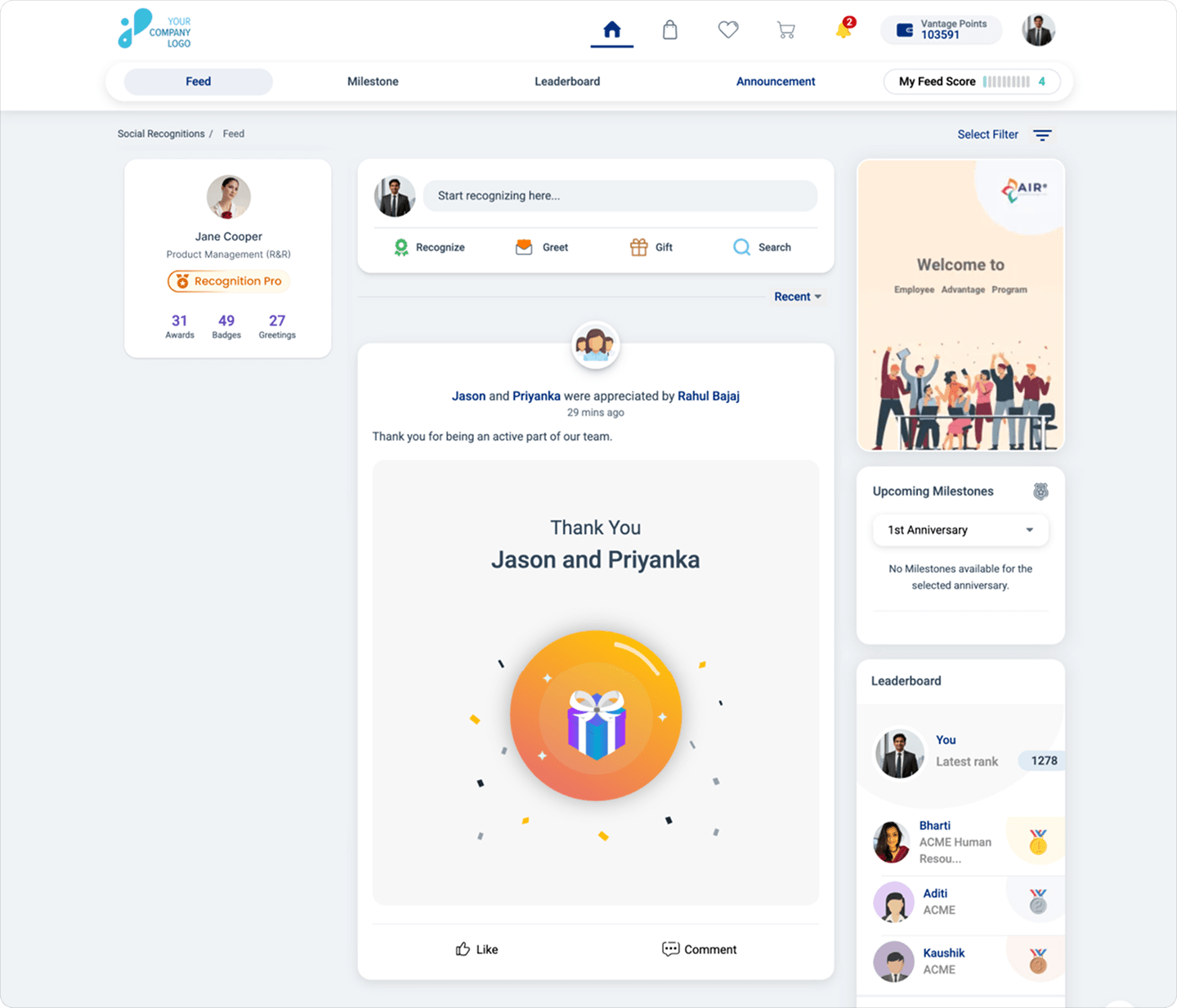
A platform like Vantage Recognition helps here — it notifies colleagues ahead of upcoming anniversaries so the team can actually prepare, rather than scrambling the day of.
2. Achieving Goals and Performance Milestones
When your team closes a major deal, ships a product on time, or blows past a quarterly target — celebrate it. Name it. Don't let the win dissolve quietly into the next sprint.
Specificity matters: "you closed $X" or "this launch drove Y result" tells employees that someone was paying attention. That visibility motivates people to replicate the behavior.
3. Promotions
Promotions are career-defining moments. They change rank, income, and responsibility — yet they're often marked with a brief announcement and an updated Slack display name.
Do better. Make the recognition visible to peers. Acknowledge the specific qualities that earned the promotion, not just the title change. Help the employee feel like they've crossed a genuine threshold, not just moved a line on an org chart.
4. The First Day and the First 90 Days
Your new hire's first day is a milestone — for them and for your first impression as an organization. Don't let Day 1 be a paperwork exercise.
And don't stop there. At the 90-day mark, your new hire has revealed a lot — about how they work, how they fit, and how well your onboarding actually set them up. A specific, written note from their manager ("here's what I noticed about how you approached X") does more for early engagement than any onboarding survey. It tells them someone was genuinely watching, and liked what they saw.
5. Retirement
A retirement celebration should honor the person, not just the tenure. That means telling the story: the specific contributions, the relationships, the legacy they're leaving behind.
Invite a speaker they admire. Put together a team-built tribute. Curate an experience around something they love. Make it feel like a send-off, not a sign-off.
6. Company Milestones
When your organization hits a milestone — a founding anniversary, a new office, a major business achievement — the recognition should cascade to the people who built it. A company milestone is a collective achievement. Naming the individuals within it reinforces the sense that their work actually added up to something.
7. Skills and Learning Milestones
When an employee earns a new certification, completes a leadership program, or finishes a degree while working full-time — acknowledge it publicly. You're telling them that growth is valued here, not just output. That message is especially powerful in roles where formal promotion paths are slow or unclear.
Worth noting: Professional milestones are visible — they happen at work, in front of colleagues. Personal milestones are different. They happen in someone's life first, and the workplace either notices or it doesn't. How you handle the personal ones says the most about your culture.
Celebrating Personal Employee Milestones
1. Birthdays
A birthday is one of the few moments that belongs entirely to the individual — not a project, not a team win, just them. The way your organization marks it sends a signal: do we see you as a person, or just a role?
What works: a handwritten card, a small gift chosen with actual knowledge of who they are, or a team moment that shows someone remembered. What doesn't work: a generic all-hands email that went out for 40 other people this year.
One important note: Birthdays are personal. Ask employees about their preferences before making celebrations public — some want the full team involved, others would rather a quiet acknowledgment.
Read more: 20 Amazing Virtual Birthday Party Ideas For The Workplace
2. New Baby or Adoption
A new child is a life-altering milestone. Organizations that acknowledge it with genuine warmth — a team congratulations, a gift to the home, flexible return-to-work support — signal that the workplace sees employees as whole people.
Vantage Rewards makes this easy with personalized e-greetings, so colleagues across locations can extend well-wishes in a coordinated, visible way — without it falling entirely on HR to coordinate.
3. Marriage
A newly married employee is navigating one of the most emotionally complex periods of their life while managing a full workload. A team congratulations and a thoughtful gesture can relieve some of that pressure. More importantly, it signals that the organization pays attention to what matters to them outside of work.
4. Personal Certifications and Projects
When someone earns a certification, finishes a degree, or completes a meaningful personal project on their own time — acknowledge it. You're telling them that you see their growth, not just their output. That message lands especially well in roles where formal career progression is slow.
5. Volunteer Work
Employees who give their time to a cause demonstrate a depth of character worth recognizing. When you acknowledge volunteer contributions — in team channels, at all-hands, or with additional paid volunteer days — you close the gap between what your organization says it values and how it actually behaves.
6. Overcoming Personal Challenges
Not every milestone calls for a public post. When an employee is navigating a health crisis, loss, or another serious personal challenge, a private message from their manager — genuine, specific, human — can mean more than any formal program. Read the situation carefully. Sometimes the most meaningful recognition is a quiet "I see what you're carrying."
7. Achievements in Work-Life Balance
When employees take real steps toward balance — an actual vacation, consistent working hours, real weekends — notice it. An organization that affirms those choices reinforces a culture where work-life balance is lived, not just written into a policy document.
9 Ways to Celebrate Employee Milestones
| # | How to Celebrate |
|---|---|
| 1 | Give personalized gifts |
| 2 | Gift company-branded items |
| 3 | Offer digital rewards points |
| 4 | Build a service yearbook |
| 5 | Create a public recognition moment |
| 6 | Host an office-wide celebration or team activity |
| 7 | Give paid time off |
| 8 | Offer experience rewards |
| 9 | Celebrate through the manager, personally |
1. Give Personalized Gifts
Generic gifts say "we ticked the box." Personalized ones say "we thought about you specifically."
A plaque or trophy tied to a specific achievement, an experience voucher aligned to something they love, a gift chosen with actual knowledge of the person — these carry meaning that a standard catalog item never will.
2. Gift Company-Branded Items
Done well, branded items create a physical connection to the organization. The key is quality and intentionality. A premium jacket or a thoughtfully designed team item lands differently from a cheap pen with a logo on it.
3. Offer Digital Rewards Points
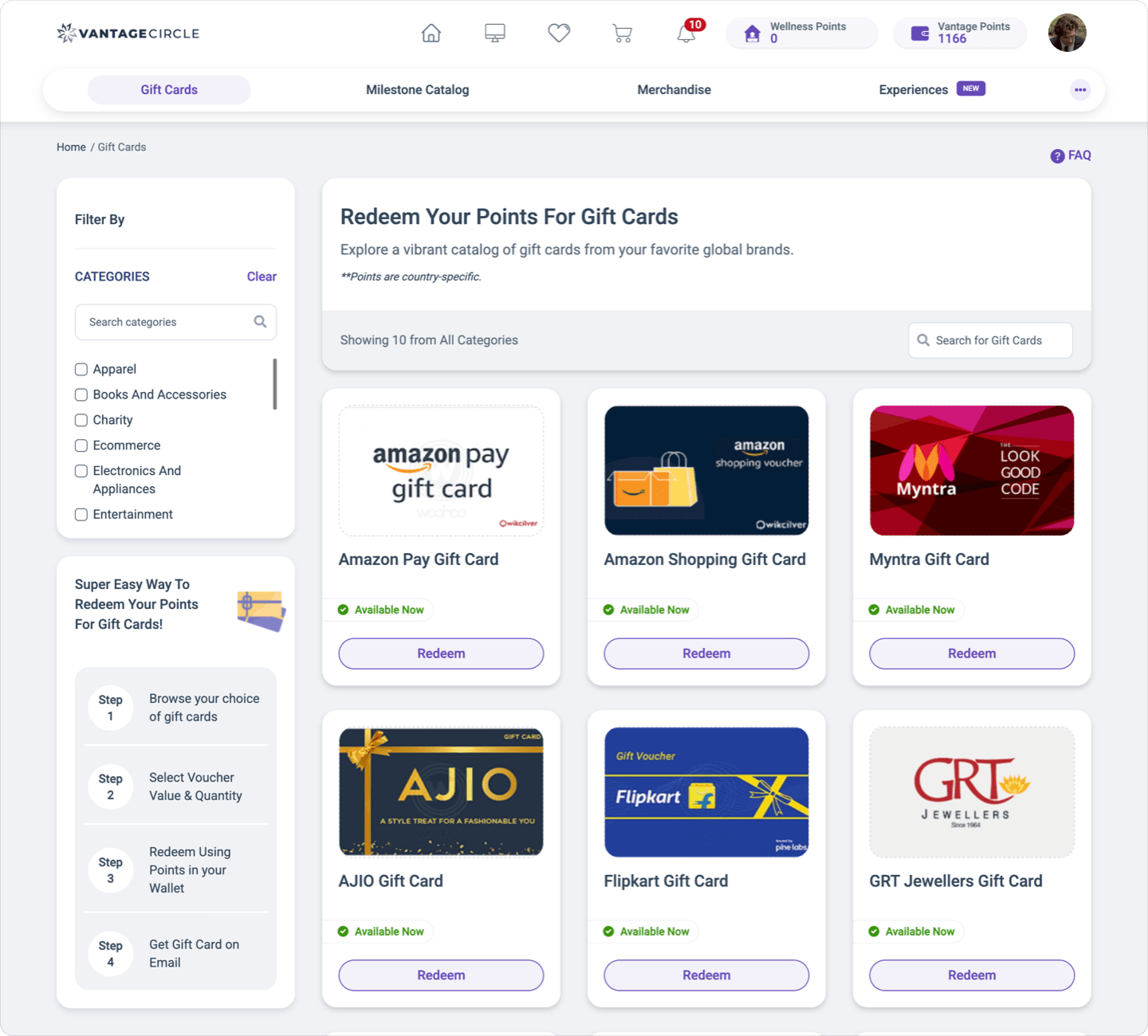
Give the choice to the employee. A points-based system — redeemable across a wide catalog with no expiration dates — lets people define what "meaningful" looks like for them. You can also tier reward catalogs by years of service, unlocking new options at the 5, 7, or 10-year mark, which adds real weight to the milestone itself.
4. Build a Service Yearbook
Before a work anniversary, Vantage Recognition's Service Yearbook lets peers and managers contribute memories, upload photos, and write personal notes. The yearbook is revealed to the employee on their milestone date — a genuine surprise that often carries more emotional impact than any physical award.
Request a free demo to see how the Service Yearbook works
5. Create a Public Recognition Moment
A private email from a manager is nice. A social feed post that generates 50 comments from colleagues is something else entirely.
Making milestone recognition visible to the whole organization turns a personal acknowledgment into a moment of belonging at scale. That difference matters.
6. Host an Office-Wide Celebration or Team Activity
Not every celebration needs a budget line. A team potluck, a shared lunch, a surprise decoration of someone's workspace, a playlist of their favorite music — small, creative gestures organized by people who actually know them carry warmth that formal programs can't fake.
Read our blog on: 38 Quick and Easy Team Building Activities Your Employees Will Love (+How to Play)
7. Give Paid Time Off
An extra day off on a work anniversary or after a demanding project says something no certificate can: we trust you to decide how to use your time. It's one of the most universally valued milestone gestures across functions, seniority levels, and geographies.
8. Offer Experience Rewards
Some people would rather have a memory than a thing. Vineyard tours, cooking classes, adventure trips, hotel stays — experience rewards tied to personal interests create associations with the milestone that outlast any physical gift. Give employees the option to choose.
9. Celebrate Through the Manager, Personally
The most impactful milestone recognition isn't a program. It's a manager who noticed.
A private message. A one-on-one that acknowledges what the person has built here, and the specific qualities that got them this far. A handwritten note on their desk. These moments are hard to scale and easy to underestimate — and they're what employees remember long after the gift is forgotten.
FAQs
1. How does celebrating employee milestones contribute to engagement?
Milestone recognition creates moments where employees feel genuinely seen — at points in their career that actually matter to them. When recognition is specific, timely, and visible, it reinforces belonging and motivates continued contribution. The emotional impact of a well-done milestone recognition tends to outlast the moment itself by a long stretch.
2. Should every milestone be celebrated the same way?
No — and this is where a lot of programs go wrong. The depth of recognition should match the significance of the milestone for that specific employee. A one-year anniversary might call for a team card and a gift card. A ten-year anniversary calls for something much more substantial and personal. The standard to aim for: the employee should feel the recognition was made for them, not generated by a calendar.
3. What's the risk of only recognizing tenure milestones?
As Bob Nelson has noted, programs that only recognize years of service can inadvertently train employees to expect recognition for showing up rather than for contributing. The strongest programs layer tenure recognition with performance-based and values-based recognition throughout the year — so milestone moments feel like part of a genuine culture, not isolated events with no connection to everyday work.
4. How can employees recognize their own milestones?
Employees can track their own progress toward goals, document achievements as they happen, and proactively share milestones with their manager. On peer-to-peer recognition platforms, they can also nominate colleagues and share congratulations directly — building a culture where milestone awareness doesn't sit entirely with HR or leadership.
5. How do you celebrate milestones for remote employees?
The goal is parity. Remote employees shouldn't receive a lesser experience at milestone moments than in-office employees. What works: a visible social feed post the whole organization sees, plus something physical at their home address — a gift, a handwritten card, or an experience voucher. The combination of public and personal covers both the visibility and the intimacy that make milestone recognition land.
Do Give a Read: How to Celebrate Small Wins at Work: Simple Strategies for Big Impact

Susmita Sarma is a Digital Marketer at Vantage Circle, making employee recognition less of a checkbox and more meaningful - helping organizations say we value our people and truly mean it.
Connect with Susmita on LinkedIn.
