"Anger and resentment accompany under-reward. Guilt tends to accompany over-reward." — J. Stacey Adams, Journal of Abnormal and Social Psychology, 1963
Equity theory, developed by behavioural psychologist J. Stacey Adams in 1963, states that employees compare the ratio of their inputs (effort, skill, time) to their outputs (pay, recognition, status) against a referent group. When the ratio feels unequal, motivation drops and behaviour changes. Quiet quitting, disengagement, and outright resignation all trace back to a broken perception of fairness.
Sixty years later, it carries more weight than ever. Your employees can benchmark their pay against the market in minutes. Gartner's 2025 research confirms perceived fairness is a top-three predictor of voluntary attrition.
This post covers Adams' framework, the four referent types, three workplace examples, and a five-step HR action plan for closing equity gaps before they become departures.
The employee motivation guide covers the broader landscape of what drives performance beyond fairness.
Key Takeaways
- What Is Equity Theory?
- The Three Core Components of Equity Theory
- The Two Types of Inequity
- How Employees Restore Equity (5 Behaviours)
- Equity Theory Examples in the Workplace
- Equity Theory in Compensation and Performance Reviews
- How Modern Recognition Technology Closes the Equity Gap
What Is Equity Theory?
Equity theory is a motivation framework stating that employees assess fairness by comparing their input-to-output ratio against a reference person or group. When the comparison feels balanced, motivation holds. When it tilts, behaviour changes.
J. Stacey Adams introduced the theory in 1963, drawing on Social Exchange Theory and publishing in the Journal of Abnormal and Social Psychology. His core insight: fairness is not felt as an absolute amount. It is felt as a ratio. Two employees earning identical salaries can perceive fairness completely differently depending on who they compare themselves to.
In simpler terms: equity theory is not about what you pay. It is about what employees believe they are getting relative to what they put in, compared to what others appear to get for theirs. What often looks like a motivation problem actually begins as a fairness problem.
The Three Core Components of Equity Theory
Equity theory has three components: inputs, outputs, and the comparison referent.
Inputs are everything an employee contributes: effort and daily output, skill and experience, tenure, emotional labour, after-hours availability, mentoring, and loyalty. The inputs that most often trigger inequity are the ones you never formally count. Emotional labour and informal mentoring are invisible in most reviews, which is exactly why employees feel undervalued.
Outputs are what employees receive in return: salary, bonuses, formal awards, promotion, autonomy, schedule flexibility, public credit, and psychological safety. Both tangible and intangible outputs matter, and employees notice when either form is absent.
The comparison referent is the individual or group an employee measures themselves against. Adams identified four types:
| Referent Type | Definition | Modern Example |
|---|---|---|
| Self-Internal | Comparing the current role to a previous role at the same organisation | "I had more autonomy in my last team here." |
| Self-External | Comparing to a previous role at a different company | "I earned 15% more for this scope at my last employer." |
| Other-Internal | Comparing against a colleague in the same organisation | "My peer was promoted faster but contributes less." |
| Other-External | Comparing against peers at other organisations | "Glassdoor shows market rate for my role is 20% above what I earn." |
The Other-External referent has expanded dramatically since 2020. Your employees no longer need insider contacts to benchmark their compensation. If you are not accounting for this, you are managing equity theory with one hand tied.
The Two Types of Inequity
Most organisations are losing people to under-reward inequity without knowing it.
Adams identified two types: under-rewarded and over-rewarded. Both reduce sustained motivation, but they produce very different behaviours.
Under-rewarded inequity is the one that costs you. When your employees perceive their ratio as lower than their referent's, the response is anger and frustration. They reduce their inputs (quiet quitting), escalate demands for raises or recognition, and begin recruiting themselves externally if the feeling persists. Gallup's 2025 research identifies fair pay as the single strongest predictor of intent-to-stay. Not pay itself. The perception of fairness.
Over-rewarded inequity tends to resolve on its own. Employees feel guilt, increase effort briefly, then normalise the advantage and recalibrate their referent.
Under-rewarded inequity costs companies more than over-rewarded inequity gives back.
Inequity's direct effect on employee productivity runs deeper than most managers realise.
How Employees Restore Equity (5 Behaviours)
When employees perceive inequity, they restore it through five predictable behaviours. Knowing which stage an employee is at tells you when and how to intervene.
| Restoration Behaviour | What It Looks Like at Work | HR Intervention |
|---|---|---|
| Reduce inputs | Slower deliverables, declining engagement, minimal participation | Manager check-in to surface the fairness concern |
| Increase output claims | Requesting a raise, claiming credit publicly | Review comp positioning; confirm recognition is visible |
| Cognitive distortion | Rationalising the gap ("they must work harder than I realise") | Monitor for patterns indicating unresolved inequity |
| Change referent | Shifting comparison from a high earner to a lower earner | No action needed unless it masks avoidance |
| Leave | Voluntary resignation, internal transfer, full disengagement | Pulse surveys proactively; exit interviews rarely surface this |
Employees rarely disengage overnight. The behavioural shifts usually appear much earlier: quieter participation in meetings, slower follow-through, reduced initiative, or withdrawal from collaborative work.
These early changes are often the clearest opportunity for managers to identify and address perceived unfairness before it turns into attrition.
Equity Theory Examples in the Workplace
Three workplace scenarios show how perceived inequity drives behaviour change, usually long before you notice anything is wrong.
Example 1: The Salary Discovery
A mid-level product manager discovers through Glassdoor that a peer at a competitor earns 18% more for an identical scope. Nothing about her job has changed and her inputs are the same. But her outputs now feel structurally lower because her Other-External referent has shifted. She starts updating her resume. Not because she dislikes her manager. Because her equity ratio is broken.
Example 2: The Promotion Bypass
A high-performing senior analyst watches a less-tenured colleague receive a promotion she was informally told she was in line for. Her inputs (two years of strong performance, mentoring two juniors, leading a cross-functional project) feel suddenly devalued. Over the next few months, she gradually pulls back. She stops volunteering for mentoring, participates less actively in discussions, and becomes less connected to the broader team.
Example 3: The Recognition Drought
A team lead delivers the strongest quarter in his business unit, hitting 130% of his target. He receives no public acknowledgement while a peer with a 90% result is called out in the all-hands. Recognition is a real output. Withholding it is a real reduction in the outputs column. Within four weeks, his effort converges towards the recognised peer's.
Recognition is treated by employees as a real output. Skipping recognition costs as much as skipping a raise. Source: Gartner Total Rewards, 2025.

Vantage Influencers Podcast
"Money is important and you've got to pay people fairly. But you've got to treat them even better. Find out how they like to be valued and thanked when they do good work. When you make that happen, the whole game changes."
— Dr. Bob Nelson, employee recognition expert and author of 1001 Ways to Reward Employees
Listen to the EpisodeEquity Theory in Compensation and Performance Reviews
Equity theory has a direct application to every review cycle. Any process that creates perceived ratio imbalances will trigger restoration behaviours, regardless of absolute pay levels.
The diagnostic is simple: audit for ratio consistency, not just absolute amounts.
Audit pay-band consistency. Before any review cycle, run a pay equity analysis across role, tenure, and performance tier. Any outliers you find are equity risks waiting to surface.
Pre-empt referent comparison with pay transparency. Communicate how pay bands work and where each individual sits within them. Do not wait for employees to find the data on Glassdoor.
Document promotion criteria visibly. Ambiguous criteria directly cause "promotion bypass" perceived inequity (see Example 2). Public criteria let employees compare themselves to a standard, not a colleague.
Pair quantitative outputs with qualitative recognition. A bonus addresses the tangible output. A public acknowledgement of the specific inputs that earned it addresses the intangible output. Recognition platforms let you tie acknowledgement to specific inputs without inflating compensation.
Run a post-cycle fairness pulse. A short performance appraisal process survey after each cycle asking whether employees felt the process was fair catches systemic equity problems before they become departures.
How Modern Recognition Technology Closes the Equity Gap
The five steps above work best when you have visibility behind them. Without data on who is recognised and who isn't, equity gaps stay invisible until they become departures. Recognition technology gives HR leaders three things traditional processes can't: a record of under-credited contributions, a transparent distribution signal, and pattern detection across cohorts.
Only 55% of employees feel truly recognized at work (The Recognition Effect, Vantage Circle × Great Place to Work India, 2025, 5.7M employees).
Think about the inputs that rarely show up in formal reviews: after-hours support, cross-functional help, informal mentoring. Peer-to-peer recognition surfaces these contributions. Platforms like Vantage Rewards' recognition flow lets any employee acknowledge what they directly witnessed, making under-credited work visible without touching compensation. Peer recognition adoption is 30 percentage points higher in high-effectiveness programs (State of Recognition and Rewards 2025).
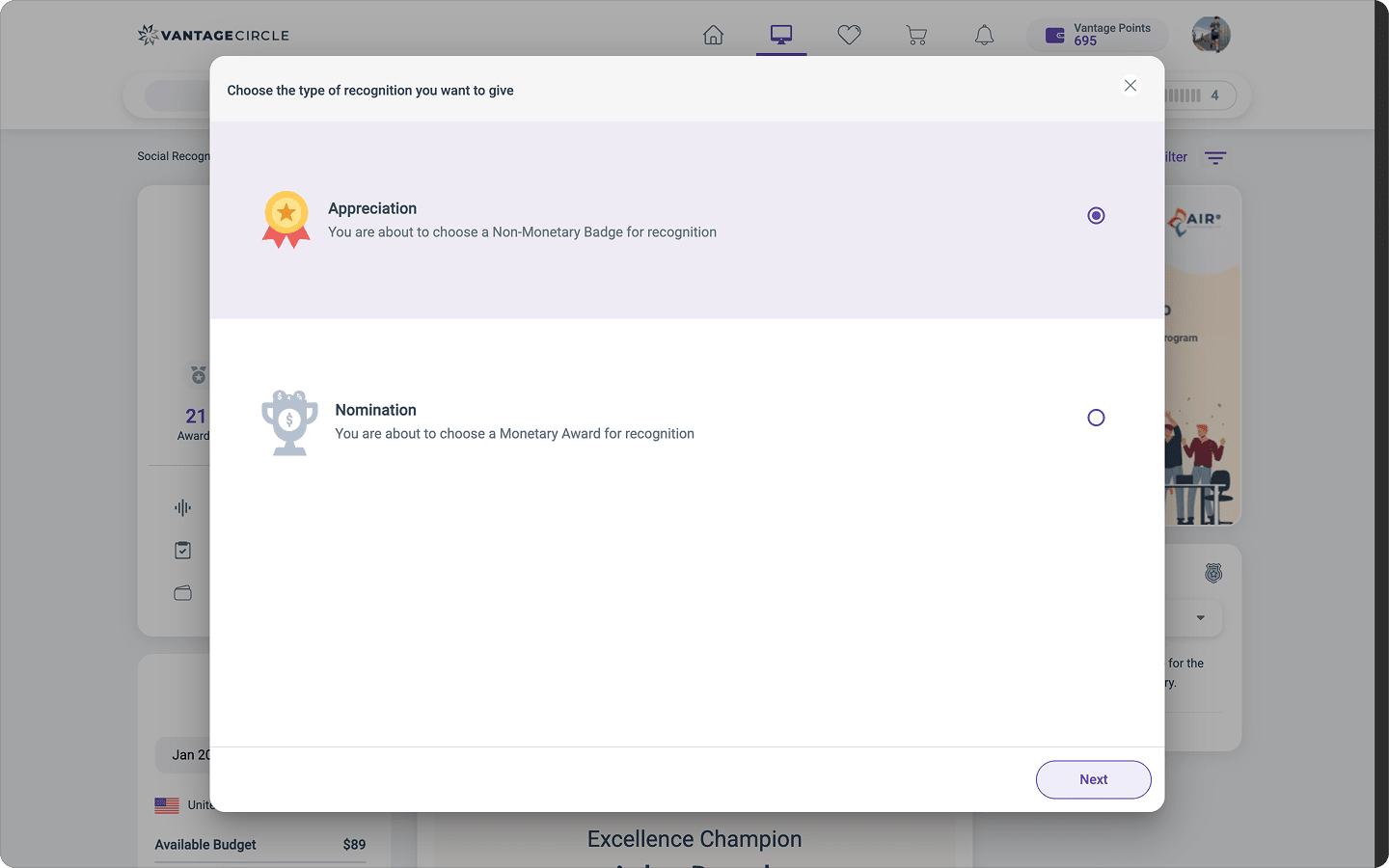
Perceived inequity also thrives in information gaps, and a social recognition feed addresses exactly that.
Recognition data can also reveal structural inequity before it becomes attrition. HR analytics break recognition events down by team, level, tenure, and demographics. If one cohort is consistently under-recognised, you see the pattern before you lose the people.
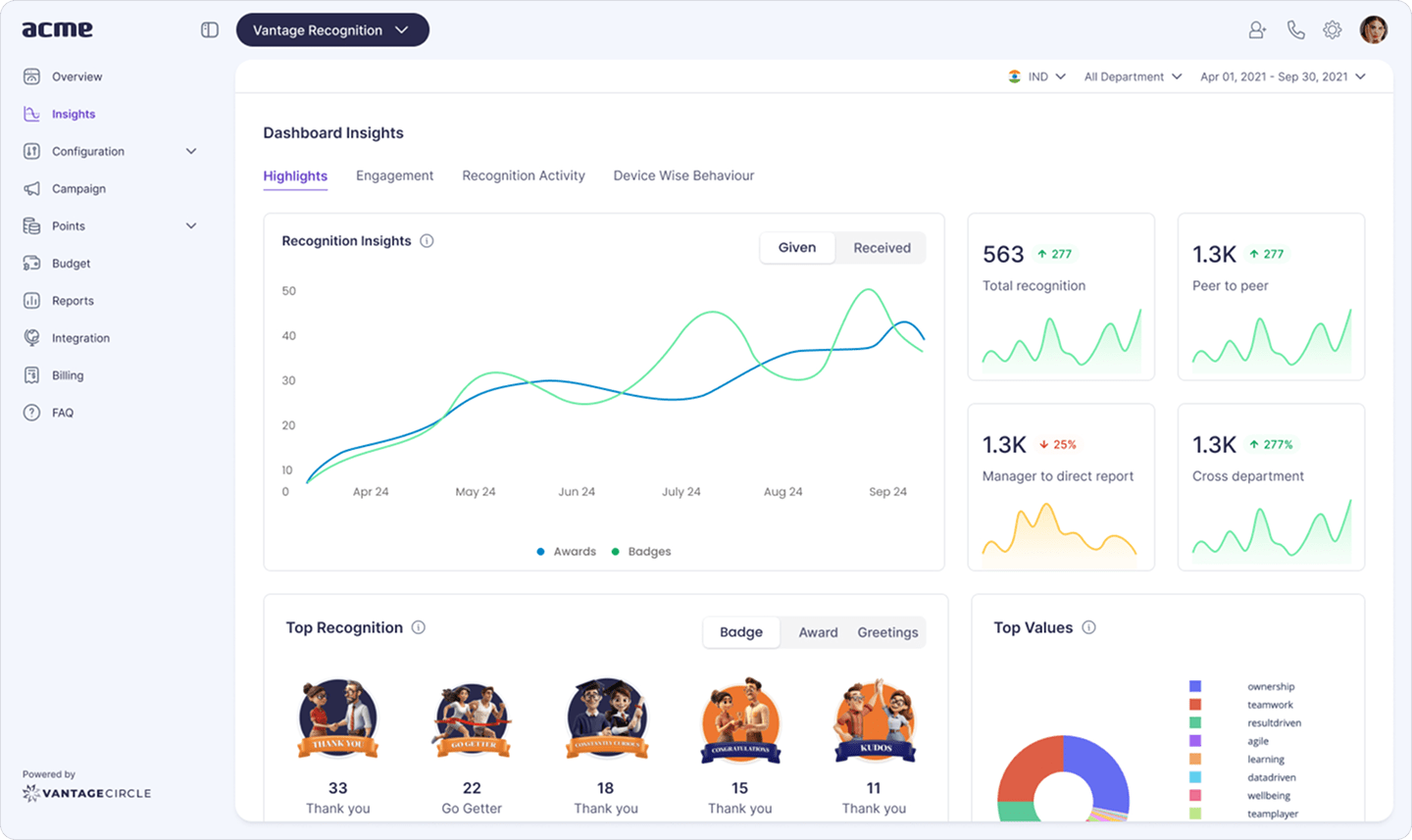
Exit interviews are post-mortems. Pulse surveys catch the signal earlier. Vantage Pulse's sentiment analysis surfaces perceived inequity in open-text responses during the disengagement stage, and anonymous responses remove the retaliation barrier that keeps honest feedback from reaching managers.
Recommended Read: The Recognition Gap: Why Valuing Employees is a Vital Business Strategy
From Theory to Daily Practice
Equity theory gives you something most motivation frameworks cannot: a diagnostic. It converts "I feel undervalued" into a measurable structure of inputs, outputs, and referent gaps you can actually investigate.
Treat recognition data like headcount data. If you track headcount by department, track recognition frequency the same way. Which teams give recognition most? Which cohorts receive the least? Structural under-recognition is visible in the data months before it shows up in attrition numbers.
Make 1:1s a fairness check. Most managers use 1:1s for project updates. Add one standing question: "Is there anything where you feel your contribution isn't being seen?" That is the equity theory diagnostic in plain language. It surfaces inequity before it calculates into a restoration behaviour.
Close referent gaps before Glassdoor does. If your employees can find their market value in five minutes online, proactive pay band communication is no longer optional. Share where each role sits within its band and how progression works. Employees who understand the rationale compare themselves to a standard, not a colleague.
Connect recognition to specific inputs, publicly. A quarterly bonus without explanation lands as a number. A public acknowledgement naming the specific contribution — the late nights, the mentoring, the cross-team collaboration — lands as evidence that the input was seen. That is the equity mechanism working in your favour.
A platform like Vantage Circle gives you the infrastructure to measure employee experience at scale, with recognition frequency, distribution by cohort, and pulse sentiment in one view. Start with a 30-day perceived-fairness audit and the gaps become obvious.
Frequently Asked Questions
What is the concept of equity theory?
Equity theory, developed by J. Stacey Adams in 1963, states that employees assess fairness by comparing their input-to-output ratio against a referent group. When the ratio feels unequal, motivation declines. The core concept: fairness is relational, not absolute.
Is equity theory still relevant today?
Yes, more so than in 1963. Public salary platforms (Glassdoor, Levels.fyi) have expanded every employee's Other-External referent pool. Gartner's 2025 Total Rewards research confirms perceived fairness is among the top predictors of voluntary attrition.
What are the three key elements of equity theory?
The three key elements are inputs, outputs, and the comparison referent. Inputs are what employees contribute (effort, skill, time, loyalty). Outputs are what they receive (pay, recognition, autonomy). The referent is the individual or group used as a fairness benchmark. Inequity occurs when the ratios do not match.

This article is written by Supriya Gupta. Supriya Gupta is a Content Marketing Lead at Vantage Circle, driving content strategy and thought leadership. She builds narratives that drive engagement and align brand purpose with impact.
Connect with Supriya on LinkedIn.