
People leave managers, not companies.
The quote is often repeated in conversations about leadership, but it points to a question managers rarely get enough time to ask themselves: What does it actually feel like to work for me?
A manager can keep projects moving, hit targets, and make sure the team gets through Monday to Friday. But leadership asks for something more.
We tend to talk about leadership as if it begins with the large things: vision, strategy, difficult decisions, the ability to command a room. But for most employees, leadership is experienced much closer to the ground. It is the manager who notices. The manager who gives useful feedback. The manager who knows when to push, when to listen, and when a person's effort deserves to be named.
That distinction is where leadership stops being a title and starts becoming a skill.

Leadership Skills vs. Management Skills: Know the Difference?
Management skills are about running the work. Leadership skills are about moving the people doing it. Planning a sprint, allocating headcount, and tracking a deadline are management. Getting a skeptical team to believe the sprint matters is leadership.
Peter Drucker compressed the whole distinction into ten words:
"Management is doing things right; leadership is doing the right things."
— Peter Drucker
It reads like a poster in an airport bookstore. It is also the most useful frame a first-time manager can carry, because the two skill sets fail in completely different ways.
A manager with weak management skills misses deadlines. A manager with weak leadership skills hits every deadline and watches their best person quit anyway.
Five Core Leadership Skills Every Manager Needs
The 5 core leadership skills are communication, emotional intelligence, decision-making under uncertainty, delegation and trust, and adaptability. Every framework in circulation, whether it lists 7 skills or 13, is a reshuffling of these five.
What separates a skill from a trait is that a skill shows up as behavior. It has a practice version and a failure version, and both are visible to the team long before they are visible to the manager.
| Skill | What It Looks Like in Practice | Common Failure Mode |
|---|---|---|
| Communication | Sets clear expectations, explains the reasoning behind a decision, and checks that it actually landed instead of assuming it did | Sends the information once, then blames the team for "not listening" |
| Emotional Intelligence | Notices what isn't being said in a 1:1, adjusts tone before delivering hard feedback, stays steady when the room gets tense | Reacts to the loudest voice in the room instead of the most accurate one |
| Decision-Making Under Uncertainty | Makes the call with 70% of the information and is transparent about the trade-off | Stalls on every ambiguous decision until someone above them is forced to make it |
| Delegation and Trust | Hands off the outcome, not just the task, and lets people reach it their own way | Delegates the task but checks in so often that nothing is actually handed off |
| Adaptability | Changes the plan when the data changes, without treating it as a personal failure | Defends the original plan long after it has stopped working, to avoid looking wrong |
Communication
Good communication is not about how much a manager says. It is about how clearly people understand what is being said, and why it matters.
A manager can give precise instructions and still leave a team confused. The real test is whether employees can explain the reasoning behind a decision, connect their work to the larger goal, and know what is expected of them without having to guess.
The gap is bigger than it may seem.
of employees cite a lack of clear, honest, or consistent communication from leaders as a primary driver of their disengagement.
Source: Gallup
That is nearly one in three employees telling us that something is getting lost between leadership and the people doing the work.
The answer is not necessarily more communication. It is better communication, with the why attached. This matters in recognition, too. The same skill that helps a manager give clear feedback helps them give meaningful recognition too.
Emotional Intelligence
Emotional intelligence at work is the ability to read what your team is feeling, regulate your own response, and act before either becomes a problem. It is less about being "good with people" and more about knowing what is happening beneath the surface.
The need for that skill is becoming harder to ignore.
Employees who trust their immediate manager
Source: DDI, Global Leadership Forecast 2025 — 10,700+ leaders surveyed
Trust does not disappear all at once. It erodes through missed signals, unresolved tension, poor communication, and employees feeling that their manager simply does not see what is happening.
Decision-making Under Uncertainty
Good managerial decision-making is not about being right every time. It is about making a clear enough decision for the team to move forward, while giving people enough context to understand the thinking behind it.
of U.S. managers strongly agree their peers make well-thought-out decisions
strongly agree they are satisfied with the speed of decision-making
Source: Gallup
The problem is not simply making the wrong call. Waiting too long can leave a team without direction, while making a decision without explaining the reasoning can leave people questioning what happens next.
Managers will rarely have complete information. The skill is knowing when you have enough information to decide, being honest about what you know and do not know, and giving the team a clear direction.
Three habits that separate managers who decide well from managers who stall:
Say the confidence level out loud
"I'm about 70% sure, and here's what would change my mind" is a stronger position than false certainty.
Set a decision deadline before gathering information
Otherwise research becomes procrastination in a nicer outfit.
Separate reversible decisions from permanent ones
Most are reversible. Treating them all like they are permanent is how teams grind to a halt.
Delegation and Trust
Delegation is a trust decision before it is a workload decision. If you hand over the task but keep the judgment calls, you have not really delegated. You have assigned homework.
This is where delegation stops being a management exercise and becomes a leadership skill. A RACI chart can tell people who owns what. Leadership is deciding how much control you are willing to give up once the work is theirs.
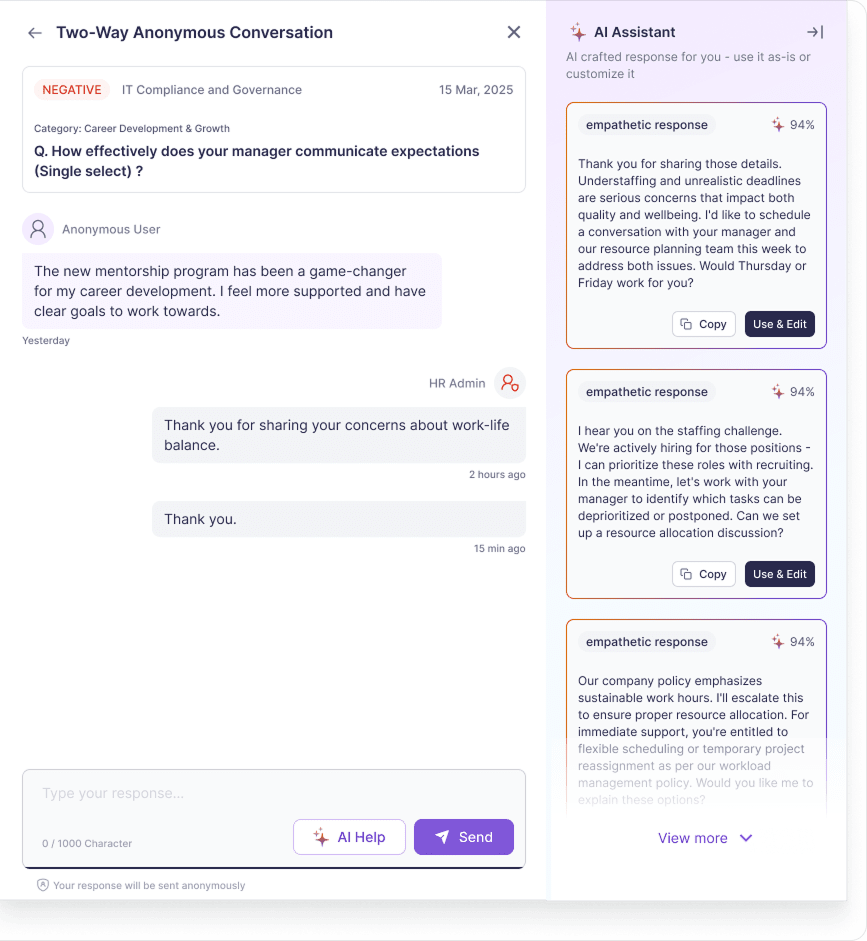
That trust is often harder to measure than the workload itself. Employees may hesitate to tell a manager that delegation feels more like dumping, especially when the person asking for feedback is the same person holding the authority.
Anonymous employee feedback can create the space for that honesty. It can help you look out for those patterns and give managers a view of what employees may not say directly.
Source: Vantage Pulse
A Simple Test
After you delegate, count how many times you ask for an unsolicited status update. If you keep checking, you may have handed over the task without handing over the trust.
Adaptability
Adaptability in leadership is not about embracing every change. It is about knowing when the situation has changed enough to require a different approach, and having the confidence to change course.
Managers are being asked to do more of that than ever.
Manager engagement, globally — the steepest decline of any worker category
Behind that decline are the realities managers are navigating: restructures, flatter organizations, AI rollouts, changing expectations, and wider spans of control.
But adaptability is not enthusiasm for change. Teams can tell the difference between genuine adjustment and optimism. Changing your mind is not a failure of leadership. Refusing to change when the evidence has changed is.
Teams can adapt to a changed plan. What wears them down is being asked to pretend the old one is still working.
How Do You Know Your Leadership Skills Are Actually Working?
Leadership is not something you can reliably measure by looking in the mirror. You have to look at what changes around you.
That means paying attention to upward feedback, employee sentiment, recognition patterns, and whether those signals improve consistently over time. One good survey cycle can tell you something. A pattern across several can tell you whether your leadership is actually landing.
There is often a gap between the two. The American Management Association surveyed more than 1,300 workers in October 2025 and found that 59% of managers believed their own engagement had improved over the previous year, while 80% of employees said manager engagement had stagnated or declined.
Both groups were describing the same workplace.
That gap is the reason leadership needs a feedback loop. If managers only discover how their leadership is experienced during an exit interview, the most useful feedback has arrived at the least useful time. The goal is to notice the signal early enough to do something with it.
The Leadership Signal Checklist
Each of the five core skills leaves a signal you can observe. Check them quarterly, look for patterns rather than isolated scores, and use what you find to adjust how you lead.
1. Communication → Clarity
Do employees understand not only what needs to happen, but why? Look for fewer repeated questions, clearer feedback, and stronger agreement on priorities. If people keep coming back for clarification, the message may not be landing.
2. Emotional Intelligence → Trust
Do people feel safe raising concerns, disagreeing, or admitting mistakes? Look at upward feedback and sentiment over time. A team that becomes more candid is giving you a useful signal; a team that goes quiet may be giving you one too.
3. Decision-Making → Momentum
Can your team move without waiting for you to resolve every question? Watch how quickly decisions turn into action, and whether people understand the reasoning behind them. Good decisions should create movement, not another layer of uncertainty.
4. Delegation → Ownership
Are people taking responsibility for outcomes, or simply completing tasks you continue to oversee? Look for fewer unnecessary check-ins, more independent problem-solving, and employees making judgment calls within their remit.
5. Adaptability → Resilience
What happens when the plan changes? Strong leadership does not eliminate disruption. It helps people navigate it. Watch whether your team can absorb a change in direction, understand the new priority, and keep moving without losing confidence.
Leadership Skills for New Managers
If you are a new manager, start with two skills: communication and delegation. Emotional intelligence and adaptability grow with experience, but if a first-time manager cannot explain a decision clearly or trust their team with important work, the rest becomes much harder.
The transition into management is not getting any easier, and many employees are questioning whether they want to make it at all. Robert Walters' 2024 survey of 3,600 Gen Z professionals found that 52% did not want to become middle managers, while 72% preferred to progress as individual contributors. DDI's Stephanie Neal has described this shift as "conscious unbossing."
The hesitation makes sense. New managers are stepping into a role that asks them to deliver through other people, often while navigating competing priorities, changing expectations, and pressure from both directions.
So, what can make the first year easier?
Stop Doing the Old Job
One of the easiest traps is staying the team's best individual contributor and managing only when there is time left. Your job has changed. Your focus now is helping the team do its best work.
Explain the Reasoning, Especially Early On
For the first 90 days, give people more context than you think they need. Your team is still learning how you make decisions, so clarity can prevent unnecessary confusion and assumptions.
Get a Baseline in Month One
Run a short [pulse survey](/en/blog/pulse-surveys/) before making major changes. It gives you a clearer picture of how the team is doing and something to compare against later.
Find a Peer Manager
You do not always need advice from someone two levels above you. Another manager dealing with similar challenges can offer practical perspective and help you figure out what is normal, what needs attention, and what you are overthinking.
Conclusion
You do not become a better manager by knowing what good leadership looks like. You become one by noticing what your team experiences from you, and changing what is not working.
The advantage of being a new manager is that you are still close enough to the transition to notice these patterns. Pay attention to them. Ask what your team needs more of, what is getting in their way, and where your own habits are making the work harder than it needs to be.
You will not get everything right in your first year. The goal is to become the kind of manager who notices, learns, and adjusts before small problems become team-wide ones.
FAQs
1. What are the 5 Key Leadership Skills?
A. The five key leadership skills are communication, emotional intelligence, decision-making, delegation, and adaptability. Together, they help managers guide their teams, handle challenges, and create clarity at work.
2. What are the Top 10 Leadership Skills for Managers?
A. The top leadership skills for managers include communication, delegation, emotional intelligence, decision-making, adaptability, strategic thinking, conflict resolution, coaching, accountability, and relationship-building.
3. What are the 7 Core Leadership Skills?
A. Seven core leadership skills are communication, emotional intelligence, decision-making, delegation, adaptability, accountability, and strategic thinking. These skills help managers balance people, priorities, and business goals.
4. What are the 8 Most Common Leadership Styles?
A. The eight commonly discussed leadership styles are autocratic, democratic, coaching, transformational, transactional, laissez-faire, bureaucratic, and servant leadership.

Shikha Gogoi is a Content Marketing Specialist focused on SEO-driven content around employee engagement, recognition, and workplace culture, helping build people-first workplaces.
Connect with Shikha on LinkedIn.