
Work resolutions tend to live short and predictable lives. They are announced with great sincerity in the first team meeting of January, worded vaguely enough that nobody could possibly fail them, and then quietly retired by February, mostly because nobody ever agreed on what "communicate better" was supposed to look like. The ones that survive owe less to willpower than to design, since they name a specific action, tie it to a date and involve at least one other person who will notice when it stops happening.
That is the thinking behind the forty resolutions in this guide, grouped by who is doing the resolving. Employees get ones built around focus, balance and growth, managers get a way to make recognition a habit instead of a memory test, and HR teams get a way to close the gap between what the engagement survey said and what actually changed. Each one comes with a way to measure it, and a planner at the end turns the chosen few into this week's to-do list.
What makes a good work resolution?
A good work resolution is specific, small enough to start this week, measurable, and something you share with at least one person. Vague intentions like "be more productive" rarely survive February.
| Quality | What it looks like |
|---|---|
| Specific | Names one action, not a general intention |
| Small | Fits inside a week, not a whole year |
| Measurable | Has a number, a date or a yes/no check |
| Role-linked | Connects to what you actually do at work |
| Shared | At least one other person knows about it |
This isn't just intuition. In a six-month study of New Year resolvers and nonresolvers trying to change the same habits, 46% of resolvers were still succeeding six months later, compared with 4% of nonresolvers (Norcross, Mrykalo & Blagys, Journal of Clinical Psychology, 2002). Naming the change and committing to it is most of the battle; goal setting for employees is what keeps it alive after January.
Productivity and focus resolutions
The best productivity resolutions protect your attention, not your to-do list.
1. Block two hours of focus time every day
Block two hours of focus time on your calendar before the day fills up with other people's priorities. Treat the block like a client meeting you can't reschedule: notifications off, chat closed, door shut if you have one. Most people overestimate how much focused work they do in a day and underestimate how much two honest, protected hours can produce.
2. Check email at set times instead of all day
Check email at set times, say 10am, 1pm and 4pm, instead of leaving your inbox open all day. An open inbox trains you to react to whatever lands last, rather than work on what actually matters most. Batching it into three windows still gets most replies out within the hour, and it hands the initiative back to you for everything in between.
3. Finish one important task before lunch
Finish one important task before lunch, every single day, before meetings and messages start pulling you in different directions. Mornings carry more focus than afternoons for most people, so the task you'd normally push to 4pm is the one most likely to get rushed or dropped. Closing it out early turns the rest of the day into a bonus instead of a deficit you're chasing.
4. Clear your digital desktop every Friday
Clear your digital desktop every Friday: archive finished email threads, close stray browser tabs, and file documents sitting loose on your desktop. A cluttered digital workspace is a hundred small, unfinished decisions waiting for you on Monday morning. Fifteen minutes before you log off on Friday buys you a genuinely clean start to the next week.
5. Say no to one meeting a week that has no agenda
Say no to one meeting a week that shows up on your calendar without an agenda. Ask the organizer what decision it's meant to produce; if there isn't a clear answer, suggest an async update instead. Protecting this one boundary consistently is usually enough to teach your calendar to respect the rest of your time too.
6. Do one thing at a time
Do one thing at a time, even when three things feel equally urgent. Multitasking feels productive in the moment, but it splits your attention across every task, so each one takes longer and the output is worse than if you'd done them one by one. Pick the next single task, finish it completely, then move to the next.
Work-life balance and well-being resolutions
Balance resolutions work when they set a clear boundary you can actually keep every week.
7. Set a fixed log-off time and tell your team
Set a fixed log-off time, and say it out loud to your team instead of just deciding it privately. A boundary nobody else knows about gets interrupted by habit within the first week. Once your team knows you log off at six, most people will plan their own asks around it instead of testing whether you'll answer anyway.
8. Take a real lunch break away from the screen
Take a real lunch break away from your screen, even if it's twenty minutes at your kitchen table instead of a proper outing. Eating while you work doesn't actually save you time, it just moves your afternoon slump earlier and makes the last two hours harder to get through. A short, deliberate break resets you more than an extra twenty minutes at your desk ever will.
9. Plan your time off in January
Plan your time off for the year in January, before the calendar fills up with other people's deadlines. Block the dates now, even if the specifics shift closer to the time; a placeholder is far easier to move than a vacation you never scheduled. Teams that plan leave early tend to actually take it, while teams that wait "until things calm down" usually don't.
10. Limit after-hours chat notifications
Limit after-hours chat notifications by muting work channels the moment you log off, not just silencing your phone. Being reachable at 9pm doesn't make you more dependable, it just quietly moves the job's boundary further into your evening. Once colleagues notice you reply at night, they start expecting it, so the fix has to be a setting, not willpower.
11. Protect your sleep before big workdays
Protect your sleep before big workdays the same way you'd prepare the materials for them. Sleep deprivation shows up in decisions, patience and judgment long before anyone in the room names it as the actual cause. A team step challenge in January can turn goals like this into something colleagues do together, rather than something each person tries and quietly drops alone.
12. Take a 5-minute mindfulness break
Take a 5-minute mindfulness break between meetings instead of reaching for your phone. A regular mindfulness practice compounds the same way exercise does: small and frequent beats occasional and long, and five minutes is short enough to survive even a packed day. It resets your attention for the next conversation better than five more minutes of someone else's feed ever could.
If balance keeps slipping no matter which of these you try, it's worth checking whether the real issue is work-life balance at a team level, or early signs of burnout that a resolution alone won't fix.
Career growth and learning resolutions
Career resolutions pay off fastest when they come with a date and a person to report to.
13. Learn one skill your role will need next year
Learn one skill your role will need next year, not one that simply sounds impressive on a profile. Ask your manager what's coming up for the team over the next twelve months, and pick the one skill that closes the biggest gap. Use a course discount benefit if your company offers one, since cost is often the real reason a learning resolution stalls by February.
14. Ask your manager for feedback every month
Ask your manager for feedback every month, instead of waiting for the annual review to find out what's working. A monthly check gives you time to actually adjust course while the feedback is still relevant, rather than hearing about a pattern after it's shaped a whole year. Here's how to ask for feedback in a way that doesn't feel like an interrogation for either of you.
15. Keep a "wins file" for your next review
Keep a "wins file", and add to it the week something goes well, not the week before your review when memory is already unreliable. A running, dated list turns a vague "I worked hard this year" into specific proof you can actually point to. It also makes it easier to ask for what you want, because you're negotiating from evidence instead of impression.
16. Find a mentor or mentor someone
Find a mentor, or become one, since both directions teach you something different. A mentor gives you a shortcut past mistakes they've already made, often saving you months of trial and error. Mentoring someone else forces you to explain what you know clearly enough for another person to actually use it, which sharpens your own understanding too.
17. Read one book a quarter that relates to your work
Read one book a quarter that relates to your work, not a stack of ten you'll abandon by February. Four finished, deliberately chosen books a year will teach you more than twelve started ones that never make it past chapter two. Pick the book because it solves a problem you actually have this quarter, not because it's trending.
18. Build your network inside the company, not only outside
Build your network inside the company, not only outside it. Have coffee with someone from a different team each month, even if there's no obvious reason to yet. Internal relationships are what get you looped into opportunities, projects and context before they're ever posted anywhere official.

Communication and teamwork resolutions
Teamwork resolutions are about small, repeated actions that make colleagues' work easier.
19. Thank one colleague by name every week
Thank one colleague by name every week, for something specific they did, not a general "great job" that could apply to anyone. A peer recognition tool makes this easy to sustain, since naming the person and the exact help they gave takes about ten seconds, and that detail is what makes the thank-you land. See words of appreciation for employees that sound genuine instead of generic.
20. Listen fully in meetings (no second screen)
Listen fully in meetings, with your second screen closed and your phone out of reach. Half-attention is obvious to everyone else in the room, and it quietly costs you the context you'll need later to contribute anything useful. Strong communication skills start with actually listening, not with knowing the right thing to say.
21. Reply to messages with a clear next step
Reply to messages with a clear next step, not just an acknowledgment that you saw them. "Got it, will send the draft by Thursday" closes a loop completely; "noted" just opens a new one, because now the sender has to come back and ask what happens next. The extra few seconds it takes to add the next step saves both of you a follow-up message later.
22. Share credit in public, take feedback in private
Share credit in public, take feedback in private. Naming who actually did the work costs you nothing and builds trust with your team fast, especially when you could have taken the credit yourself. Taking correction in a side conversation instead of in front of the group protects everyone's ability to speak honestly with you next time.
23. Ask for help sooner
Ask for help sooner, before a problem has been quietly eating your week in silence. Most colleagues would rather answer a two-minute question on day one than discover on day four that the deadline is already at risk. Asking early reads as organized, not incapable, no matter how it feels in the moment.
24. Help one new joiner settle in
Help one new joiner settle in, even if onboarding officially isn't your job. A five-minute "here's who to ask about X" conversation in someone's first week can save them weeks of guessing who actually owns what. It's a small gesture, but it's consistently the kind of thing people remember years later.
New Year resolutions for managers
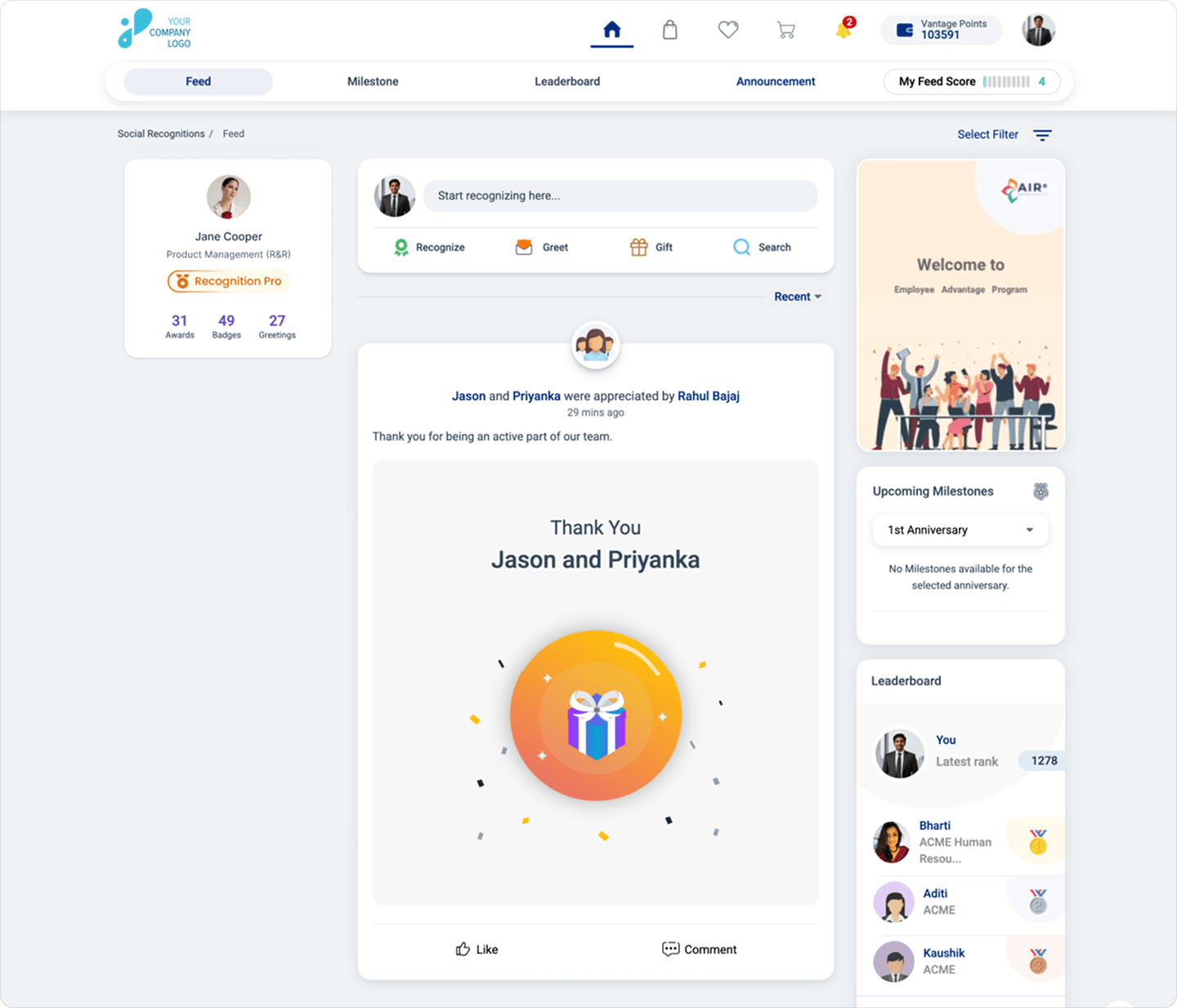
The most useful manager resolution is to recognize your people more often, because most employees go months without it. Fewer than 20% of US employees are recognized every quarter, according to AIRe Benchmarking Report USA 2023-24 (Vantage Circle).
25. Recognize someone on your team every week, for something specific
Recognize someone on your team every week, and name the specific thing they did rather than offering a general thank-you. 91% of employees in high-recognition cultures feel motivated, compared with 73% in emerging-recognition cultures, an 18-point gap, according to The Recognition Effect (Great Place To Work® India × Vantage Circle, 2025). When that recognition is visible on a shared feed, it sets the standard for the whole team, not just for the person being thanked, and it lets you see at a glance who hasn't been recognized lately before the quarter quietly ends.
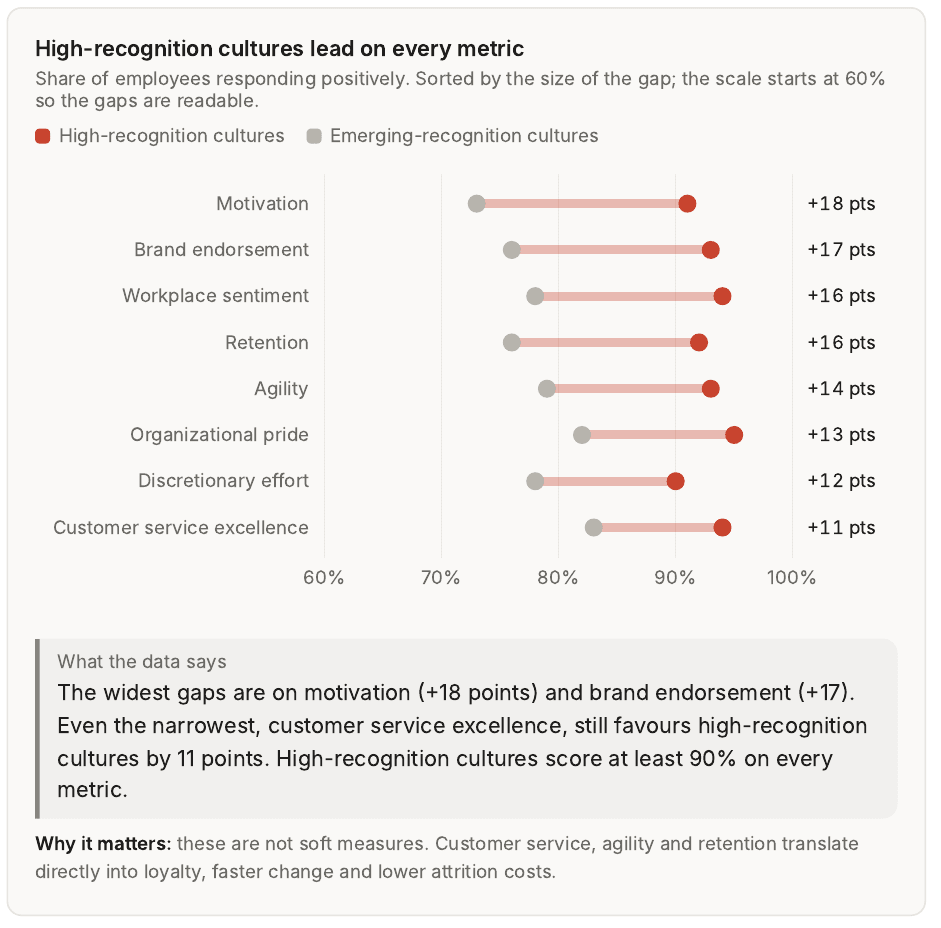
Source: The Recognition Effect, a study of 5.7M+ employees (Great Place To Work® India × Vantage Circle, 2025)
At Tata Communications, the recognition programme reached a pace of 1 recognition every 2 minutes in FY2024-25. That's what consistent, specific recognition looks like at scale. See how employee recognition works as a weekly habit, not an annual event.
See it in action: Explore Vantage Recognition
26. Hold a 15-minute one-to-one with every report each month
Hold a 15-minute one-to-one with every report each month, even when the sprint is genuinely busy and it feels skippable. These are the conversations that catch a stalled project, or a quietly disengaged employee, weeks before either one turns into a resignation letter. Fifteen minutes is short enough that "no time" stops being a real excuse.
27. Give feedback within a week, not at review time
Give feedback within a week of the thing it's actually about, not six months later at review time. By then, neither of you remembers the context clearly, and the person has had no real chance to adjust along the way. Here's how to give positive feedback that actually lands instead of arriving too late to matter.
28. Set three team goals, not ten
Set three team goals, not ten. A long list of priorities is really just a list of things that won't get done this quarter, dressed up to look ambitious. Pick the three that matter most, say no to the rest for now, and team goals work better anyway when everyone can actually name them from memory.
29. Protect your team's focus time
Protect your team's focus time the way you'd protect your own: no recurring meeting without a clear purpose, no "quick sync" that could have been a two-line message instead. A manager who consistently guards focus time earns more real output from their team than one who fills every hour with visibility and status updates.
30. Invite resolutions, don't mandate them
Invite resolutions, don't mandate them. A resolution forced on a team breeds quiet resentment rather than genuine commitment, since nobody likes being assigned a personal habit by someone else. Share this guide and the planner below, and make it clear that joining in is optional, not something anyone will be checked on later.
31. Celebrate small wins every Friday
Celebrate small wins every Friday, even the ones that feel too minor to bring up in a meeting. A five-minute round of "what went well this week" builds momentum that a single annual award ceremony never comes close to matching. See how to celebrate small wins at work without it feeling forced or performative.
32. Ask your team what to stop doing
Ask your team what to stop doing, not just what to start doing differently this year. Every team is quietly carrying at least one report, meeting or process that nobody actually needs anymore, and nobody has said so out loud. Removing it usually frees up more time than any new productivity habit you could add instead.
New Year resolutions for HR teams
HR resolutions for 2027 should make the employee experience simpler and the feedback loop faster.
33. Close the loop on every survey within 30 days
Close the loop on every survey within 30 days of collecting it, not whenever the next project allows. Short pulse surveys make that deadline realistic: three focused questions, then a clear share-back on what you heard and what will change, even when the honest answer to part of it is "not yet." Silence after a survey is exactly what makes the next one harder to get real answers on.
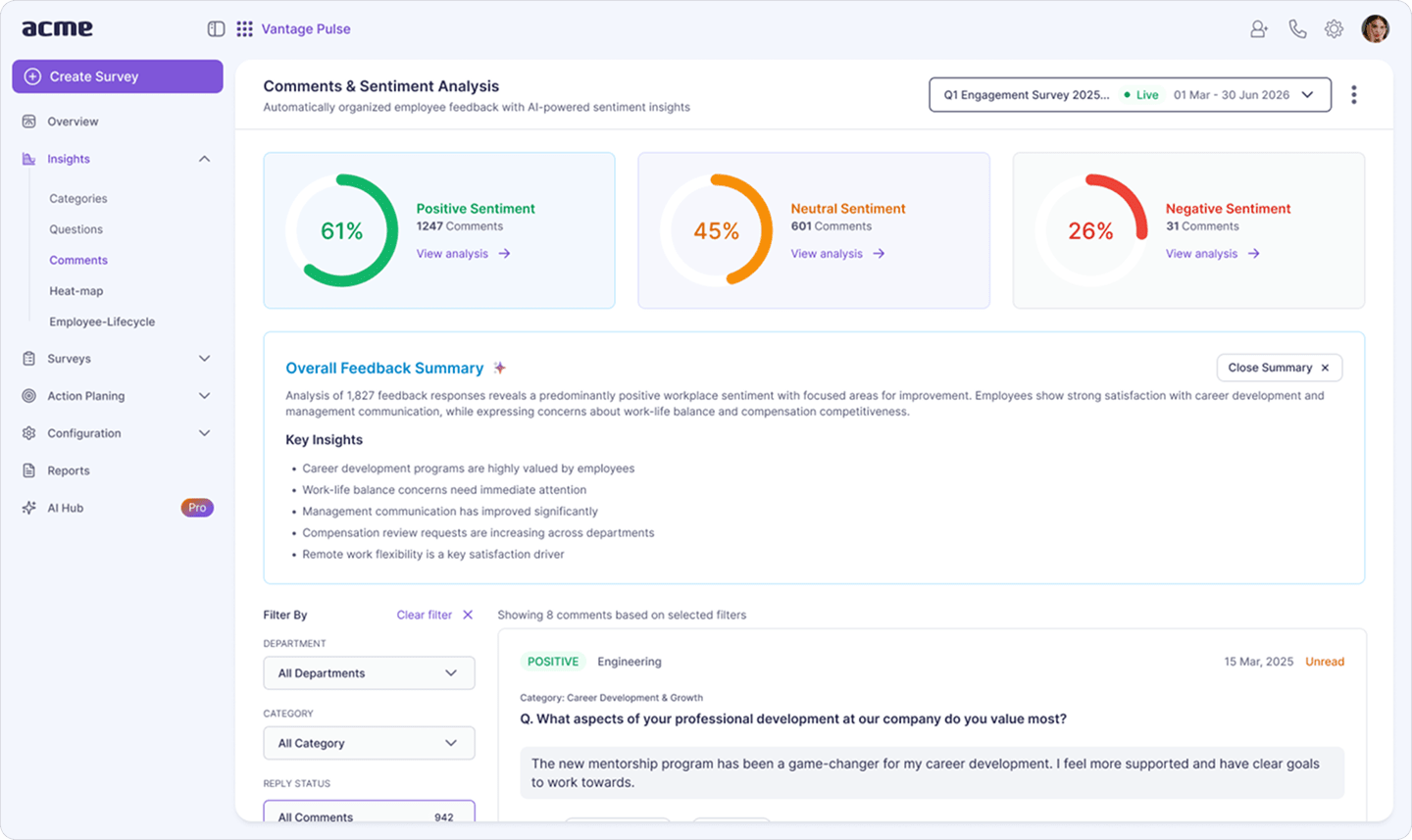
34. Use AI to read feedback faster, but check it with people
Use AI to read feedback faster, but check what it tells you against people on the ground before acting on it. Sentiment analysis can group thousands of open-text comments into themes in minutes, which is the easy part technology solves well. The harder, still-necessary part is what Pooja Malhotra, Head HR India at StoneX Group Inc., named on the Vantage HR Influencers Podcast: "HR business partners need to know the pulse on the ground, to not just blindly believe what AI is telling you."
35. Put recognition into onboarding from day one
Put recognition into onboarding from day one. A new hire's first small win, whether it's finishing their setup checklist or closing their first ticket, deserves the same visible thank-you a five-year veteran would get for something bigger. It sets the cultural expectation early, before anyone has to explain it in a handbook.
36. Rewrite one confusing policy a quarter in plain language
Rewrite one confusing policy a quarter in plain language. Pick the one policy HR fields the most repeat questions about, and rewrite it so a brand-new employee could follow it correctly without calling anyone for help. Clearer policy means fewer tickets, less frustration, and less of HR's week spent re-explaining the same paragraph.
37. Make recognition fair across every level and location
Make recognition fair across every level and location. Check whether frontline and remote employees are recognized at roughly the same rate as people who happen to sit near leadership, and whether one office or team is quietly winning every award. SMART goals for HR professionals can turn "make it fair" from a good intention into something you can actually measure.
Team resolutions to set together
A team resolution is one shared habit the whole team agrees on in the first week of January. 79% of high-effectiveness recognition programs recognize both the team and standout individuals when celebrating collective achievements, compared with 37% of other programs, according to The State of Recognition & Rewards 2025 (Vantage Circle). Build at least one around celebrating the group as a whole, not just its top performers.
38. Celebrate team wins and individual standouts together
Celebrate team wins and individual standouts together, in the same moment, instead of treating them as two separate kinds of recognition. Running a themed January kick-off campaign, where teams nominate one shared win and one standout colleague at the same time, gives the resolution an actual start date and a public moment instead of a vague good intention. It also signals early that both the team's effort and the individual's contribution will be noticed all year.
39. Run a 20-minute "start, stop, continue" kick-off
Run a 20-minute "start, stop, continue" kick-off in the first week back from the break. Ask the team what to start doing, what to stop, and what's already working well enough to keep exactly as is. It's a lighter, faster version of a planning offsite, and it works just as well right after a New Year office party as it does in a plain meeting room.
40. Review the team's resolutions at the end of each quarter
Review the team's resolutions at the end of each quarter, not just once in December when the year is already over. Drop what genuinely isn't working, keep what is, and add one new resolution if the team actually has the bandwidth for it. A resolution nobody ever revisits quietly becomes a resolution nobody kept, without anyone deciding that on purpose.
How to make work resolutions stick
Work resolutions stick when you shrink them, schedule them, track them and review them with someone else.
- Pick one or two. Trying to fix everything in January is how most resolutions die by February.
- Write the week-1 action. Turn the resolution into the exact first thing you'll do this week.
- Decide how you'll measure it. Pick a number, a date or a simple yes/no check.
- Tell one person. A resolution nobody else knows about is easy to quietly drop.
- Set a quarterly check-in. Resolutions survive on review, not willpower alone.
Use the planner below: pick a row close to your resolution, copy its week-1 action, and set your own check-in date.
| Resolution | Week-1 action | How to measure | Check-in date |
|---|---|---|---|
| Block two hours of focus time every day | Add a recurring 2-hour block to your calendar | Protected blocks completed each week | End of January |
| Thank one colleague by name every week | Send one specific thank-you message this Friday | One named thank-you logged per week | End of January |
| Recognize someone on your team every week | Pick this week's person and the specific thing they did | Weekly recognition count by team member | End of each month |
| Close the loop on every survey within 30 days | Calendar the 30-day share-back date | Days between survey close and results shared | End of each quarter |
| Set a fixed log-off time and tell your team | Message your team your log-off time today | Days per week you log off on time | End of January |
| Celebrate team wins and individual standouts together | Name one team win and one standout this week | Both recognized in the same meeting, logged | End of each month |
Conclusion
Pick one resolution from your section, write its week-1 action today, and tell one person before the day ends. The forty ideas above only work if one of them becomes this week's to-do list instead of next December's regret.
Start with the planner above. Find the row closest to your resolution, copy its week-1 action, and set a date for the check-in. That's the whole system, repeated forty times, for employees, managers and HR alike.
If you're also planning the team's broader return in January, pair this with our January employee engagement ideas.
Frequently Asked Questions
1. What are some good workplace goals for the new year?
A good workplace goal names a habit, not a feeling. Instead of "communicate better," try "reply to messages with a clear next step." Instead of "be a better manager," try "recognize someone on your team every week, for something specific." The test is simple: could you show someone proof you kept it by the end of the month, or is it still just a hope?
2. What are the top 3 things an employee can improve on?
Three areas carry the most weight for most employees: protecting focus time so deep work actually gets finished, replying to requests with a clear next step instead of a vague acknowledgment, and asking for feedback monthly instead of waiting for a review to find out what isn't working. None of these need more hours in the day, just a more deliberate use of the ones you already have.
3. What are most people's new year's resolutions?
Outside of work, the most common New Year's resolutions are about health, fitness, money and personal habits. Inside work, the common ones are about managing time better, setting clearer boundaries, and building a skill the next role will actually need. That split is why work resolutions deserve their own category instead of getting folded into generic self-improvement advice.
4. What are fun new year resolutions?
A few lighter, work-safe ones: learn everyone's coffee order, keep a desk plant alive past March, start a running tally of the year's best inside jokes, or challenge a colleague to a step-count contest. None of these will fix a broken process, but a team that can laugh together in January usually works better together the rest of the year too. Pair one with a New Year trivia for work session.

Shaoni Gupta is a content marketing specialist at Vantage Circle, with expertise in scriptwriting and copywriting in the field of employee rewards and recognition.
Connect with Shaoni on LinkedIn.