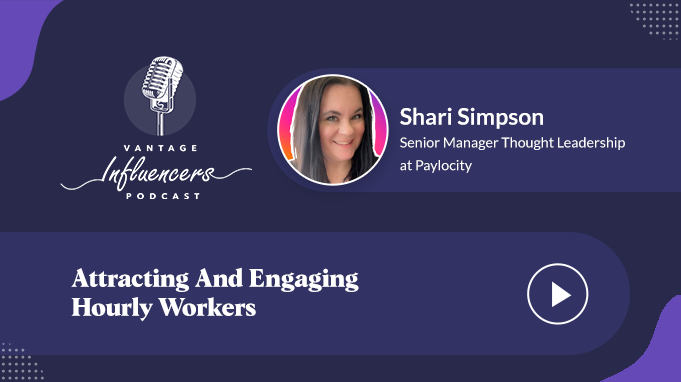
Attracting And Engaging Hourly Workers
Episode Overview
Hourly workers keep entire industries running, but they rarely get the same strategic attention as salaried staff when it comes to attraction and engagement. In this episode of Vantage Influencers, host Sanjeevani Saikia speaks with Shari Simpson, Senior Manager of Thought Leadership at Paylocity, about what hourly workers actually look for in an employer, why old assumptions about them are wrong, and what innovative organizations are doing differently.
Shari draws on real examples, including McDonald's remote drive-through order takers and pandemic-era shifts in how "essential workers" are viewed, to lay out practical, specific strategies: recognition designed for hourly roles, real flexibility beyond remote-work-one-day-a-week, and benefit packages that go beyond the standard checkboxes.
Episode Highlights
- The idea that hourly workers are less career-focused or less valuable than salaried staff is an outdated misconception. The pandemic exposed just how essential this population actually is.
- Recognition can't use a "peanut butter approach," spreading the same generic program across every role. Peer-to-peer recognition matters especially, since leadership often doesn't see an individual hourly worker's day-to-day impact.
- Flexibility for hourly workers doesn't have to mean remote work. It can mean control over shift swapping, input into benefit design, or autonomy within a manufacturing floor's constraints.
- Innovative moves worth studying: tuition repayment (not just reimbursement), gig-economy-style skill families instead of rigid job descriptions, and McDonald's testing fully remote hourly roles for drive-through order-taking.
- Punishing employees for using benefits they're entitled to, like sick days counting against attendance policies, actively undermines trust and should be redesigned.
- Hourly workers can shape culture too: getting the basics right (punctuality, reliability), staying curious enough to ask for exposure to new things, and bringing frontline insight straight to leadership.
About the Guest
Shari Simpson — Senior Manager, Thought Leadership at Paylocity
Shari Simpson is a seasoned HR professional with over 16 years of experience across training and development, talent acquisition, and employee relations. She co-hosts the HR Mixtape podcast alongside other industry voices, and is active in elevating HR, payroll, and business professionals through speaking at national conferences, cross-industry collaboration, and co-leading a women's employee resource group.
Connect with Shari Simpson on LinkedIn
Host
Sanjeevani Saikia — Vantage Influencers Podcast Host
What You Will Learn
- What hourly workers actually prioritize when evaluating an employer, and how it differs from salaried staff
- Why common assumptions about hourly workers being less committed or less skilled are wrong
- How to design recognition and benefits programs specifically for an hourly workforce
- What real flexibility looks like even in roles that can't go remote
- Emerging trends in hourly workforce management, from skill-based hiring to remote hourly roles
- How hourly workers themselves can help shape a more positive workplace culture
Key Topics & Timestamps
| Time | Topic |
|---|---|
| 01:57 | Shari's corporate journey so far |
| 03:35 | What hourly workers weigh most when evaluating employers |
| 08:14 | Innovative strategies to engage and retain hourly workers |
| 11:03 | Building a culture of recognition that actually motivates hourly workers |
| 14:45 | Emerging trends and innovations in hourly workforce management |
| 19:20 | Designing benefit packages that meet hourly workers' real needs |
| 22:32 | Obstacles employers face in attracting and engaging hourly workers |
| 25:57 | How hourly workers themselves can shape a more positive work environment |
Full Transcript
Read the full transcript
Sanjeevani: Welcome to the Vantage HR Influencers Podcast. This podcast is sponsored by Vantage Circle, the simple and AI-powered rewards and recognition platform for employee engagement.
Sanjeevani: Hourly workers are the unsung heroes of many industries, they keep things running smoothly. But attracting and engaging them can be as difficult as finding a unicorn in a haystack, with the gig economy on the rise and competition for talent fiercer than ever, businesses need to step up their game if they want to attract and retain top-notch hourly workers. In this episode, let's take a journey into discovering the secrets to attracting the best of the best hourly workers and keeping them engaged.
Sanjeevani: Hello listeners, welcome to another episode of the Vantage Influencers Podcast, where we explore a wide range of HR topics to grab your attention and inspire you. I'm your host, Sanjeevani Saikia, and today we'll be talking about attracting and engaging hourly workers. Joining me for that is Shari Simpson, Senior Manager, Thought Leadership at Paylocity. Hi Shari.
Shari Simpson: Hi, how are you today?
Sanjeevani: I'm absolutely fine, how are you?
Shari Simpson: I'm wonderful. It's a beautiful day here in Chicago, hopefully you'll hear some birds in the background today.
Sanjeevani: Unfortunately I can't hear them, but I'm sure it's lovely. Thank you for giving your time to join us today. Before we dive into today's topic, could you walk us through your corporate journey so far?
Shari Simpson: Yeah, like most HR professionals, I didn't actually start in HR. My undergrad is in adolescent studies, and I started my career in mental health, working with adolescent teenagers who were wards of the state. I had the world's best boss at the time, and he pulled me aside one day and said, "you're in the wrong profession, I think you should go work in HR." I was completely shocked, I thought, you want me to go be the policy police? That's just not my thing. But he sat me down and we had a really great conversation about my skill set and what he thought I could accomplish. I had a lot of trust and psychological safety with him, so I took that leap into HR, about 16 years ago now, and I haven't looked back. Since then I've done a variety of roles, learning and development, payroll and benefits, employee relations, talent acquisition, across a range of industries too, local government, manufacturing, real estate, and now tech. Having worked in both union and non-union environments, I feel like I've become a bit of a jack-of-all-trades in HR.
Sanjeevani: That's wonderful, Shari, thank you for sharing your journey, some really valuable insight there. We're grateful to have you on the episode today. Let's dive straight into the topic. When it comes to attracting and retaining hourly workers, it's important to understand what factors matter most to them when they're evaluating potential employers. What are some of the most important things hourly workers consider, and could you also touch on some of the misconceptions around them?
Shari Simpson: Most hourly workers are looking for a lot of the same things salaried workers look for, just with a different flavor. Hours worked matters a lot, is it full-time or part-time, that can really determine whether a job feels right depending on someone's season of life. I think a lot about working moms right now trying to balance raising kids and working, where being an hourly employee is genuinely a benefit for them. The other big thing is what benefits are actually being offered, are they designed just for salaried employees, or genuinely built with hourly workers in mind? We'll dig into that more. Paid time off matters too, what does that look like for hourly employees, are accrual rates actually an incentive, is there any flexibility in how it's used? And then there's advancement, with Gen Z entering the workforce and reshaping how we think about employees, "how do I move to the next level" is one of their biggest questions, and they're looking for that during the interview process itself. Something newer I've seen: hourly workers increasingly care about an organization's broader social impact, things like carbon footprint, how a company handled the pandemic. A lot of that shifted because of how we viewed essential workers during COVID, so what hourly employees want today looks different than it did just a couple of years ago.
On misconceptions: I think there's still this idea floating around that hourly workers are unreliable, expendable, or somehow lower on the career hierarchy than salaried employees. That's just not true. Being hourly doesn't make you any less valuable or any less skilled. So attracting and retaining them means covering the basics, but also thinking outside the box, are you building relationships with high schools so you can bring in talent right out of school? Are you tapping into untapped talent pools, like prison programs or reentry programs for people with felony records coming back into the workforce? These are all worth rethinking as part of how we define "hourly worker."
Sanjeevani: Where do you think that perception, that hourly workers are less career-focused, actually comes from?
Shari Simpson: I think it's an old idea, one I genuinely think is changing. It's this notion that if you don't have a salaried role, if you don't have that level of autonomy, you're somehow "less." But I keep coming back to how we treated essential workers during the pandemic, that hourly population is what kept our world running. It's great to have knowledge workers in salaried roles, but when the rubber meets the road, hourly workers brought us through. So it's time to redefine how we think about them.
Sanjeevani: Makes a lot of sense. What innovative strategies can employers use to engage and retain hourly workers?
Shari Simpson: I love this question, because I think the sky's the limit when you think about this generation, meaning Gen Z, and hourly workers together. Gen Z is pushing all of us to think differently, and that's having a real impact on how we think about hourly work too. First: recognition. How are you actually recognizing your hourly workers? Salaried employees often get things like restricted stock units or bonus structures that hourly workers don't have access to, so are you giving them public recognition instead? Is your CEO talking about the impact those employees have on the bottom line, on serving clients and customers? That matters enormously for hourly workers feeling seen and heard.
Next is flexibility, which everyone wants right now, and "I can work remote one day" just doesn't cut it anymore. Flexibility now means choosing where you work, when, how, who with, maybe even what tech you use. So how do you build flexibility into an hourly workforce? If you're thinking, "we're a manufacturing environment, there's not much flexibility possible on the floor," you have to get creative. Flexibility might mean giving people control over their own shift swapping, or surveying your hourly population more often about what benefits they actually want. It's really about redefining flexibility for that population. Last is asking what's in it for them: put on the employee experience hat for hourly workers specifically. What tech are you giving them to do their jobs? How easy do you make it to engage with policies?
Sanjeevani: We already agree hourly workers are a vital part of the workforce, but they can feel undervalued due to a lack of recognition. What are some ways employers can build a culture of recognition and reward that actually motivates them?
Shari Simpson: I'd start here: what you allow, you approve. Are you incentivizing the culture and behaviors you actually want, or are you ignoring the bad behavior and just focusing on KPIs? That's a critical question for this population specifically. You can't take a "peanut butter" approach, spreading the exact same recognition across every position and every person. Lean into a genuine company-wide recognition program, especially peer recognition, because a CEO or the C-suite often can't see the impact one specific hourly worker is having, but their peers can. Get creative with programs unique to hourly populations too. One I've seen recently is tuition repayment, not just reimbursement where you submit receipts after the fact, but actual repayment of existing student loan debt for someone coming in out of college. That genuinely helps meet a real need in that population's own hierarchy of needs.
Next, give hourly workers a clear path to promotion, something HR still generally struggles with. We talk a lot about performance ratings, everyone's chasing "exceeds expectations," but we haven't taught managers to actually articulate what gets someone there. Managers should be having real conversations: if I see this from you over the next year, you'll be meeting expectations, if I see this, you'll be exceeding, and so on. And last, make it fun, but genuinely reflective of your specific culture, not a generic corporate idea of fun. Forced fun isn't fun for anyone.
Sanjeevani: You've likely seen the labor market evolve constantly, from digital tools to new strategies. What promising trends and innovations in hourly workforce management should both employers and employees know about?
Shari Simpson: What we're seeing in the tech space is genuinely interesting, we're putting more autonomy into employees' hands to manage their own work. I mentioned shift swapping earlier, but shift-scheduling software now lets you set parameters and hand ownership of scheduling back to employees, working within the boundaries the organization sets, while still giving them real flexibility. The more we let employees take ownership of their own careers, the more invested they feel. Second: employee experience. This used to just get labeled "culture," but we need to think about it the way we think about customer experience, deliberately curating what that experience actually is. Third: the gig economy. We've seen it in Uber, TaskRabbit, Instacart, and I love bringing that methodology into our own workforces, because a lot of people are multi-passionate and multi-talented, just because someone's in an hourly role doing task A doesn't mean they don't have a much broader skill set that could help elsewhere in the organization. That means rethinking rigid job descriptions in favor of families of job skills, which lets you tap talent in a much more flexible way.
Another one: how we think about hourly work and remote work. This has always been complicated, some roles genuinely need to be in person, but there's room to be innovative. McDonald's, for example, has been testing hourly workers who take drive-through orders remotely from home, via video chat, which I think is such a creative move. McDonald's has actually been ahead of the curve on this for a while, I remember them letting candidates apply for jobs via Amazon Alexa, sitting in your living room having a conversation and applying for a job. Last is on-demand pay, giving people the option to get paid whenever they want rather than strictly every two weeks, a lot of HCM software supports this now, and it puts more autonomy in employees' hands over how they want to live their lives.
Sanjeevani: Do you think this shift is more visible because of the pandemic, or was it already happening and we just hadn't caught up to it?
Shari Simpson: I think the pandemic accelerated it, it wasn't that it wasn't already happening. I've talked a lot about Gen Z, but they're genuinely pushing us to think differently, and we've started to see that shift. One example: we used to talk about career progression as a ladder, climbing rungs toward a fixed destination. We don't talk about it that way anymore, we talk about careers as lattices, you might move up two rungs, go lateral, or step down a level, because now it's about building a broader skill set, not just climbing in one direction.
Sanjeevani: Our listeners, especially hourly workers and employers, would love to know the role retirement plans, health insurance, and paid time off play in attracting hourly workers. How can employers design benefit packages that genuinely meet their needs?
Shari Simpson: Start with the basics, retirement plans, healthcare, those are check-the-box items. Get those right, look at your competition in your area, figure out the baseline, and then level up from there. There's a big push right now for mental health support, so can you offer something like a Calm app subscription or Headspace, something that feels genuinely unique and supportive rather than just another checkbox? We sometimes get so stuck on checking boxes that we forget we can design genuinely robust, thoughtful benefit programs. One example from our own experience: we have a large population that loves animals, so offering pet insurance became a real benefit that attracts talent, even though it doesn't seem like an obvious lever, it communicates something real about your culture and values.
Second, paid time off, take a human approach to it. There's a lot of chatter around unlimited time off, but data actually shows people take less time off when it's "unlimited" than when it's clearly defined, so have robust time-off programs, but be realistic. One thing I keep seeing in hourly populations that genuinely bothers me is punishing employees for using benefits they're entitled to. Say you have a sick-time policy allowing ten days a year, that's generous, but if those sick days also count against a separate attendance policy that can trigger discipline, that's deeply unfair, and it says something bad about your culture. If sick time is a benefit and someone uses it, they shouldn't also be punished for it, we need to rethink how paid time off actually functions in practice. Last, get creative with employee discounts, if your organization has a genuinely great product, giving employees a discount to access it turns them into brand advocates and adds real value to your benefits offering.
Sanjeevani: Is there a particular problem employers face in attracting and engaging hourly workers, and how can it be resolved?
Shari Simpson: One big one: why is a role at your organization better than any similar role elsewhere? We saw a real pendulum swing during the pandemic, we became very employee-centric around late 2020 and early 2021, all the "Great Resignation" and "Great Regret" language, we love our catchphrases, but now the pendulum's swinging back toward employers having more say in who they hire. Essential workers, though, will always remain essential. So it's important to connect the dots for hourly employees on the actual impact they have on the bottom line. Here's an example: our organization is an HCM company, and one arm of it literally prints payroll checks that go out to our clients' employees. You might assume that's not a very impactful role, but if those checks don't go out the door on time, we end up in the news, that's genuinely how consequential it is. So start connecting those dots explicitly for your hourly employees.
And think about growth broadly, not everyone wants a promotion, some people want to go deep in their current role instead. Design learning and development opportunities for both types of people, not just your highest performers who want to climb. Last is communication, get people genuinely connected and excited to be part of the organization, and this is where technology helps, whether it's peer-to-peer communication built into your HCM or other tools. One client of ours was struggling to get their hourly population connected and communicating, and it turned out one employee posted about a big fish he'd caught over the weekend, which sparked an internal competition and community around fishing. It created real stickiness, and reaffirmed for those hourly employees that they weren't just there for career advancement, they were getting genuine connection and community too. That community piece matters enormously for a lot of people in any organization.
Sanjeevani: We're nearing the end of the episode, but one last question both our listeners and I would love your take on: while employers play a big role in shaping a positive work environment, hourly workers have a part to play too. How can hourly workers themselves contribute to a more positive, productive workplace?
Shari Simpson: I love this question, because hourly workers' impact on the business is genuinely huge. If you're an hourly worker listening, start with the basics: attitude, punctuality, reliability, you're going to be evaluated on those at the most fundamental level, so get those right. Second, think about how you communicate, not just with peers but with management, and stay curious. I always encourage people to ask questions, because you can't get a "no," or a "yes," unless you actually ask. Say something like, "I'd love to learn more about X, can I sit in on that meeting, can you walk me through it, is there someone here doing something really creative I could learn from?" You're uniquely positioned to ask those curious questions. And last, take initiative. Hourly workers are often positioned to see things in the organization that upper management simply can't see from where they sit. Bring that to the table, "I've noticed X, and I think if we made these changes, it could really improve our customer experience or productivity." Being hourly shouldn't exclude you from thinking with a business mindset, don't sell yourself short, bring those ideas forward.
Sanjeevani: That's a really important point. We've reached the end of today's episode. Our audience might want to stay in touch after this, how can they reach out to you?
Shari Simpson: I'd love for people to connect with me on LinkedIn, I'm always growing my network there, you can find me as Shari Simpson. I also host my own podcast, HR Mixtape, for HR and business professionals, we cover a lot of serious content but also plenty of fun stuff too, answering Reddit questions, linking leadership concepts to trending TV shows, that kind of thing. Really happy to have been here, and I look forward to connecting with this audience further.
Sanjeevani: Shari, it's been a pleasure having you, your insights have been invaluable, and we're grateful for your time today. Thank you so much.
Shari Simpson: This was wonderful, thank you so much for having me.
FAQ
What do hourly workers actually look for in an employer?
Similar things to salaried employees, but with a different flavor: full-time versus part-time flexibility, benefits genuinely designed for hourly roles, meaningful paid time off, a real path to advancement, and increasingly, an organization's broader social impact and how it treated essential workers during the pandemic.
Why is it a misconception that hourly workers are less committed to their careers?
The pandemic made clear how essential hourly workers are to keeping organizations running. Being paid hourly rather than salaried has no bearing on someone's skill, reliability, or value to the business, an outdated assumption that's increasingly being retired.
How should recognition programs differ for hourly workers?
Recognition shouldn't use a one-size-fits-all "peanut butter" approach. Peer-to-peer recognition matters especially for hourly roles, since leadership often can't see an individual's day-to-day impact the way coworkers can.
What does real flexibility look like for hourly workers who can't work remotely?
It can mean giving employees control over shift swapping, more input into which benefits get offered, or autonomy within the practical limits of a role, flexibility redefined for a workforce, not literally translated as remote work.
Related Reading
- The Ultimate Guide To Employee Rewards and Recognition
- The Key Components of Employee Benefits Packages: A Deep Dive
- Gig Workers
This episode is part of the Vantage Influencers Podcast, where we bring HR thought leaders to discuss engagement, compensation, benefits, and everything related to HR.
Also listen on