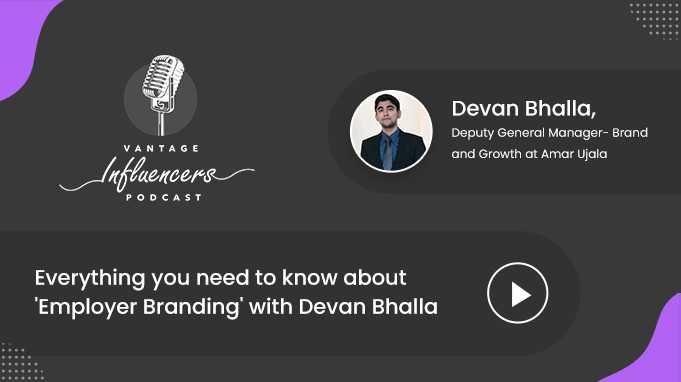
Everything you need to know about 'Employer Branding' with Devan Bhalla
Episode Overview
Employer branding is how job seekers, employees, and other stakeholders perceive and talk about your company as a place to work. In this episode of Vantage Influencers, host Susmita Sarma speaks with Devan Bhalla, Deputy General Manager of Brand and Growth at Amar Ujala, about what employer branding really means, the mistakes brands make, and how companies like Airbnb, Walmart, and Apple used their employer brand to respond to COVID-19 layoffs and hiring decisions.
Devan breaks the topic into practical pieces: why employer branding matters, what content to put out (and what to avoid), how to run brand identity research using a simple SWOT-style framework, how employee value proposition (EVP) ties into it, and how startups can build an employer brand without a dedicated team.
Episode Highlights
- Employer branding is built on trust: candidates trust a company's own employees three times more than the company's own marketing.
- Never confuse a company brand (customer-facing) with an employer brand (talent-facing) — the messaging and audience are different.
- Brand identity research can borrow the SWOT framework: one guiding question each for strengths, weaknesses, opportunities, and threats.
- EVP = compensation and benefits plus the intangible rewards (interesting work, culture, flexibility, growth).
- How a company treated employees during COVID-19 layoffs (Airbnb, Walmart) became a real signal candidates used to judge the employer brand.
- Startups need employer branding more than established companies, since they lack a pre-existing brand to lean on.
About the Guest
Devan Bhalla — Deputy General Manager, Brand and Growth at Amar Ujala
Devan Bhalla has experience across media, e-commerce, and ed-tech, with a core interest in brand management, social media marketing, P&L management, and product development. He is a TEDx speaker at NIT Rourkela and has spoken at CII and institutes including BITS Pilani, SRCC, Hansraj College, Goa Institute of Management, VIT, SIBM, PUMBA, and NIPER.
Connect with Devan on LinkedIn
Host
Susmita Sarma — Vantage Influencers Podcast Host
What You Will Learn
- What employer branding is, and why it matters more than most companies think
- The difference between a company brand and an employer brand
- How to run brand identity research using a SWOT-style framework
- What employee value proposition (EVP) is and why it drives hiring and retention
- How companies handled employer branding during COVID-19 layoffs and hiring
- How a startup with no dedicated brand team can start building an employer brand
Key Topics & Timestamps
| Time | Topic |
|---|---|
| 02:10 | What is employer branding, and why does it matter? |
| 04:28 | What content should companies put out for employer branding? |
| 08:09 | What should you not do for employer branding? |
| 11:42 | What does brand identity research usually consist of? |
| 16:44 | How companies responded to COVID-19 (Apple, Airbnb, Walmart) and what it did for their employer brand |
| 21:28 | How to get started with employer branding without a dedicated team |
| 24:28 | How startups can build a solid employer brand |
| 27:47 | Employee value proposition (EVP) and why it's crucial to employer branding |
| 29:50 | How employer branding can tell a company's diversity and inclusion story |
| 32:18 | Books and resources to learn more about employer branding |
Full Transcript
Read the full transcript
Susmita: Welcome to the Vantage HR Influencers Podcast. This podcast is sponsored by Vantage Circle, the leading employee benefits and engagement platform.
Susmita: "A word is worth a thousand pictures, but a brand is worth a million." That's a famous quote by Tony Hsieh. We often talk about corporate brand, which is the public face of an organization. But beyond that big-picture goal, there's another audience to consider, one that's often overlooked: your prospective and current talent, your employees. Today we'll talk about employer branding, an investment that's just as critical as any other an organization makes.
Susmita: Hello everyone, this is Susmita Sarma on the Vantage HR Influencers Podcast. Introducing our guest speaker today, Mr. Devan Bhalla, who is currently the Deputy General Manager, Brand and Growth at Amar Ujala. Welcome to the show, Devan.
Devan Bhalla: Thank you so much, Susmita.
Susmita: Before we start, please tell us a bit more about yourself and your corporate journey.
Devan Bhalla: Sure. Welcome everyone to this podcast, and good evening. I'll give a brief intro about myself. Currently I'm the DGM of Brand and Growth at Amar Ujala. I've worked with organizations across media and e-commerce, and I'm quite passionate about emerging technologies in the fields of marketing, and a bit into consumer psychology as well. On top of that, I believe communication is critical, and we'll be talking today about how employer branding is one of the ways to do that. I've also been a dedicated public speaker and I'm really passionate about speaking. Thank you so much for having me.
Susmita: Okay, let's start with the topic: everything we need to know about employer branding. At the beginning, it's important to understand what employer branding is, and how complex and important it actually is.
Devan Bhalla: Yeah. Technically, if you have to talk about employer branding, it's basically an organization's image in the minds of its employees and prospective employees, meaning job seekers. So it addresses the question: why would I want to work for this organization? Employer branding is a way of building a reputation, exactly how you're viewed by your current and prospective employees, and that's why it's so critical.
As per a well-known study, candidates are three times more likely to trust a company's own employees than the company itself giving out a message. That's why, when we talk about employer branding, the core focus should be your people, your talent.
Why should you invest in employer branding? There are basically four reasons, based on my experience. First, it drives inbound applications from candidates. Second, it makes it easier to tap into the right talent through referrals — but only if your current employees are genuinely happy working for you, which bridges the gap toward being a great place to work. Third, you attract top talent that's superior in skill and a strong fit for your company culture. And fourth, you retain your top talent, and those same employees become brand ambassadors to the outside world.
Susmita: Companies that consistently attract the best talent get one thing right: employer branding. Like any other purchasing decision — like checking reviews on Amazon — candidates today are turning to social media and websites like LinkedIn and Glassdoor to get the real scoop on companies. According to you, what type of content should we put out for employer branding?
Devan Bhalla: Everyone wants to read more about a company before they apply. So it's critical that your brand is well represented everywhere people are looking for information about you. In my view, there are three areas a brand should focus on.
First, a well-thought-out digital footprint for your own company presence — showcasing your achievements, your employees' contributions, and their stories through blogs and videos. Long-time employees talking about their career journeys works especially well here.
Second, addressing your reviews across social media and recruitment platforms — Glassdoor, LinkedIn, and others. People go through reviews and comments from former and current employees before deciding whether to interview or accept an offer, so you shouldn't just showcase workplace photos, but also your senior leaders' social presence and the employee-centric benefits and activities happening internally — things like work anniversaries, festivals, and cultural days. These build both existing employee morale and appeal to prospective candidates.
And one important note: never leave a negative review unattended. Address every query, use it as feedback, and make sure the same negative experience doesn't repeat — because the brand's reputation builds up over time either way. This applies whether you're a startup or a large company.
Susmita: So what should you not do for employer branding?
Devan Bhalla: Good question. A few things you should definitely avoid. First, don't reduce yourself from a brand to a generic product — don't become like everyone else in the market. Have your own signature tone and style of messaging, including video content, and always answer the question: why would a candidate work for my firm rather than the one next door? If you're a startup competing for the same computer scientist that a company like Adobe wants, you have to constantly think about how to stand out and make your employer brand authentic, and actually practice it.
Second, a company brand should never be confused with an employer brand. A company brand is what a customer engages with through your product — they approach you with a completely different mindset than a job seeker does. A job seeker is looking for a challenging career and long-term opportunity; a customer is looking for a solution to a need. The messaging for each has to be different and should never be mixed up.
Third — and this is the most important — never downplay your current employees. Always showcase them as your brand ambassadors, because they're the proof that your employer brand exists, is alive, and is growing. Showcase their career journeys. For example, if I'm an associate product manager considering a move, I'd want to see how a CTO at that company grew in their career, what skills they picked up, what training programs exist — these are the things everyone looks at when evaluating whether an organization will help them reach their next career goal. Many brands miss this, which is exactly why showcasing employees as brand ambassadors is so critical — because that's the real story.
Susmita: That was really insightful, Devan. So what are your views on brand identity research, and what does it usually consist of?
Devan Bhalla: I'll answer this based on my experience engaging with HR teams at different companies. In my opinion, brand identity is a must for every organization — but before you can establish it, you need to know what to work on, and that's where research comes in. In other words, it's a way of showing how you're positioned relative to others in the market — your competitive edge. Before jumping straight into branding, you need to understand how your brand is currently perceived by customers, competitors, and employees.
One effective way to do this is a SWOT-style framework, with one guiding question for each pillar. This helps figure out where your brand stands today and how to move it toward where you want it to be, for both internal stakeholders (your employees, your management) and external ones (customers, job seekers, suppliers).
Strengths — Does your business have a unique story or mission? What do you have that nobody else has, and how have you thrived on it? That's something you can lean on across employer branding, brand management, marketing, and campaigns.
Weaknesses — What aspects of your brand are perceived poorly? For example, a major tech firm might currently be under fire for how it treats sales employees or handles flexible working hours — something everyone is questioning. Identifying what isn't working, largely through feedback, is key here.
Opportunities — Can your brand authentically align with a popular cause? During COVID-19, for instance, how were employee-centric activities affected, and how could a brand respond meaningfully — through job security measures or bonuses for employees on the front line?
Threats — Are there current events that could cast any part of your brand in a negative light? Again, COVID is the clearest real-time example. Some companies handled layoffs and furloughs poorly; others, like Airbnb, handled downsizing in a deeply personal, well-communicated way that actually strengthened their employer brand with the very employees who were let go.
The point of this research is to ensure your brand consistently carries a single, coherent tone across visuals and language, and that it resonates with every stakeholder group.
Susmita: That connects to my next question. Early in the COVID-19 pandemic, Apple gave unlimited sick leave to retail employees and their families for coronavirus-like symptoms, and moved other teams to flexible work arrangements. That created a sense of belonging and set Apple apart as an employer. How do you view the way companies responded to COVID-19 in terms of employer branding?
Devan Bhalla: This is closely tied to what we just discussed. During COVID, everyone was sailing in the same storm, given the uncertainty, and searching for a new normal since everything moved virtual and interpersonal connection was gone. That put every brand's employee value proposition to the test, right when it mattered most.
There were a lot of layoffs during this period, which left a bitter aftertaste in many cases. But even in that situation, a company like Airbnb stood out. They downsized close to 25% of their workforce due to the pandemic, but the way it was handled had real integrity — it wasn't a quick phone call or a Skype message saying "we have to let you go." The CEO was transparent about the move, laid out the reasoning clearly, explained that it wasn't about the people being let go but about eliminated positions, and did it in a very deliberate, step-by-step way, with real support extended to affected employees. It was personal and full of empathy, and it spoke volumes about the culture Airbnb had built internally. That's a powerful employer brand, the kind people would vouch for.
Walmart was at the other end of the spectrum — they weren't downsizing, they were actually hiring additional resources during this time given increased demand. If you look at their India-origin CEO's messaging, it was consistently full of positivity, empathy, and focus, with special bonuses announced for frontline store employees. As a senior leader, he became a cheerleader for his workforce, and that builds employer brand too. Indian brands like Asian Paints made similarly rare moves, offering bonuses during this period.
The reason these examples work is that they share four key elements: being transparent, showing empathy for employees, demonstrating and actually walking the talk from senior leadership, and being a genuinely people-first organization with the right communication. Because right now, job seekers' first question about any brand is: how did you treat your employees during COVID? Did you throw them under the bus, or were you there with them?
Susmita: Considering everything — the pandemic and the general case for employer branding — once a company is ready to get serious about this but can't hire a dedicated team for it, how do they get started?
Devan Bhalla: This is something anyone on the team can actually take up, because it comes down to a fundamental marketing question: where is your audience? A potential employee typically finds you in one of two ways — the careers section of your website, or recruitment portals. On both, you should be doing a rich showcase, informed by checking in with current employees about what would genuinely appeal to a prospective hire. Is it something personal? An office culture with visibly happy people? These things trigger something psychological in a candidate evaluating whether this is a good place to work.
Addressing your reviews is equally make-or-break. As a brand, you should have full confidence in your employees, encourage them to post honest reviews, and if there's a negative one, connect with HR to address it directly rather than ignoring it. Usually, HR manages the digital handles for recruitment. If it's a startup, you need to talk more about company culture and legacy, because the same talent you're competing for might otherwise go to a Google or a Facebook. Talk about the flexible culture, the flatter hierarchy, the faster growth, the cross-functional exposure — you won't just be a product manager, you'll build something, launch it, and market it too. Those are the kinds of things worth showcasing on your careers page and recruitment portals.
Susmita: Since you're talking about startups — research says 23% of startups fail due to an inadequate team, so recruiting the right people matters enormously. Employer branding may not be top of mind when you're running and growing a startup, but it can heavily influence the kind of talent you bring in. How can a startup build a solid employer brand?
Devan Bhalla: I believe a great team makes a great organization, and vice versa. Startups actually need employer branding more than established organizations, because they aren't a recognized brand yet and have to work harder to attract quality talent. There are three easier ways for a startup to do this.
First, get clarity on what needs to be communicated — the startup's values and mission — so you can find the right fit for the role you're hiring for. Second, showcase the company culture: what a day in the life of a product manager or brand manager actually looks like there, which paints a real picture for a prospective hire making a quick decision, and also brings dynamism to the culture itself. Third, build visibility and credibility — you could send out a periodic newsletter or email celebrating milestones (say, hitting 10,000 downloads on the app store), which builds the sense that "these people know what they're doing, and I want to contribute to that." Video also plays a big role here: a short clip of a current employee describing their experience eases a lot of the uncertainty a job seeker feels before making a decision. And a blog section helps too — I built one from scratch for a multi-million-dollar organization, working closely with the HR team, and it worked out really well for their employer branding.
Susmita: Let's talk about employee value proposition. We know the basics — it's the "people deal" that exists between an organization, its employees, and the talent it wants to recruit. What makes EVP so crucial to employer branding efforts?
Devan Bhalla: EVP, or employee value proposition, is essentially a magnet — the total value an employer provides in exchange for work. It's not just about money. If I put it as an equation: EVP equals compensation and benefits, plus the function of intangible rewards — interesting work, company culture, flexible working, and so on. There's an interesting stat from a leading resource: 44% of candidates are looking for interesting, challenging work and career advancement opportunities, which is nearly as important as the monetary aspect.
Beyond compensation and benefits, EVP is the ultimate answer to a candidate's question: what's in it for me? It should be much more than just the paycheck — growth environment, benefits, career growth, all of it matters. If you're looking to hire good people, EVP is the first thing that needs to be showcased consistently across every platform and format: blogs, videos, and everywhere else.
Susmita: Last question. Companies like Johnson & Johnson and Microsoft are committed to making diversity and inclusion part of their employer branding, to acquire and retain great talent. Employer branding can help tell your D&I story. What are your views on that?
Devan Bhalla: This has been one of the major things brands have been talking about lately. Diversity is a recognition of people across backgrounds, religion, gender, and preferences, valuing them for who they are as individuals. Inclusion is built on top of that — the provision of equal opportunity for everyone, regardless of where they come from. Companies like J&J and Microsoft have been championing this for a while, and as per Glassdoor research, 78% of job seekers actually want their employers to be inclusive and provide equal opportunity for all.
D&I is one of the strongest ways a brand can tell a story like no other — through official channels, championing a cause, supporting a marginalized community, or holding periodic meetups across backgrounds and religions. The bigger question is why this matters: for employer branding, it addresses three key areas — it makes the brand more attractive to applicants, it helps forge stronger relationships with customers from those same backgrounds, and having a clear D&I plan in place generates a sense of transparency that builds trust in your brand.
Susmita: Any books or resources you'd recommend to learn more about employer branding?
Devan Bhalla: One of my favorites, which I've quoted in a lot of interviews, is Positioning by Al Ries. It talks about one of the key aspects of brand management: what unique position you want your brand to occupy in your prospect's or consumer's mind. For employer branding, that "prospect" is the job seeker — and if we can recreate the same magic there, it addresses most of an organization's talent acquisition and retention problem, because it speaks directly to mindset. Marketing is essentially an evolution of psychology, and branding is a subset of marketing.
Susmita: Lastly, tell us the best way our listeners can reach out to you.
Devan Bhalla: They can reach out to me on LinkedIn and Instagram — my handle is Devan Bhalla on both platforms.
Susmita: That was a really insightful and great conversation with you. We hope to have you back again. Thanks for joining us.
Devan Bhalla: Thank you so much for having me, I had a nice time. Thank you.
Susmita: Thanks for listening to the Vantage HR Influencers Podcast. Please subscribe on Apple Podcasts and Spotify for new episodes.
Resources Mentioned
- Positioning: The Battle for Your Mind by Al Ries and Jack Trout
FAQ
What is employer branding?
Employer branding is how job seekers, employees, and other stakeholders perceive and talk about a company as a place to work. It's the reputation an organization builds among its current and prospective talent, distinct from its consumer-facing company brand.
How is employer branding different from company branding?
A company brand is what customers engage with through a product or service. An employer brand is what job seekers and employees engage with as a workplace. The two require different messaging: customers look for solutions to a need, while job seekers look for career growth and opportunity.
What is employee value proposition (EVP), and how does it relate to employer branding?
EVP is the total value an employer offers in exchange for work: compensation and benefits, plus intangible rewards like interesting work, culture, and flexibility. It's a core input into employer branding because it answers a candidate's central question — what's in it for me?
How can a startup build an employer brand without a dedicated team?
A startup can build an employer brand by getting clarity on its mission and values, showcasing its actual day-to-day culture, and building visibility through newsletters, employee video testimonials, and a company blog — all without needing a dedicated employer branding hire.
How does diversity and inclusion connect to employer branding?
D&I strengthens employer branding by making a company more attractive to applicants, building stronger relationships with customers from diverse backgrounds, and creating a sense of transparency and trust, since candidates increasingly expect employers to provide equal opportunity for everyone.
Related Reading
- Becoming An Employer Of Choice
- How to Craft an Effective Employee Value Proposition
- Diversity and Inclusion in the Workplace: A Complete Guide
This episode is part of the Vantage Influencers Podcast, where we bring HR thought leaders to discuss engagement, compensation, benefits, and everything related to HR.
Also listen on