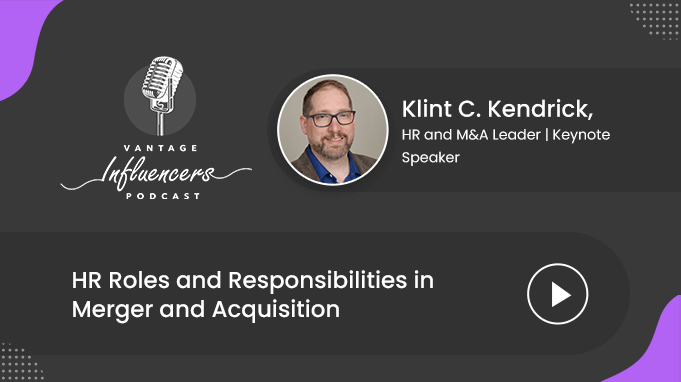
HR Roles and Responsibilities in Merger and Acquisition
Episode Overview
Mergers and acquisitions get framed as a finance and strategy problem, but the outcome usually comes down to how people are treated. In this episode of Vantage Influencers, host Susmita Sarma speaks with Klint C. Kendrick, chairperson of the HR M&A Roundtable, about what HR should actually own during a merger: due diligence, layoffs, re-onboarding, and communication under real uncertainty.
Klint draws on personal experience, he's been acquired three times in his own career, to make the case that culture and people leadership aren't a soft afterthought in M&A, they're a leading cause of deal failure. He walks through what respectful layoffs look like in practice, how to re-onboard employees who never applied for their new company, and why "overcommunication" during a merger is nearly impossible.
Episode Highlights
- HR should be involved from the very beginning of an M&A deal, starting at due diligence, not brought in after the deal is signed.
- Respect during layoffs isn't just an ethical issue, it's a retention issue. Klint describes a deal where mishandling layoffs of one group led to significant turnover in the group they'd actually acquired the company to keep.
- Acquired employees need a different onboarding path: a structured induction plus a buddy program, since they don't have the informal knowledge new hires build up over time.
- It's nearly impossible to overcommunicate during a merger. Messages should come through multiple channels and trusted messengers, especially direct managers.
- COVID pushed M&A due diligence and onboarding onto video, welcome boxes, virtual office hours, and some of it is likely to stick even after the pandemic.
- A 30% of failed M&A deals fail specifically due to cultural incompatibility between the two organizations (EY research), which is shifting the field toward a people-centric approach.
About the Guest
Klint C. Kendrick — Chairperson, HR M&A Roundtable
Klint C. Kendrick is a results-oriented HR professional with 15+ years of experience leading growth initiatives across manufacturing, aerospace and defense, media, and IT. He's recognized as an authority on people, culture, and leadership issues in M&A, and has presented at events sponsored by Thomson Reuters, Bloomberg BNA, McKinsey, Mercer, Willis Towers Watson, and Chicago Booth. He currently chairs the HR M&A Roundtable, a peer-learning forum for M&A professionals focused on managing people, culture, and leadership through mergers and acquisitions.
Connect with Klint on LinkedIn
Host
Susmita Sarma — Vantage Influencers Podcast Host
What You Will Learn
- Why HR needs a seat at the table from due diligence onward, not after the deal closes
- How to handle layoffs during M&A without damaging retention in the parts of the business you're keeping
- How to re-onboard acquired employees who didn't choose to join your company
- Why over-communicating during a merger is nearly impossible to actually overdo
- How COVID changed M&A due diligence, onboarding, and integration
- Why culture, not finance, is now one of the leading reasons M&A deals fail
Key Topics & Timestamps
| Time | Topic |
|---|---|
| 01:07 | Klint's journey in the corporate world |
| 01:43 | What kept him engaged in M&A specifically |
| 02:38 | About the HR M&A Roundtable |
| 03:27 | HR's roles and responsibilities in a merger or acquisition |
| 05:03 | Layoffs during M&A, and how to handle them with respect |
| 07:32 | Building employee experience after a merger or acquisition |
| 13:09 | COVID-19's effects on M&A activity |
| 15:30 | Klint's closing thoughts on the complexity of M&A |
| 18:05 | Latest trends in the M&A field |
Full Transcript
Read the full transcript
Susmita: Welcome to the Vantage HR Influencers Podcast. This podcast is sponsored by Vantage Circle, the simple and AI-powered rewards and recognition platform for employee engagement.
Susmita: Hi, I'm Susmita, and I welcome you to this episode of the Vantage HR Influencers Podcast. In this episode, we'll discuss HR's role, especially in dealing with any crisis or conflict that may arise in an organization when a merger and acquisition process sets in. For that, I'm so glad to welcome our guest speaker today, Klint C. Kendrick. Klint is the chairperson at the HR M&A Roundtable, a peer-learning forum for M&A professionals with experience managing people, culture, and leadership issues in mergers and acquisitions. Welcome to the show, Klint.
Klint C. Kendrick: Thank you for having me.
Susmita: Welcome once again, and thanks a lot for joining me on today's podcast. Klint, before we get into today's topic, HR's role in mergers and acquisitions, tell us a bit about your journey in the corporate world.
Klint C. Kendrick: Certainly. I've been an HR practitioner for over two decades now, starting out in talent acquisition, then spending time as an HR business partner, then in diversity and inclusion, and ultimately working my way into the mergers and acquisitions world. So I've done a bit of a lot of different things in HR, and that's one of the things I love about M&A: I get to use all the skills I've built across my career in a very specific, fast-paced way.
Susmita: What kept you engaged in this particular area, organizational mergers and acquisitions?
Klint C. Kendrick: Sure, a couple of things. First, I was an acquired employee myself, I've actually been acquired three times in my career. One of those times, I left the organization because they'd changed my compensation so significantly that I was going to struggle to take care of my family under the new structure. When I walked away, I took a fairly significant book of business with me. I've kept that lesson in mind ever since, because I certainly didn't win as an employee in that situation, and the company that did the acquiring didn't win either. It really got me thinking about how we treat employees when we do M&A activity, and that's stayed at the core of my thinking ever since.
Susmita: You're currently the chairperson at the HR M&A Roundtable. What does that involve day to day?
Klint C. Kendrick: Certainly. As chair of the HR M&A Roundtable, I bring practitioners together who are interested in how people, leadership, and culture drive M&A deal value. Alongside that, I have a day job as a director at a Fortune 500 company, so the Roundtable is a bit of a passion project for me, making sure HR people can really show up and help both employees and companies through M&A.
Susmita: So it's a learning forum for HR professionals?
Klint C. Kendrick: It is. And we're fortunate to have some business leaders join us too, because they're just as concerned about how people are managed through this process.
Susmita: When it comes to mergers and acquisitions, how should HR be involved in the process?
Klint C. Kendrick: I believe HR should be brought in right at the very beginning, unless you're literally just buying a piece of real estate or a stack of equipment, people are going to be involved. Having someone who understands people, and how people affect the business, is critical to a successful outcome.
Susmita: What are some of the major things HR should focus on during a merger or acquisition?
Klint C. Kendrick: The M&A process usually starts with due diligence, taking a close look at the company you're about to buy. An HR person can understand how the leaders have shaped the company, how the employee value proposition is communicated, and whether the workforce is actually sufficient to meet the objectives of the acquisition. Once the deal is completed and announced and you move into integration, there's a lot of change management involved, aligning things like total rewards in many cases, and supporting both employees and leaders through what's really a re-onboarding process. All of that requires real HR expertise to do well.
Susmita: Those are great points for anyone who might be facing an M&A process soon. You mentioned it results in a lot of organizational change, and it often results in layoffs, is that right?
Klint C. Kendrick: Sometimes it does. I find a lot of organizations try to avoid it, but you can end up with layoffs or headcount reductions, or sometimes people just choose to leave. So yes, those kinds of changes absolutely happen.
Susmita: When an organization does decide to reduce headcount during a merger, how can HR minimize the disruption?
Klint C. Kendrick: A lot of it comes down to basic respect for employees. I remember a situation a couple of years ago where we were acquiring a company and knew we weren't going to keep the sales force, we were only taking on a group of technical professionals. The way we handled the sales team's layoffs wasn't seen as respectful by the broader culture, they were left waiting a long time without knowing what would happen to them. What's interesting is that because we handled that layoff poorly, we ended up losing a lot of the technical people, the very reason we'd bought the company in the first place. How you treat one part of an organization during a layoff absolutely affects the rest of it. For that deal, mishandling the layoffs led to significant turnover among the technical professionals we'd actually wanted to retain.
So when layoffs are happening, it's critical to be respectful to the people leaving. There are several ways to make that easier: enhanced severance so people get a bit of a soft landing, outplacement assistance to help them look for opportunities elsewhere, or in larger organizations, actively trying to redeploy people into other roles even if we don't want them in their current one. At the end of the day, it comes down to respect for the people who won't be staying, that's just a fundamental value for me personally, and I think most business leaders understand the need for that, especially in difficult moments.
Susmita: During a merger, it's one of the most crucial times to keep the employees who are staying focused, incentivized, and productive. That's where employee experience comes in. What are the ways to build employee engagement or experience following a merger or acquisition?
Klint C. Kendrick: Absolutely, and again this comes down to basic respect and empathy for what employees are going through. There's often a tendency, right at the announcement meeting when employees learn their company has been purchased, to lead with strategy, why the deal was done. But employees sitting in that room are really asking themselves: am I still going to have a job? Can I still feed my kids? Will I still have medical care? It's important to understand where employees actually are emotionally and answer those questions before getting into strategy or large-scale change.
Susmita: So really, clearing their doubts about their own status first?
Klint C. Kendrick: Absolutely. In a lot of ways, you're re-recruiting those employees, so you want them to understand the value the organization brings to them and their careers, especially with the Great Resignation looming, a lot of employees feel they have other options, and if you don't treat them well, they'll go find something else.
Another thing: onboarding those employees needs to be handled differently than onboarding someone hired off the street. When I started at my current company, I went through a normal interview process, a normal orientation, there was a clear structure I walked into, a great group of co-workers, an administrative assistant who could help me figure out things like filing an expense report. But when you bring on a group of employees through M&A, they don't have anyone in the new organization telling them how things actually work. That's where it matters to think differently about handling a large incoming group versus a single new hire. Beyond a strong induction process, one of the best tools is a buddy program, assigning someone from the acquiring company to help new employees informally, one-on-one, so they have someone to ask questions. It's also worth leaning on basic HR tools like stay interviews, talking to employees about what they want from their careers and why they'd stick around long term. A lot of our standard HR practices just need to be turned up a notch when you're dealing with a large group of people who've all just been through a major change event in their lives and careers.
Susmita: So in short, it's HR's job to make the whole M&A process feel seamless for employees?
Klint C. Kendrick: If possible, absolutely. Sometimes there are hiccups, an employee asks a question you don't have the answer to, or the business strategy isn't fully sorted yet. In those cases, it's important to be honest and transparent: "I don't have the answer right now, but I'll update you in a couple of days." You don't want to make someone wait three, four, five, six months to hear what's happening to them. Get people answers quickly, make decisions quickly, and treat them with respect throughout.
Susmita: So effective communication is really key to solving most of these problems? Or is there such a thing as overcommunicating?
Klint C. Kendrick: I have a friend who puts this really well. We think of things like overeating or overspending as bad. She says it's almost impossible to overcommunicate, you can't really do too much of it during an M&A deal. I love that philosophy. Now, you can communicate the wrong things, or things employees don't actually care about, but it's important to send key messages through trusted messengers, the organizational leaders and, especially, the direct manager, who's usually the most trusted source of information for any employee. You want employees reached through multiple channels: a town hall, a newsletter, an email blast, a Slack channel. People have different communication preferences, so I believe in using as many of those channels as possible. If some people call that overcommunication, fine, call it that. What matters is communicating frequently, accurately, and with what employees actually need to know.
Susmita: In-person communication matters here too, I'd imagine.
Klint C. Kendrick: Absolutely.
Susmita: Has COVID affected M&A activity across workplaces, and how are M&A professionals responding?
Klint C. Kendrick: COVID has been disruptive for everyone in HR, and M&A is no exception. There was a brief pause in overall activity at the start of the pandemic, but what's really interesting is how much more activity we're seeing now, we're actually breaking records for M&A volume. Companies have been sitting on a lot of cash since the 2008 recession without deploying it, and with interest rates so low, borrowing is cheap too. So a lot of companies are on shopping sprees, looking for organizations that fit their strategy.
COVID has changed how we do the work itself. Instead of flying out for a site visit to a factory or office, we're doing a lot of that over video now, asking the selling company for a video tour, or getting on FaceTime or Zoom and walking a phone around the office. Meetings that used to be in person now happen over Zoom, and so does induction and orientation. That creates real challenges for helping employees feel like part of a new team, and we've had to get creative. Some of our HR M&A Roundtable member companies have started mailing welcome boxes or gifts directly to new employees on their first day, or running one-on-ones with new managers virtually. One classic in-person practice is office hours, sitting with employees so they can ask questions, and we're seeing that shift to virtual office hours, where employees sign up on a manager's, HR person's, or executive's calendar. A lot of creative things are happening, and I hope some of these innovations stick around even after the pandemic passes.
Susmita: You've talked about the challenges COVID has brought. Overall, M&A looks attractive from the outside, but it's actually an incredibly complex, constantly changing process. What are your final thoughts on that? And is the process harder for startups specifically?
Klint C. Kendrick: Let me take the complexity question first. It really is a complex, constantly evolving process. That's why it matters so much for people doing M&A to talk to each other, at my own company, we have a particular way of doing things that's worked for us, but as we face new challenges, we want to hear from people who've faced different ones and lean on their expertise. That peer learning, talking to other HR and business professionals about what's worked and what hasn't, is genuinely what keeps us agile and up to date in how we work with employees through M&A.
On startups: I think it can be harder for them in some ways, and easier in others. Harder because, unlike a large company that's done a lot of acquisitions and has real resources behind it, startups tend to be scrappier and haven't built the muscle for doing M&A well yet, so they're learning from scratch. But that can also be an advantage: a large organization that's done things a certain way for a long time may be less agile or less willing to change its approach than a startup that's already used to constant change as it scales, going from 10 people to 50 to 100 is a very different scale and skill set than a company of 50,000 suddenly growing to 50,100. So it can be harder for startups as they learn, but they usually have the advantage of being more flexible.
Susmita: So starting from scratch, but able to learn from what the larger companies have already figured out?
Klint C. Kendrick: Exactly, and understanding where the larger companies sometimes stumble too.
Susmita: Do you see any new trends in this field?
Klint C. Kendrick: I do. I've been doing M&A for about eight years now, and in the early days, we didn't hear much conversation about culture at all, it was talked about on the fringes. It was a very finance-driven process, the spreadsheet ruled the day, whatever made the financial business case work. Organizations would say "the financials make sense, let's do this deal, and we'll sort out the employee stuff later." What we're learning as an M&A community is just how important culture, people, and leadership really are to a deal going well, so we're seeing a real shift toward a people-centric approach to M&A. I saw a recent EY survey that found 30% of failed M&A deals fail specifically because of cultural incompatibility between the two organizations. With a failure rate like that, organizations are realizing they're investing millions of dollars in these deals and need that investment to actually pay off, so they're starting to pay real attention to culture, employee retention, and the role of leaders in making sure the company they've just bought can actually perform to expectations. That's a genuinely big shift in the landscape, and a good one for HR to be part of.
Susmita: We often talk about bringing more humanity into HR, and this seems like no exception.
Klint C. Kendrick: Absolutely not an exception. Honestly, I'm excited to see this change, reflecting back on how we started this conversation, my own experience of being treated with less respect than I deserved during an acquisition, I'm genuinely glad to see other people don't have to go through that same experience, at least not at the level I did during my first acquisition.
Susmita: Finally, Klint, how can listeners reach out to you?
Klint C. Kendrick: I'm an open networker on LinkedIn, so I'm happy to have people reach out and connect there. They can also visit our website at masteryourmerger.com, where we have resources and upcoming meetings for people who might be getting involved in M&A deals. We have regional chapters all over the world, we're actually getting a group started in India soon, plus groups in the UK and several across the United States. For anyone interested in learning more about due diligence specifically, I have a book available on Amazon that walks through the due diligence process in depth. I'd encourage folks to check it out if they want to sharpen how they work through that front end of a deal, understanding what's really going on with the target company.
Susmita: I'll put that in the show notes. Klint, this was wonderful. Thanks for your time and all the valuable insights, looking forward to connecting again.
Klint C. Kendrick: Thank you so much.
FAQ
What is HR's role in a merger or acquisition?
HR should be involved from due diligence onward: assessing how leadership shapes the target company, understanding the workforce, and later managing change, total rewards alignment, and re-onboarding employees once the deal closes and integration begins.
How should layoffs be handled during an M&A process?
With clear communication, speed, and respect. Enhanced severance, outplacement assistance, and internal redeployment all help. How one group is treated during layoffs directly affects retention in the parts of the organization you're keeping.
How should acquired employees be onboarded differently from new hires?
Acquired employees don't have the informal knowledge new hires build up naturally, so they need a stronger structured induction plus a buddy program pairing them with someone from the acquiring company, along with tools like stay interviews to understand what will keep them long-term.
Why do so many M&A deals fail?
Research from EY found that 30% of failed M&A deals fail specifically due to cultural incompatibility between the two organizations, not finance or strategy. That's pushed the M&A field toward a more people-centric approach.
Related Reading
- Employee Experience: The Complete Guide for HR Leaders (2026)
- Employee Productivity: How To Measure, Improve, and Overcome Challenges
This episode is part of the Vantage Influencers Podcast, where we bring HR thought leaders to discuss engagement, compensation, benefits, and everything related to HR.
Also listen on