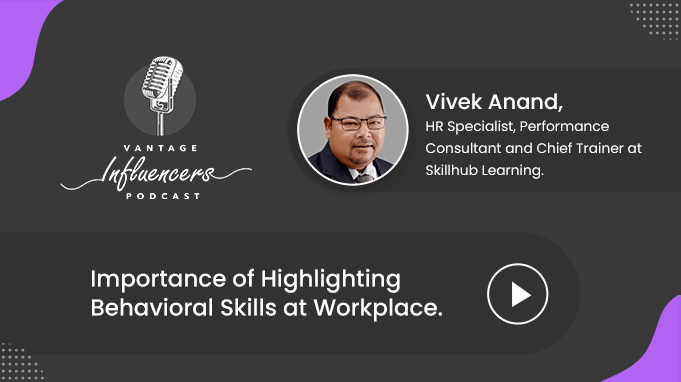
Importance Of Highlighting Behavioral Skills In The Workplace
Episode Overview
Behavioral skills shape how well an organization actually functions, but most hiring and training still centers on technical skill. In this episode of Vantage Influencers, host Susmita Sarma speaks with Vivek Anand, Performance Consultant and Chief Trainer at Skillhub Learning, about why behavior deserves equal weight to skill in hiring, what "good" and "bad" behavior really means at work, and how HR can assess and develop it, including for remote teams.
Vivek's core argument: skill and knowledge gaps can be closed quickly, but a bad behavioral fit is expensive and hard to reverse. He makes the case for hiring humans, not evaluating candidates like machines, and explains how behavioral training has to be built around what a specific organization needs, not a generic checklist.
Episode Highlights
- Behavior is a mix of inherent personality traits and learned habits — habits can be developed, but changing personality is slow and difficult.
- There's no universal "good" or "bad" behavior — only behavior that fits or doesn't fit a specific organization's culture and goals.
- Hiring decisions should weigh behavior as heavily as skill, because skill gaps are far easier to close than behavior mismatches.
- Remote work needs a specific behavioral profile: focus, independence, and ownership, not constant supervision.
- Interviews should be exploratory conversations, not interrogations aimed at catching mistakes.
- Behavioral training programs must be built around the organization's specific goals and the individual learner's actual gaps, not a generic template.
About the Guest
Vivek Anand — Performance Consultant & Chief Trainer at Skillhub Learning
Vivek Anand helps organizations build strong-performing teams through hiring strategy, competency mapping, behavioral analysis, structured interviews, learning and development, and performance management. He believes HR is one of the most important contributors to any business and is passionate about bringing a more human element into it. Before Skillhub Learning, he worked with organizations including Tata Infotech, Edutech Consulting, and Sucseed Learning.
Connect with Vivek on LinkedIn
Host
Susmita Sarma — Vantage Influencers Podcast Host
What You Will Learn
- Why behavior is partly inherent and partly learned, and what that means for training
- Why "good" and "bad" behavior should be judged by organizational fit, not a universal standard
- Why behavior should carry as much weight as skill in hiring decisions
- What behavioral traits predict success in remote work
- How to turn interviews into exploratory conversations instead of interrogations
- How to design a behavioral training program around an organization's actual goals
Key Topics & Timestamps
| Time | Topic |
|---|---|
| 00:43 | Is workplace behavior inherent, or something employees must learn and practice? |
| 05:54 | What are the top behavioral skills to develop in employees? |
| 08:45 | What actually defines "good" and "bad" behavior at work? |
| 11:18 | The top behaviors of successful HR managers |
| 14:40 | The best behavioral practices for remote work |
| 17:40 | Tools for assessing behavioral traits |
| 20:40 | How to design a customized behavioral skill training program |
| 23:35 | Suggestions for HR on building focus around behavioral skills |
Full Transcript
Read the full transcript
Susmita: Welcome to the Vantage HR Influencers Podcast. This podcast is sponsored by Vantage Circle, the leading employee benefits and engagement platform.
Susmita: Hello everyone, this is Susmita from the Vantage HR Influencers Podcast. In today's episode, we have with us HR specialist Vivek Anand, who is a Performance Consultant and Chief Trainer at Skillhub Learning. He offers training programs on strategic HRM, talent acquisition, learning and development frameworks, performance management, HR analytics, and instructional design. He believes HR is one of the most important contributors to any business, and he's very passionate about bringing a more human element into HR. Welcome to the show, Vivek.
Vivek Anand: Thank you, Susmita. It's a pleasure being with you.
Susmita: When we talk about the human element in HR, we can't ignore the importance of highlighting behavioral skills in the workplace. That's exactly the topic of discussion today. But before we start, please let us know a little more about your journey in the corporate world.
Vivek Anand: My journey in the corporate world has been nothing more than an accident. I say accident because I never planned for it, I didn't even work toward it. I was a very happy-go-lucky kind of person, just enjoying life. Then this happened: I was learning computers at one of the institutes, and the center head saw something in me. He offered me a small job as a lab instructor.
He didn't choose me because I was technically very sound, and that's where I want to bring in the behavioral angle. He saw that I had the ability to manage people, and that discipline was needed in the labs, so that's how it began. I also took it because it offered some pocket money. The whole journey started when those students began calling me "sir," and I felt more responsible. I started working with them, helping them, guiding them, and I found I loved doing it.
People say "discover your passion" — but how do you actually discover it? That gentleman identified it in me and put me on that job, and I'm indebted to him for it. From there, it went on for a few years at those institutes, training and teaching students, before my first corporate assignment at Tata Infotech, which is now TCS. They had their own computer education center, and I was chosen to be academic head there.
That's how the journey began, a journey I never planned, a happy accident, because the right behaviors and skills were identified and I kept honing them. From teaching, to academics, to management, to HR and learning — it's all been part of the flow. I kept raising my milestones, and my last corporate assignment was with Tata, where I was part of a team developing HR frameworks, handling the complete skill framework for them. It was never planned, but when the right behaviors are identified early and you're put on the right job, and you do what you love, growth is just a matter of time. That, in short, is my corporate journey.
Susmita: That's very good to know. So coming to the topic: when we talk about workplace behavioral skills, is that something that comes naturally as part of being good or smart, or is it something employees must learn and practice in the workplace?
Vivek Anand: It's a mix of both. Each individual has their own personality and their own traits, and then there are habits. Personality and traits are inherent, they come naturally to you. Habits are formed over time and are highly influenced by your surroundings. As an employee in an organization, you have both factors, and you need to work on both. Habits can be developed, but changing a personality, or bringing about a real change in behavior, is a very difficult and time-consuming task. So if the question is whether behavior is inherent or can be developed, it's a mix: there are inherent abilities you have to put to the right use, and there are good habits that can be developed.
Susmita: So what are the top behavioral skills to develop within employees? What are your views?
Vivek Anand: I'll caveat this: it's also a result of your specific organization, we can't be too generalized when it comes to behavior and habits. Behaviors need to suit the organization's value system. But some generic ones I'd point to: employees should be given decision-making opportunities and the freedom to work, so they can be innovative, bring value, and own their decisions. Openness to learning matters a lot too, especially now, when business models and technologies keep changing. People who aren't adaptive to learning will keep resisting change, while the good ones treat it as a challenge and move forward. Collaboration is another one: how well people work together as a team. Beyond that, the right behaviors really depend on the organization, the role, the kind of work environment, and what brand the organization is trying to build. Your end goal determines what behaviors are good for it. But broadly: if employees have the freedom to work, take and own decisions, are open to learning, collaborate well, and are allowed to fail (because that's how people learn), that's a strong foundation.
Susmita: When we talk about employee behavior, it's not just what a person does or doesn't do, but the overall impact their behavior has on the team's mission and effectiveness. What would be your definition of "good behavior" and "bad behavior"?
Vivek Anand: Individual behavior absolutely has a huge impact on team performance and morale. But labeling it "good" or "bad" is difficult for me — it's more that a behavior is either a fit or it isn't. This is personal to what the organization is trying to build. Any behavior aligned with the culture the organization is developing can be treated as good; if it isn't a fit, that doesn't make it "bad," it might be a great fit somewhere else, in a different environment. So for me it's about what's best suited to a specific context, not a generic top-five or top-ten list of behaviors. Your business is unique, so identify what behaviors are best suited to your vision, mission, and value system first, then choose accordingly. It's not about eligibility versus badness, it's about fit. A technology organization can't take a commerce graduate for a technical role, that doesn't mean the commerce graduate is bad, they're just better suited to a different environment.
Susmita: HR managers should have a strong foundation in organizational behavior and know the mix to be effective in their roles. Would you highlight some of the top behaviors for successful HR managers?
Vivek Anand: It's very important for an HR manager to understand organizational behavior, and specifically the organizational behavior their own organization requires, not a generic one. That understanding is what helps them know what behavior will suit the organization and what won't. Behavior should be a large factor in every hiring decision, not just skills and knowledge, because knowledge and skill can be developed easily, but hiring a behavior that doesn't fit your environment can cost you that person, the time invested in hiring them, and their impact on team performance.
As an HR manager, the most important trait is being human: having a human approach to every action, a lot of empathy, and an open mindset, being receptive to different ideas rather than working with a fixed mindset. Take interviews as an example: most interviews today are treated as pure evaluation, when an interview should really be a process of exploring the candidate, not digging for faults. That openness to explore is what makes an HR manager effective, along with good listening skills and a sense of ownership. What makes us different from machines is that we're human. A lot of technology has crept into how we work, and one mistake is trying to mimic it. Technology is there to support us, let's remain human and hire humans, not people who work like machines. Those emotions and behaviors are exactly what set us apart, technology can handle everything else.
Susmita: A new remote work arrangement takes a person with a particular set of skills and behaviors. What are the best behavioral practices for remote work?
Vivek Anand: This has genuinely been a big concern, especially for small and medium businesses. A lot of them came to us saying: now that the bulk of our people are working from home, how do we manage them, monitor their output, see their work, engage with them? Our guidance starts with a question: why do you want to monitor them at all? The foundation should be trust. Yes, there are exceptions and you can't trust everyone blindly, but you need to identify the behaviors that let you trust people to do the job.
The candidates to look for are people who are focused, have firm goals, and know what to do to reach them, people with an independent style of work who don't need hand-holding every minute. Someone who needs constant guidance will struggle badly in a work-from-home setup. You need people who are adaptive, because there are plenty of distractions at home, and the person has to be able to adapt to that environment, stay confident, and take ownership. When you trust them, keep them focused, assign the task with clear deadlines, and then leave them to it, you get better results. Not everyone is a good fit for remote work, and if you don't choose carefully, you end up wasting all your energy on monitoring instead. Choose the right people, assign the task, give them space, and they'll deliver.
Susmita: Are there any tools or metrics that can help HR assess employee behaviors to build a successful, productive remote worker?
Vivek Anand: Yes, there are psychometric tools that help evaluate behavioral aspects, personality traits, and driving forces. But the best way to judge behavior is still through conversation, which is why, as I said earlier, we need to change the tone of our interviews. A lot of interviews today are really interrogation sessions: you're just trying to verify something, and while you listen to the answers you're holding a magnifying glass looking for mistakes. We need to change that. An interview is a process for exploring potential, treat the candidate as human, converse with them, understand them rather than judge them, and the real behaviors will surface. You still need the ability to identify the right behaviors in that conversation. Tools exist, but they're fairly generic: you shouldn't expect a black-and-white answer from a personality assessment report, you still have to interpret it correctly. So yes, use tools, but interviews remain the best method, alongside things like assessment centers, task-based exercises, group discussions, and role plays. Depending on the seniority and criticality of the role, you can combine multiple methods, because getting the behavior right is one of the most critical parts of any hiring decision. As I said, a knowledge or skill gap doesn't matter much, you can close that with time. But if the behavior isn't right, you don't just lose that person, they can also negatively influence the environment around them.
Susmita: You're deeply into behavioral skill training, and that has to be highly customized for employees to actually adopt it. What factors do you keep in mind when framing a program? How do you plan an employee behavioral skill training program?
Vivek Anand: It's very specific. The first factor is the organization: what are its goals, vision, and value system? What's the work culture, the environment we're developing or have already built? That's the focal point, because once we understand that, we know what behaviors this individual actually needs. Then we evaluate where the individual currently stands, and try to bridge the two. All of this training is very customized: we start with the organization as the benchmark and the goal, then assess the individual and identify the gap, then build a program to close it, whether that's a small behavioral shift or a major change. The critical thing throughout is avoiding assumptions.
If you ask who the real "hero" of a training program is, for me it's the learner, because it's their need. They're lacking something, or want to reach a point they're not at yet, and the program should get them there. So the two focal points are the organization, which tells us what skills and behaviors are needed, and the learner, who's the actual hero of the program. You identify the gap between what the organization needs and what the individual currently has, figure out how to build and integrate those behaviors, and then execute the program.
Susmita: Any suggestions for HR on how they can focus on behavioral skills at the workplace?
Vivek Anand: Very simply: hire human, treat them as human, and develop their behavioral skills. The mistake we often make is trying to turn people into machines, expecting tasks completed fast and on time above everything else. Let's treat them as human. The best thing people can do that machines can't is feel and take a decision. So hire humans, not a stereotype of someone who just "knows how to do things." Before you hire, understand what your organization actually needs, then assess whether the candidate is a fit, and make the decision from there. And as I said, don't interrogate, explore, try to genuinely understand the candidate and whether they have the behaviors that best suit what the organization needs. So the one piece of advice: hire human, treat them as human, and help them develop their own potential.
Susmita: Lastly, how can our listeners reach out to you?
Vivek Anand: I'm available almost around the clock. They can reach me on LinkedIn, or write to me through my website.
Susmita: We'll share that in the show notes. That was a really interesting conversation, Vivek. Thank you for all your insights, and thank you so much for joining me.
Vivek Anand: Thanks a lot, Susmita. I hope I was able to live up to it, because when you first approached me for this, I said yes immediately, since I saw one of my own role models had been on this podcast before, Harjeet Khanduja. I felt honored to be on a platform where my role models have been featured.
Susmita: I'm glad we could meet your expectations, and I hope this helps others too.
Vivek Anand: Yes. Thank you so much, Susmita. Thanks a lot.
FAQ
Is behavior at work something people are born with, or can it be developed?
It's a mix of both. Personality and traits are inherent and come naturally, while habits form over time and are shaped by environment. Habits can be developed with the right guidance, but changing core personality is slow and difficult.
What makes a behavior "good" or "bad" at work?
There's no universal standard. A behavior is either a fit or not a fit for a specific organization's culture, vision, and values. A behavior that doesn't suit one organization isn't inherently bad, it may be well suited elsewhere.
Why should behavior matter as much as skill in hiring?
Because skill and knowledge gaps can be closed relatively quickly through training, but hiring someone whose behavior doesn't fit the organization is costly: you can lose the person, the time invested in hiring them, and see a negative impact on team performance.
What behavioral traits make someone successful working remotely?
Focus, clear goals, an independent working style, adaptability, confidence, and a sense of ownership. People who need constant supervision or guidance tend to struggle in remote settings.
How should HR assess a candidate's behavior in an interview?
Treat the interview as an exploratory conversation, not an interrogation. Psychometric tools can help evaluate personality traits, but genuine conversation, understanding rather than judging the candidate, remains the most reliable way to surface real behavior.
Related Reading
- Top 7 Employee Behaviors That Are Worthy Of Recognition
- Recognition That Drives Business Performance: Aligning Employee Behavior with Organizational Goals
This episode is part of the Vantage Influencers Podcast, where we bring HR thought leaders to discuss engagement, compensation, benefits, and everything related to HR.
Also listen on