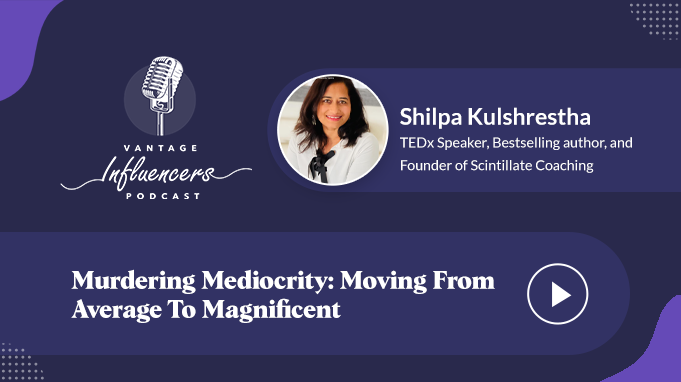
Murdering Mediocrity: How To Move From Mediocre to Magnificent
Episode Overview
75% of us slide into mediocrity without ever noticing it, still believing the fire that got us started is intact, when it quietly isn't. In this episode of Vantage Influencers, host Susmita Sarma speaks with Shilpa Kulshrestha, TEDx speaker, bestselling author of Play It Full, and founder of Scintillate Coaching, about how high achievers drift into "average," why HR professionals are especially prone to it, and what it actually takes to reverse course.
Shilpa draws directly on her own story: two decades of corporate success, three professional degrees, a reputation for having the "Midas touch," and then a quiet decline into underperformance that ended when her employer asked her to leave in 2018. That turning point became the foundation for her "Murdering Mediocrity" philosophy.
Episode Highlights
- Mediocrity isn't failure, it's comfort. Shilpa describes staying "busy" for years while adding no real value, mistaking activity for achievement.
- Mediocrity affects men and women almost equally, just in different forms, driven by different social conditioning around career versus family priorities.
- HR is especially vulnerable to mediocrity because it's often treated as a support function, making it easy to hide behind "process" instead of genuinely helping people.
- Comfort compounds mediocrity: a stable paycheck, a good lifestyle, and safety make it easy to stop asking yourself hard questions about performance.
- The people who break out of mediocrity in HR are the ones who challenge the process instead of hiding behind it, and become the "go-to person" others rely on.
- Her core advice: stop giving up on ideas just because "it's never been done before" in your organization.
About the Guest
Shilpa Kulshrestha — Founder, Scintillate Coaching
Shilpa Kulshrestha spent over two decades in corporate roles before realizing that life is meant to be enjoyed, not endured. After being let go from her corporate role in 2018 for underperformance, following years of quietly coasting despite her earlier reputation for a "Midas touch," she built the "Murdering Mediocrity" philosophy and founded Scintillate Coaching with her husband, Kapil Kulshrestha. Scintillate works with mid-career professionals, typically 12 to 20 years in, helping them move into new roles, promotions, and higher compensation within months rather than years. She is a multi-award-winning career coach, TEDx speaker, and bestselling author of Play It Full.
Connect with Shilpa on LinkedIn
Host
Susmita Sarma — Vantage Influencers Podcast Host
What You Will Learn
- How high achievers quietly slide into mediocrity without realizing it
- Why mediocrity affects men and women in different but equally real ways
- What specifically breeds mediocrity among HR professionals
- How to move from being a process-follower to becoming the "go-to person" in HR
- Practical advice for catching mediocrity in yourself before it costs you your role
Key Topics & Timestamps
| Time | Topic |
|---|---|
| 01:35 | Shilpa's journey in the corporate world |
| 06:30 | What mediocrity actually means |
| 11:15 | What makes us mediocre in the first place |
| 11:25 | What breeds mediocrity specifically among HR professionals |
| 15:37 | How to move from mediocrity to magnificence |
| 17:33 | Shilpa's advice for HR professionals |
| 19:27 | Resources to learn more |
Full Transcript
Read the full transcript
Susmita: Welcome to the Vantage HR Influencers Podcast. This podcast is sponsored by Vantage Circle, the simple and AI-powered rewards and recognition platform for employee engagement.
Susmita: When you're stuck in life and all you want to do is get out of the atmosphere you're living in, because it's not giving you enough space to do something significant, you know you're being mediocre and settling for "adequate." In fact, 75% of us fall into mediocrity without even realizing it. We keep believing we still have the fire that got us started, but the truth is rather different. And then some people ask, what's wrong with being mediocre anyway? Let's break all the bubbles today with this podcast. It'll help you question how you've been living your life, and give you some quick ways to move from a mediocre life to a magnificent one.
Susmita: Hi everyone, I'm your host, Susmita, and I have with me today Shilpa Kulshrestha, a multi-awarded, game-changing career coach, TEDx speaker, bestselling author of Play It Full, and founder of Scintillate Coaching. Welcome to the show, Shilpa.
Shilpa Kulshrestha: Thank you, Susmita. Thank you so much for having me today on this episode of the Vantage Influencers Podcast.
Susmita: Before we get into mediocrity for HR professionals specifically, could you give us a brief on yourself and your journey in the corporate world?
Shilpa Kulshrestha: Sure, Susmita. If I talk about my journey, I started off with, well, a host of degrees: a CPA, a law degree, and an MBA. Everything society tells you that you need to be successful, I had it all packaged up and thought, I'm set for life. And it started really well. Early in my career at a startup, I became known for having a Midas touch, anything I touched, any client, any project, any delivery, turned to gold, that's what people said, and I loved it, who wouldn't? My journey continued, and about a decade in, I don't know exactly how or when it happened, but I started giving my bare minimum. I became part of the "average game." And even though I was part of that average game, I stayed in the illusion that I was still that school topper, that national-level ranker, the one with multiple professional degrees, the ego that stops you from getting to the root of the problem. So I kept going with that illusion, and I kept underperforming.
Then one day in 2018, my company asked me to leave. They'd had enough of my mediocre performance, and that was the turning point in my life, the lowest point. It's like you're a high achiever and suddenly you fall out of the sky, your whole self-image breaks. At that point, the easiest thing would have been to take my severance, I'd worked in corporate for 16 years, the last nine of them at Westpac, and just go join another company, which is very common, especially in Western countries. But the harder path was actually understanding what had happened to me. Where did I slip? Where did I go from high achiever to mediocre performer? That started my war with mediocrity. I started traveling the world, learning from world-class coaches, learning to ask myself uncomfortable questions. As the missing pieces started coming together, I started seeing a very different Shilpa, someone I'd genuinely never met before. And that's where the vision for "Murdering Mediocrity" started, because it had genuinely been the pain, the numbness, of my life. I wasn't failing, so because I wasn't failing, I assumed I was achieving. That wasn't actually true. So that's where I started working with people, helping them ask themselves honestly: are you doing great work, or are you being mediocre? And that's what brings me here today.
Susmita: You're also the founder of Scintillate Coaching. What is that all about?
Shilpa Kulshrestha: Scintillate is a company I run with my husband, Kapil Kulshrestha. We work with people who are mid-career, roughly 12 to 20 years in, who have achieved genuinely impressive things in the past but, at this point, aren't loving what they do anymore. It's become routine, it's become easy, they're on a hamster wheel, or they're putting in real effort but the returns just aren't proportionate anymore. They're not enjoying it, and they feel stuck. Scintillate helps people figure out what they actually want to create next in their life or career, sometimes that's a promotion. We've had people stuck in the same position for as long as nine years, senior directors trying to reach VP, people across different roles who are stuck somewhere or want a new job but are struggling to get there. We help people get promoted or land jobs in as little as three to four months, double their salaries, in some cases people have moved up four levels in just sixteen months. It really helps people create the next big thing in their life.
Susmita: Brilliant, Shilpa. Before we go further, would you define mediocrity for us? What do you actually mean by it?
Shilpa Kulshrestha: Great question. I didn't even know this term until 2018, it wasn't in my vocabulary. It was only when I realized I'd somehow become part of the "average game" myself. What happens is, when we start our careers, there's a lot of enthusiasm, a lot of fire in the belly, and for a few years we genuinely do well. But then life's other priorities show up. It happens to both men and women, but in my case specifically, you get married, you have kids, you move cities, maybe countries, and somewhere in that process, a real conflict emerges between family and career. I kept putting my career in the backseat, again and again, and didn't realize it had quietly become a nine-to-five where I was doing exactly what was expected, being a diligent worker, not wasting time, but also not doing anything beyond what was required. That's what pulls you into the average game, something a lot of us experience, because a lot of us pick careers we never really thought deeply about, engineering, chartered accountancy, medicine, whatever it was, simply because that's "the way of the world." At some point you realize you don't love it anymore, or it's become boring, and that keeps you from working up to your real potential. You feel it, you have the thought, but you keep shoving it aside instead of actually asking yourself: am I really working up to what I'm capable of? When that question goes unanswered long enough, that's mediocrity.
Susmita: Does this affect working women more, given the balancing act between work, life, and marriage that you described in your own story?
Shilpa Kulshrestha: That's such an excellent question, Susmita, genuinely no one's ever asked me that before. It affects men and women equally, just in different forms. For women, a lot of it comes from childhood conditioning, from our mothers, grandparents, the stories we grew up on, about what's supposed to be your priority and what isn't, from a very young age. Women also tend to wear multiple hats at once, which compounds it. But men are affected just as much, you'd be surprised. Men have often been conditioned to see themselves as the primary breadwinner, so their focus becomes making a living, paying the bills, keeping things moving, and they've been so busy with that they've never actually stopped to ask if they could take a break. I remember in 2018, my husband resigned from his job as a director at Cognizant because he simply wasn't enjoying it anymore. My own mother asked him, "why would you do that, how will you pay the bills?" He said, "she'll pay the bills, that's fine," and it was genuinely hard for my mother to accept that he wanted to take time to figure out his passion. It worked out amazingly for him, but very few men actually get to do that, and it can be hard to fit back in afterward. So no, I wouldn't say it's more common in working women specifically, it hits both, just in different shapes and different phases of life. About half my clients are men, half are women, in every program I run.
Susmita: What exactly causes mediocrity? Is it pressure, or something else?
Shilpa Kulshrestha: It starts with us buying into society's definition of success, picking up professions or degrees we were never actually passionate about. I don't even remember hearing the word "passion" when I was doing my CA. Over time, because those are "safe" professions, we start making good money, a big paycheck lands in your account, you get a big house, a nice car, and you get used to that lifestyle, it becomes your comfort. That comfort is the second piece: things just keep going, and we forget to ask ourselves the uncomfortable questions, am I actually performing well? Looking back on my 16 years in corporate, I was constantly busy, Susmita, I remember going to the office as usual on the very last day of my pregnancy, coming home at five, cooking dinner, and then going to the hospital and having my baby by nine that night. What I'm getting at is, I was busy the entire time, but I genuinely don't know what I was accomplishing. It was mediocre performance the whole time, wrapped in the ego of "I'm busy, I'm indispensable." And that big house, that big car, the comforts we all reach at some point, kept me firmly in my comfort zone.
Susmita: Since this podcast is all about talking to and for HR professionals, what specifically breeds mediocrity in HR?
Shilpa Kulshrestha: I actually worked in HR projects myself for about five years of my career, so I've seen this world up close. What happens with HR people is that it's very easy to get comfortable, I've seen people stay in HR at the same company for years, it becomes their home. One drawback is that HR is often seen as a support function, something that's there to slow things down rather than help, and HR professionals don't like hearing that, but it's genuinely how a lot of the rest of the organization perceives finance and HR both, as blockers rather than enablers. So it's easy to get lost in process, HR is famous for its processes, and it's easy to just say "this isn't how it works" and hide behind that instead of actually helping people. When I was in HR, there were always a handful of people who knew how to work around the process, and they're the ones who went to the top. But most people, I'd say 90%, hid behind the process because it was simply more comfortable to point at a rule and let people deal with it. It's very easy to fall into that comfort zone in HR, and only the people who think beyond it are the ones who reach that "superstar" identity.
Susmita: So what does it actually mean to be open and flexible as an HR professional, moving from mediocrity to magnificence?
Shilpa Kulshrestha: I've worked at places like Deloitte and Tech Mahindra, and my husband's worked at Cognizant and Microsoft, some of the best-known names in the industry, and everywhere, the general mindset people bring to HR is "they're going to make my life harder." That's the perception the rest of the organization walks in with. Having sat close to HR myself, moving from mediocrity to magnificence really means becoming the go-to person, the one who's always ready to challenge the process rather than hide behind it, and who goes above and beyond. I'd bet if you think about your own company, or wherever you're listening from, you can already picture one or two people in HR who are just different, who go above and beyond, who become the person the business actually turns to. There's usually one in every organization, one in every team, and you can spot them easily. If you want to visualize magnificence for yourself, that's it: become the go-to person, become the one who challenges the norm instead of just putting a process in front of people, the one who works with others to actually make things happen. That's what takes you into that extraordinary territory as an HR professional.
Susmita: Brilliant. Any advice you'd give to the HR professionals listening today?
Shilpa Kulshrestha: My biggest advice: go above and beyond. We've largely forgotten to do that in HR. Be the person who makes things happen, and give up giving up. Most of the time we quit on an idea simply because "that's never happened here before" or "there's never been a case like that," but you can absolutely be the one who does something that's never been done. So: give up giving up, that's what I'd tell people.
Susmita: One more thing, Shilpa: after how many years in corporate life do people typically start becoming mediocre? Or does it really depend on the kind of work?
Shilpa Kulshrestha: It depends on you, and how much you genuinely love your work. Speaking specifically from the HR professional's point of view, I've seen people for whom it's become pure routine: come in, work nine to five, go home, cook dinner, watch TV, spend some time with family, sleep, and get up to do it again. Make sure you don't fall into that routine, that was my biggest mistake, I wasn't creating any value. Whether it takes two years, ten years, or two decades, the moment you feel you're not adding value and you're stuck in a routine that isn't giving you any real energy, that's when you've become mediocre. And at that point, the responsibility is on you to challenge it and change how things are.
Susmita: Thank you, Shilpa. Any resource, book, podcast, or anything else you'd suggest to listeners who want to know more?
Shilpa Kulshrestha: For anyone who wants a way to keep themselves in check, please follow me on LinkedIn, just search Shilpa Kulshrestha, I'm sure there aren't too many of us. I'll also mention my TEDx talk, "Murdering Mediocrity," which gives a good sense of what mediocrity actually looks like and how it shows up in people's lives. Those are the two simplest resources to go to.
Susmita: Brilliant, Shilpa. Finally, how can listeners reach out to you if they want to know more about murdering mediocrity?
Shilpa Kulshrestha: Just send me a message on LinkedIn, I reply to every single one, or reach out by email through the details in the show notes.
Susmita: We'd love that. Thank you so much, Shilpa, for being here with me today and sharing all your insights and experience. With that, we've come to the end of today's episode, you just heard Shilpa Kulshrestha talk about murdering mediocrity. We'll be back with more episodes like this soon, until then, stay tuned to the Vantage Influencers Podcast. Thank you.
FAQ
What does "mediocrity" actually mean in a career context?
Mediocrity is quietly doing just enough to get by, staying "busy" without creating real value, while assuming that not failing means you're still succeeding. It typically develops when someone stops asking themselves hard questions about their own performance for a long stretch of time.
Does mediocrity affect men and women differently?
It affects both roughly equally, but through different social conditioning. Women often face early conditioning around competing family priorities, while men are frequently conditioned to prioritize being the primary earner, both patterns can lead to years of coasting without noticing it.
Why are HR professionals especially prone to mediocrity?
Because HR is often treated as a support function, it's easy to hide behind "process" instead of genuinely solving problems for people. HR professionals who break out of mediocrity are the ones who challenge the process and become the "go-to person" for the business.
How can someone tell if they've become mediocre at work?
A key sign is feeling like you're not adding real value and you're stuck in a routine that no longer energizes you, regardless of whether that took two years or two decades to set in. At that point, the responsibility to change it sits with you.
This episode is part of the Vantage Influencers Podcast, where we bring HR thought leaders to discuss engagement, compensation, benefits, and everything related to HR.
Also listen on