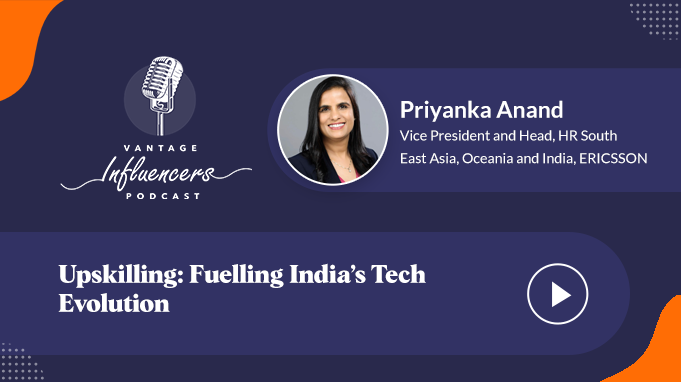
Upskilling: Fuelling India's Tech Evolution
Episode Overview
India's telecom industry alone is projected to face a 2.4 million-person skills gap by the end of 2025, and closing it is about far more than running a few training sessions. In this episode of Vantage Influencers, host Sanjeevani Saikia speaks with Priyanka Anand, Vice President and Head of HR for Southeast Asia, Oceania, and India at Ericsson, about what it actually takes to build a future-ready tech workforce.
Priyanka draws on Ericsson's own experience deploying 5G at unprecedented scale in India to make the case that upskilling only works when it's self-driven, tied to real business outcomes, and paired with soft skills like curiosity and adaptability, not treated as a checkbox technical exercise.
Episode Highlights
- India's telecom sector is projected to face a 2.4 million-person skills gap by the end of 2025, driven largely by the pace of 5G rollout.
- Real upskilling isn't about training people for their current job, it's about giving employees flexible, self-driven access to learning for roles they don't have yet.
- Hard skills and soft skills have to be built together. Technical experts who can't collaborate as a team don't move the needle for a business.
- When Ericsson brought in international 5G experts to train local teams during India's rollout, the on-the-job knowledge transfer drove both a record-breaking deployment and stronger retention.
- Priyanka's take on "AI won't replace jobs, but people who know AI will": she agrees, and argues AI mostly frees people up for more interesting work rather than eliminating it outright.
- Her advice for new graduates: stay curious, keep learning continuously, invest in interpersonal skills, and align personal goals with organizational ones, not just technical depth.
About the Guest
Priyanka Anand — Vice President and Head, HR Southeast Asia, Oceania and India at Ericsson
Since taking on the role of Vice President and Head of HR for Southeast Asia, Oceania & India at Ericsson in January 2018, Priyanka Anand has brought over two decades of HR experience to steering the organization's growth in the region. She currently leads an HR team of 60 people spread across more than 10 countries, driving HR strategy across the geography and partnering closely with business leaders on practices that drive outstanding business results.
Connect with Priyanka on LinkedIn
Host
Sanjeevani Saikia — Vantage Influencers Podcast Host
What You Will Learn
- Why India's tech industry faces a projected multi-million person skills gap, and what's driving it
- Why upskilling only works when it's self-driven and tied to real business goals, not generic training
- How to balance technical (hard) skills with soft skills like curiosity and collaboration
- How on-the-job knowledge transfer between experts and local teams can accelerate both learning and retention
- What skills recent graduates actually need to stay competitive
- How Ericsson is investing in India's broader tech ecosystem, beyond its own workforce
Key Topics & Timestamps
| Time | Topic |
|---|---|
| 01:28 | Priyanka's corporate journey so far |
| 03:20 | Demand and supply of skillsets in the Indian tech industry |
| 08:18 | How the skill gap affects ongoing industry transformation |
| 14:07 | How strategic upskilling affects employee retention |
| 18:08 | Essential skills for recent business school graduates |
| 25:16 | Ericsson's role in India's tech evolution |
| 30:32 | Closing thoughts |
Full Transcript
Read the full transcript
Sanjeevani: Welcome to the Vantage HR Influencers Podcast. This podcast is sponsored by Vantage Circle, the simple and AI-powered rewards and recognition platform for employee engagement.
Sanjeevani: India's tech industry is booming, driven by a relentless push toward innovation and growing demand for advanced digital solutions. At the heart of this growth lies the critical practice of upskilling. This isn't just about filling skill gaps, it's about empowering employees to drive the next wave of innovation, enhancing their careers, and ensuring India remains a global tech leader. Welcome to another episode of the Vantage Influencers Podcast, I'm your host Sanjeevani Saikia, and today we have with us Priyanka Anand, Vice President and Head of HR, Southeast Asia, Oceania and India at Ericsson. In this episode, we'll delve into how upskilling is fueling India's tech growth and explore the most effective strategies for building a future-ready workforce. Let's begin. Hi Priyanka, thank you so much for joining today's conversation.
Priyanka Anand: Hi Sanjeevani, pleasure to be here, thanks for inviting me.
Sanjeevani: The pleasure is ours. Before we dive into today's topic, upskilling fueling India's tech evolution, I'd love to hear about your professional journey so far.
Priyanka Anand: In brief, I have more than two and a half decades of HR experience, all within the ICT industry, telecom, IT, and related services, for more than 25 years. I've had the privilege of working in transformative roles, growing organizations from a thousand to 20,000 people, building operations across more than six countries, servicing over 100,000 employees, and driving cultural assimilation across multiple geographies for Ericsson over the last 15-plus years. Overall, I've led a fair number of greenfield projects in HR, enhanced employee value proposition, and made sure our HR interventions accelerate business growth in meaningful ways. So, a transformative HR leader with depth across multiple facets of HR, but always with a proactive partnership approach with the business, to accelerate growth and create opportunities for people as the business itself grows.
Sanjeevani: Wonderful, thank you for sharing your journey, Priyanka. With your permission, I'd like to move into today's topic.
Priyanka Anand: Sure, you have my permission, let's go.
Sanjeevani: Amid the growing demand for specialized skillsets, there's a real gap between the skills the workforce has and what the market demands, and that gap presents both challenges and opportunities for strategic intervention. How is the demand and supply of skillsets evolving in the rapidly changing landscape of the Indian tech industry?
Priyanka Anand: It's an important challenge all of us are dealing with. To start with the big picture, research and study after study makes it evident that there's a visible skill shortage, and it's projected we'll see a gap of 2.4 million skilled workers in telecom specifically by the end of 2025. That means to meet the industry's upcoming talent needs, we need an accelerated upskilling and reskilling journey, and doing that well also helps us combat the challenges created by rapid technology shifts. The rollout of 5G, for example, has been the fastest technology shift we've experienced, and that shift means we need new upskilling pathways, new learning, and new pools of people with the right skillsets. There's a definite new demand for skills, and we also need to get people into the specialized roles those new skills create. As we upskill and reskill people on technologies like 5G and AI, we also need to find new use cases that create proof points for the industry and society at large, and when we build those use cases, we need to strengthen the industry partnerships and ecosystem that accelerate the upskilling drive and bridge that gap.
Sanjeevani: As we look at the consequences of that widening skill gap, it clearly has a real influence on the ongoing transformation journey, from hindering innovation to embedding new capability. What factors particularly contribute to this gap, and how does it affect transformation?
Priyanka Anand: A couple of things come to mind. Looking at the big picture, India is genuinely on an unprecedented growth path, we're expected to become the third-largest economy per most reports, with a GDP of more than five trillion dollars, and the next milestone is already marked out too, almost seven trillion GDP by the end of 2030. That requires us to think and act very differently than we ever have. We have real ambition, per government projections, to lead Industry 4.0, and we're also accelerating our ambition to become a digitally empowered India, and that vision depends on having a strong base of digital skills to draw on. I say all this because, at Ericsson, we provide the 4G and 5G digital infrastructure that underpins this country's journey, so that becomes the foundation for accelerating the Digital India program. To strengthen that infrastructure foundation, we need to upskill our workforce and our people, and leverage these new technologies to bring value to both society and industry, and to keep people employable. All in all, technology-first upskilling is really the only way to address the current situation and capitalize on the future, and we need to accelerate that journey.
Sanjeevani: That's a really good explanation of the importance of technology-first thinking. In envisioning a future-ready workforce, the imperative is prioritizing technology-first upskilling. Could you elaborate on that, and on which specific skills are crucial for people to prepare for what's ahead?
Priyanka Anand: We've spoken so far about technology and technical skills, which are definitely needed, and there's a real gap between what's needed and what's actually available in the technical talent pool right now. But what's equally critical is balancing hard skills and soft skills, because navigating this dynamic landscape genuinely requires both. To give you an example: I could have plenty of individual stars with strong 5G competence, but unless they're willing to work as one team, bring everyone along with them, and help us build talent repositories rather than isolated talented individuals, we won't succeed as an industry or a company. So hard and soft skills both have to be in play to get the best out of any given situation. Another example: there are plenty of people with great technical expertise, but some roles require more than technical competence, problem-solving ability, a proactive approach to problems, a stronger solution orientation. There has to be clear investment in both.
The other thing I've closely observed, and invested in myself, is having a curious learning mindset. Let me share one example: I had an employee on my team some years ago named Smitha, a strong administrative generalist across multiple areas, but always very curious, always keen to upskill herself, self-driven to attend courses, workshops, and industry events. With that proactive, curious approach, she identified AI early on as something that would be a real game-changer, and started taking courses, experimenting, and running small pilots within our own team well before most people were paying attention to it. Today, because of that mindset, she's led initiatives across multiple teams within HR, integrating AI into recruitment, into leadership programs, into learning methodology and personalized learning design. That's what a curious, learning mindset in a team can produce. So the overall message: people need to stay curious, build both technical and soft skills, and be ready to experiment with and embrace new skills rather than resist them, that's the only way to successfully navigate change as it comes.
Sanjeevani: There's a popular saying going around right now: "AI won't replace jobs, but people who know AI will." Do you agree with that?
Priyanka Anand: Completely, and Smitha's example illustrates it well. To me, AI will mostly open up newer, more interesting jobs and better ways of leveraging people's skills. What it takes away is work that doesn't really require manual or human intervention, which frees up time for people to do more interesting work. Once you genuinely embrace AI, it opens up avenues for people to do things with higher quality in less time, freeing them up to acquire new skills and move into different roles. It's only once we start embracing and fully leveraging AI that it has an exponential impact on both the new roles it creates and the efficiency it brings to existing ones.
Sanjeevani: How does implementing strategic upskilling initiatives affect employee retention and help build a more engaged workforce?
Priyanka Anand: To me, real upskilling isn't about feeding people the training they need for their current job. Strategic upskilling happens when we empower people to take a flexible approach to learning, meaning employees can learn anytime, anywhere, using technology, with access not just to content relevant to their current role but also to what they want to do in the future. That prepares them for both today and tomorrow. Upskilling only really works when it's self-driven, expected as part of the culture, and when people are empowered to curate their own learning journeys and decide what works best for them. At the same time, it's important to align that learning with business objectives and goals, and build a culture where learning isn't optional, it's mainstream, not something done "on the side."
Here's a concrete example tying upskilling to retention: when we were deploying 5G last year, at an unprecedented pace we'd never attempted before, we didn't have many people with deep 5G deployment expertise on the ground, and there was no way we could have done it without experts. So we brought in talent from other parts of the world where we'd already deployed 5G. That created a genuine two-way win: it was a great opportunity for those experts to experience a massive, complex 5G deployment, and it was a huge win for our local people, who got to work alongside experts, which dramatically accelerated their own learning through hands-on, practical experience. That combination created enormous motivation and engagement, for both the people training and the people learning, and we ended up delivering a record-breaking 5G deployment across the country. That kind of cross-collaboration, learning from each other, on-the-job training, creates real engagement, which in turn drives retention and a workforce that's willing to go the extra mile.
Sanjeevani: Amid talent scarcity and retention challenges, recent business school graduates are at a real crossroads, needing a diverse skillset that goes beyond traditional boundaries. What essential skills should recent graduates have to stay competitive in today's job market?
Priyanka Anand: The geopolitical situation we're living through creates challenges we haven't seen before, and the one constant right now is change, often in unexpected ways. That creates real challenges around finding and retaining the right talent, and for business school graduates specifically, it's critical to invest every day in being well-rounded across multiple skill areas to stay competitive.
A few things I've learned from working alongside many business school graduates over the years: first, being extremely focused on learning. A continuous learning mindset is critical, because without it, it's impossible to keep pace with a changing world, you need genuine motivation to adapt, grow, and acquire new skills throughout your career, whether you're just starting or well into it. Second, and related, stay curious, because curiosity keeps you open to new ways of doing things, questioning assumptions, experimenting with new ideas, all of which drives innovative best practices. Third, networking matters enormously, because meeting people in different realities and different parts of how the world is evolving is how you develop a genuinely diverse perspective, nurturing both professional and personal relationships gives you insight you can't get otherwise. And to network successfully, you need to invest real time in your interpersonal skills, effective communication, prioritizing collaboration and teamwork, and being able to succeed in diverse environments, because the world is only becoming more that way. Last, but not least: be adaptable. Only adaptability lets you deal with change moving faster than ever, ready to pivot toward new opportunities and handle a genuinely dynamic business landscape. So whether you're a business or engineering graduate, my message is: stay curious, keep a continuous learning mindset, invest in interpersonal skills, be adaptable and resilient, and network wherever you can. And finally, align all of this with your organization's objectives, having your personal and career goals clearly aligned with the organization you're serving matters, because it's never just about the individual, it's about what you're doing to help the organization succeed too, mutual success has to be a goal you carry through your whole journey.
Let me give you one example: we hire heavily from campuses, both business and engineering schools, through our own graduate hiring program, Ascent. One student we hired last year showed real interest in embracing new technologies within just a couple of months of joining, was open and curious about learning what was happening across the organization, and consistently put himself in front of different leaders and teams, wanting to go the extra mile to explore multiple frontiers of technology. Through that curiosity, networking, and being visible, he was very quickly positioned to represent our company, and just months out of university, he was representing Ericsson at the India Mobile Congress, speaking about digital twins and their relevance to 5G for enterprises. My point isn't really about the specific technology, it's about how willing you are to go the extra mile, that's what gives you the winning edge, and that mindset should stay with people throughout their careers.
Sanjeevani: Thank you for sharing that, Priyanka, some really crucial points there. At the forefront of India's tech evolution stands Ericsson, driving transformative change through a strong commitment to upskilling and collaboration. How is Ericsson driving India's tech evolution and contributing to the country's emergence as a hub of technological innovation?
Priyanka Anand: I'm excited to talk about this, because India has been a hugely important country for Ericsson, and that's not a recent thing, we've been present in India for over 120 years, and part of the country's telecommunications journey the whole way through. It's been one of our proudest journeys, watching India go through this technology revolution and seeing telecommunications become foundational to it. To give you a sense of scale: Ericsson has supported every mobile generation in India, from 2G through 3G, 4G, and now 5G. We were also the first telecom equipment company to start manufacturing in India, back in 1994, when most companies were talking about deploying services but very few were manufacturing here. Today, around 95% of the products we supply to customers across the country are manufactured at our state-of-the-art facility in Pune, Maharashtra. As India embraces the 5G revolution, upskilling and transforming the industry's workforce has become paramount, and at Ericsson, we're not just upskilling our own workforce, that alone would be far too narrow a view, we're also proactively running upskilling programs that benefit the country's youth more broadly.
For example, we've publicly spoken about our partnership with TSSC, which helps young people in this country get employed based on training we provide around 5G deployment and technologies like IoT. We also have a partnership with the Department of Telecommunications, DoT, offering access to Ericsson Educate, a 21st-century technologies program where our online learning platform will be made available to 100 institutes with 5G labs. The third big initiative is our Open Ericsson Educate platform, which will give around 10,000 students from these institutes access to learning material across key technologies, at an introductory level, covering areas like automation, telecommunications, artificial intelligence, IoT, 5G, and even machine learning, a rollout that should meaningfully accelerate technology adoption. And finally, we're partnering with institutes like IIT Kharagpur and IIT Chennai to start research on 6G already. So it's been a critical journey in many ways, and we're doing everything we can to contribute to India's emergence as a technology innovation hub and its fast-paced growth in telecom.
Sanjeevani: Thank you for sharing Ericsson's journey, Priyanka, and everything you're doing with your partners, genuinely insightful. As we reach the end of today's episode, do you have a final message for our listeners, and how can they stay in touch with you?
Priyanka Anand: Thank you for this opportunity, it was great to share some of these insights. If I had to leave people with key takeaways as they think about their own upskilling journey: the telecom industry has undergone a remarkable evolution over the past few decades, driven by technological advances and changing consumer needs, moving from being entirely voice-based to today's lightning-fast data experience. With AI and 5G together, we're clearly on the brink of something even bigger. 5G is a platform for innovation, it opens up a whole new world of possibilities, things we're only just hearing about today, self-driving cars, remote surgery, smart factories, remote education that can genuinely enable a more inclusive society, smart cities, that will already be reality in parts of the world very soon. It's driving the digitalization of enterprises and fueling economic growth, and telecom will be foundational to that journey. The future of this industry is incredibly exciting, and as we continue embracing these technologies, I'm confident they'll enhance our lives and create real new opportunities for growth. So I'll close by saying: it's critical for people to embrace new technologies, take some risk, hold onto a learning mindset, and embrace diversity in every sense. Once you're open to all of that, you're walking into a world of genuinely unlimited possibility, where you can make the unimaginable happen. Imagine possible, and make the unimaginable possible. Thank you, Sanjeevani.
Sanjeevani: Incredible, thank you so much for joining today's episode, Priyanka, it was an absolute pleasure, and thank you for all the insights you've shared.
Priyanka Anand: Thank you so much.
FAQ
How big is India's tech skills gap right now?
The telecom industry alone is projected to face a gap of 2.4 million skilled workers by the end of 2025, driven largely by the rapid pace of 5G rollout and the need for new technical capability.
What's the difference between generic training and real upskilling?
Real upskilling is self-driven, gives employees flexible access to learning beyond their current role, and is tied directly to business objectives. Generic training just prepares people to do their existing job slightly better.
Does upskilling actually improve employee retention?
Yes. Ericsson's 5G rollout in India showed that pairing international experts with local teams for hands-on knowledge transfer accelerated learning and created strong engagement on both sides, contributing directly to retention.
What skills should recent graduates focus on to stay competitive?
A continuous learning mindset, genuine curiosity, strong interpersonal skills, adaptability, and active networking, combined with aligning personal career goals with the organization's objectives rather than focusing on technical skill alone.
Related Reading
- Role of AI in HR: A Complete Guide
- Continuous Learning in the Workplace: Definition, Benefits, and How to Build a Culture
This episode is part of the Vantage Influencers Podcast, where we bring HR thought leaders to discuss engagement, compensation, benefits, and everything related to HR.
Also listen on