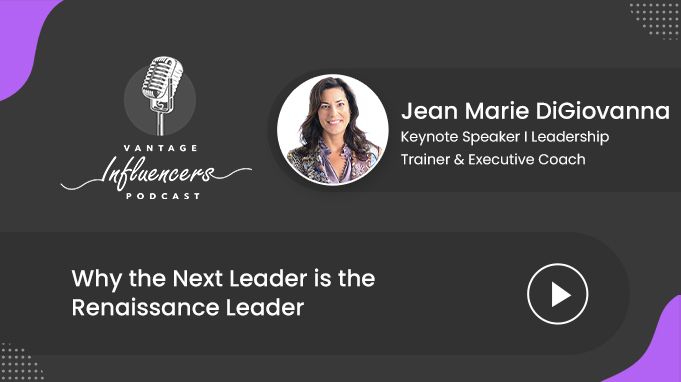
Why the Next Leader is the Renaissance Leader
Episode Overview
Today's leaders need more than one strength; they need to move fluidly between analytical thinking, intuition, and interpersonal skill. In this episode of Vantage Influencers, host Susmita Sarma speaks with Jean Marie DiGiovanna, international keynote speaker, certified executive coach, and developer of the Renaissance Leadership Program, about what she calls the renaissance leader: someone who challenges established beliefs, balances mind and heart, and brings out hidden talent in their teams.
Jean walks through the five principles behind renaissance leadership, the specific, deceptively simple questions leaders should be asking their people, and closes with practical tips any leader can apply immediately, in disruptive times or otherwise.
Episode Highlights
- Renaissance leaders borrow from the actual Renaissance: curiosity, open-mindedness to different perspectives, and being a master of many disciplines rather than a jack-of-all-trades.
- The five Renaissance principles: ask new questions, honor diversity, connect to innovate, magnify the impact, and act with accountability.
- Powerful questions typically start with "what" or "how," not "why," because "why" tends to put people on the defensive.
- Three questions worth asking your team right now: what's important to you in a career, what talent of yours are we not tapping into, and what motivates you.
- A good leadership gauge: you should be talking roughly 30% of the time, and listening the other 70%.
- Create a safe environment for mistakes, explicitly. Waiting a week to discover a missed deadline is worse than hearing about the problem immediately.
About the Guest
Jean Marie DiGiovanna — International Keynote Speaker & Developer of the Renaissance Leadership Program
Jean Marie DiGiovanna is an international keynote speaker, leadership development expert, certified executive coach, and best-selling author. With over 25 years of experience, she helps leaders and their teams shift how they think, lead, and communicate, building a culture of trust, collaboration, and innovation. She has a distinct ability to ask the questions no one else is asking and to listen for what isn't being said, creating an environment where teams find their voice and resolve conflict quickly and gracefully. She is the author of Stop Talking, Start Asking, which lays out 27 questions to shift an organization's culture.
Host
Susmita Sarma — Vantage Influencers Podcast Host
What You Will Learn
- What a "renaissance leader" actually means, and where the concept comes from
- The five core principles of renaissance leadership
- Which specific questions leaders should be asking their teams right now
- Why "what" and "how" questions work better than "why" questions
- A simple talk-to-listen ratio for gauging your own leadership style
- How to build a team culture where mistakes surface immediately instead of a week too late
Key Topics & Timestamps
| Time | Topic |
|---|---|
| 01:35 | Jean's background and professional journey |
| 04:11 | Her work at Jean Marie Speaks and Workshop University |
| 05:50 | How to become a renaissance leader, and what skills they possess |
| 10:03 | The five principles of renaissance culture |
| 12:40 | The most important questions leaders should ask employees right now |
| 17:44 | Who Jean looks up to, and how she thinks about mentorship |
| 20:06 | Practical tips for leaders and their teams |
Full Transcript
Read the full transcript
Susmita: Welcome to the Vantage HR Influencers Podcast. This podcast is sponsored by Vantage Circle, the simple and AI-powered rewards and recognition platform for employee engagement.
Susmita: In this 21st century, organizations need leaders who are well-grounded and have multiple intelligences. First of all, they're expected to showcase a diverse set of talents to survive in a quickly changing global marketplace. And to succeed, they must have a firm grasp of analytical and strategic thinking, as well as the ability to use intuition and interpersonal skills effectively. In short, now is the time for renaissance leaders, leaders who can challenge established beliefs, develop their own abilities, and make the seemingly impossible possible. They have to perfect the art of balancing mind and heart to get the best out of themselves and their organization. It's a big concept in business today, and there's a lot to learn about it. Let's dig in.
Susmita: Hi everyone, I'm your host, Susmita, and I welcome you to this episode of the Vantage HR Influencers Podcast. Please join me in welcoming my guest today, Jean Marie DiGiovanna. Jean is an international keynote speaker, leadership development expert, certified executive coach, best-selling author, and the developer of the Renaissance Leadership Program. Welcome to the show, Jean.
Jean Marie DiGiovanna: Thank you for having me, it's a pleasure to be here.
Susmita: Thank you for being here for this conversation, Jean. We'll get into today's topic shortly, but before that, please tell us a bit about your background and your professional journey.
Jean Marie DiGiovanna: Sure. Believe it or not, I actually studied computer science, so I came up through the ranks of the high-tech world. How I got into training and development is that I landed at an amazing high-tech startup called Cambridge Technology Partners back in the early '90s. I started out as a software programmer, and a few years in, I realized it just wasn't me, it wasn't where I wanted to be. I wanted to work closer with people. An opportunity came up to run one of the service lines, around how to design systems, and it let me work with project teams to help create the methodology. That tied together everything I enjoyed, process and technology, and that's also where I found my passion for training.
The biggest turning point for me was when the company was growing so rapidly we were hiring over 100 employees a month, and we couldn't sustain that growth. The CEO at the time pulled about five of us aside and said he wanted us focused for the next six months on change management: our core values, guiding principles, core competencies, and onboarding program. I got to be part of shaping the company that way, and as a result I created a lot of the curriculum for business problem-solving for consultants, and ended up as the lead trainer for over 100 employees a month. So I really built my training, coaching, and facilitation background on the job. I left nine years later, started my own coaching and training business, and got certified as a coach in 2000. So it's been a journey from tech, to learning and development, to HR, and many of my clients today are still in high tech, which makes for a beautiful match.
Susmita: When you mentioned your own organization, did you mean Jean Marie Speaks?
Jean Marie DiGiovanna: There's actually a bit of history there too. I started out with a company called Think People, and I had that for many years. When the high-tech bubble crashed and I lost essentially all my clients overnight, my business went from six figures to zero. Instead of fighting that uphill battle or looking at other industries, I ended up running public seminars and getting coached myself that year. I ended up building another business called Workshop University, because so many colleagues and workshop attendees wanted to learn how to turn their own content into workshops. So there's this interesting history of moving into Workshop University and running both businesses. Several years later, my corporate clients started calling again as business picked back up, and I maintained both. Now everything sits under Workshop University, and Jean Marie Speaks is my keynote speaking business at the front end, that's the one I point everyone to, since it's the newest, about five years old, and it combines my speaking, training, and coaching. From there it points into Workshop University, which is really the training arm of the business. So, several ups and downs, but that's 25 years of training and consulting experience.
Susmita: Under Jean Marie Speaks, you have the Renaissance Leadership Program. We're going to talk about that today. To start: how does someone become a renaissance leader in today's business world?
Jean Marie DiGiovanna: Let me first explain what a renaissance leader is, and where the idea comes from. If you think about the actual Renaissance period, it was a time of rebirth, innovation, and invention, coming right out of the medieval era. There were incredible leaders at that time who paved the way: they were innovative, curious, they thought of new ways of doing things, and they pushed people to step out of the status quo. I take that concept and look at the skills of those renaissance leaders, and ask how we can apply them in the corporate world today.
So when I talk about becoming a renaissance leader, there are specific skills involved. One is curiosity, think of Leonardo da Vinci, he had an insatiable appetite for it. Another is being open-minded, honoring ideas from different places. Back in the actual Renaissance, the Medici family, the largest bankers of the era, would gather people from completely different walks of life together: artists with philosophers, with politicians, with poets, to solve problems together. That's a great model to bring into the corporate world today. Renaissance leaders are also agile, their talents and skills run broad but also deep, so instead of being a jack-of-all-trades, they're a master of many. That's what I teach: how to build more of that inside your organization, to create more innovation and fulfillment for your teams and your work.
Susmita: What specific skills do renaissance leaders possess?
Jean Marie DiGiovanna: Definitely curiosity, definitely empathy, and genuinely honoring ideas from all different walks of life. Another is self-awareness, or emotional intelligence. One thing renaissance leaders do is see connections where others might not, they ask the questions no one else is asking, and to do that, you have to become more self-aware. Another trait is influencing through action: it's one thing to be aware of something, it's another to actually act on that awareness, acting with accountability, influencing through action. They also engage and collaborate deeply with their teams, in innovative ways.
Susmita: Especially given everything happening with the pandemic?
Jean Marie DiGiovanna: Yes. One interesting thing is that this pandemic and the challenges it's brought have forced us to think not just outside the box, but as if there is no box at all. In a lot of ways we've had to create a clean slate and start over, asking not "what can we bring back to normal" but "what can we actually create." Thinking like a renaissance leader is also about finding people who aren't like you, and tapping into how they think, because that's how we learn to think differently ourselves.
Susmita: Would you describe the principles of renaissance culture?
Jean Marie DiGiovanna: Sure, there are five principles I cover in my programs. The first is ask new questions, the questions no one else is asking. When I teach this, it's not about asking just any question, it's about asking a genuinely powerful one. Typically the most powerful questions start with "what" or "how," because those words open up dialogue and move the conversation forward.
The second principle is honor the diversity, honoring the diversity of ideas, perspectives, cultures, and lifestyles people bring to the table. When we do that, we actually generate new ideas. The third is connect to innovate: renaissance leaders see connections where others don't look, and when you connect two things in a new way, that's innovation. The fourth is magnify the impact. What happens a lot in corporations is that teams do amazing work, but it never scales out to the rest of the organization that could learn from it. I'll go into a company, work with one department, and they'll realize something they're working on was already solved by another department a year or two earlier, that knowledge could have been leveraged. So the fourth principle is about magnifying the value of a great idea by sharing it more broadly across the organization. And the last is act with accountability, something I touched on earlier. Taking action is one thing, but one of the biggest barriers to actually getting things done on teams is the absence of real accountability. That's the last renaissance principle I cover.
Susmita: The first principle you mentioned, asking questions no one else is asking to uncover the truth, that connects to your book, Stop Talking, Start Asking, which has 27 questions to shift an organization's culture. What are the most important questions leaders should be asking in these critical, disruptive times?
Jean Marie DiGiovanna: Great question, there are so many. Especially now, going on two years into this pandemic, there's a real feeling of tiredness, a sense of "is this ever going to end, when do we get back to normal." It's really important right now to ask questions that help uncover what actually matters to your employees, what they really want. When you think about the Great Resignation happening right now, there's a reason behind it, and as leaders we have to get genuinely curious and stay open to what we hear.
A few questions I think matter right now: What's important to you in a career? Where do you feel you're contributing most, in a way that aligns with your gifts and talents and what the organization actually needs? Because often people are in the wrong roles, they have amazing skills and talents that just aren't being used well. Another: what's a talent or skill you have that we don't know about, or that we're not tapping into? When people aren't using all of their gifts, a part of them can feel somewhat dead inside, so our job as leaders is to uncover that hidden talent so people feel fully honored for what they bring. Another simple one: what motivates you? It sounds obvious, but we rarely actually ask it, we assume we already know the answer. What motivates people varies enormously from person to person, and I'd say the real mastery of leadership is being willing to lead each person a little differently, because each person is genuinely different. And a fun last one: what's the question you don't want me to ask? Asking questions like that takes the brain somewhere it hasn't been before, and that's the whole point of asking genuinely powerful questions.
Susmita: Very simple, very basic questions that we often just don't ask.
Jean Marie DiGiovanna: Exactly, we ignore them, or honestly, sometimes we just don't know to ask them at all. Once you get access to that question, you think, "how have I never asked this before?" One of the things I love doing with teams and leaders is helping them see what they don't know they don't know, because that opens up a level of knowledge they can finally tap into.
Susmita: Do you recommend asking these questions face to face, or through something like a feedback survey?
Jean Marie DiGiovanna: It depends, but I never recommend a form or an online survey for these, they're genuinely deep questions, and they tend to get ignored in a form. I recommend picking a couple to bring into your one-on-ones, ideally over video or in person, even with so much happening virtually. People also process and learn differently, so I recommend sharing some of these questions in advance: let the person know, "I'd love to learn more about what makes you tick, here are the questions I'll ask when we meet," so they can think it through and bring real answers. And you should be willing to answer the same questions yourself, if you're going to put a question out there, you have to be willing to answer it too.
Susmita: With so many years of experience, you're a highly respected coach, and leaders across the world follow your lessons. But who do you look up to, Jean? Who's your own life coach?
Jean Marie DiGiovanna: Great question. I've had so many amazing coaches. I got certified back in 1993, when I hired my first coach before coaching was even really a recognized field, because I myself was trying to figure out my own purpose, that's actually when I started shifting from tech to the people side of business. The coaches I hire tend not to be purely life coaches or business coaches, one thing that matters a lot to me is that they're holistic, more spiritual. I'm drawn to more spiritual teachers, because my own journey has really been about tapping more into my own intuition. Dr. Wayne Dyer has been a huge influence in that journey, in becoming more self-aware and trusting my own intuition. Brené Brown is another person I deeply admire, her message aligns with what matters most to me: being completely authentic, and giving yourself permission to be who you actually are.
What I'll say about coaches in general: I've always had one, a speaking coach, a mentor I check in with every six weeks. I've found that instead of hiring one person for a very long stretch, since my own needs shift over time, I've built a group of people I go to for different kinds of support. I don't think I've gone without a coach since I started this journey in 1993.
Susmita: What tips would you leave for the leaders and teams listening right now?
Jean Marie DiGiovanna: A couple. First, stay curious, ask open-ended questions that start with "what" or "how." So often we default to "why", why didn't they do this, why aren't they getting back to me, and while some "why" questions can be powerful, like "why is that important to you," my general tip is to shift your "why" questions to "what" or "how" when working with your teams, because it opens up dialogue rather than putting people on the defensive.
The second tip: a good practice to keep in mind is that when you're leading well, you should be talking roughly 30% of the time. The rest of the time, you're asking questions and the other person is doing the talking. That's a useful gauge, if you're directing far more than you're listening, that's a sign your team isn't learning at the pace it could be. Let people think for themselves, let them make mistakes, and build a genuinely safe environment for that. Be explicit about it: tell people it's okay to make a mistake, that you'd rather know about it right away and work through it together than find out a week later that you've missed a deadline.
Susmita: Thank you for all of that. Lastly, how can our listeners reach out to you?
Jean Marie DiGiovanna: My website is jeanmariespeaks.com, everything's there. I'll also mention I'm launching a new site in Q1 of this year, called Join the Leadership Lab, a space for leaders across the globe to come together, mastermind, and learn the tools we've talked about today.
Susmita: Congratulations on that, and all the best. This was lovely talking to you, Jean, thank you for the conversation.
Jean Marie DiGiovanna: Thank you, it was a pleasure to talk with you. Bye bye.
FAQ
What is a renaissance leader?
A renaissance leader is someone who blends analytical thinking, intuition, and interpersonal skill, borrowing qualities from actual Renaissance-era figures: curiosity, open-mindedness to different perspectives, and being a master of many disciplines rather than a specialist in just one.
What are the five principles of renaissance leadership?
Ask new questions, honor diversity, connect to innovate, magnify the impact, and act with accountability. Together they describe a leader who surfaces new ideas, shares them broadly, and follows through with real accountability.
Why should leaders ask "what" or "how" questions instead of "why" questions?
"Why" questions often put people on the defensive and shut down dialogue, while "what" and "how" questions open up conversation and move it forward, making them more effective for genuinely understanding a team member's perspective.
What's a good talk-to-listen ratio for leaders?
Roughly 30% talking, 70% listening. If a leader is directing far more than they're listening, it's a sign the team isn't learning or contributing at the pace it could be.
Related Reading
- Interpersonal Skills In The Workplace: Importance and Ways to Improve
- Leadership: Fundamentals, Evolution, Challenges & Future
- Employee Recognition: What It Is, Why It Matters & How to Do It Right
This episode is part of the Vantage Influencers Podcast, where we bring HR thought leaders to discuss engagement, compensation, benefits, and everything related to HR.
Also listen on