Why You Need A Chief Happiness Officer?
Episode Overview
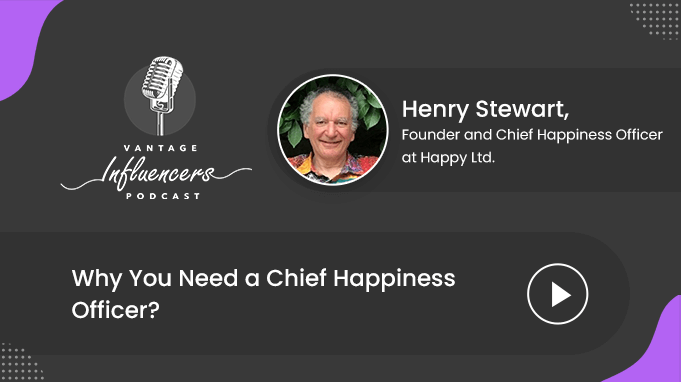
Employee happiness has moved from a nice-to-have to a real focus for organizations, and it's led some companies to create a new role: the Chief Happiness Officer (CHO). In this episode of Vantage Influencers, host Susmita Sarma speaks with Henry Stewart, founder and CHO of Happy Ltd., a UK workplace learning provider repeatedly listed among the country's best places to work.
Henry's central point: a Chief Happiness Officer isn't about parties, free fruit, or gym memberships. It's about giving people trust, freedom, and a manager who coaches rather than controls, and doing that consistently enough that people find long-term fulfillment in their work, not just a good Friday afternoon.
Episode Highlights
- People dislike being micromanaged, told what to do, and blamed. They like flexibility, trust, and a manager who coaches instead of commands.
- A CHO's job isn't throwing parties, it's building a framework where managers actually coach, based on Google's Project Oxygen research showing "good coach" as the single most important manager behavior.
- No certification is needed to be a CHO. Henry hires for attitude, not credentials, and has for 20 years.
- Real trust means giving people a budget and framework, then letting them execute without pre-approval, as Happy Ltd. did when a 19-year-old employee redesigned their café.
- Research from Wharton's Alex Edmans found that investing in "great workplaces" over 25 years would have grown $100,000 into $236,000, more than double the standard market return.
- A CHO only works if senior leadership already believes happiness matters. Otherwise, the person in the role will just be frustrated.
About the Guest
Henry Stewart — Founder and Chief Happiness Officer at Happy Ltd.
Henry Stewart founded Happy Ltd., a UK-based learning provider that has run for over 30 years and been listed among the UK's top workplaces for five consecutive years (Financial Times / Great Place to Work Institute). Happy was voted best in the UK for customer service by Management Today, recognized by Business in the Community for its positive social impact, and rated one of the world's most democratic workplaces. Henry was named to the Thinkers50 Guru Radar as one of the thinkers shaping the future of business. Outside of work, he's a strong advocate for local, comprehensive education and an avid cyclist, completing the Haute Route (seven days across the Alps, three Tour de France climbs a day) in 2016.
Connect with Henry on LinkedIn
Host
Susmita Sarma — Vantage Influencers Podcast Host
What You Will Learn
- What a Chief Happiness Officer actually does, and doesn't do
- Why trust and freedom matter more than perks for long-term employee fulfillment
- What Google's Project Oxygen research says about the single most important manager behavior
- How to give employees real ownership without losing accountability
- Whether a CHO role needs certification, or a specific personality type
- Whether your organization should hire a CHO, or fix its HR management first
Key Topics & Timestamps
| Time | Topic |
|---|---|
| 01:08 | Henry's journey building Happy Ltd. over 30+ years |
| 01:28 | What Happy Ltd. actually does |
| 03:18 | What makes a happy workplace |
| 04:28 | What a Chief Happiness Officer does that HR typically doesn't |
| 08:24 | A real example: giving a new employee full ownership of a project |
| 12:45 | Does a CHO need certification? |
| 13:27 | Should you hire a full-time CHO, or fix HR management instead? |
| 15:12 | Henry's closing advice for HR listeners |
Full Transcript
Read the full transcript
Susmita: Welcome to the Vantage HR Influencers Podcast. This podcast is sponsored by Vantage Circle, the simple and AI-powered rewards and recognition platform for employee engagement.
Susmita: Employee happiness is becoming a key focus for organizations of all sizes and industries. Employers are gradually realizing that happy employees make teams that are committed, motivated, and high-performing. This increasing value placed on workplace happiness has changed conventional HR strategy, and it's led to the development of a new role: the Chief Happiness Officer. So who is a Chief Happiness Officer? What's their role in the organization, and how are they different from HR? Let's find out in today's episode, with guest speaker Henry Stewart. Henry is the CHO of Happy Ltd., listed as one of the top 20 workplaces in the UK for five consecutive years. Welcome to the show, Henry.
Henry Stewart: Thank you, I'm delighted to be here.
Susmita: Same here, Henry, thanks a lot for joining me today. Before we get into today's topic, we'd like to know a bit about your journey in the corporate world.
Henry Stewart: I've been running Happy for over 30 years now. It started as an IT training provider, and now it helps organizations create happy workplaces, mainly through leadership training based on the ideas of trust and freedom.
Susmita: Can you tell us a bit more about Happy Ltd.?
Henry Stewart: We're a learning provider based in London, and what we offer is a range of happy workplace leadership programs that help people step out of command-and-control habits and micromanagement, and instead trust people to be their best and play to their strengths. We train mainly in the UK, but we've also worked in Australia, India, and other places.
Susmita: So at your own organization, Henry, I imagine you're effectively working as a Chief Happiness Officer yourself?
Henry Stewart: That's right. I'm the founder of the organization, and Chief Happiness Officers can play many different roles. They can be the person at the top who creates the framework, or the HR manager who works to create happiness, or just an individual who decides to take on that title because they want to bring more happiness into the organization. I've seen all of those versions.
Susmita: So it's a title that anyone, even an HR manager, could take on?
Henry Stewart: Anybody can take it up. It's particularly popular in France, there are a lot of Chief Happiness Officers there. The concept actually originated with a company called Woohoo in Copenhagen, Denmark, where Alex Kjerulf became Chief Happiness Officer around 2000. They now run courses on how to be one.
Susmita: Important question, Henry: what do you think makes a happy workplace?
Henry Stewart: Good question. What people don't like is being told what to do, being micromanaged, and blame cultures. What they do like is being able to do what they're best at, playing to their strengths, being given the trust and freedom to work at their best, and being coached by their manager instead of instructed. When I talk about a happy workplace, I'm not talking about in-the-moment hedonism, wine on a Friday afternoon, free fruit, or gym membership. I'm talking about long-term fulfillment, people coming to work feeling genuinely fulfilled in their role and loving being there. That comes down to trust, freedom, and the ability to do what you're good at.
Susmita: So people like flexibility, and they like leaders who guide them properly. These things typically fall under employment policy. So what's the specific thing a CHO does that an HR manager generally doesn't?
Henry Stewart: It can be anything, really. HR managers can play very different roles, sometimes very focused on policy and procedure. If you're at work and someone says "the HR manager wants to see you," that's not usually exciting news, is it? It usually means you've broken a rule or something. Whereas an HR manager who's more of a Chief Happiness Officer is about enabling people, helping them do what they're best at, and making sure managers step out of the way so people get the freedom to work at their best.
Susmita: Is it more about personality traits that make someone a great Chief Happiness Officer?
Henry Stewart: I'd say you've got to be fairly cheerful, have a sense of optimism, maybe a bit of energy about you. But more than that, you've got to think differently, you're not just putting in a new policy, you're actually changing how the organization works, and getting rid of the old ways that used to be there. Let me give you an example. Not every organization I admire has a formal CHO, but what I like to promote are organizations where people have real freedom in their role, and often there aren't many middle managers at all, more of a self-managing organization. Because the key thing in a happy workplace is the role of the manager. Research from London Business School found that the person you're least likely to want to spend time with is your own manager. If you get to work in the morning and see a note from your manager saying "I want to see you at two," do you feel excited? You should. So we come back to: what is the role of a manager? It shouldn't be to be the expert or to tell people what to do. There's research from Google on this, called Project Oxygen, looking at the most important behaviors of managers. They identified eight, and ranked them: the top three were showing interest in your people, empowering rather than micromanaging, and the very top one was being a good coach.
That's what a Chief Happiness Officer tries to ensure is actually happening. It's not about going into the office telling jokes and organizing games. It's about making sure there's a framework where the managers, in my organization and in the organizations we work with, actually coach. Being a good coach means building people's confidence, asking questions, and helping them find their own solutions. When I ask colleagues how their one-to-one with their coach went, they'll say it left them inspired, wanting to go and do a great job. That isn't always true of managers generally, though it is of some.
Susmita: All the factors you've mentioned, Henry, a Chief Happiness Officer can give a real boost to employee engagement. Do you see any challenges in improving engagement in your own organization?
Henry Stewart: I don't see challenges in my own organization, our data shows we have great employee engagement, but I do see challenges in many organizations that don't have that. And yes, a Chief Happiness Officer can give a massive boost. Let me give you a very specific example. We had a 19-year-old at Happy who was managing our café, and she wanted to improve it. We didn't ask her to show us a plan for approval, we didn't form a committee to look at it. What we did was agree a budget, check that she understood the organization's values, and then left her to decide for herself how she wanted to set up the café. That café is the first thing you see walking into Happy. I saw it for the first time after she'd already created it, I didn't approve it in any sense. But imagine how that 19-year-old, three months into her first job, felt walking into her café every morning. She felt proud, she felt real ownership. That's what creates happiness in an organization: having the freedom and trust that you don't have to go to someone for approval, you're given the framework and guidelines, and then you decide for yourself, possibly with support from a coach.
Susmita: In that café example, she probably knew what would work best because she had the experience for it, right?
Henry Stewart: She did know. But we trusted her even though she'd only been there three months. And that's what we try to do in every part of the organization. Take our website, for example. In the early days, I was very micromanaging about it, always suggesting changes, and the person working on it never really felt encouraged or in control. Eventually we decided to give full pre-approval instead, approving the framework at the beginning rather than the output at the end. We agreed on a branding exercise so expectations were clear, agreed on metrics like visitor numbers and income generated, sent the person managing it, Johnny, on the best SEO training we could find, and insisted he talk directly to clients so he understood what they needed. I saw the finished website the night before it launched, and honestly, I didn't particularly like it. But it was completely within the guidelines we'd agreed. So up it went. Two months later, when we checked the metrics, visitors had tripled and income had doubled, without any input from my own expertise. That's the key point: Johnny felt complete ownership of that website. I like to think I'm clever, that I know best, but after 33 years of Happy, I've learned I don't always know best, and other people need to be put in charge. Everyone in the organization needs to be in charge of what they're doing, and I shouldn't be telling them what to do. That's the whole goal of a Chief Happiness Officer: enabling that trust and freedom.
Susmita: Lovely example, Henry. So, does a CHO require any special certification?
Henry Stewart: No, though you can get certified, there's an organization in Denmark called Woohoo that offers it, but I don't believe in certifications. When we recruit at Happy, we don't ask for any qualifications, and we haven't for the last 20 years, because we want to explore people's attitude, not their skills. Skills can be trained. A Chief Happiness Officer really just needs the right attitude.
Susmita: Jim Harter, a Gallup chief scientist, has said that if HR managers don't genuinely believe keeping workers happy is vital, a separate CHO role won't be fruitful. What's your take: should organizations hire a full-time Chief Happiness Officer, or focus on HR management instead?
Henry Stewart: If senior leadership doesn't believe workers need to be happy, there's no point creating that role, the person will just be frustrated at every turn. Organizations need to understand that happy workplaces are simply more effective. The research is absolutely clear on this. There was research on great workplaces done by Alex Edmans at Wharton Business School, looking at whether companies on "great workplace" lists actually perform better. He looked at stock market metrics and found that if you'd invested in the standard stock market over 25 years and ended up with $100,000, investing instead in the great workplaces would have gotten you $236,000. That's the difference a genuinely great workplace makes. Any manager who believes keeping workers happy isn't important to the bottom line honestly needs to quit their company and go do something other than management, because keeping people happy is vital to the bottom line, and makes the organization more productive and effective.
Susmita: Very true. Thanks for all the insights. Lastly, any suggestions for the HR professionals listening today?
Henry Stewart: I'd encourage you to explore these ideas. You can download a free Happy Manifesto from my website, happy.co.uk, which will tell you more about all of this. If you're very policy-based in your thinking and don't believe workers need to be happy, I'd still encourage you to read it and other books like it, and consider changing your attitude. But if this is something you've always felt, that you've always wanted your workers to genuinely feel happy, then go ahead and change your title to Chief Happiness Officer and go down that route. Just remember, it's not about the tangential things, it's not about free gym membership. It's about long-term fulfillment, giving your people the trust and freedom they need to do a fantastic job, and making sure the role of managers is to coach their people.
Susmita: So simply changing the title won't help on its own, you have to take on real added responsibility for the overall happiness of your workforce.
Henry Stewart: Absolutely. Just changing the title alone won't do it.
Susmita: Finally, Henry, how can listeners reach out to you?
Henry Stewart: I'm Henry at happy.co.uk, that's my email, you can reach me there. I'm also @HappyHenry on Twitter. I'd love to hear from anyone who wants to know more about this. And everything is virtual now, so we can deliver our courses to India too, and I've already been doing that for one or two companies.
Susmita: That was a great conversation, Henry. Thanks a lot for joining me on the Vantage HR Influencers Podcast.
Henry Stewart: Thank you, it was delightful.
FAQ
What does a Chief Happiness Officer actually do?
A Chief Happiness Officer builds a framework where managers coach rather than control, giving employees trust and freedom to do their best work. It's not about parties or perks, it's about creating the conditions for long-term fulfillment at work.
Does a Chief Happiness Officer need certification?
No. While certification programs exist, Henry Stewart's own company hasn't required qualifications for 20 years of hiring. The role depends more on attitude, optimism, and the ability to change how an organization works, than on any formal credential.
Should every company hire a Chief Happiness Officer?
Only if senior leadership already genuinely believes employee happiness matters. Without that belief, the person in the role will be constantly frustrated. Research shows "great workplaces" significantly outperform the market, but the role only works when leadership is already bought in.
How is a Chief Happiness Officer different from a typical HR manager?
A typical HR manager is often associated with policy, procedure, and enforcement. A Chief Happiness Officer is focused on enabling people: making sure managers step back, coach instead of instruct, and give employees real ownership over their work.
Related Reading
- Effective and Simple Tips for a Happy Workplace
- How Micromanagement Is Harming Your Company? (Mini Guide)
- Employee Engagement in 2026: Definition, Importance, Drivers, Strategies & Examples
This episode is part of the Vantage Influencers Podcast, where we bring HR thought leaders to discuss engagement, compensation, benefits, and everything related to HR.
Also listen on