In the mid-1990s, Amy Edmondson set out to prove something that seemed obvious, that the best-run hospital teams made the fewest medication errors, only for the data to insist on the opposite. The strongest teams appeared to make more mistakes, and it took her a while to see that they were simply admitting more of them, while the weaker teams were busy keeping theirs off the record.
That accidental finding became the foundation of her 1999 research on psychological safety, a concept Google's Project Aristotle would later rank above every other dynamic it found in its most effective teams. It also explains why so many workplace problems reach leadership late and fully formed, since the warning was usually there early and someone decided it was not worth the risk of saying out loud.
This guide unpacks what psychological safety actually means and what it is often mistaken for, then moves through Timothy R. Clark's four stages, a way to measure it using Edmondson's own validated survey, and seven practical steps for building it on a real team.
What Is Psychological Safety?

Psychological safety is the shared belief that no one on the team will be punished, rejected, or embarrassed for speaking up, taking a reasonable risk, or admitting a mistake. Amy Edmondson, a professor at Harvard Business School, introduced team psychological safety in her 1999 paper and defined it as a shared belief held by members of a team that the team is safe for interpersonal risk-taking.
The term itself is older than her paper. Organizational psychologists Edgar Schein and Warren Bennis used "psychological safety" as early as 1965, in their research on helping people unlearn old behavior during organizational change. Edmondson's contribution was to study it at the team level and show that it predicts how well teams learn and perform, not just how comfortable people feel day to day.
That link between psychological safety and performance was confirmed at scale by Google's Project Aristotle, a study of 180 of its own teams. Among 5 factors that separated high-performing teams from the rest, psychological safety ranked first. McKinsey research found that 89% of employee respondents consider psychological safety essential at work, though far fewer say they experience it consistently.
What Psychological Safety Is Not
Psychological safety isn't comfort, isn't the same as trust, and doesn't mean lowering your standards. It's one of the most common things managers get wrong, usually by confusing it with being nice.
| Myth | Reality | Example |
|---|---|---|
| It's the same as comfort | It's closer to the opposite. Real psychological safety makes the discomfort of a hard conversation normal and survivable, instead of something people avoid | A team debates a flawed plan openly in the meeting, instead of nodding along and raising objections afterward in private |
| It's the same as trust | Trust is between two people. Psychological safety is a property of the group, so you can trust your manager completely and still stay quiet in a team meeting | A new hire trusts their manager one-on-one but says nothing when a senior peer dismisses a junior colleague's idea in a group setting |
| It means being nice | Niceness protects feelings by avoiding honesty. Psychological safety protects people while still allowing direct, critical feedback | A manager tells a direct report their work missed the mark, clearly and respectfully, instead of softening it into vague praise |
| It means lowering standards | High standards and high safety go together. Teams need safety to surface problems early, and standards to hold people accountable for fixing them | A team flags a missed deadline the same day it happens, then still delivers a corrected plan within the week |
Why Psychological Safety Matters at Work
Teams that feel safe raise problems earlier, learn faster, and stay longer, because people stop hiding mistakes and ideas out of fear.
"Silence has a cost. You pay it in attrition, in rework... Process definitely holds performance together, but it's psychological safety what makes performance possible. ... You cannot install a safety through a policy rollout or a town hall. It requires far more genuine effort, consistency, visible intent by leader every single day."
Kanu Priya, Chief People Officer, India and APAC, Credera, on the podcast episode Why Some Teams Perform Better Than Others
Fewer hidden errors. When people can admit a mistake without fear, problems surface while they're still small and cheap to fix, instead of after they've compounded.
Faster learning. Teams that can question "the way we've always done it" adapt faster when conditions change, because no one is protecting a decision just to save face.
Better decisions. Research from the Center for Creative Leadership, studying 278 senior leadership teams, found that 62% showed real disagreement among members about how safe the team actually was. Teams where members agreed they felt safe had the highest performance and the lowest task and relationship conflict of any group in the study.
Retention. Gallup points to internal research from Google showing that employees on teams with higher psychological safety were less likely to leave the company.
The closest evidence we have from our own data isn't a psychological-safety survey, but it measures something adjacent: whether people feel genuinely seen, accepted, and valued at work. When employees consistently feel Appreciated, Accepted, Validated, and Accomplished, motivation rises by 18 percentage points, intent to stay by 16, agility by 14, and customer excellence by 11, according to The State of Recognition & Rewards 2025 (Vantage Circle).
The 4 Stages of Psychological Safety
Timothy R. Clark's model breaks psychological safety into 4 stages: inclusion safety, learner safety, contributor safety, and challenger safety. Each stage has to be in place before the next one can take hold, so a team stuck at stage 1 will never reach stage 4 no matter how much a manager talks about "speaking up."
| Stage | What It Looks Like | What Kills It | What a Manager Does |
|---|---|---|---|
| 1. Inclusion safety | People feel accepted as part of the team, not just tolerated | Cliques, inside jokes that exclude newer members, ignoring quieter voices in meetings | Learn names and roles quickly; actively bring newer or quieter members into the conversation |
| 2. Learner safety | People feel safe asking questions, trying new things, and making mistakes while learning | Mocking a "basic" question; punishing a reasonable attempt that didn't work out | Answer every question as if it were a good one; normalize "I don't know yet" |
| 3. Contributor safety | People feel safe using their skills to make a meaningful contribution, not just execute instructions | Micromanaging every output; taking credit for a team member's idea | Delegate real ownership, not just tasks; credit ideas publicly by name |
| 4. Challenger safety | People feel safe questioning decisions, raising dissent, and challenging the status quo without being "nice" about it | Treating disagreement as disloyalty; only rewarding agreement | Ask directly for the counterargument before deciding; thank people for pushing back |
1. Inclusion safety
Inclusion safety is the foundation. If people don't feel like they belong on the team in the first place, nothing built on top of it holds. It starts with the basics: using someone's name correctly, including them in the conversations that affect their work, and noticing when a colleague from an underrepresented group is consistently talked over.
2. Learner safety
Learner safety means people can ask questions, request help, and experiment without looking incompetent. Teams that skip this stage end up with employees who nod along in meetings and then quietly ask a peer what actually happened afterward, which slows everyone down.
3. Contributor safety
Contributor safety is where people start applying their own judgment instead of just following instructions. It requires a manager to actually let go of some control, which is often the hardest stage for a newly promoted manager to reach.
4. Challenger safety
Challenger safety is the final and hardest stage: being able to question a decision, a process, or even the manager, without it being read as disrespect.
"The fourth part is the most important part of psychological safety. It's the challenge of safety. I can challenge somebody. I can deny them. I don't really agree with you. I don't need to be nice."
Dr. Amit Singh, Chief Human Resources Officer, CARE Hospitals, on the podcast episode Rebuilding Resilience in Healthcare Teams After Burnout
12 Signs of Low Psychological Safety
The clearest sign is silence. Meetings where only the leader talks, problems that surface late, and nobody admitting mistakes until they're forced to.
| Sign | What to Check |
|---|---|
| Only the manager talks in meetings | Count how many distinct voices speak up in a typical team meeting, unprompted |
| Problems surface late | Look at how close to a deadline issues get raised, versus how early they were actually known |
| Mistakes get hidden, not reported | Check whether near-misses or small errors ever get mentioned before they become visible |
| Decisions get agreed to in the room, reversed outside it | Watch for "sure, sounds good" followed by complaints in one-on-ones or side channels |
| Micromanagement replaces delegation | Check whether a manager reviews every small decision instead of outcomes |
| New hires go quiet fast | Compare how much a new hire spoke in their first week versus their first month |
| Feedback only flows downward | Check whether anyone has given the manager critical feedback in the last quarter |
| Humor at someone's expense goes unchallenged | Notice if the same person is the target of "jokes" repeatedly, and whether anyone pushes back |
| People over-prepare for simple updates | Watch for visible anxiety before routine status updates, not just major presentations |
| Credit for ideas gets reassigned upward | Check whether the person who originated an idea gets named when it's presented further up |
| High turnover with vague exit reasons | Look for a pattern of departures citing "culture fit" or declining to give a reason at all |
| The team feels like a toxic work environment under pressure | Notice whether stress makes people more guarded instead of more collaborative |
How to Measure Psychological Safety
Psychological safety is hard to measure because it lives in what people choose not to say. Edmondson's 1999 paper tackled this with a seven-item survey, rated from "very inaccurate" to "very accurate" and averaged per team, since the belief belongs to the team rather than to any one person.
| What It Is Really Asking | Survey Statement | Scoring |
|---|---|---|
| Is it safe to fail or take a risk? | If you make a mistake on this team, it is often held against you. | Reverse |
| It is safe to take a risk on this team. | Standard | |
| Can people speak up and ask for help? | Members of this team are able to bring up problems and tough issues. | Standard |
| It is difficult to ask other members of this team for help. | Reverse | |
| Are people valued as they are? | People on this team sometimes reject others for being different. | Reverse |
| No one on this team would deliberately act in a way that undermines my efforts. | Standard | |
| Working with members of this team, my unique skills and talents are valued and utilized. | Standard |
Reverse-score before averaging
Three statements describe a problem rather than a strength, so their responses need flipping (subtract from 8, turning a 6 into a 2) before averaging. Skip this, and a team that strongly agrees mistakes are held against them can look perfectly healthy on paper.
Read the spread, not just the average
A team averaging 5 could be six people at 6 and two at 2, and those two are usually the real story. A wide gap between the highest and lowest scorers deserves attention even when the average looks fine, and steady decline across quarters says far more than one bad score after a brutal deadline.
Run it so people answer honestly
Asking people whether it feels safe to speak up and then attaching their names defeats the point, so keep it anonymous, report only at team level, and fold any group under five into a larger one. At roughly two minutes, the survey is easy to repeat every quarter, often enough to link shifts to manager behavior without turning answers into autopilot.
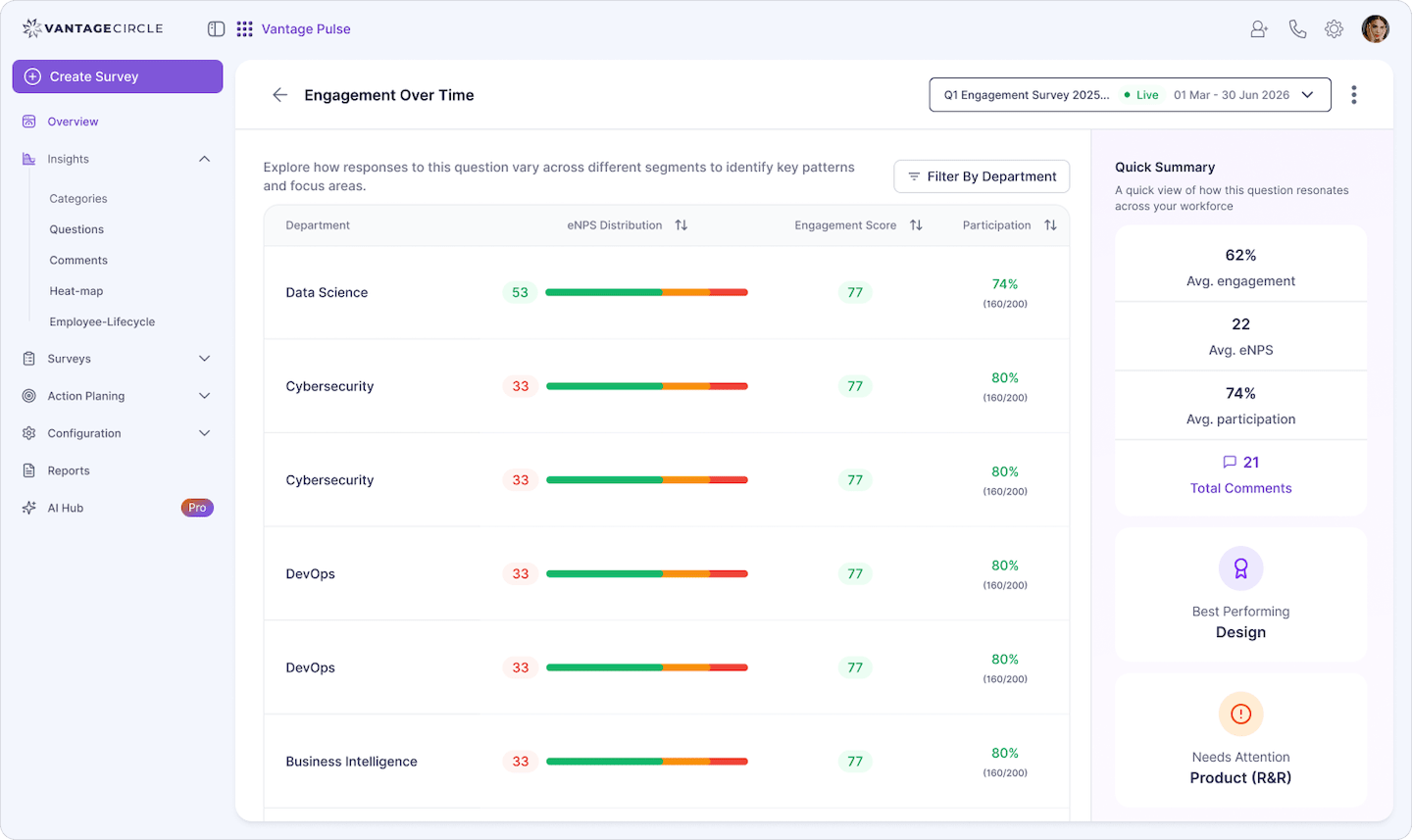
The 7 items fit easily into a short, anonymous pulse survey that can be repeated every quarter. Because psychological safety is a team-level climate, a single company-wide average hides the teams that need attention most, and a department-wise view shows exactly which managers need support, instead of averaging everyone into one meaningless number.
How to Build Psychological Safety at Work: 7 Practical Steps
Leaders build psychological safety by inviting input, responding well to bad news, and showing their own mistakes, repeated every week rather than announced once.
1. Frame work as learning, not execution
When a project is framed as "we're figuring this out" instead of "here's the plan, execute it," mistakes become information instead of failures. This single reframe makes it easier to admit when something isn't working.
2. Ask for input before you give yours
A manager who shares their own opinion first anchors the room, and most people will simply agree with it. Asking others first, then adding your own view last, surfaces more honest input.
3. Respond to bad news with thanks, not blame
How a manager reacts the first time someone admits a mistake or raises bad news sets the norm for every time after. A defensive or blaming reaction teaches the team to hide the next one instead.
| Moment | What to Say |
|---|---|
| Someone raises a risk | "Thanks for flagging that before it became a bigger problem. What do you need from me?" |
| Someone admits a mistake | "I appreciate you telling me directly. Let's figure out the fix together." |
| Someone disagrees with your decision | "Say more about what you're seeing that I might be missing." |
| Someone asks a basic question | "Good question, here's the context," rather than any version of "you should already know this." |
| Someone brings bad news | "What's the situation now, and what do you need to fix it?" instead of asking who's at fault first. |
4. Show your own mistakes
A manager who never admits being wrong signals that admitting mistakes isn't actually safe, regardless of what they say in a meeting. Naming a recent mistake out loud, including what you learned from it, does more than any policy statement.
5. Check in on more than deliverables
"When managers consistently check in, not just on deliverables, but on energy levels, on stress patterns, on what support their team needs, that builds psychological safety."
Meera Mohandas, India Head of Rewards, Wipro, on the podcast episode Unlocking the X Factor: Well-being in Total Rewards
A status update tells you if the work is on track. A real check-in tells you if the person doing it is running out of capacity before it shows up as missed deadlines or workload problems.
6. Recognize candor, not just results
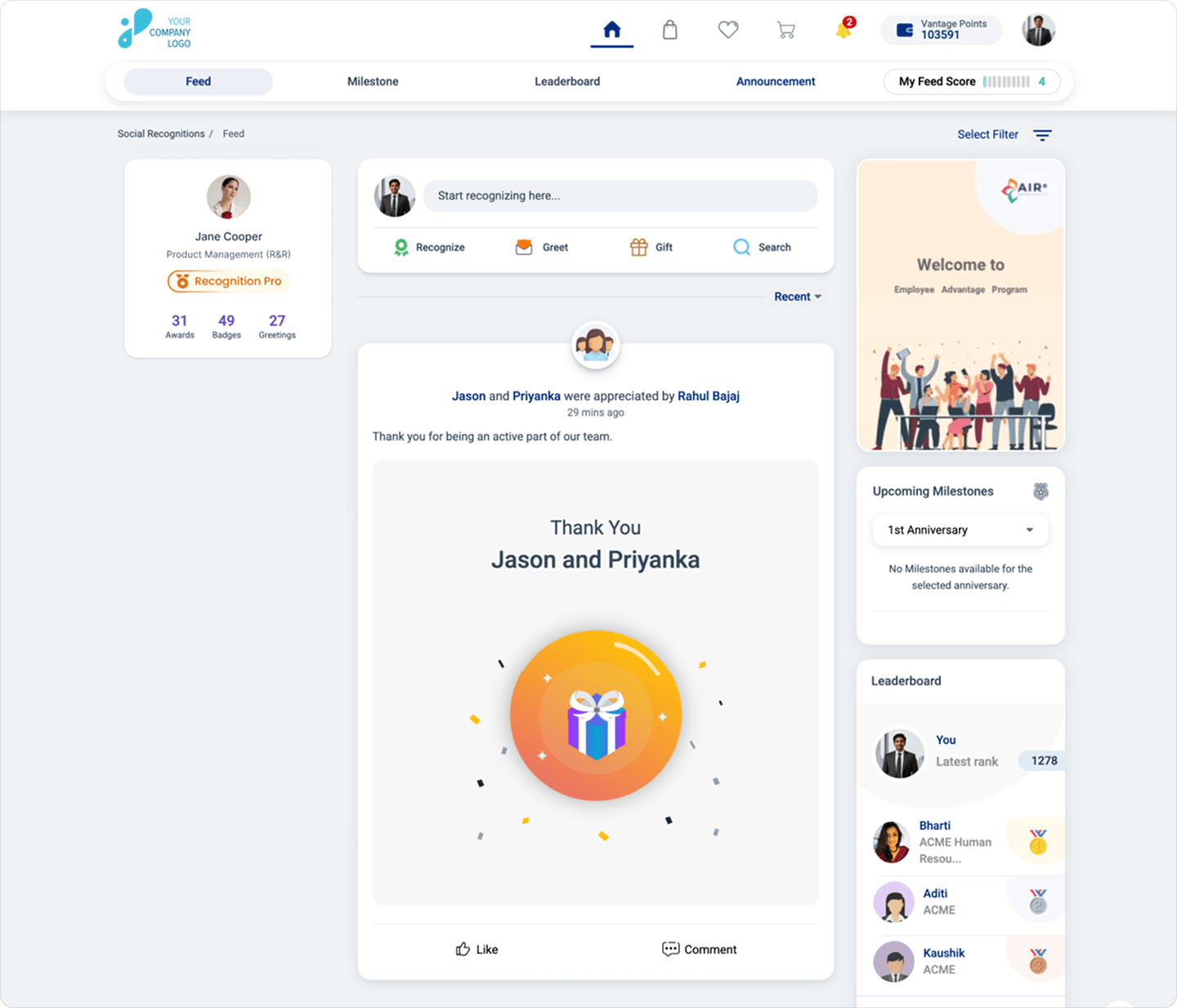
Thanking someone publicly for flagging a risk early, or for admitting a mistake before it escalated, tells the whole team that speaking up is valued, not just tolerated.
"Without judging, without practicing any biases, if I'm actively listening, that creates a lot of space for an individual, that safe space."
Binni Rai, Chief Human Resource Officer, Omnipresent Robot Tech, on the podcast episode Humanizing the Workplace Through Recognition
Tagging a value like "speak up" or "learn fast" on a piece of recognition turns candor into something visible, not just something you say you want. If recognition consistently reaches the same few people and never the quieter or newer members of a team, that's an inclusion-safety gap worth checking.
7. Close the loop on feedback
Asking for feedback and never acting on it teaches people their input doesn't matter, which undoes every other step on this list. Make sure every round of employee feedback ends with a visible response, even when the answer is "not yet, and here's why."
Keeping an open-door policy only works if people actually see it used, not just announced.
Conclusion
The managers who get this right rarely talk about psychological safety by name. They just react well the first time someone tells them something went wrong, ask a real question instead of assigning blame, and let a disagreement sit in the room long enough to be heard. None of that shows up as its own line on an engagement survey, but it is the difference between a team that raises a problem in week one and a team that buries it until it becomes a resignation.
Edmondson's hospital teams never set out to prove anything about safety. They were simply the ones willing to say what had gone wrong. That is still the simplest test available to any manager: not whether the team has a policy for speaking up, but whether someone actually did, this week, without being asked twice.
FAQ
What are the benefits of psychological safety?
Teams with higher psychological safety catch mistakes earlier, learn faster from failure, make better decisions because dissent gets raised before a decision is finalized, and hold onto employees for longer. Research from the Center for Creative Leadership also links it to lower task and relationship conflict within a team.
What are the characteristics of psychological safety?
A psychologically safe team shows 4 characteristics in sequence: people feel included, people feel safe to learn and ask questions, people feel safe to contribute their own ideas, and people feel safe to challenge decisions and the status quo. These map directly to Timothy R. Clark's 4 stages.
How do you create psychological safety in the workplace?
Frame work as learning rather than flawless execution, ask for input before giving your own, respond to bad news with thanks instead of blame, admit your own mistakes, check in on well-being and not just deliverables, recognize candor publicly, and close the loop on any feedback you collect.
What is the impact of psychological safety on teams?
Google's Project Aristotle found psychological safety was the single strongest predictor of team effectiveness among the 180 teams it studied, ahead of factors like individual talent or team structure.
How do you measure psychological safety?
Run Amy Edmondson's validated 7-item survey anonymously, score it on a 7-point scale with 3 items reverse-scored, and read team averages and the spread between members rather than individual scores.
Who defined psychological safety?
Organizational psychologists Edgar Schein and Warren Bennis used the term as early as 1965 in their research on organizational change. Harvard Business School professor Amy Edmondson popularized team psychological safety with her 1999 research and later work, making it the concept HR and management use today.
What does a lack of psychological safety look like?
As Amy Edmondson put it in The Fearless Organization, it looks like: don't want to look ignorant, don't ask questions; don't want to look incompetent, don't admit to mistakes or weaknesses; don't want to be seen as disruptive, don't make suggestions.

Shaoni Gupta is a content marketing specialist at Vantage Circle, with expertise in scriptwriting and copywriting in the field of employee rewards and recognition.
Connect with Shaoni on LinkedIn.