I recall that exact moment when the star product manager of our organization walked straight into the office one fine day and handed in her resignation letter. Four more followed three weeks later. Within a quarter, we lost a chunk of our workforce, not due to a recession or layoffs, but to voluntary attrition.
What made it worse was that no one saw it coming. We had the usual engagement surveys, annual reviews, and exit interviews. And yet we had no clear answer for why they left, other than guessing.
Most articles on employee attrition list the same causes and stop there. The harder question is: which cause is driving your attrition, and what do you do once you know?
This blog covers all of it: the causes, the types, how to calculate your attrition rate, the real cost of attrition, and a six-step plan to bring it down, backed by data.
What Is Employee Attrition?
Employee attrition is the natural, gradual loss of employees over time through resignation, retirement, or role elimination, where the position is not always backfilled.
That last part matters more than most leaders realize. Turnover usually counts every employee who leaves and assumes the role will be filled again. But attrition points to a bigger change. It sheds light on the fact that the workforce may be shrinking or changing over time, whether planned or unplanned.
For example, a company that removes an entire department is facing attrition. So is a company that keeps losing experienced employees to retirement without preparing the next group of leaders.
Turnover counts every separation and assumes the role will be refilled. Attrition counts separations where the role may not be refilled at all. High attrition does not always imply high turnover, but it almost always means shrinking institutional knowledge and compounding knowledge gaps over time.
The 8 Most Common Reasons for Employee Attrition
Here are the most common reasons for employee attrition that require your immediate attention:
1. Inadequate Compensation and Benefits
Employees leave for compensation when the gap between their market value and their current pay becomes too wide to ignore.
Obsolete salary bands are the most common culprit here. When a new hire earns more than a tenured employee doing the same work, the message becomes clear to employees: Loyalty is not rewarded here. Pay inequity compounds in remote and distributed teams, where salary discrepancies across geographies become visible in ways they never existed in a single-office environment.
The warning signs are specific: employees referencing competitor offers in one-on-ones, a spike in departures immediately after the annual review season, or a pattern of exits to one or two competitors offering 20-30% more.
What HR can do: Run a compensation market audit at least once a year. Fix internal pay inequities before employees bring them up. Make total rewards visible and accessible, not buried in a benefits portal no one opens.
2. Poor Management and Leadership
People leave managers not companies. – Marcus Buckinghum
Marcus Buckingham said it first. The State of the Global Workplace report (2023) found that managers account for at least 70% of the variance in employee engagement scores. It's clear that a disengaged team is an attrition risk sitting right in the open. And the manager is usually the cause.
The patterns that drive exits are familiar to anyone who has studied this long enough: micromanagement that signals distrust, feedback that only arrives at formal performance reviews, favoritism that distorts opportunity, information hoarding that leaves teams working blind, and managers who fail to advocate for their people in rooms those employees never enter.
What HR can do: Invest in leadership development before promotion, not after. Train managers for feedback, coaching, and conflict resolution. Track manager-level engagement scores separately from company-wide averages.
3. Limited Career Growth
Research shows that 70% of employees are somewhat likely to leave their current job to work for an organization known for investing in employee development and learning.
Organizations have growth paths, but they remain invisible. Succession planning often happens behind closed executive doors. Lateral moves exist but are never formally offered. Development conversations happen only once a year that produce no concrete next step. The employee who cannot name their next role in the organization is already scanning job boards.
The highest concentration of attrition for knowledge workers generally falls in the two-to-four-year tenure band. These are employees who have learned the role, built relationships, and are now making a deliberate decision about their future. Hence, organizations that make career paths visible and drive development conversations routinely lose significantly fewer people at this stage.
What HR can do: Make career paths explicit and public. Build lateral mobility into the operating rhythm. Have career conversations quarterly, not annually. Ensure high-potential employees know they are high-potential employees.
4. Burnout and Poor Work-Life Balance
Burnout drives attrition by targeting the employees who care most: the ones who push hardest until they finally break.
The warning signs are consistently visible across industries: chronic understaffing with no relief in sight; a culture that celebrates overwork as commitment; disappearing boundaries, with after-hours messages becoming the norm; and no recovery time between high-intensity delivery cycles.
What makes burnout particularly costly from a retention standpoint is who leaves because of it. Burned-out employees are often top performers. They had the most options. They had the least tolerance for a situation that was not improving. By the time a high performer hands in their resignation citing burnout, most organizations have already lost months of runway to reverse it.
What HR can do: Enforce realistic workloads. Staff adequately before people are stretched, not after they start leaving. Protect time off and mean it. Require leaders to model boundaries, not just talk about them in all-hands meetings.
5. Lack of Recognition
A Forbes study reveals that 66% of employees would quit their jobs if they didn't feel appreciated.
A study reveals that the top 20% of companies with a "recognition-rich culture," have a 31% lower voluntary turnover rate.
The data on recognition reveal that it is no longer a nice-to-have, but a retention lever.
Recognition gaps cluster in predictable places: bonuses that arrive months after the work they were meant to acknowledge, inconsistent acknowledgment of similar contributions across teams, and peer recognition that goes unseen because feedback only flows top-down.
What HR can do: Make recognition frequent, specific, and visible. Build peer-to-peer recognition into daily workflows, not just manager-to-employee channels. Connect recognition to the work itself, not to the calendar.
6. Culture Misalignment
When the values a company states and the values it practices are visibly different, that's when we call that cultural values are misaligned. And the attrition resulting from this misalignment is culture attrition.
This kind of attrition is the hardest to surface and the easiest to misread. It shows up in specific, observable patterns, such as incivility reframed as "direct feedback," high performers protected from accountability because of their output numbers, in-group and out-group dynamics that make belonging conditional on certain behaviors, and blame cultures that punish mistakes rather than learn from them.
Employees who leave for cultural reasons rarely cite their actual reasons during exit. Instead, they cite career growth or compensation, because those are safer answers. Exit interview data rarely captures culture attrition cleanly. Stay interview data does. Organizations with genuinely low culture-driven attrition tend to be the ones that ask harder questions well before the exit conversation happens.
What HR can do: Apply zero tolerance for toxic behavior regardless of performance level. Build reporting channels that have real follow-through, not just real-looking forms. The standard you walk past is the standard you set.
7. Ineffective Onboarding
The most common onboarding failure is the gap between the role described in the interview and the role experienced in the first quarter. It is not always dishonesty. It's often a mismatch between what the hiring manager believed the role was and what the team actually needed. Employees may feel misled, even if that was not the company's intention.
The secondary failure is subtler: talented employees get placed in roles that underutilize them. Promised projects never materialize. No one asks how it goes until the 90-day review. And by this point, the employee has already made their decision.
What HR can do: Write job descriptions that reflect the actual role. Build a structured onboarding process with a genuine 30/60/90-day check-in cadence. Be honest with recruitment, because early attrition is the most expensive kind.
8. Lack of Flexibility
Strict return-to-office rules can push employees to leave when they do not consider the nature of the role. The same happens when companies offer little flexibility for caregivers or force employees into only two choices: fully in-office or fully remote.
The employees most likely to leave because of limited flexibility are often experienced, mid-career, and high-performing. They usually have more career options, so they can choose workplaces that better fit their needs.
What HR can do: Audit which roles genuinely require physical presence and which do not. Build flexible frameworks that give managers and teams the tools to set clear expectations without defaulting to blanket rigidity. Flexibility is no longer a perk. For a large portion of the workforce, it is a baseline.
What Are the 5 Types of Employee Attrition?
Having a sound understanding of the types of employee attrition can be helpful before we dive into any further discussions.
| Type | What It Means |
|---|---|
| Voluntary | Employee chooses to leave (resignation, departure for another role) |
| Involuntary | Organization-initiated (layoffs, terminations, role eliminations) |
| Internal | Employee moves to a different team or role within the same company |
| Demographic-specific | Attrition concentrated in a particular gender, age group, or ethnic demographic |
| Retirement | Employees leaving due to age or tenure milestone, with or without a succession plan in place |
How to Calculate Your Employee Attrition Rate
Calculate the employee attrition rate by dividing the number of employees left in a period by the average headcount for that period, then multiplying by 100.
Formula: Attrition Rate (%) = (Employees who left ÷ Average headcount) × 100
Example: Start of year: 500 employees, End of year: 480 employees
Average headcount: (500 + 480) ÷ 2 = 490
Employees who left during the year: 45
Attrition rate: 45 ÷ 490 × 100 = 9.2%
Track this every month or quarter, not just once a year. Annual numbers can hide sudden increases in exits that may point to bigger issues, such as a new manager, a return-to-office rule, or a promotion cycle that did not go well.
The pattern over time is just as important as the final number.
What Is the Real Cost of Employee Attrition?
According to SHRM, the cost of replacing an employee can range from 50% to 200% of their annual salary, depending on their level.
Here is what that looks like in practice. A company with 500 employees, an average salary of $75,000, and a 10% annual attrition rate loses 50 people per year. At the conservative 50% estimate, that is $1.875 million. At 100%, it doubles. These are not abstract figures. They show up in recruiting fees, hiring manager hours, new hire ramp time, and the institutional knowledge that walks out the door and never fully comes back.
The cost breakdown is worth understanding because it reveals where to invest:
Direct costs: recruiting fees, job advertising, background checks, onboarding administration
Productivity costs: 6-8 months for most professional-level hires to reach full productivity
Knowledge costs: undocumented processes, institutional relationships, and client context that cannot be transferred in a two-week handover
Training costs: certifications, skills, and development investments that now benefit whoever hired them next
What the numbers often miss is the morale cost to the people who stay. When departures cluster, the remaining employees start asking whether they should too. That number compounds faster when morale drops, and no one intervenes.
How to Reduce Employee Attrition: A 6-Step Diagnostic
Many organizations tend to skip straight to expensive interventions, perks programs, off-sites, and new benefits packages, without knowing which driver was driving the outcome. Acting on a hunch wastes budget and erodes credibility. But acting on data changes outcomes. These six steps provide HR with a structured method for identifying the source before committing to a solution.
Step 1: Measure Engagement and Attrition Risk
Start by measuring, because you cannot fix what you cannot see.
An eNPS (Employee Net Promoter Score) survey gives HR a single, repeatable risk signal. A falling score in one department is an early attrition warning that can be acted on before the resignations land on your desk.

Source: Vantage Pulse
Attrition risk hides in averages. A 7 out of 10 engagement score looks manageable until you break it by team and find one manager running at 4. Department-level insights shift HR from reactive to proactive, and that shift is where most retention wins happen.
Step 2: Run Stay and Exit Interviews
Most organizations run exit interviews. Fewer run stay interviews with high-tenure, high-performing employees. The gap matters here as an exit interview tells you what has already happened. A stay interview tells you what is at risk of happening next quarter.
There is another gap worth closing: employees rarely give the real reason for leaving in a formal, on-the-record exit conversation. Anonymous feedback channels surface the candid drivers that formal interviews almost never capture. If you want to know why people are leaving, you must create conditions where they feel safe sharing with you.
Step 3: Fix Compensation and Managers First
Compensation and management are the two attrition drivers with the clearest return on investment and the shortest window to act.
Both have a tipping point. Once an employee has decided they are underpaid or under-managed, the decision to leave is largely made. The cost of acting after that point is always higher than the cost of acting before it. Use the market audit to identify the pay gaps. Fix both before they compel employees to depart.
Step 4: Build Visible Career Paths
High performers leave because they cannot see a future for themselves at the company. Hence, navigate paths in a way that shows and assures them a future in the company. Make development plans explicit, not assumed. Build internal mobility into the HR operating rhythm. Have career conversations at least quarterly. The employee who can name their next role within the organization is rarely the one updating their LinkedIn profile.
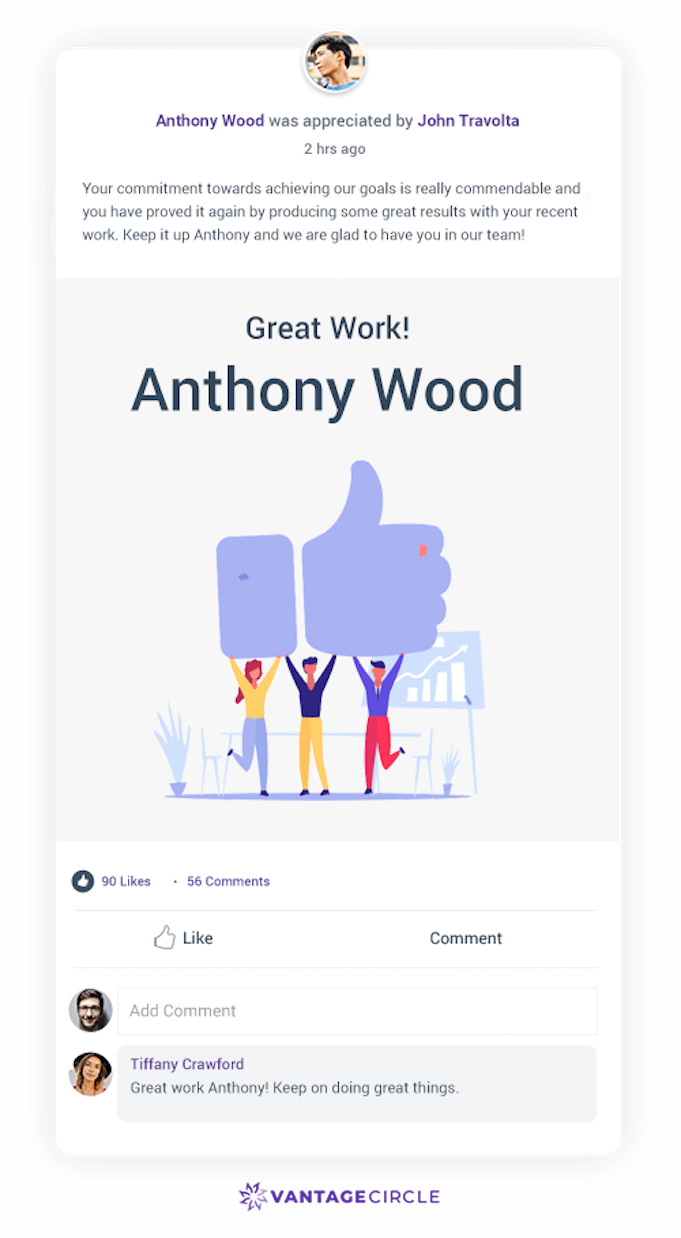
Step 5: Strengthen Recognition
Recognition is the attrition lever HR can move fastest, and it costs significantly less than any other retention intervention at scale.
Source: Vantage Recognition
The goal is not a formal rewards program sitting on a platform no one opens. The goal is a culture where good work is consistently seen and acknowledged by managers and peers alike. Frequent, specific recognition changes the felt experience of work. It signals to employees that their contribution matters, which is the foundational reason most people stay. When that signal is absent, disengagement follows, and attrition follows disengagement.
Step 6: Track the Rate and Iterate
Attrition is not a project with a finish line. It is a metric you track, respond to, and improve over time.
Set a monthly or quarterly cadence for reviewing attrition rate by department, tenure band, and separation type. Build the baseline now so that every intervention you make can be evaluated against a real benchmark. The organizations that meaningfully reduce attrition rates over 12-18 months are not the ones that launched the best new perk. They are the ones who measured consistently and adjusted early.
Conclusion
Most attrition is not inevitable. It is the accumulated result of unaddressed compensation gaps, management practices that erode trust, career paths no one could see, and recognition that never came. The drivers are understandable. The fixes are documented. The six-step diagnostic in this blog exists because acting on data beats acting on regret.
Companies that reduce attrition are not the ones with the most creative perks. They are the ones who measure early, diagnose honestly, and fix the right things before the exit interviews start stacking up.
So, start with your engagement data, run the stay interviews, fix compensation, and management. The rest follows from there.
FAQs
What are the top 5 reasons for attrition?
The top 5 reasons for employee attrition are inadequate compensation, poor management, limited career growth, burnout, and lack of recognition. These five account for the majority of voluntary departures in most industries, though their relative weight varies significantly by sector, role type, and workforce demographics.
What are the root causes of employee attrition?
The root causes of employee attrition are the underlying organizational failures behind each surface driver: pay structures that do not keep pace with the market, management practices that prioritize output over people development, career frameworks that are opaque or inconsistently applied, cultures that normalize chronic overwork, and recognition systems that are sporadic or exclusively top-down.
What are the 5 types of attrition?
The 5 types of employee attrition are voluntary (employee-initiated), involuntary (organization-initiated), internal (transfers within the company), demographic-specific (concentrated in a particular gender, age group, or ethnic demographic), and retirement. Each type requires a different response from HR, and tracking them separately gives a much clearer picture than a single headline rate.
What are the 5 C's of retention?
The 5 C's of employee retention are Compensation, Career growth, Culture, Connections (relationships at work), and Contribution (a sense of purpose and impact in the role). Organizations that score well across all five consistently see lower voluntary attrition than those addressing only one or two in isolation.

Riha Jaishi is a Content Marketing Specialist at Vantage Circle and host of the HR Vantage Influencers podcast, sharing insights that help organizations build recognition-rich, people-first cultures!!
Connect with Riha on LinkedIn.