
The single greatest competitive advantage an organization possesses is not its technology, market share, or excellent infrastructure. It is the high-performing employees who build, sell, and support that organization.
And yet, many organizations are hemorrhaging this critical resource, not due to mass layoffs or underperformers moving on, but because of a subtle, systemic drain known as regrettable attrition.
Regrettable attrition is the voluntary loss of employees an organization actively wanted to keep. It affects high performers, critical-role holders, and people carrying institutional knowledge that is hard to replace. It is the opposite of non-regrettable attrition, where an underperformer's departure leaves the organization stronger, not weaker.
If you have observed today's volatile talent market, you will know that employee attrition is a fierce, costly battle, and retaining your high-impact employees has become the ultimate retention metric.
This failure to retain core talent represents a significant financial drain. Research by the Center for American Progress (2015) shows that the cost of replacing a specialized, high-skilled employee can reach 213% of their annual salary.
This guide explains what regrettable attrition is, how it differs from non-regrettable attrition, the early warning signs to watch, how to calculate your rate, and the strategies that keep your best people from leaving.
What Is Regrettable Attrition?

Regrettable attrition refers to the loss of employees whose exit can seriously affect the organization's performance, knowledge base, and strategic objectives.
The Core Definition
At its heart, regrettable attrition is the voluntary turnover of an employee who is considered a high performer in a critical role.
- High Performer: An employee who consistently exceeds expectations, drives innovation, and possesses specialized or indispensable skills.
- Critical Role: A position directly tied to core business value (e.g., a top-quota-carrying Account Executive, a Principal Engineer, or a Senior Product Manager).
When these two elements align, the exit is regrettable because the cost extends far beyond a vacant desk. It hits your revenue, innovation pipeline, and team morale.
Quick Definition: Regrettable attrition = the voluntary exit of a high performer in a role that is hard to fill. Every such departure is a measurable setback to organizational performance.
Regrettable vs. Non-Regrettable Attrition
Understanding the difference is the first step toward effective talent retention. While many companies track overall attrition (all voluntary departures), distinguishing between the two types gives your retention strategy far more precision.
| Dimension | Regrettable Attrition | Non-Regrettable Attrition |
|---|---|---|
| Employee performance | High performer; consistently exceeds expectations | Average or low performer; meets minimum standards |
| Role criticality | Critical role tied to core business outcomes | Role that can be refilled quickly or restructured |
| Knowledge transfer | Specialized knowledge that is hard to replace | Knowledge that is well-documented or transferable |
| Organizational impact | Immediate damage to revenue, innovation, and morale | Neutral to mildly positive; creates opportunity to refresh |
| Replacement timeline | 3 to 12 months to find and onboard an equivalent | Weeks to a few months |
| Urgency of response | Immediate investigation and prevention plan | Standard offboarding process |
By separating these metrics, you can shift your focus from chasing a low overall turnover percentage to strategically protecting your most valuable assets.
Regrettable Attrition Examples
Understanding the definition becomes clearer with concrete cases.
A clearly regrettable exit: A Principal Software Engineer with eight years of institutional knowledge leaves for a competitor after feeling her career growth had stalled. Her team loses its technical lead, a key product launch is delayed by three months, and recruitment spends six months finding a comparable hire.
A clearly non-regrettable exit: A sales representative who has missed quota for three consecutive quarters resigns to pursue a different career. The team's output is unaffected, and the role is filled within six weeks from an existing candidate pipeline.
A less obvious case: A customer success manager who is not a top performer by metrics but holds primary relationships with three of the company's largest accounts. If those accounts leave with her, the exit is regrettable despite her average performance rating. This is exactly why the criticality check matters as much as the performance check.
Is Attrition the Same as a Layoff?

No. It is understandable why attrition can be confused with layoffs, as both result in a reduced headcount. The causes are fundamentally different: attrition (voluntary) is when the employee chooses to leave the company. A layoff is when the company decides to terminate the employee's role.
Regrettable attrition focuses solely on the voluntary departures of top talent, suggesting internal issues that need to be addressed. A layoff, even of a high performer, is not regrettable attrition in the HR sense because the decision originated with the organization. You can read more about the distinction in our guide to employee turnover.
What Are the 4 Early Warning Signs of Regrettable Attrition?
One of the biggest mistakes companies often make is treating regrettable attrition as an unavoidable event. In reality, the decision to leave is not sudden. It is a slow-burning process, usually signaled by clear behavioral and productivity changes months in advance.
Your leaders and managers must be trained to proactively identify these signals to execute a retention plan before it is too late. Vantage Pulse sentiment analysis reads the tone of pulse responses across a team, so a quiet decline shows up as a trend rather than a surprise resignation.
1. Behavioral Disengagement: The Retreat from the Team
This is the earliest, most human sign of an impending exit. The employee has not quit the job yet, but they have started quitting the culture. This withdrawal manifests as:
- Reduced participation in meetings.
- Stopping extra-curricular contributions like mentoring or being the social glue of the team.
- A noticeable decline in proactive communication or enthusiasm for new projects.
They begin to create emotional distance because they are mentally preparing for a future outside the company. When connection disappears, attrition follows.
Disengagement usually appears in the data before it appears in behavior. A regular eNPS (Employee Net Promoter Score) pulse from Vantage Pulse tracks whether employees would still recommend the company as a place to work: the single clearest early signal that a high performer is starting to look elsewhere.
2. Productivity Stagnation: The Quiet Quitting Precursor

For a top performer, quiet quitting is not about doing the minimum. It is about their work going from great to merely good. They stop innovating or going above and beyond. They meet deadlines but no longer beat them, and they stop suggesting better, long-term solutions.
This pattern is especially damaging in high-growth environments where speed is everything. One study reports that 52% of U.S. employees were actively quiet quitting. A top performer slipping into that majority is a significant red flag.
3. Lack of Career Planning: The Sudden Stalling
This is one of the most reliable indicators for high-potential employees. A top performer who was previously proactive about their growth suddenly shows no interest in their own development plan, training, or career-pathing conversations. They are now planning their career path with another company.
7 in 10 workers say learning improves their sense of connection to their organization (LinkedIn Workplace Learning Report, 2024). A sudden loss of interest in development signals that an employee believes the investment in their growth has run out.
4. Increased Complaints About Resources or Leadership
While constructive criticism is healthy, a high performer who is preparing to leave may become increasingly critical or vocal about organizational failures. This is rarely an attempt to fix things. It is more often a way to justify an upcoming departure to themselves and their peers.
This behavior, if not addressed through open, non-defensive dialogue, can quickly spread dissatisfaction across the team.
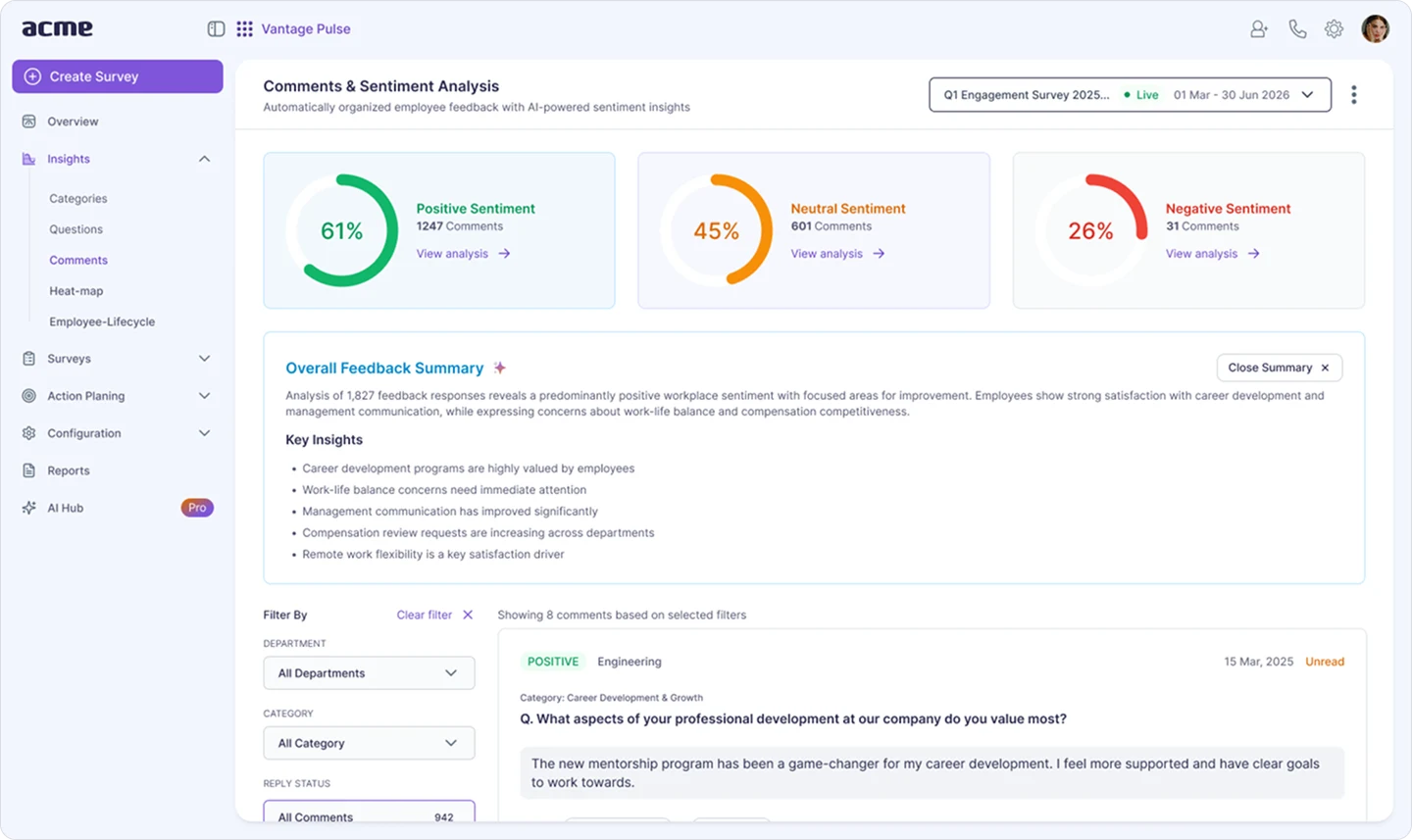
The good news is you can spot these behavioral shifts before they become irreversible by deploying pulse surveys. Regular, anonymous pulse surveys through Vantage Pulse, focused on employee sentiment, team collaboration, and work-life balance, can flag department-level disengagement themes before resignations follow.
What Proactive Strategies Prevent Regrettable Attrition?
The best defense against losing your most valuable team members is a proactive, employee retention strategy. Here are four key strategies to prevent regrettable attrition.

Strategy 1: Run Stay Interviews Before Exits Occur
The classic exit interview is fundamentally a post-mortem: the valuable data arrives too late. Stay interviews are a proactive alternative.
Stay interviews are structured, one-on-one conversations focused entirely on what keeps an employee at the company and what might tempt them to leave. This simple move makes employees feel genuinely heard, and employees who feel heard are far less likely to be quietly planning a departure.
A stay interview only works if the employee is candid, and candor is hard face-to-face. Anonymous pulse responses through Vantage Pulse give employees a safe channel to flag retention risks early, turning the stay interview into a follow-up conversation rather than a first discovery.
Strategy 2: Build a Career Lattice, Not Just a Ladder
We have seen how restrictive the traditional vertical career ladder can be. Top talent, especially those who seek broad experience, will leave if they feel boxed in. A career lattice offers lateral, project-based opportunities that allow an employee to expand their skillset without needing an immediate promotion.
Strategies like this retain deep institutional knowledge while satisfying the high performer's need for continuous challenge and growth.
Strategy 3: Make Recognition Your Primary Retention Tool
Lack of appreciation is consistently cited as a leading reason for voluntary departures. Recognition is the fuel of a high-performance culture, and it works only when it is consistent, meaningful, and shared across peers. Frequent peer-to-peer recognition through Vantage Rewards keeps appreciation continuous rather than reserved for annual reviews, which directly reduces the quiet drift that precedes a regrettable exit.
An important signal to watch: recognition analytics show which employees and teams are consistently under-recognized. Under-recognized employees disengage first and leave without warning.
Strategy 4: Train Managers to Coach, Not Just Manage

The role of a manager in retaining top talent cannot be overlooked. A toxic or unsupportive manager is the single most significant contributor to regrettable attrition. Gallup research estimates that managers account for 70% of the variance in employee engagement.
To prevent regrettable departures, train your managers to:
- Ask for Feedback: Regularly request input on their own leadership style.
- Lead with Empathy: Prioritize the team member's well-being and development over mere task completion.
- Facilitate, Not Dictate: View their role as removing obstacles so their high performers can excel, fostering the autonomy that retains technical and creative talent.
Structured manager recognition through Vantage Rewards gives managers a consistent way to reinforce the behaviors they want to retain, making recognition a coaching habit rather than an occasional gesture.
How Do You Calculate the Regrettable Attrition Rate?
Tracking overall attrition rate is foundational, but monitoring your regrettable rate is strategic. It moves the metric from an HR problem to a KPI (Key Performance Indicator) that directly measures the health of your talent pipeline.
The Formula
The regrettable attrition rate is calculated as:
Regrettable Attrition Rate = (Number of Regrettable Departures ÷ Average Headcount) × 100
The math is straightforward. The harder part is deciding which departures to classify as regrettable in the first place.
Step 1: Check the Employee Against Two Key Questions
For every person who voluntarily quits, answer two objective questions:
- Performance Check: Was this person a high performer?
Was the employee in the top 10% or 20% of their team? Were they consistently excelling in their performance reviews?
- Criticality Check: Were they in a critical role?
Did they have knowledge, skills, or responsibilities that would be nearly impossible to replace or transfer to someone else in the next six months?
Step 2: Classify the Departure
If the answer to either question in Step 1 is "Yes," classify that person's departure as regrettable.
Why track this separate number?
Tracking this KPI is the only way for company leaders to know if their retention efforts are actually working on the people who matter most.
If your overall turnover rate looks low and safe, but your regrettable rate is high, it means you are keeping the average performers but constantly losing your best talent. That is a strategic failure and a significant drain on your future potential.
Do Give a Read: How To Calculate Employee Turnover Rate
What Is a Good Regrettable Attrition Benchmark?

There is no perfect universal number, as it varies by industry. However, the most crucial goal for any innovative organization is simple: your regrettable attrition rate must be much lower than your overall turnover rate.
- Simple Goal: If 10% of your staff leave every year, aim for your regrettable rate to be less than 2%, and ideally closer to zero.
- The Bottom Line: Top-performing companies aim to keep this rate as close to zero as possible. Every percentage point above zero means measurable damage to your innovation, team knowledge, and revenue pipeline.
How Can You Use Exit Data to Build a Better Retention Strategy?
The last and perhaps the most crucial step in tackling regrettable attrition is to turn the reactive data from employee exits into proactive, systemic changes. Here are three ways to do that.
1. Accept the Resignation Professionally

When a valued team member resigns, the leader's response sets the final tone and opens the door for honest feedback.
A leader should express genuine disappointment and support for the employee's decision, then request their honest feedback to help the company learn. For example:
"I am truly disappointed to hear that, as you are a valued member of our team and your contributions have been instrumental to our success. I want to be supportive of your decision, and I would be sincerely grateful if you would be open to sharing your honest, candid feedback in a focused exit interview so we can learn and improve from this experience."
2. Conduct a Focused Regrettable Exit Interview
When an exit is marked as regrettable, the exit interview becomes a goldmine of honest, high-value data.
Actionable Advice: Conduct this interview with an objective third party (HR or a consultant) to encourage maximum candor.
Key Questions to Ask:
- "What was the primary reason that led you to search for a new role?"
- "What does the new role offer that you could not get here?"
- "If you had my job, what is the one thing you would fix to improve the experience for a top performer like yourself?"
3. Build a Regrettable Attrition Report
The final step is connecting the dots from collected data to create targeted, urgent solutions.
Create a Regrettable Attrition report every quarter. This report must combine quantitative data (which teams and roles are losing talent) with qualitative data (the recurring themes from exit interviews).
Example: Suppose your Q3 data shows 70% of regrettable departures came from the Engineering team, and exit interviews consistently cited "stagnant career growth" as the primary reason. The urgent mandate would be to create a formal, technical-track career lattice for engineers within the next quarter.
This moves the conversation from "We have a turnover problem" to a clear, executive-level mandate. Companies that use data-driven retention strategies see 35% higher productivity and 12% lower labor costs (HBR, via Google Cloud Transform, 2023).
Recognition analytics from Vantage Circle show which teams and individuals are under-recognized, turning an exit report into a targeted list of where to act before the next resignation. Pair this with an employee pulse survey to track sentiment in your highest-risk teams on a continuous basis.
Frequently Asked Questions
What does "regrettable attrition" mean?
Regrettable attrition means the voluntary departure of an employee an organization actively wanted to retain: a high performer in a critical role whose exit damages revenue, innovation, or institutional knowledge. The term separates strategically harmful exits from routine turnover. Unlike non-regrettable attrition, where an underperformer's departure is neutral or positive, every regrettable exit is a measurable setback.
What does 80% attrition mean?
An 80% attrition rate means an organization lost 80% of its average workforce within a given period, typically one year. For example, a company with 100 employees at the start of the year would have seen 80 departures by year end. An attrition rate this high signals a severe retention crisis and almost certainly includes significant regrettable loss alongside non-regrettable turnover.
What does "regrettable" mean in a resignation?
In an HR context, "regrettable" applied to a resignation means the employer actively wished the employee had stayed. The resignation is logged as regrettable in workforce analytics because it is a preventable loss of a high-value person, as distinct from routine or expected turnover. HR teams use this classification to separate signal from noise when analyzing their turnover data.
What is non-regrettable attrition?
Non-regrettable attrition is the voluntary departure of an employee whose exit is neutral or positive for the organization: typically a low performer, someone in an easily filled role, or a poor cultural fit. Organizations track non-regrettable attrition separately to avoid inflating the regrettable rate and to assess whether natural workforce turnover is healthy. A small amount of non-regrettable attrition is considered normal and even beneficial.
Is attrition good or bad?
Attrition is neither inherently good nor bad. A low level of non-regrettable attrition is healthy: it removes poor fits, refreshes teams, and creates room for high-potential hires. Regrettable attrition, however, is always damaging. The goal for any organization is to minimize regrettable exits while accepting that some level of overall voluntary turnover is unavoidable.
What are the 5 C's of HR?
The 5 C's of HR is a leadership framework that identifies five core responsibilities of an effective HR function: Competence (ensuring the workforce has the skills to perform), Commitment (building loyalty and reducing regrettable attrition), Contribution (connecting individual output to organizational goals), Culture (building an environment where high performers choose to stay), and Communication (maintaining transparency between leaders and employees). Different frameworks use slightly different terms; the version above reflects common HR leadership practice.
Conclusion
Regrettable attrition is not random. It is predictable and preventable. When organizations pay attention to early warning signs, invest in career growth, and build a culture where high performers feel genuinely valued, retention follows.
The companies that win are the ones that keep their best people. The four strategies in this guide: stay interviews, career lattices, consistent recognition, and coaching-led management, are the clearest path to a regrettable attrition rate that stays close to zero.
The time to start is now. Do not wait for your next top performer to hand in their notice.
Your next regrettable attrition is preventable. Here's how:
See how Vantage Circle helps you spot the warning signs early, act fast, and retain the people who matter most.
Book a Free Demo
This article is written by Shaoni Gupta. Shaoni Gupta is a content marketing specialist at Vantage Circle, with expertise in scriptwriting and copywriting in the field of employee rewards and recognition.
Connect with Shaoni on LinkedIn.