
A gold watch for twenty years of service. A trip for hitting the decade mark. A bonus check when someone finally retires. The impulse to celebrate loyalty is instinctive. Whether that gesture just became taxable income is not something most companies think to check until payroll does it for them.
The IRS and Canada's CRA have both thought about this moment longer than most HR teams have, and both start from the same default, that a service award counts as taxable income unless it earns a specific exception. Where they diverge is in what counts as narrow. The two exceptions are built on different logic, use different math, and forgive different mistakes, so a program that clears one country's bar can fail the other's and nobody finds out until it's already cost someone money.
Get the form of the gift wrong and the exemption disappears no matter what it's worth. Get the value wrong and it is no better, since there's no partial credit, the entire amount becomes taxable, not just the part over the line. That same gap shows up once the program crosses the US-Canada border, where these aren't small variations to plan around. A gesture that's fully compliant on one side can still trigger a liability on the other, by design, not by accident.
What follows is exactly where each authority draws that line, covering the dollars, the frequency, and the fine print that decides whether a thank-you stays a thank-you.
Key Takeaways
- What Makes a Service Award Taxable or Tax-Free?
- US Service Award Tax Rules: IRS Thresholds Explained
- Canada Service Award Tax Rules: CRA Thresholds Explained
- US vs. Canada: Service Award Tax Rules Side by Side
- Is This Specific Award Taxable? A Quick Decision Framework
- Structuring a Compliant Service Award Program
This article does not constitute official tax or legal advice. It reflects Vantage Circle's interpretation of current IRS and CRA guidance on employee recognition and service award programs, and its contents do not bind the IRS, the CRA, or any court. Tax rules can change, so consult a qualified tax professional before applying these thresholds to your own program.
What Makes a Service Award Taxable or Tax-Free?
Three conditions decide whether a service award stays tax-free in the US or Canada: the award must be non-cash, it must be tied to a genuine length-of-service or safety milestone rather than routine pay, and its value must fall under the country's dollar threshold.
| Condition | US (IRS) rule | Canada (CRA) rule | Why it matters |
|---|---|---|---|
| Non-cash | Cash, gift cards, and cash equivalents are excluded, with a narrow exception for a small preselected item catalog | Certain gift cards can qualify if they meet CRA's specific non-cash card conditions | Cash is the fastest way to turn a tax-free award taxable in either country |
| Tied to a genuine milestone | Must mark length of service or safety, not double as a performance bonus | Must recognize 5 or more years of service, not routine performance | This is the line both tax authorities draw between recognition and disguised compensation |
| Under the dollar threshold | $1,600 a year under a qualified plan, $400 outside one | $500 or less in fair market value | Exceeding either limit makes the award, or the excess above it, taxable income |
These 3 conditions apply independently. An award can be non-cash and still fail if it's handed out every year instead of on a genuine milestone, or it can mark a real 10-year anniversary and still fail if its value clears the threshold. All 3 boxes need to be checked at once, not just one or two of them.
US Service Award Tax Rules: IRS Thresholds Explained
IRS Publication 15-B draws the line at $1,600 a year, which is the ceiling for a non-cash achievement award given under a qualified written plan. Skip the written plan, and the ceiling drops to $400. Either way, the award still has to be tangible personal property tied to a real length-of-service or safety milestone, since it can't be cash or a stand-in for cash.
| Award type | Dollar threshold | Taxable if exceeded? |
|---|---|---|
| Non-qualified plan award | $400 per employee per year | Yes, the amount above $400 becomes taxable wages |
| Qualified plan award (written plan that doesn't favor highly compensated employees) | $1,600 per employee per year, combined with any non-qualified award | Yes, the amount above $1,600 becomes taxable wages |
| Item of nominal value | No official IRS dollar figure; commonly treated by practitioners as roughly $50 | Excluded entirely from the average-cost calculation for qualified plans |
| Cash, gift cards, vacations, event tickets, or securities | Any amount | Always taxable, regardless of value or milestone |
Qualified vs. non-qualified plan awards: A qualified plan is a written, nondiscriminatory program that doesn't favor highly compensated employees. Only qualified-plan awards get the higher $1,600 ceiling; an ad hoc, non-written award is capped at $400, even if it's otherwise identical. Most companies running an informal, manager-discretion award process are operating under the lower $400 limit without realizing it, simply because nothing is written down.
What Counts as "Tangible Personal Property"
Physical items qualify for the exclusion, among them plaques, watches, trophies, and similar tangible goods. Cash does not qualify, and neither do gift cards, cash equivalents, vacations, meals, lodging, event tickets, stocks, bonds, or other securities, since IRS guidance rules them out even when the milestone is genuine. There is one narrow exception, though, a gift-card-style arrangement granting only the right to select from a small, preselected, non-negotiable catalog of tangible items, since the IRS treats that as tangible personal property rather than a cash equivalent.
The 5-Year Rule for Length-of-Service Exclusions
Length-of-service awards are excluded from income only after an employee's first 5 years with the company, and only if that employee hasn't received another length-of-service award from the same employer within the preceding 5 years. That means a company handing out an anniversary gift every single year is not applying the exclusion correctly, since only the awards spaced at least 5 years apart actually qualify.
Canada Service Award Tax Rules: CRA Thresholds Explained
Move north of the border and the CRA draws its own line, one flat number set at $500 instead of two. A non-cash long-service award stays out of an employee's income once its fair market value falls at or under that figure, the employee has put in 5 or more years, and at least 5 years have passed since their last long-service award.
| Condition | Non-taxable | Taxable |
|---|---|---|
| Award type | Non-cash item, or a gift card meeting CRA's non-cash conditions | Cash, near-cash, or a gift card that doesn't meet those conditions |
| Value | $500 or less in fair market value, including tax | The amount above $500 becomes a taxable benefit |
| Frequency | At least 5 years since the employee's last long-service award | Given more frequently than every 5 years |
This $500 long-service limit stays separate from the CRA's general non-cash gifts and awards allowance, and the two cannot be combined. If an employer gives a $300 long-service award and a $300 general non-cash gift in the same year, the unused $200 from the long-service limit does not roll over to cover the gift, since each limit is tracked and applied on its own.
US vs. Canada: Service Award Tax Rules Side by Side
Put the two rulebooks side by side and one difference stands out above the rest, namely that the US ties its limit to which type of award plan you use, $400 or $1,600 depending on the plan, while Canada ignores plan type entirely and holds every award to one flat fair-market-value cap of $500, plus a hard 5-year frequency rule no plan structure can get around.
| Rule dimension | United States | Canada |
|---|---|---|
| Governing authority | IRS, Publication 15-B (IRC Section 274(j)) | CRA administrative policy |
| Non-cash dollar cap | $400 (non-qualified) or $1,600 (qualified plan) | $500 fair market value |
| Minimum service before eligibility | 5 years | 5 or more years |
| Minimum gap between awards | 5 years since the last length-of-service award | 5 years since the last long-service award |
| What's excluded from the exemption entirely | Cash, most gift cards, vacations, meals, lodging, event tickets, securities | Cash and near-cash items; most gift cards, unless they meet CRA's specific non-cash conditions |
That difference stops being academic the moment a company operates on both sides of the border. A single global service-award policy rarely survives contact with both rulebooks at once, since a US-designed program built around the $1,600 qualified-plan ceiling will routinely blow past Canada's flat $500 cap for the exact same award. The fix is simple even if it's not free, and it comes down to running two thresholds or designing the whole program to the lower, stricter number.
Is This Specific Award Taxable? A Quick Decision Framework
Before checking a single dollar figure, run the award through four more fundamental questions, and work through them in that order. The sequence isn't arbitrary. Confirming the basics first, whether the award is non-cash, whether it ties to service or safety rather than performance, whether it falls under the threshold, and whether enough time has passed since the last award, resolves most edge cases long before the dollar amount ever becomes relevant, often by the second question alone.
- Is the award non-cash?
- Is it tied to length of service or safety, not performance pay?
- Is it under your country's dollar threshold?
- Has enough time passed since the employee's last service award?
Look closely enough at the three scenarios below, and one pattern starts to repeat itself. The milestone is almost never in question, and neither is the intent behind the award, since most of these gifts are given in good faith, for the right reasons, at the right time. What actually disqualifies them, again and again, is far more mechanical than that. It comes down to the form the award takes, cash handed over where tangible property was required, or a value that inches just past a threshold nobody happened to be watching closely enough.
| Scenario | US (IRS) Verdict | Canada (CRA) Verdict |
|---|---|---|
| $75 gift card at year 3 | Taxable, gift cards are treated as cash equivalents outside the narrow preselected-catalog exception | Also fails, doesn't meet the 5-year service minimum at year 3, regardless of the card |
| $600 engraved item at year 10 | Non-taxable, stays under the $1,600 qualified-plan limit if no other award that year | Partially taxable, the $100 above the $500 flat cap becomes a taxable benefit |
| Cash bonus at year 5 | Always taxable, no exclusion applies to cash | Always taxable, no exclusion applies to cash |
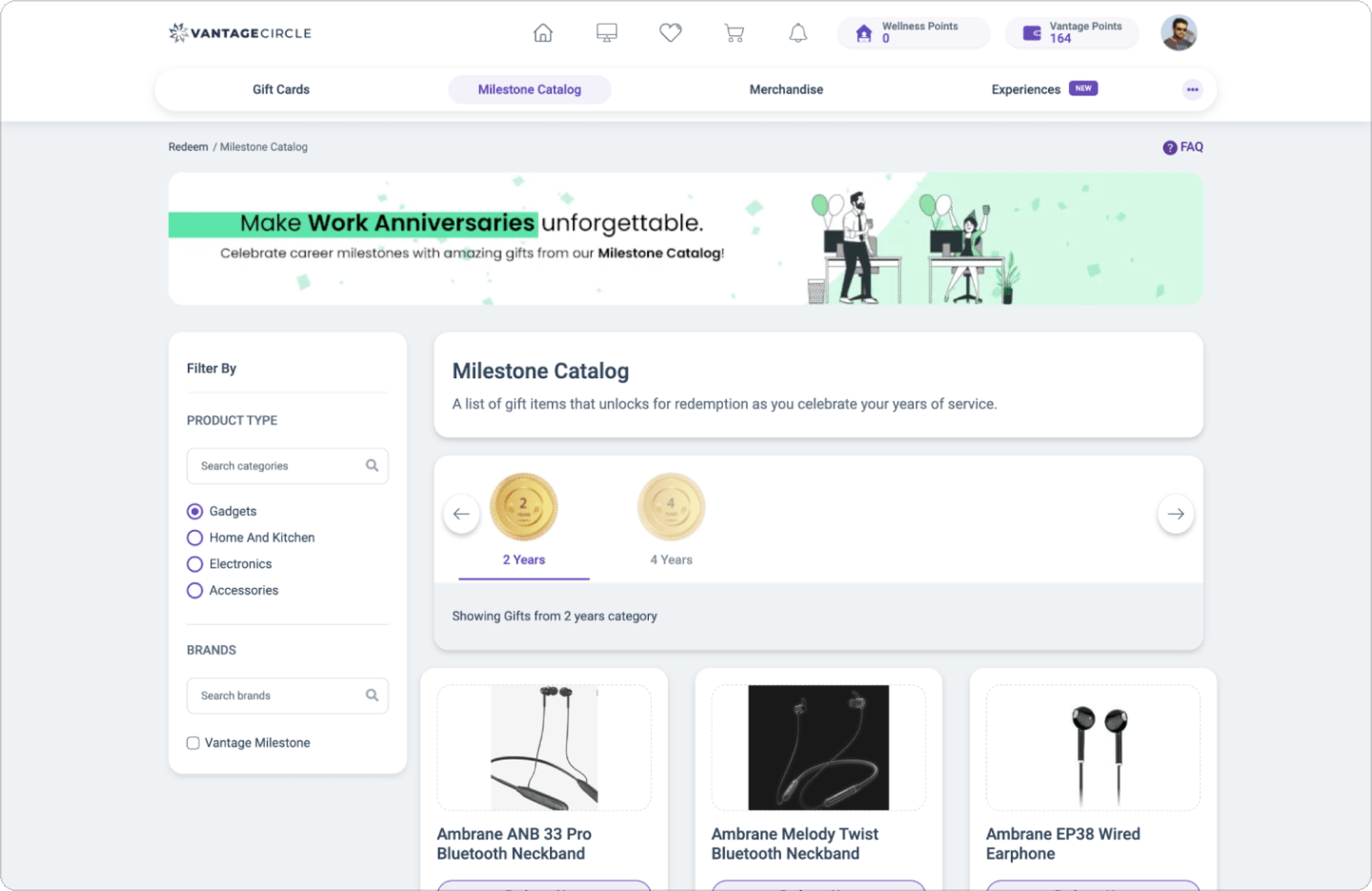
A points-based, non-cash rewards catalog keeps every redemption inside "tangible personal property," the category both the IRS and CRA require for the exclusion to apply at all. It's a structural way to avoid the most common compliance mistake: defaulting to cash or gift cards, which rarely qualify in either country. See how a non-cash rewards catalog keeps your program inside the exemption by design.
Structuring a Compliant Service Award Program
Three design choices keep a program inside both countries' exemptions: keep the award non-cash, tie it to a real milestone instead of a recurring schedule, and track value and frequency per employee so nobody quietly crosses a threshold.
Automating milestone triggers means an award only fires once per employee at the right interval, exactly the "not more than once every 5 years" rule both countries require to stay non-taxable, rather than relying on a manager to remember the last time that employee was recognized.
A one-time, milestone-tied campaign structure is what separates a genuine service award from a recurring perk that starts to look like disguised compensation to a tax authority, rather than genuine recognition. Tying the award to a specific achievement or tenure milestone, instead of issuing it broadly across a whole team, reinforces that same distinction, which is exactly what regulators are checking for when they draw the line between recognition and routine pay.
Per-employee award value and frequency tracking is the record payroll actually needs to apply the $400, $1,600, and $500 limits correctly at year-end, not just a nice-to-have dashboard. Without it, confirming which employees are still inside their 5-year window, in either country, becomes a manual reconstruction project every time an audit or a year-end filing comes up.
Suggested Reading: For award ideas by milestone year, see Years of Service Award Ideas. For full program-design guidance, see Service Award Programs, and for naming conventions, see Creative Employee Award Titles.
FAQ
Do you have to pay taxes on awards?
Not if the award is non-cash, tied to a genuine length-of-service or safety milestone, and stays under your country's threshold: $1,600 (or $400) in the US, $500 in Canada. Cash and cash-equivalent awards are always taxable in both countries, regardless of the amount.
What are the IRS rules for employee achievement awards?
The IRS excludes non-cash achievement awards from income up to $400 per employee per year under a non-qualified plan, or $1,600 under a qualified written plan that doesn't favor highly compensated employees, per Publication 15-B.
Are awards considered income?
Only if they fail one of the exclusion conditions: paid in cash, exceeding the dollar threshold, or given more frequently than once every 5 years. An award that meets every condition is excluded from the employee's taxable income entirely.
What is the $600 rule?
The $600 rule refers to the old IRS 1099 reporting threshold for payments to independent contractors, not a service award rule, and it never applied to employee achievement awards, which are governed separately by the $400 and $1,600 thresholds under Publication 15-B. Note that for tax year 2026, this contractor-reporting threshold itself rose to $2,000 under the One Big Beautiful Bill Act, though that change has no bearing on service award taxability.
Sources
- IRS Publication 15-B: Employer's Tax Guide to Fringe Benefits.
- CRA: Gifts, awards, and long-service awards: Administrative policy on non-cash long-service award taxability.
Conclusion
Whether a service award is tax-free comes down to the same 3 checks in both countries: is it non-cash, is it tied to a genuine milestone, and does it stay under the threshold, $1,600 or $400 in the US, $500 in Canada. Get those 3 right, and the award never touches an employee's taxable income. Get any one wrong, cash instead of a tangible item, an award given too often, or a value that quietly clears the cap, and the exclusion disappears entirely.
For a company operating in both the US and Canada, the safest approach is designing to the stricter number rather than running two separate policies. A program built around Canada's flat $500 cap, with milestone automation and per-employee tracking in place, comfortably clears the US thresholds too, without needing a second set of rules for the other side of the border.

Shaoni Gupta is a content marketing specialist at Vantage Circle, with expertise in scriptwriting and copywriting in the field of employee rewards and recognition.
Connect with Shaoni on LinkedIn.