
Two managers can lead teams of the same size, engage in similar work, and still have completely different weeks.
One spends most of the time reacting. Priorities keep changing; meetings pile up, and by the week’s end, it is hard to tell what moved forward.
The other manager’s week is much more predictable. Meetings are scheduled at set times, each one has a clear purpose, and everyone knows what is being worked on and who owns it.
The difference here has nothing to do with talent. It all narrows down to the structure.
Good team management skills go beyond personal skills. And this blog is particularly designed to focus on those systems, routines, and processes that help a team stay aligned and get work done consistently.
What is Team Management?
Team management is the ongoing work of setting a team's goals, cadence, and structure so that people collaborate to produce desired results. It differs from leadership, which focuses more on influence and direction, and from individual management skills, which are a personal set of capabilities.
Understanding the distinction matters because people often use them interchangeably. This lack of clarity is part of the reason why managing a team feels more complex than it should.
| Term | What it refers to |
|---|---|
| Team management | The system you run. Goals, cadence, structure, decision rights, and the conditions the team works under. |
| Management skills | The manager's personal capabilities. Communication, emotional intelligence, delegation, conflict resolution. |
| Leadership | Influence and direction. Setting a vision, building buy-in, developing other leaders. |
The difference matters in practice. If a team has no clear goals or way of working, even a highly skilled manager may struggle to make it successful. At the same time, if a manager cannot handle difficult conversations, having the right processes won’t be enough.
How to Manage a Team: The Short Answer
Managing a team requires a clear system instead of relying only on instincts. That system should include four things: goals aligned with company priorities, a regular schedule for one-on-one meetings and team check-ins, clear ownership and decision-making responsibilities, and a feedback process that everyone understands.
A manager’s personal skills still matter, but those are covered separately in this blog: Management Skills: 10 Essential Skills Every Manager Needs
Now, if you ask, why does a system matter? It’s because managers often have very little time to focus on their people. According to Deloitte's 2025 Global Human Capital Trends report, published in March 2025 and based on responses from nearly 10,000 business and HR leaders across 93 countries, managers spend nearly 40% of their time solving today's problems and handling administrative tasks, and only 13% of their time developing the people who work for them.
This doesn’t mean managers don’t care about their people. It means people management can easily get pushed aside when other tasks take priority. A regular team rhythm ensures that important conversations, feedback, and development don’t get missed.
What Makes a Team Work: Google's 5 Research-Backed Factors
Google's Project Aristotle identified five key factors associated with effective teams: psychological safety, dependability, structure and clarity, meaning, and impact.
The research examined 180 teams at Google and looked at both team composition and team dynamics. Its central finding was that team effectiveness depended less on who was on the team and more on how team members worked together.
Here is what each factor means in practice:
| Factor | What it means for how you run the team |
|---|---|
| Psychological safety | People feel safe asking questions, admitting mistakes, sharing ideas, and taking interpersonal risks without fear of embarrassment or punishment. Create space for people to speak openly and contribute their opinions. |
| Dependability | Team members reliably complete quality work on time. Clarify roles and responsibilities, and use project plans that make ownership visible. |
| Structure and clarity | People understand what is expected of them, how the work should be done, and what they are working toward. Communicate team goals clearly and make sure everyone understands the plan for achieving them. |
| Meaning | People find a personal sense of purpose in their work or what it produces. What makes work meaningful can differ from person to person. |
| Impact | People can see that their work makes a difference and contributes to the organization's goals. Help the team understand how its work affects users, clients, the team, or the wider organization. |
Set the Team's Operating Cadence
A team’s operating cadence is simply a regular schedule of meetings that helps everyone stay aligned. This can include weekly one-on-one meetings, a weekly team meeting, short standups, and a retro every two to four weeks.
Each meeting should have a clear purpose. If two meetings cover the same topic, you may remove one.
A cadence is one of the simplest ways to manage a team, but it is often overlooked. When managers say they don’t have time for one-on-one meetings, it is often because their calendars are brimming with unnecessary meetings.
| Meeting | Frequency | Length | What it is for |
|---|---|---|---|
| One-to-one (1:1) | Weekly, or fortnightly at minimum | 30 min | To discuss blockers, growth, workload, and anything they would not raise in a group. |
| Team meeting | Weekly | 45 to 60 min | Shared context. Priorities, decisions made, cross-dependencies. |
| Standup | Daily or twice weekly | 10 to 15 min | Coordination only. What is moving, what is stuck, who needs whom. |
| Retro | Every two to four weeks | 60 min | The team feedback loop. What worked, what did not, changes with owners. |
| Skip-level | Quarterly | 30 min | Information the manager's own line of sight misses. |
| Planning | Monthly or quarterly | 90 min | Connecting team outcomes to the next stretch of work. |
What a 1:1 is For
A one-to-one, or 1:1, should focus on the employee. It should not be used only for status updates. If the meeting is only about tasks and progress, it has quietly become a report that the person could have written in five minutes.
Instead, use the time to ask what is blocking them, what they want to achieve, and what support they need from you. They can convey the status through other means.
What a Retro is For
A retro is a meeting where the team looks at how it worked, not what it delivered.
The goal is to understand what went well, what did not, and what should change. Any action agreed on should have a clear owner and deadline.
What to Cut
Keep a meeting only if it helps the team decide or take action.
If a meeting is only conducted to share information, consider replacing it with a written update. If two meetings cover the same topics, keep the one most useful to the team.
Once the cadence is in place, track whether it helps. Tracking team engagement trends over time can show whether the new approach has improved how the team works or has simply added more meetings.
How Many People Can One Manager Actually Manage?
Span of control is the number of employees who directly report to one manager. As numbers grow, it becomes harder for the manager to give each person the required attention.
Too many direct reports under a manager often lead to skipped one-to-one meetings, reduced recognition, and a lack of clarity in managers’ understanding of each employee’s workload and needs.
There is no ideal team size. It depends on how much support and guidance employees need from a manager. However, when the team becomes too large, these problems usually appear in a similar order.
| Direct reports | What still works | What starts to break |
|---|---|---|
| Roughly 3 to 6 | Weekly 1:1s, close knowledge of each person's work, fast course correction. | Little. The risk here is more likely to be micromanagement |
| Roughly 7 to 10 | 1:1s hold if protected. Delegated ownership becomes necessary, not optional. | Development conversations get shortened. Recognition concentrates on the most visible people. |
| More than 10 | Coordination and reporting. | 1:1s get postponed, then canceled. Workload visibility drops. Quieter reports go unnoticed for weeks. |
Deloitte's 2025 research quantifies the strain: 36% of managers say they are insufficiently prepared to be people managers, and 40% report a decline in mental health after becoming managers.
What Widens a Workable Span
A manager can handle more direct reports when the work is stable and the team is experienced. Senior employees, clear processes, repeatable work, and strong team support all reduce the amount of attention each person needs from the manager.
What Narrows It
A manager needs fewer direct reports when the work or the team is new. New hires, unclear or fast-changing work, distributed teams, and employees going through performance discussions all need more support and attention.
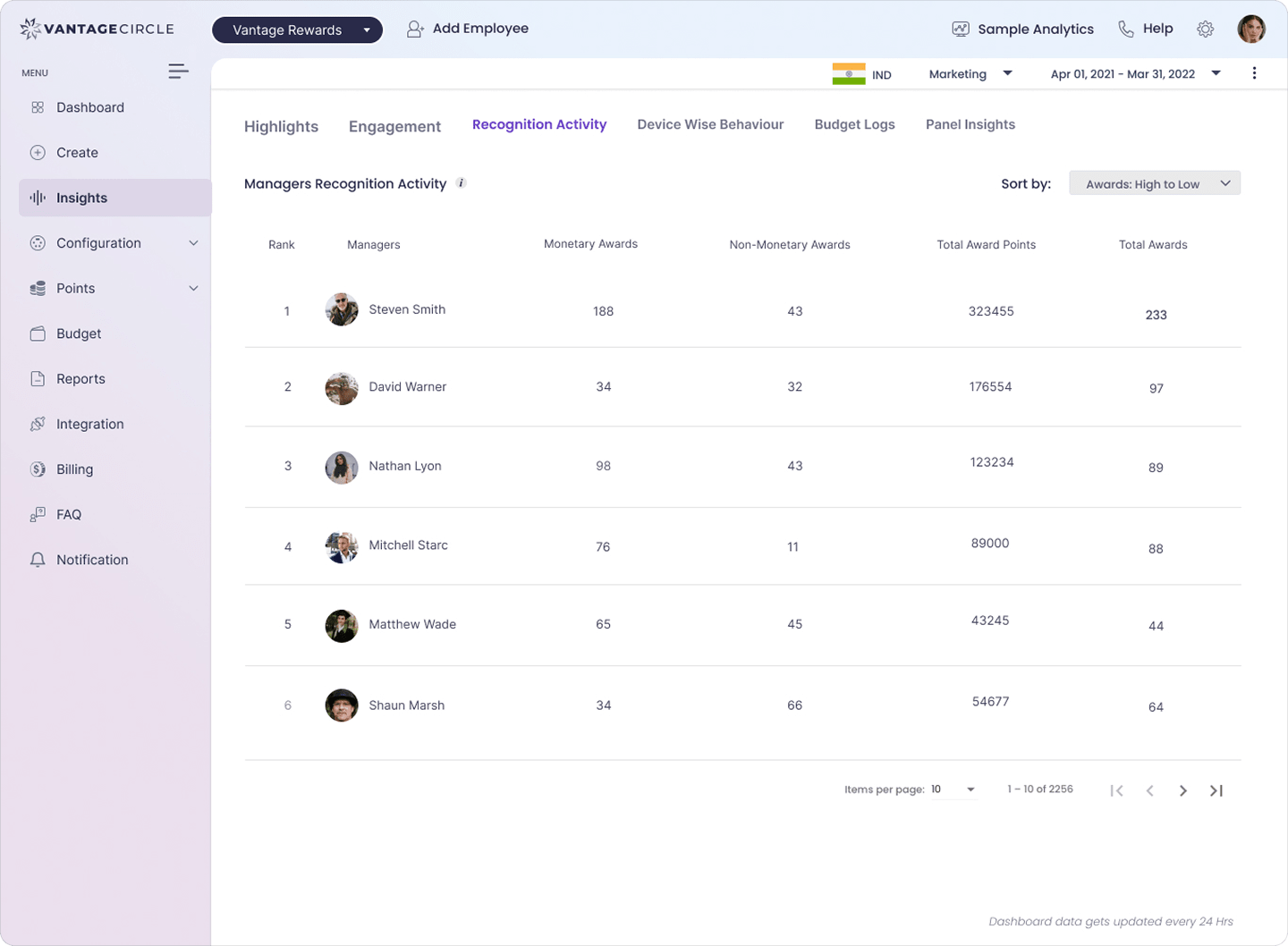
Recognition activity can also signal an early warning. If a manager starts recognizing some team members less often, those may be the same employees whose one-to-one meetings are being postponed or moved.
Source: Vantage Rewards
Run Transparency as Team Information Architecture
Build team transparency in how the team works. Decide what information to share by default, where to store it, and who will keep it up to date.
The goal for any team member is to answer, “What are we doing and why?” without the compulsion to ask the manager.
Most teams do not lack information. The real problem is finding the information because it’s spread across direct messages, different documents, or stored in one person’s memory.
What to Make Shared by Default
Four things should always be easy to find: the team’s current goals, this week’s priorities, decisions that have been made and the reasons behind them, and who is responsible for what.
Other information can be shared when needed.
Where It Lives
Keep one main source of truth and assign someone to keep it updated. Two documents that are only partly maintained create confusion because people do not know which one to trust.
Build clear communication around this structure. It helps the team stay aligned even in the absence of the manager.
Distribute Workload to Prevent Burnout
Preventing burnout starts with managing workload, even before you begin focusing on wellbeing. Make each person’s actual workload visible, review it regularly, and redistribute work when needed. Teams should also keep some extra capacity rather than expecting everyone to work at full capacity all the time.
Work is not always distributed as evenly as the organization chart suggests. Reliable employees often end up taking on more work because managers know they can depend on them.
Sustainable workload management also helps prevent manager burnout. When a team is overloaded, managers often absorb the extra work, becoming the last buffer before problems start affecting performance. Open-text survey responses can reveal signs of burnout weeks before they show up in productivity or attrition, making employee sentiment a useful early warning signal rather than something to review only after problems appear.
Cascade Goals So Every Task Connects to a Team Outcome
Goal cascading means connecting everyday work to the company’s larger priorities.
Start with one or two company goals and turn them into three to five clear team outcomes. Then check whether each regular task or project supports one of those outcomes. If something does not connect to any goal, it may be worth stopping or reviewing.
The important part is not just setting goals, but checking whether the team’s actual work still supports them.
Once every quarter, list the team’s regular tasks and projects in one column and the team outcomes in another. Match each task to the outcome it supports. Review and stop any task that does not connect to an outcome.
This can help identify work that has continued out of habit but may no longer be useful.
Treat Team Building as Designed Practice, Not Events
Team building should be woven into everyday collaboration, rather than treated as a one-off event. Sharing information openly, working together on tasks, and holding regular retros can strengthen teamwork, as they improve everyday collaboration.
Events can still be useful, but they are not designed to fix deeper problems. If employees return from an offsite to unclear priorities, poor communication, or uneven workloads, the positive impact will quickly fade.
Team building is most effective when the team already has a strong structure in place. Activities should support and strengthen good teamwork, not fix problems that need better processes or management.
Build a Team Feedback Loop
A team feedback loop is a visible, regular process not limited to a one-to-one conversation. This can include a retro every two to four weeks, a shared action log, and a rule that every item has an owner and a close-out date.
The difference matters. Personal feedback happens between two people. A team feedback loop changes how the team works, and everyone can see whether the change happened.
If the same complaint comes up in three retros, the loop is not being closed. In that case, the issue is a lack of follow-through, not the facilitator’s quality. The close-out rule is what needs to be fixed.
A shared record of what the team completed between retros also helps. It gives the team something concrete to discuss instead of relying on memory.
Managing Distributed and Hybrid Teams
Managing a distributed team changes the team’s cadence, but the basic principles stay the same. Move status updates to written, asynchronous communication. Keep only a few live meetings, document decisions clearly, and reduce each manager’s span of control because context is harder to share across a distributed team.
A common mistake is managing a distributed team like an office-based one and relying on extra video calls to make up for the lack of face-to-face interaction.
Psychological Safety Is a Property of the Team
Psychological safety means that people on a team feel safe speaking up, admitting mistakes, and questioning decisions. It exists at the team level and can be measured. It is not simply a manager’s personal trait.
People often treat it as something that depends on a manager’s personality, but it does not. It develops from what people have seen happen when someone speaks up, raises a difficult issue, or says something uncomfortable.
A 3-Question Psychological Safety Pulse Check
Ask these questions anonymously and focus on how the results change over time, rather than on the score itself.
If I make a mistake on this team, it is held against me. (Reverse scored.)
I can raise a problem or a difficult issue with this team.
It is safe for me to take a risk on this team.
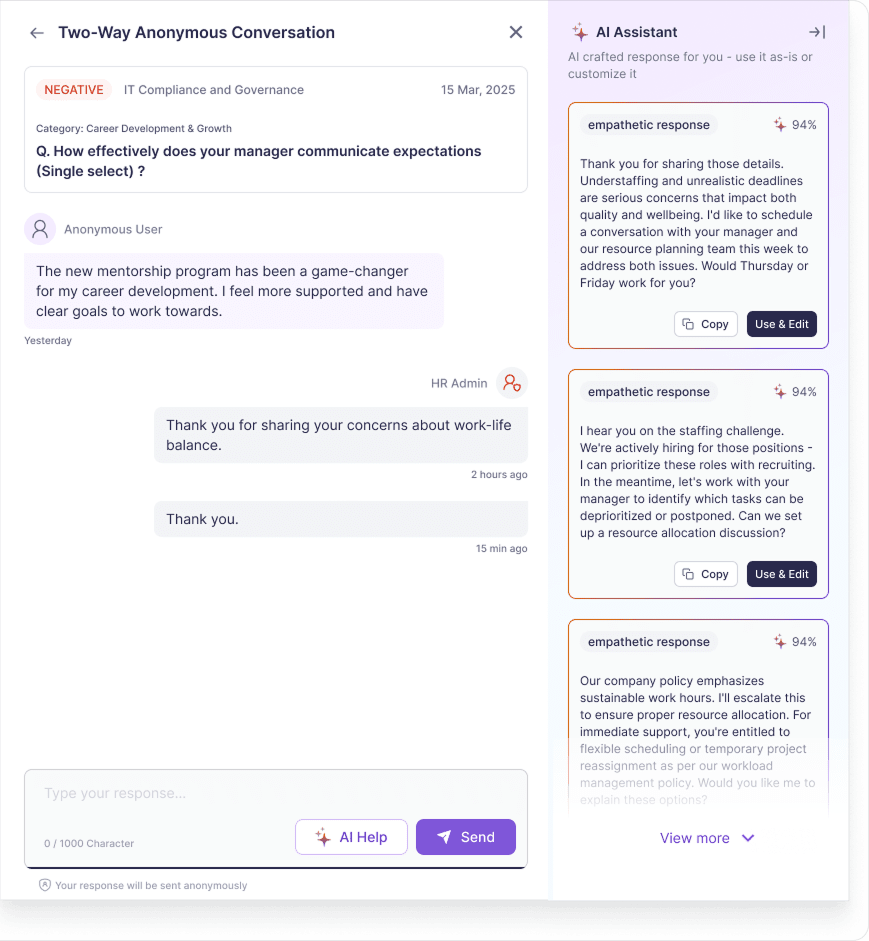
These questions should be asked anonymously because they are measuring whether people feel safe enough to be honest.
Source: Vantage Pulse
Distributing Work When Part of It Is AI-Assisted
When an AI tool helps with part of a task, assign the task the same way. What changes is the review process. Make it clear who owns the final output, require that person to check it before sharing it, and credit them for the judgment behind the work rather than crediting the tool for creating the draft.
The two common problems to watch for are: the first is work that looks finished but has not been properly checked, because AI created the draft quickly and the review was treated as optional. The second is less obvious: a person’s contribution can become harder to see because it looks like the tool did the work, and recognition often goes to the effort people can see.
The rule is simple: ownership doesn’t transfer to the AI tool. If someone’s name is attached to the work, that person is responsible for its contents. They should also receive credit when the work succeeds.
Your First 90 Days Managing a New Team
In the first 90 days, take time to understand the work and the people before making changes. Set the team’s operating cadence in the second or third week, then make one structural change at a time so you can see what actually works.
It can be tempting to start with a plan. But you may not yet know which parts of the team are genuine problems and which are simply ways of working that developed for reasons you haven’t seen yet.
Spend the first two weeks in 1:1s and learning how the work gets done. Then set the team cadence, because it is easy to introduce and gives you useful information.
After that, give yourself time to observe. By around week six, you should have a much clearer idea of the team’s main constraint, and it may be different from what you expected on day one.
What to Do About a Team Member Who Is Not Performing
Start by checking the team’s operating system. Check whether the person had clear goals, clear decision-making responsibilities, and a manageable workload. Then have a direct 1:1 about the performance gap, agree on what needs to change, and set a date to review progress.
This order is about being accurate. If someone was working with unclear priorities or an unrealistic workload, a performance conversation alone will not solve the problem.
Once you know the system was clear and fair, be direct. Explain the performance gap with a specific example, say what needs to change, agree on how you will measure improvement, and set a review date.
Avoid being vague. Clear feedback gives the person a fair chance to understand the issue and act on it.
Is Your Team's Operating System Actually Running?
Run this nine-point check. If you cannot tick most of them, the problem is the system rather than the people.
Every report has a 1:1 on the calendar that was not moved last month.
The team has three to five written outcomes everyone could name.
Every recurring project maps to one of those outcomes.
Decisions have named owners, and the team knows who decides what.
Each person's workload is visible to you without your having to ask.
A retro ran in the last four weeks and its actions were closed out.
One source of truth for priorities and decisions, and it is current.
You measured psychological safety in the last quarter.
Recognition last month reached more than the two most visible people.
The items you cannot tick are the agenda. Fix one at a time, and give each change a few weeks, or you will not know which one worked.
Conclusion
Strong team management skills are not only about how a manager communicates or leads. They also depend on the systems that keep a team aligned, from clear goals and regular meeting rhythms to visible ownership, feedback, and follow-through.
When these structures are in place, managers can spend less time reacting and more time helping the team work effectively.
FAQs
1. How do you manage a team effectively?
Managing a team effectively means running four things deliberately rather than reactively: goals that cascade from company objectives, a fixed meeting cadence where each meeting has one job, delegated ownership with clear decision rights, and a visible feedback loop. Structure is what makes personal skill repeatable.
2. What are the 5 keys to a successful team?
Google's Project Aristotle research identified five factors that predict team effectiveness: psychological safety, dependability, structure and clarity, meaning, and impact. Psychological safety was the strongest of the five. Google's conclusion was that how a team works together matters more than who is on it.
3. What are the 5 C's of a team?
The 5 C's are usually listed as communication, camaraderie, commitment, confidence, and coachability. They are a useful shorthand, though they describe individual behaviors rather than team conditions. For a research-backed alternative, use Google's five factors above.
4. What are the 7 basics of team leadership?
Team leadership basics usually cover setting direction, communicating clearly, delegating with trust, developing people, giving feedback, resolving conflict, and modelling the standard you expect. These are individual capabilities rather than team mechanics.

Riha Jaishi is a Content Marketing Specialist at Vantage Circle and host of the HR Vantage Influencers podcast, sharing insights that help organizations build recognition-rich, people-first cultures!!
Connect with Riha on LinkedIn.