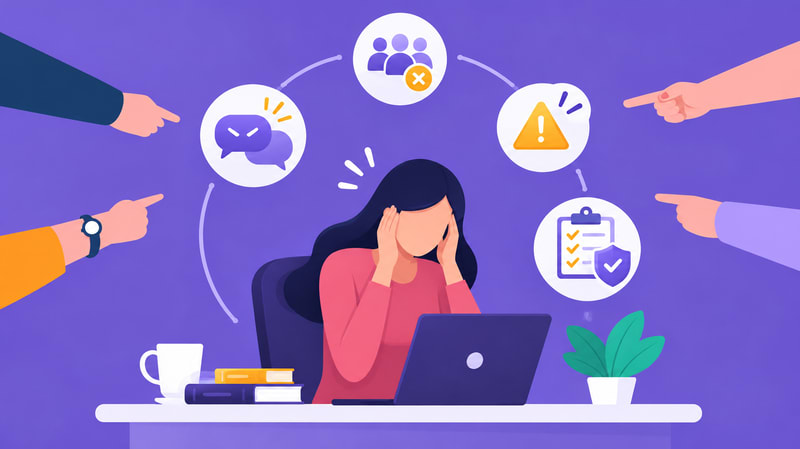
A colleague shares a joke about someone’s religion in a work group chat. A few coworkers react with laughing emojis. But the employee targeted by the joke feels uncomfortable. The next day, they approach HR. What should happen next?
Workplace harassment can take multiple forms, and some behaviors may go unnoticed or be dismissed as harmless jokes. For HR teams, recognizing these situations early and responding fairly is essential to protecting employees and maintaining a respectful workplace.
This blog explores seven types of workplace harassment, provides 12 practical examples, explains how employees can report concerns, and outlines the steps HR can take to address and prevent harassment.
What Is Workplace Harassment?
Under US federal law, workplace harassment is unwelcome behavior based on a protected characteristic. It becomes unlawful when an employee tolerates the behavior to keep their job or when the behavior is serious or frequent enough to create a hostile work environment.
In the US, the Equal Employment Opportunity Commission (EEOC) treats harassment as a form of employment discrimination. The EEOC's harassment page lists the following protected characteristics under federal law:
Race and color
Religion
Sex, including pregnancy, sexual orientation, and gender identity
National origin
Age (40 and over)
Disability
Genetic information
A comment can make an employee feel harassed, even if the person who made it claims they were only joking. HR should consider what was said or done, the context, and how it affected the employee. Under US federal law, minor annoyances or one-time incidents are generally not considered unlawful harassment unless they are extremely serious. However, employers can still take action under their workplace policies.
The Legal Line vs. the Policy Line
Employers can prohibit offensive or disrespectful behavior even when it does not meet the legal definition of unlawful harassment.
A clear workplace policy gives employees a consistent standard of conduct. It also helps HR respond to concerns before harmful behavior continues or escalates.
| Tier | What it looks like | Who acts | Typical response |
|---|---|---|---|
| Unlawful harassment | Conduct tied to a protected characteristic that is severe or pervasive, or a quid pro quo demand | HR, with legal counsel | Formal investigation, interim protection, discipline up to dismissal |
| Policy breach | Demeaning jokes, slurs, unwanted touching, or targeted exclusion that have not yet reached the legal bar | HR and the line manager | Investigation, written warning, coaching, training |
| Incivility | Rudeness, interrupting, curt emails with no clear target or pattern | The line manager | A direct conversation, clear expectations, follow-up |
Where the Law Stands in 2026
The EEOC rescinded its 2024 workplace harassment enforcement guidance on 22 January 2026. Federal laws prohibiting workplace harassment remain in effect.
2026 legal update: On 22 January 2026, the EEOC voted 2–1 to withdraw its 2024 Enforcement Guidance on Harassment in the Workplace. The underlying federal anti-discrimination and anti-harassment laws still apply.
Title VII of the Civil Rights Act, the Age Discrimination in Employment Act (ADEA), the Americans with Disabilities Act (ADA), and the Genetic Information Nondiscrimination Act (GINA) all remain in force. If you are updating your policy, cite the statutes and the EEOC harassment page rather than the withdrawn guidance.
If your workforce spans more than one country, here is how the main frameworks compare.
| Jurisdiction | Main law | What it requires of employers |
|---|---|---|
| United States | Title VII and state laws such as California's Fair Employment and Housing Act (FEHA) | Take reasonable steps to prevent and correct harassment. Some states, including California and New York, require regular training. |
| United Kingdom | Equality Act 2010, amended by the Worker Protection Act 2023 | Since 26 October 2024, a duty to take reasonable steps to prevent sexual harassment of employees |
| India | Sexual Harassment of Women at Workplace (Prevention, Prohibition and Redressal) Act 2013, known as the POSH Act | Set up an Internal Committee (IC) at every workplace with 10 or more employees |
| Global | International Labor Organization (ILO) Violence and Harassment Convention, 2019 (No. 190) | Recognize everyone’s right to a world of work free from violence and harassment in the countries that ratify it |
What are the 7 Common Types of Workplace Harassment?
In HR training, workplace harassment falls into seven common categories. These are practical categories, not seven separate legal offenses. The legal position depends on the conduct, its context, and the applicable law.
This helps us observe harassment through two lenses. The first is what it targets, such as a person's sex, race, or religion. The second is how it is delivered: through words, actions, images, or screens. One incident can fall under more than one type.
| Type | What it looks like | Example | When it may become unlawful |
|---|---|---|---|
| Sexual | Unwelcome sexual remarks, advances, touching or requests | A manager hinting that a promotion depends on going out with him | Always a risk when a job benefit is tied to it, or when it is severe or repeated |
| Discriminatory | Mockery or hostility linked to race, religion, age, disability, national origin, sexual orientation or gender identity | Repeated jokes about a colleague's accent | When it is severe or pervasive |
| Verbal | Slurs, insults, threats, yelling, offensive nicknames | A supervisor using a slur in a team meeting | When it targets a protected characteristic |
| Psychological | Isolation, sabotage, humiliation, taking credit for someone's work | One person is left out of every project meeting | When the target is chosen because of a protected characteristic |
| Physical | Unwanted touching, blocking someone's path, damaging their belongings | Repeated shoulder rubs after being asked to stop | Often, and assault can also be a crime |
| Cyber | Harassment over chat, email, text or social media, including edited images | An altered photo of a colleague shared in a group chat | When the content targets a protected characteristic |
| Retaliation | Punishing someone for reporting or taking part in an investigation | Moving a complainant to a worse shift after a report | Unlawful, even if the original complaint is not upheld |
1. Sexual Harassment (Quid Pro Quo and Hostile Environment)
Sexual harassment is unwelcome conduct of a sexual nature, and it takes two forms: quid pro quo, where a job benefit depends on accepting it, and hostile environment, where it makes the workplace intimidating or abusive.
Quid pro quo usually involves someone with power, such as a manager or client lead. Hostile environment harassment can come from anyone, including peers, customers, or vendors. People of any gender can be the target or the harasser, and the two can be the same gender. Sexual harassment also connects to wider equity issues.
2. Discriminatory Harassment
Discriminatory harassment is hostile or demeaning conduct aimed at someone because of their race, religion, age, disability, national origin, sexual orientation, or gender identity.
It often starts small. Think of "jokes" about someone's food, comments that an older colleague is "too slow for this", or deliberately using the wrong name or pronouns. One comment may not cross the legal line, but a steady pattern can. Many of these behaviors begin as microaggressions, which is why early action matters.
3. Verbal Harassment
Verbal harassment is the use of words, spoken or written, to insult, threaten, mock or degrade someone.
That includes slurs, name-calling, threats, and repeated put-downs. A common question is whether yelling counts. Yelling alone is usually a conduct issue for the manager to address. It becomes harassment when it is repeated, aimed at one person, or mixed with slurs or comments about a protected characteristic.
4. Psychological (Mental) Harassment
Psychological harassment, often called mental harassment, is a pattern of behavior that wears down someone's confidence or dignity at work.
Examples include shutting someone out of meetings, setting impossible deadlines to make them fail, mocking their work in public, or taking credit for their ideas. Since it leaves no physical mark, it is easy to dismiss.
It’s crucial to look for the pattern. One missed invite can be a mistake. But the same person missing every invite for three months is a signal.
5. Physical Harassment
Physical harassment is unwanted physical contact or threatening physical behavior.
This ranges from touching, hugging, or brushing against someone to standing too close, blocking a doorway, or damaging their belongings. Physical assault is also a crime, so treat it as an urgent safety matter and involve the police where needed. A single incident of physical harassment can be serious enough to meet the legal standard on its own.
6. Cyber and Digital Harassment
Cyber harassment is bullying that happens through digital channels, such as team chat, email, text messages, and social media.
Remote and hybrid work has moved a lot of workplace talk online, and harassment followed it. Common forms include explicit memes in a group chat, late-night messages that will not stop, edited or deepfake images, and posts about a colleague on social media. If it involves colleagues and spills into work, your policy should cover it, even when it happens after work hours or on a personal phone.
7. Retaliation
Retaliation is any action that punishes someone for reporting harassment, supporting a complaint, or taking part in an investigation.
It can be obvious, like a demotion or dismissal. It can also be quiet: a worse shift, being left off a project, or a sudden run of poor reviews. Retaliation is a serious concern for employees who report discrimination or harassment. HR should pay attention to changes in an employee’s shifts, responsibilities, performance reviews, or treatment after a complaint.
Power Harassment: When the Harasser Is the Manager
Power harassment is harassment that leverages a position of authority, such as control over shifts, reviews, or promotions, to pressure or humiliate someone.
When the harasser is a manager, the employee has more to lose by speaking up. That is why your policy needs a reporting route that does not run through the line manager. It is also why HR should treat complaints about managers with extra care around retaliation.
12 Workplace Harassment Examples and How HR Can Respond
The following situations are illustrative examples designed to help managers recognize concerns and consider a suitable response. They are not documented legal cases. The suggested categories indicate potential risk, rather than a legal verdict. HR must review the full facts and applicable law before reaching a conclusion.
| Illustrative scenario | Type | Possible concern | Suggested HR response |
|---|---|---|---|
| A manager tells a team member that a promotion "would be easier" if they went on a date | Sexual (quid pro quo) | Unlawful risk | Formal investigation, interim separation that does not penalise the employee, legal counsel |
| A colleague posts a sexual joke in the team group chat after hours, and one person says it makes them uncomfortable | Sexual, cyber | Policy breach (unlawful risk if it continues) | Investigate, ask for the post to be removed, written warning, reminder that chat is covered by policy |
| A manager yells at one team member, in front of others, several times a week | Verbal, psychological | Policy breach | Investigate the pattern, check whether a protected characteristic is involved, coaching or discipline |
| A manager raises their voice once at the whole team during a tense deadline | Verbal | Incivility | Manager's leader addresses it directly and sets expectations |
| Coworkers regularly mimic a colleague's accent | Discriminatory (national origin) | Unlawful risk | Investigate, discipline, team-level training |
| A supervisor says an older employee is "too old to learn this system" | Discriminatory (age) | Policy breach (unlawful risk if repeated or linked to decisions) | Investigate, check whether it affected training or assignments, corrective action |
| An employee asks for a reasonable accommodation and the manager refuses while mocking the request | Discriminatory (disability) | Unlawful risk | Investigate, process the accommodation request properly, discipline |
| A colleague keeps giving unwanted shoulder rubs after being asked to stop | Physical, sexual | Unlawful risk | Investigate, interim measures, discipline up to dismissal |
| Someone shares an edited photo of a colleague in a group chat | Cyber | Policy breach (unlawful risk if sexual or targets a protected trait) | Remove the content, investigate, discipline |
| One team member is left out of every meeting and team lunch for months | Psychological | Policy breach | Investigate the pattern and whether a protected characteristic is involved |
| An employee is moved to a worse shift a week after making a complaint | Retaliation | Unlawful risk | Reverse the change, investigate the decision-maker, review documentation |
| A client keeps making sexual comments to an employee during visits | Sexual (third party) | Unlawful risk | Act even though the harasser is not on staff: reassign the account or contact, raise it with the client, document everything |
The right response depends on what happened and the risks involved. A single serious incident may require immediate action. Employers should also act when harassment comes from a client, customer, or vendor, rather than an employee.
What Qualifies a Hostile Work Environment?
A hostile work environment develops when harassment tied to a protected characteristic is severe or pervasive enough that a reasonable person would find the workplace intimidating, hostile, or abusive.
Courts look at the whole picture rather than a single moment. The following are the main factors drawn from Harris v. Forklift Systems (1993).
| Factor courts weigh | What it means in practice |
|---|---|
| Frequency | How often it happened. A comment every week weighs more than one comment a year. |
| Severity | How serious each incident was. A threat or a slur weighs more than a careless remark. |
| Physically threatening or humiliating | Whether it involved physical intimidation or public humiliation, or was "merely an offensive utterance" |
| Interference with work | Whether it made it harder for the person to do their job |
One severe incident, such as a physical assault, can be enough on its own. Many smaller incidents can add up over time.
People often confuse a hostile work environment with a toxic one, but they are different. A toxic workplace can be stressful and unfair without involving harassment based on a protected characteristic. This means it may not be unlawful, but employers should still address it, as it may violate company policies.
Harassment vs Bullying vs Incivility: What's the Difference?
Harassment targets a protected characteristic; bullying is the repeated mistreatment of anyone, regardless of who they are; and incivility is low-intensity rudeness with unclear intent.
The three can overlap, where one can turn into another. Bullying that focuses on someone's religion becomes harassment. Incivility that keeps landing on the same person can become bullying.
| Harassment | Bullying | Incivility | |
|---|---|---|---|
| Basis | Tied to a protected characteristic | Anyone, for any reason | No clear target or reason |
| Pattern | One severe act or a repeated pattern | Repeated over time | Often one-off or scattered |
| Legal status (US) | Unlawful when it meets the legal standard | Not unlawful under federal law unless linked to a protected characteristic; some states are considering laws | Not unlawful |
| Example | Repeated jokes about a colleague's disability | A manager who belittles one employee in every meeting | Ignoring a colleague's greeting, sending curt emails |
Why Most Workplace Harassment Goes Unreported
Many employees are reluctant to report harassment. They may worry about their jobs, relationships with coworkers, or whether others will take their concerns seriously.
The Australian Human Rights Commission’s Time for Respect survey (2022) found that one in three workers had experienced workplace sexual harassment in the previous five years. Only 18% of incidents were reported. The survey covered more than 10,000 people.
In the UK, a Trades Union Congress poll published on 12 May 2023 found that 58% of women surveyed had experienced sexual harassment, bullying, or verbal abuse at work. The poll involved more than 1,000 women. This figure covers all three behaviors, not sexual harassment alone.
Employees also fear retaliation. A colleague losing a desirable shift or being excluded after making a complaint can discourage others from raising concerns. HR should monitor changes in treatment after any report.
Vantage Influencers Podcast
How To Design A Fearless Workplace Culture?
Gustavo Razzetti, CEO of Fearless Culture
Listen to the EpisodePower differences can make reporting harder, particularly when an employee is complaining about someone who controls their work or performance review. Offering more than one reporting route gives employees a way to raise concerns outside their normal reporting line.
Anonymous surveys help as well. Most people will not put their name to a complaint about someone who controls their shifts or their review. An anonymous pulse question such as "I feel safe raising concerns about how I'm treated at work" gives HR an early signal before anyone files anything. Treat it as an early warning and pair it with a named route for formal complaints.
How to Report Workplace Harassment (for Employees)
Employees who wish to raise concerns can follow the six steps. This helps them preserve information and file a report.
Document it. Write down the date, time, place, exact words or actions, and the names of anyone who saw it. Save screenshots of messages and emails.
Read the policy. Your employee handbook or intranet should name who to report to and how.
Report on writing. An email to HR creates a dated record. You can still ask for a meeting.
Use another route if the harasser is your manager. Go to HR, your manager's manager, or the alternative contact named in the policy. Many companies run an open-door policy for exactly this.
Ask for confirmation. Ask HR to confirm by email that they have received your report and to explain the next steps.
Know the external route. In the US, you can file a charge with the EEOC. You generally have 180 calendar days from the incident, extended to 300 days if a state or local agency enforces a similar law. Federal employees have a separate process with a 45-day limit to contact an EEO counselor.
You do not have to confront the person directly before reporting. If you feel unsafe, seek immediate help through the appropriate workplace or emergency channel.
How HR Should Respond to a Harassment Complaint: 6 Investigation Steps
HRs should be extra careful while responding to harassment complaints. You can follow these steps:
Acknowledge and assess risk. Confirm receipt in writing, thank the person for coming forward, and check whether anyone is at risk. Put interim measures in place if needed, such as separate reporting lines or schedules. Make sure those measures do not penalize the person who complained. Moving the complainant to a worse shift "for their protection" can look like retaliation.
Plan before you interview. Before speaking to anyone, write down who you need to talk to, what you need to ask each person, and in what order. Gather documents, messages, and records first.
Speak to everyone involved. Begin by understanding the complaint in detail. Interview witnesses and the person accused, giving each a fair chance to respond. Plan the order around the evidence and risk of influencing other accounts. Do not reach a conclusion before reviewing the available facts.
Warn everyone about retaliation and promise fairness. Employees often ask HR to keep their name out of it. Be honest about what you can promise. Assure the complainant they can contact you straight away if they are treated differently. Tell the accused clearly that retaliation will lead to serious consequences.
Review the evidence and record the decision. Compare accounts with messages, documents, and witness statements. Apply your organization’s investigation standard and local legal requirements. Record the findings, reasons, and corrective action. The response should reflect the seriousness of the conduct.
Close the loop and follow up. Inform the people directly involved that the investigation has concluded, sharing details only where appropriate. Explain how concerns about retaliation or repeated behavior can be raised. Check in afterward and review whether any team-wide issues need attention.
What Should I Do If I Am Accused of Harassment at Work?
If you happen to be accused of harassment, cooperate with the investigation, share relevant evidence, follow HR’s instructions, and avoid contacting the complainant about the allegation outside the investigation process.
Being accused is stressful, and it is natural to want to explain yourself to the other person. But don’t. Even a well-meant message can look like pressure or retaliation. Keep the matter private, as HR will likely ask you to. Share any messages, emails, or names of witnesses that support your account. If the allegation could affect your job or lead to legal action, speak to an employment lawyer.
How to Prevent Workplace Harassment
All four measures discussed below are important in preventing workplace harassment. A policy has little impact if employees do not read or understand it. Similarly, training is less effective when employees do not feel safe reporting harassment. These measures must work together to create a safer workplace for employees to thrive.
Anti-Harassment Policy Checklist
A strong anti-harassment policy clearly defines harassment, covers every place and channel where work occurs, provides multiple reporting options, and explains exactly what happens after a complaint.
Use this checklist to review your current policy.
| Policy element | What good looks like |
|---|---|
| Definition and examples | Plain-language definition plus real examples, including the 7 types |
| Scope | Covers employees, contractors, clients and vendors, remote work, work events and after-hours chat |
| Reporting channels | At least two routes, including one outside the line manager |
| Anonymous option | A way to raise concerns without giving a name, clearly labelled as an early-warning route |
| No-retaliation clause | A clear ban on retaliation, with consequences spelled out |
| Investigation steps and timelines | Who investigates, in what order, and how long each stage usually takes |
| Range of consequences | From coaching and warnings to dismissal, matched to severity |
| Training cadence and sign-off | Training for all staff at a set frequency, with extra training for managers, and a signed acknowledgement |
Training that Changes Behavior
Effective harassment training is interactive, scenario-based and teaches people what to do when they see something, in addition to what the rules say.
Click-through slides tick a compliance box but rarely change behavior. Use real scenarios, such as the 12 above, and ask managers to decide where each one sits and what they would do next. Include bystander intervention: simple ways to step in, such as interrupting a joke, checking on the person afterward, or reporting what they saw. Tailor sessions to the teams where complaints cluster instead of giving everyone a generalized course.
Reinforce the Behavior You Want in Public
Employee recognition can help encourage respectful behavior at work, especially when it reflects the company's core values.
For example, organizations can include Respect or Inclusion as values in their recognition programs. This allows employees to appreciate colleagues who speak up against inappropriate jokes, treat others fairly, or make sure everyone has a chance to share their opinions.
Through value-based recognition, organizations can acknowledge these actions and encourage others to follow the same practices. When employees see respectful behavior recognized, it reinforces the importance of speaking up and supporting one another.
However, recognition should always support the company's anti-harassment policy and the standards managers are expected to follow. It cannot replace proper investigations or disciplinary action when harassment occurs.
Listen Continuously, Not Only When Someone Complains
Short, confidential pulse surveys can help HR understand whether employees feel respected and safe raising concerns. Survey results should be shared only for groups large enough to protect employee confidentiality.
By comparing survey results across departments, HR can identify teams where employees may be experiencing unfair treatment or feel uncomfortable speaking up. Open-ended responses can also reveal common concerns, such as being excluded from discussions, facing inappropriate jokes, or dealing with disrespectful behavior.
Tools like Vantage Pulse can help HR analyze employee feedback and identify patterns through sentiment analysis. These insights can help organizations take timely action and provide additional training or support where needed.
However, pulse surveys should complement formal harassment reporting channels, not replace them. Regular employee feedback is also helpful in building psychological safety, where employees feel comfortable speaking up without fear of negative consequences.
Conclusion
A respectful workplace needs clear standards, safe reporting routes, prompt and fair investigations, and consistent follow-through.
Think again about the employee who reported a joke in a team chat. The first conversation with HR can shape whether that person feels safe raising concerns in the future. Listening carefully, investigating fairly, and acting on the findings are practical ways to build that trust.
.
FAQs
What qualifies as a hostile work environment?
A hostile work environment exists when harassment tied to a protected characteristic is severe or pervasive enough that a reasonable person would find the workplace intimidating, hostile or abusive. Courts weigh how often it happened, how serious it was, whether it was threatening or humiliating, and whether it interfered with the person's work. One severe incident can be enough on its own.
What are the five types of harassment at work?
A common five-type list is verbal, psychological, cyber, sexual and physical harassment. Verbal covers insults and slurs. Psychological covers isolation and humiliation. Cyber covers harassment over chat, email or social media. Sexual covers unwelcome sexual conduct. Physical covers unwanted touching or intimidation. Many HR teams add discriminatory harassment and retaliation to make seven types.
How do I know if I am being harassed at work?
Consider whether the behaviour is unwelcome, whether it relates to a protected characteristic, and whether it affects your working conditions. Serious incidents and repeated patterns deserve attention. Even when you are unsure whether the law applies, document what happened and consider reporting the concern through your employer’s policy.
How to document a hostile work environment?
Keep a written log of every incident as soon as it happens. Note the date and time, the location, the exact words or actions, the names of anyone who saw it, and any evidence such as screenshots, emails or texts. Store copies somewhere other than a work device. Report in writing to HR and keep a copy of your report and any reply.
What evidence is needed for harassment to be proven?
Useful evidence includes a dated incident log, messages, emails, screenshots, photos, and statements from witnesses. Evidence that you reported the behaviour, and how the employer responded, also matters. Records showing changes to your shifts, pay or reviews after a complaint can support a retaliation claim. An employment lawyer can tell you what is needed under the law where you work.
What makes a strong harassment case?
The strength of a claim depends on the applicable law and evidence. Relevant information may include contemporaneous notes, messages, witnesses, the connection to a protected characteristic, and the seriousness or frequency of the conduct. An employment lawyer can assess the specific circumstances.

Riha Jaishi is a Content Marketing Specialist at Vantage Circle and host of the HR Vantage Influencers podcast, sharing insights that help organizations build recognition-rich, people-first cultures!!
Connect with Riha on LinkedIn.