EN
EN  FR
FR  ES
ES  DE
DE 





What Is an Employee Recognition Program Proposal Template?
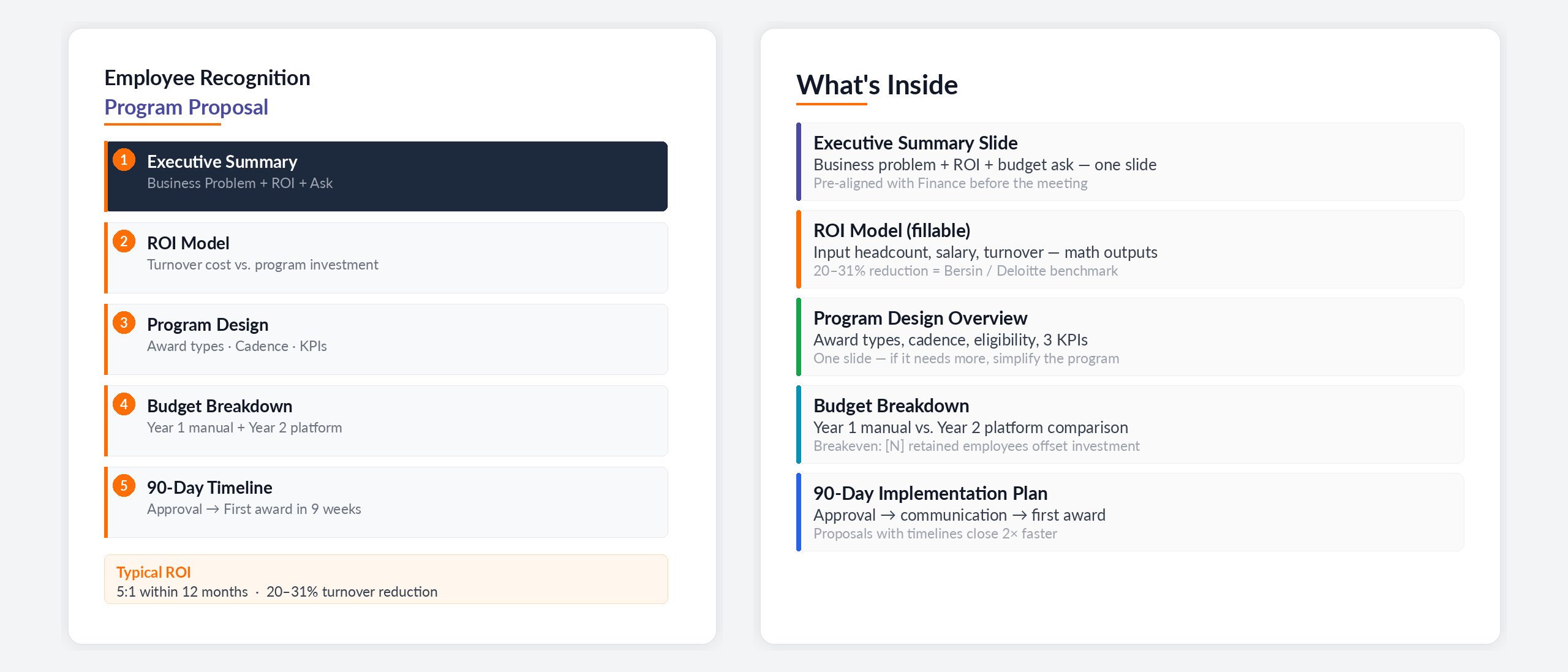
An employee recognition program proposal template is a structured deck that helps HR leaders build the business case, design the program overview, model ROI, and present a ready-to-approve recognition program investment to senior leadership and Finance.
Most recognition programs never get funded because the proposal does not speak the language of Finance. This template bridges the gap: it provides HR teams with the recognition ROI model, cost framework, and executive summary language they need to build a credible business case and win approval in a single presentation.
Recognition proposals that open with program design ("we want to create five award categories") lose the CFO in the first minute. Proposals that open with business impact ("voluntary turnover cost us $2.4M last year and exit interviews point to lack of recognition") have the room's attention. Bersin / Deloitte data shows organizations with recognition-rich cultures see up to 31% lower voluntary turnover — pair this proposal template with a full program design from the Recognition Templates hub.
How to Use This Employee Recognition Program Proposal Template?
A four-step approach that turns a blank proposal into a fully funded, leadership-approved recognition program.
Step 1
Step 1: Start With the Business Problem, Not the Program Design
Open the proposal with current-state data: your organization's voluntary turnover rate, engagement survey scores, and any recognition program gaps identified in exit interviews or stay interviews. The business problem makes the program proposal relevant to Finance and the C-suite — not just to HR.
Recognition proposals that open with program design ("we want to create five award categories") lose the CFO in the first minute. Proposals that open with business impact ("voluntary turnover cost us $2.4M last year and exit interviews point to lack of recognition") have the room's attention.
Step 2
Step 2: Build the ROI Model
Use the ROI calculator slide in the template: input your current headcount, average salary, voluntary turnover rate, and cost-per-replacement multiplier (1.5x is conservative). Apply a 20–31% turnover reduction from a well-run recognition program. Compare the resulting retention savings to the annual program investment.
The ROI model does not need to be precise to be persuasive. A range ($1.2M–$1.8M in retention savings against a $180K program investment) is more credible than a single precise number and more impactful than no number at all.
Step 3
Step 3: Design the Program Overview Slide
Summarize the program in one slide: award types (3–5 categories), cadence (monthly, quarterly, annual), eligibility (who can nominate, who can receive), budget per employee per year, and the three KPIs you will track. One slide, no text walls — if it cannot fit clearly, the program is too complex to approve in one meeting.
Proposals that require three slides to explain the program design signal to stakeholders that the program will be equally complex to manage. Clarity in the proposal slide is a proxy for execution confidence.
Step 4
Step 4: Include an Implementation Timeline
Map the 90-day launch plan: week 1–2 (stakeholder alignment and approval), week 3–4 (program communication and training), week 5–6 (first nomination cycle opens), week 7–8 (first awards presented), week 9–12 (feedback collection and program adjustment). Proposals with timelines close faster than proposals without them.
The implementation timeline answers the question leadership is always thinking but rarely asks: "If we approve this today, when will we see results?" A clear timeline transforms the proposal from a concept into a commitment.
6 Elements Every Recognition Program Proposal Must Include
Proposals that win budget approval consistently include these six elements. Proposals that get deferred or rejected are typically missing at least three of them.
1. Executive Summary Slide
One slide that states the problem, the proposed solution, the investment amount, and the projected ROI. Decision-makers often read only the executive summary — it must be able to stand alone. Write it last, after you have built the full deck, so it accurately reflects every number in the appendix.
2. Business Case With Data
Current-state metrics that establish the cost of inaction: voluntary turnover rate, estimated cost per replacement, engagement score, and recognition gap data from exit or stay interviews. The business case is not about the program — it is about the problem the program solves. Finance needs to see that doing nothing costs more than the investment.
3. ROI Model
A quantified return projection built on three inputs: current turnover cost, expected reduction percentage from a structured recognition program (20–31% per Bersin / Deloitte), and total program investment. Present as a range, not a single number. A $1.2M–$1.8M retention savings range against a $180K investment is both credible and compelling.
4. Program Design Overview
Award types, cadence, eligibility, nomination process, and governance — summarized on one slide. The program overview is not the place for operational detail; that belongs in the appendix. The overview slide should allow a senior leader to describe the program back to you accurately after reading it once.
5. Budget Breakdown
Itemized cost model showing Year 1 (manual program) and Year 2 (platform-based option), cost per recognized employee, and breakeven calculation. Present a phased investment option where possible: a manual pilot in Year 1 proves ROI before committing to a platform investment. This framing reduces Finance's perceived risk and accelerates approval.
6. Success Metrics and Review Cadence
Three to five KPIs with 6-month and 12-month targets, agreed in the proposal before the program launches. Voluntary turnover rate, eNPS, nomination participation rate, and program utilization rate are the core four. Agreeing on evaluation criteria in the proposal protects the program from retrospective goal-shifting and gives HR the mandate to show results on its own terms.
Sample Employee Recognition Program Proposal Templates
Two ready-to-deploy proposal frameworks — one for executive sign-off, one for Finance. Both are included in the full template pack along with the ROI calculator, 90-day timeline, and program design slides.
Sample Template 1: Executive Summary Slide
Best for: C-suite or CFO presentation in under 5 minutes.
Problem: [X]% voluntary turnover rate, [Y]% of exit interviews cite lack of recognition; estimated cost $[Z].
Solution: Structured employee recognition program covering peer, manager, and leadership recognition across [N] award types.
Investment: $[X] annually ($[Y] per employee per year) — [manual / platform-based].
Projected ROI: $[X]–$[Y] in retention savings within 12 months (20–31% turnover reduction, SHRM / Bersin data).
Ask: Budget approval of $[X] and an executive sponsor from [department].
Sample Template 2: Budget Breakdown Slide
Best for: Finance sign-off — presenting the cost model with phased investment options.
Year 1 (Manual Program): Award certificates: $[X] | Spot awards: $[X] | Events: $[X] | Admin time: [Y] hrs/month | Total: $[X]
Year 2 (Platform Option): Platform license: $[X]/employee/month | Reduced admin time: [Y] hrs/month | Total: $[X]
Cost Per Recognized Employee: $[X] (Year 1) | $[X] (Year 2 with platform)
Breakeven Point: [N] retained employees offset total investment
Recommendation: Launch Year 1 manual program to prove ROI; evaluate platform investment at 6-month review.
Explore Employee Recognition & Engagement Templates
Employee Recognition Program Template
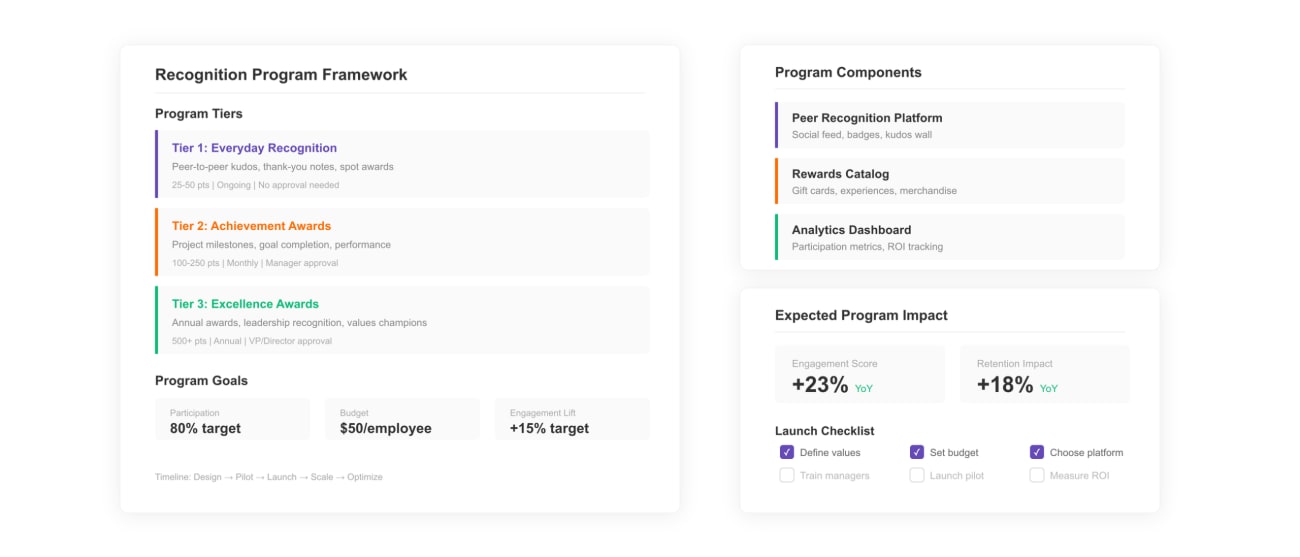
Full program design framework for after your proposal is approved.
View Template ›
Employee Recognition Nomination Form Template
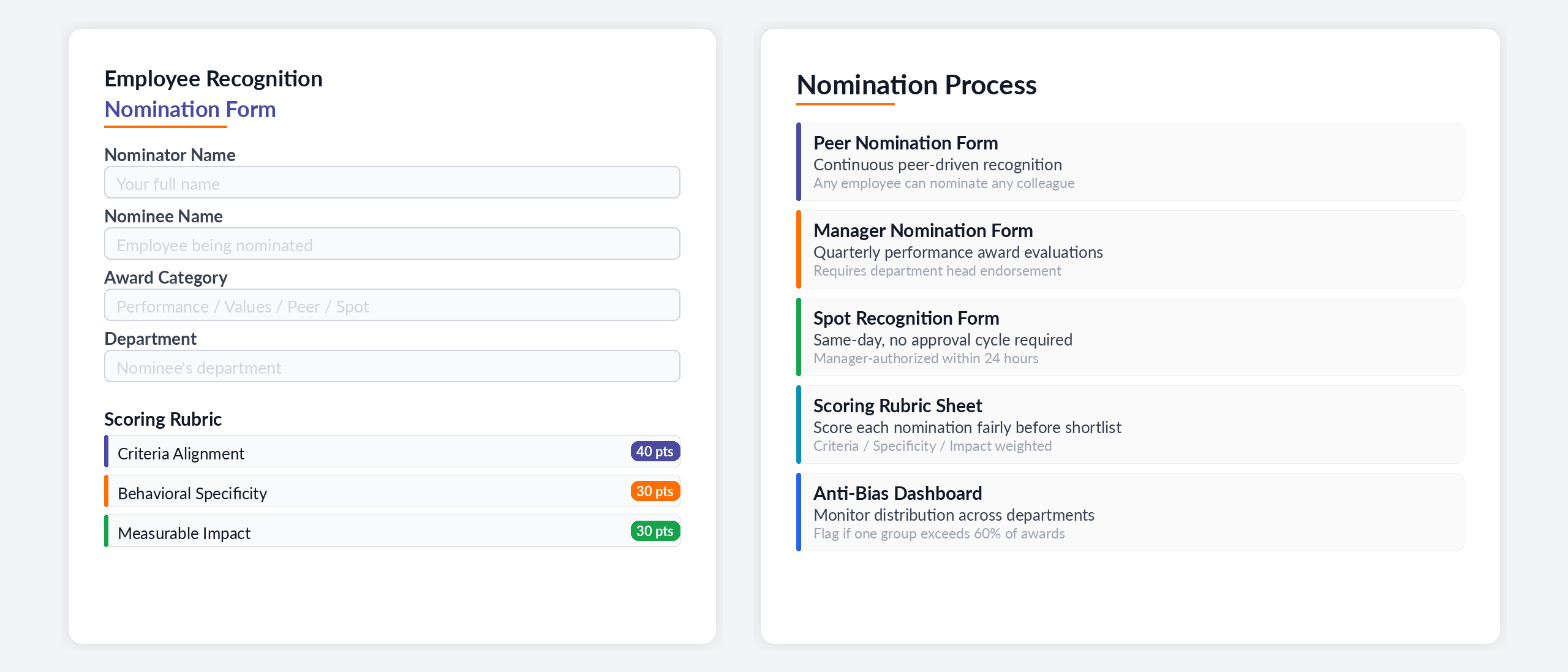
Structured nomination process to embed in your approved program.
View Template ›
Employee Recognition Award Template
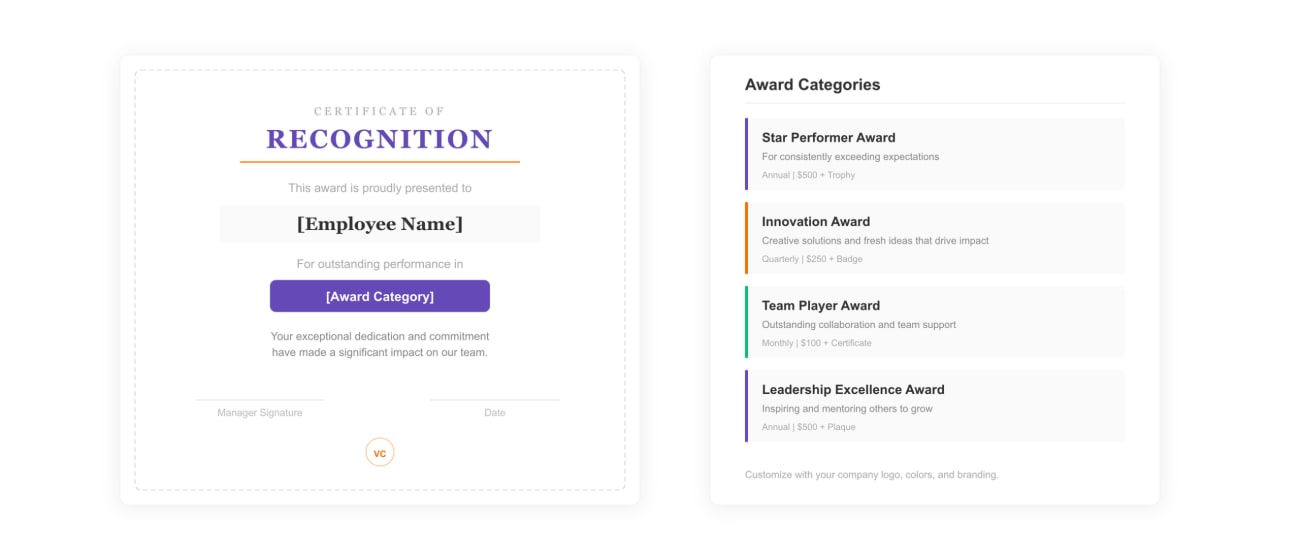
Award design to include in your recognition program proposal.
View Template ›