Imagine a company rolling out a major change. The leadership team has laid out a clear plan, the communication emails have gone out, and everything seems on track. But a few weeks later, employees are confused, managers are struggling, and adoption is slower than expected.
What went wrong? Nobody paused to ask employees how the change was affecting them.
That's where change management surveys come in. They help leaders gauge employee readiness, uncover concerns, and track adoption before small issues turn into bigger problems.
In this guide, you'll find 40 change management survey questions, a readiness scorecard, a survey timeline, and practical steps to act on employee feedback.
What Is a Change Management Survey?
A change management survey is a short set of questions that tells you how employees are taking a specific change. It shows whether people understand the change, whether they support it and whether they can actually work the new way.
It differs from a yearly engagement survey in two ways. First, it is about one change, such as a new HR system, a restructure or a new hybrid work policy. Second, you run it more than once. Asking the same questions at different stages shows you how people's answers move as the change rolls out.
Our guide to change management covers how to plan and roll out a change step by step. This guide covers the listening part: what to ask employees at each stage, and what to do with their answers.
Why Use a Change Management Survey?
A survey shows you where a change is stuck before the problem turns up in missed targets. It tells you whether people don't understand the change, don't want it, or don't yet know how to do it. Each of those needs a different fix.
Getting people to adopt a change is hard, even for experienced leaders. In a 2025 Gartner study, only 32% of business leaders said the last change they led reached healthy adoption by employees. Gartner defines healthy adoption as employees taking up the change on time without a drop in their performance, engagement or stress levels.
A well-timed survey helps you:
- Spot resistance early, while it is still a few worried comments and before it spreads.
- Measure readiness, so you know whether people need more training or time before launch.
- Find hidden barriers, such as unclear goals, patchy communication or managers who aren't on board.
- Track adoption, so you can see which teams have switched and which are still using the old way.
Yael Irom, Head of Talent Development and AI Leader Transformation at Tanium, has seen this play out in AI rollouts. On the Vantage Influencers podcast, she said:
Vantage Influencers Podcast
"A rollout that is a here's the tool rollout will always fail for the same reason. It's because it's treated as a technology rollout instead of a change management opportunity. Adoption failure is almost never a tooling failure."
Yael Irom, Tanium, on AI Literacy as the New Workplace Skill (2026)
Listen to the EpisodeLogin data shows who opened the new tool. A survey shows who is confused, who is worried and who has quietly gone back to the old way.
Types of Change Management Surveys
There are five types of change management surveys, and each one matches a stage of the change: readiness, pulse, adoption, resistance and retrospective.
| Survey Type | Purpose | Recommended Length |
|---|---|---|
| Readiness Survey | Gauge how prepared employees feel before the change goes live | 20 to 30 questions |
| Pulse Survey | Track ongoing sentiment and adoption during rollout | 5 to 10 questions |
| Adoption Survey | Measure how well employees are adapting after launch | 15 to 20 questions |
| Resistance Survey | Find pockets of friction before they grow | 10 to 15 questions |
| Retrospective Survey | Review long-term results and lessons learned | 20 to 25 questions |
The pulse survey does most of the work during a rollout. If you are new to the format, our guide to pulse surveys explains how to set one up.
When to Send Each Survey: A Change Survey Calendar
Run a readiness survey 2 to 4 weeks before launch, send short pulses every 2 to 4 weeks during rollout, and finish with a reinforcement survey 60 to 90 days after go-live. Here is how that looks in practice, using the question sets in the next section.
| When | Survey type | Question sets to use | Length |
|---|---|---|---|
| 4 weeks before launch | Readiness survey | Readiness scorecard, Awareness, Communication | 20 to 25 questions |
| 1 week before launch | Pulse | Readiness and adoption, Leadership support | 5 to 8 questions |
| 2 weeks after launch | Adoption pulse | Readiness and adoption, Resistance and concerns | 5 to 10 questions |
| Mid-rollout (every 2 to 4 weeks) | Pulse | The set that scored lowest last time, plus the manager questions for managers | 5 to 10 questions |
| 30 days after go-live | Adoption survey | Readiness and adoption, Resistance and concerns, Leadership support | 15 to 20 questions |
| 90 days after go-live | Reinforcement survey | Reinforcement, the readiness scorecard again, one eNPS question | 20 to 25 questions |
Keep an eye on how often the same people hear from you. When employees get surveyed too often, fewer of them reply and their answers get shorter. Keeping pulses short and at least two weeks apart is the simplest way to avoid survey fatigue.
40 Change Management Survey Questions by Phase
Ask about six things, in this order: awareness, communication, leadership support, readiness, resistance and reinforcement. The 40 questions below cover all six, plus a short set for managers. Each question shows the answer format to use.
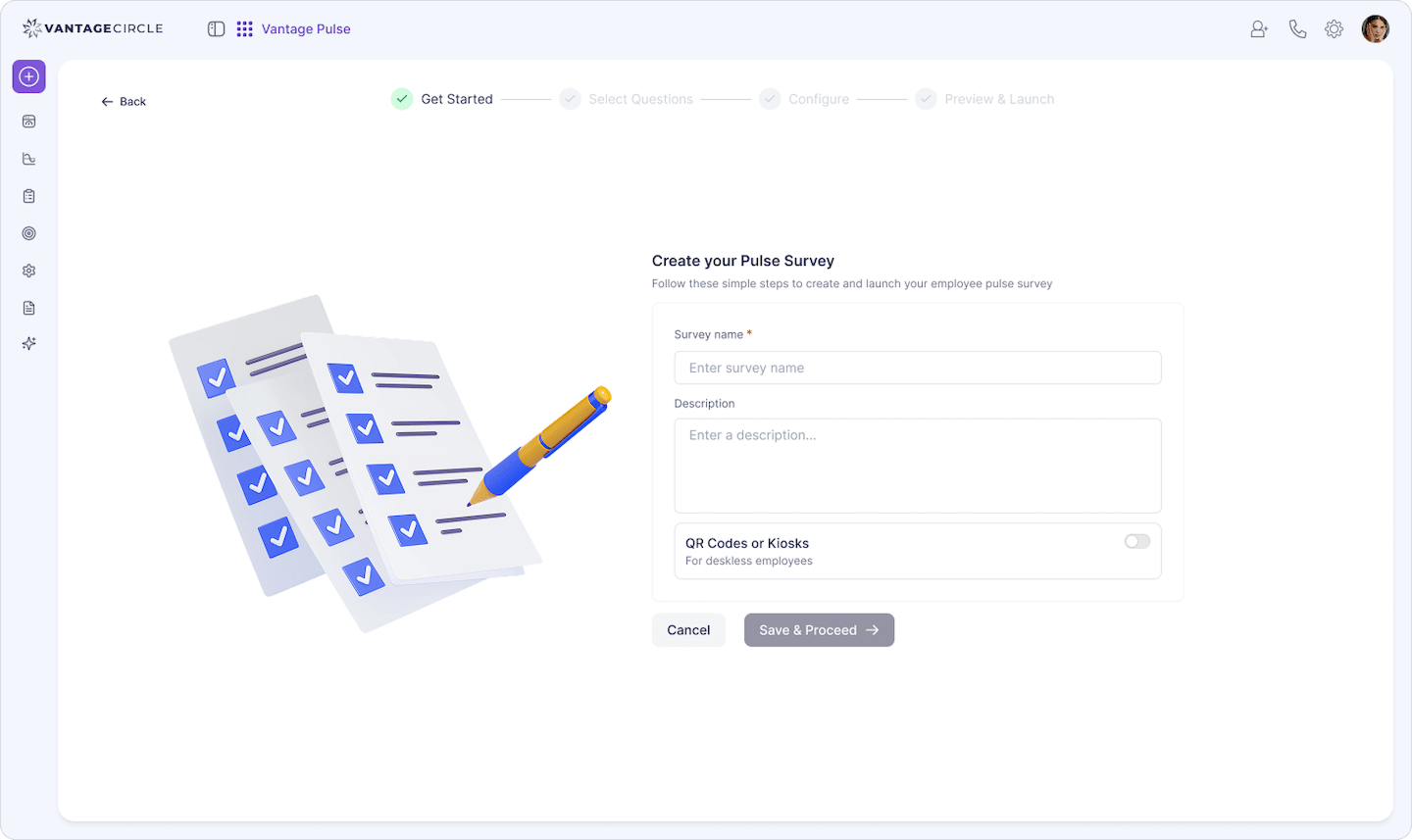
You don't need to send all 40 at once. Pick the set that fits your current stage and turn it into a short pulse. Five well-chosen questions every two weeks will tell you more than 40 questions once. In Vantage Pulse, you can build that pulse from your own questions or start from a ready-made template.
Agreement scale used below: Strongly disagree, Disagree, Neutral, Agree, Strongly agree (scored 1 to 5).
Awareness and understanding (6 questions)
These questions check whether people know why the change is happening and what it means for them. If people don't understand the reason, they are unlikely to support the change.
- I understand why this change is happening. (Agreement scale)
- I know what will change in my day-to-day work. (Agreement scale)
- I understand what the company hopes to achieve with this change. (Agreement scale)
- I could explain the reason for this change to a colleague in my own words. (Agreement scale)
- I believe this change fits where the company is heading. (Agreement scale)
- What would help you understand this change better? (Open text)
Communication (6 questions)
These questions show whether your updates are reaching people clearly, on time and through the right channel.
- How clear has the communication about this change been so far? (1 = Very unclear, 5 = Very clear)
- I heard about this change early enough to prepare for it. (Agreement scale)
- Where did you first hear about this change? (Single choice: Email, Town hall, My manager, A colleague, Intranet or chat, Other)
- Which channel works best for you for updates about this change? (Single choice: same options as above)
- I have had enough chances to ask questions about this change. (Agreement scale)
- What is one question about this change that nobody has answered yet? (Open text)
Leadership support (6 questions)
These questions tell you whether managers and senior leaders are backing the change in ways employees can see. Our guide to change leadership covers what that support looks like day to day.
- My manager has explained how this change affects my role. (Agreement scale)
- My manager is prepared to support me through this change. (Agreement scale)
- Senior leaders seem committed to this change. (Agreement scale)
- In the past month, how often have you heard from senior leaders about this change? (Single choice: Weekly, Every two weeks, Once, Not at all)
- When I raise a concern about the change, my manager takes it seriously. (Agreement scale)
- How well has your manager answered your questions about this change? (1 = Very poorly, 5 = Very well, plus "I haven't asked any questions")
Readiness and adoption (6 questions)
These questions check whether people have the skills, time and tools to work the new way.
- I feel confident I can work the new way. (Agreement scale)
- The training I received prepared me for this change. (Agreement scale)
- I have had enough time to practise before the change goes live. (Agreement scale)
- I know who to contact if I get stuck. (Yes / No)
- I have the tools and access I need to work the new way. (Agreement scale)
- What training or resources would help you most right now? (Open text)
Resistance and concerns (6 questions)
These questions give people a safe way to say what worries them. The wording matters here. A question like "How threatened do you feel?" puts words in people's mouths, so the questions below stay neutral.
People only answer these honestly when they feel safe doing so. That is why psychological safety matters during change. A 2023 Gartner press release found that when managers create a psychologically safe environment, employees' change fatigue can drop by up to 46%.
- What worries you most about this change? (Open text)
- How do you expect this change to affect your work? (Single choice: Much easier, Somewhat easier, No real difference, Somewhat harder, Much harder)
- I feel comfortable sharing my concerns about this change openly. (Agreement scale)
- Which part of this change is hardest for you to accept? (Open text)
- How do you feel about this change right now? (1 = Very negative, 5 = Very positive)
- What would make this change easier for you? (Open text)
The open-text answers in this set usually hold the real reasons people push back. Reading hundreds of comments by hand takes days, though. Sentiment analysis and word cloud views in Vantage Pulse show which worries keep coming up, so you can answer those first.
Reinforcement and post-change review (6 questions)
These questions check whether the change has stuck, 60 to 90 days after go-live. This is the stage most teams skip, and it is often where people quietly slip back to the old way.
- Six weeks on, I use the new process without needing help. (Agreement scale)
- This change has made my work easier or better. (Agreement scale)
- What, if anything, has made you go back to the old way of working? (Open text)
- People who took up the change early have been recognised for it. (Agreement scale)
- The problems I raised during the rollout have been dealt with. (Agreement scale)
- What should we do differently the next time we roll out a change like this? (Open text)
Questions for managers (4 questions)
Managers see how their team is coping before any survey does. Send these to managers alongside each pulse.
- How many people on your team still need support with this change? (Number)
- What questions do you get most often from your team? (Open text)
- I have the information I need to answer my team's questions. (Agreement scale)
- What support do you need from HR or senior leaders right now? (Open text)
Questions to Ask Leadership During a Restructure
During a restructure, employees often have questions of their own for leaders. These five work well in a town hall or a team Q&A:
- Why is this restructure happening now?
- How will my role or reporting line change, and when will I know?
- What happens to people whose roles are affected?
- Who is making these decisions, and how?
- Where can I take my questions after this meeting?
How to Run a Change Readiness Assessment
To run a change readiness assessment, ask employees to rate 8 statements from 1 to 5, work out the average score, and read the result against 3 bands.
The statements below follow ADKAR, a change model from Prosci. ADKAR stands for Awareness, Desire, Knowledge, Ability and Reinforcement, the five things a person needs to make a change stick. You can read about ADKAR and other change management models in our separate blog.
Change readiness scorecard
| Statement (rate 1 = Strongly disagree to 5 = Strongly agree) | ADKAR element |
|---|---|
| 1. I understand why this change is needed. | Awareness |
| 2. I know how this change will affect my role. | Awareness |
| 3. I want this change to succeed. | Desire |
| 4. I believe this change will be good for my team. | Desire |
| 5. I know what I need to do differently. | Knowledge |
| 6. I have had the training I need for this change. | Knowledge |
| 7. I have the time and tools to work the new way. | Ability |
| 8. I believe leaders will stick with this change after launch. | Reinforcement |
How to score it
- Ask everyone affected by the change to rate all 8 statements.
- Work out the average across all 8 statements for the whole group, then for each team.
- Read each average against the bands below.
- Check the average for each ADKAR element too. The lowest one tells you where to act first.
Score bands
| Average score | What it means |
|---|---|
| 4.0 to 5.0 | Ready. Go ahead with the launch and keep the updates coming. |
| 3.0 to 3.9 | Ready with support. Launch, but add training and manager briefings, and run a pulse within two weeks. |
| Below 3.0 | Not ready. Fix the lowest-scoring element before launch, or move the date if you can. |
Treat these bands as a practical rule of thumb. They are a quick way to read your results, and they are not a validated research tool. What matters most is how scores move between surveys and how teams compare with each other.
What to Do With Your Survey Results
Start with the lowest-scoring area, because each one points to a different fix. More training won't solve a low awareness score, and more emails won't solve a skills gap.
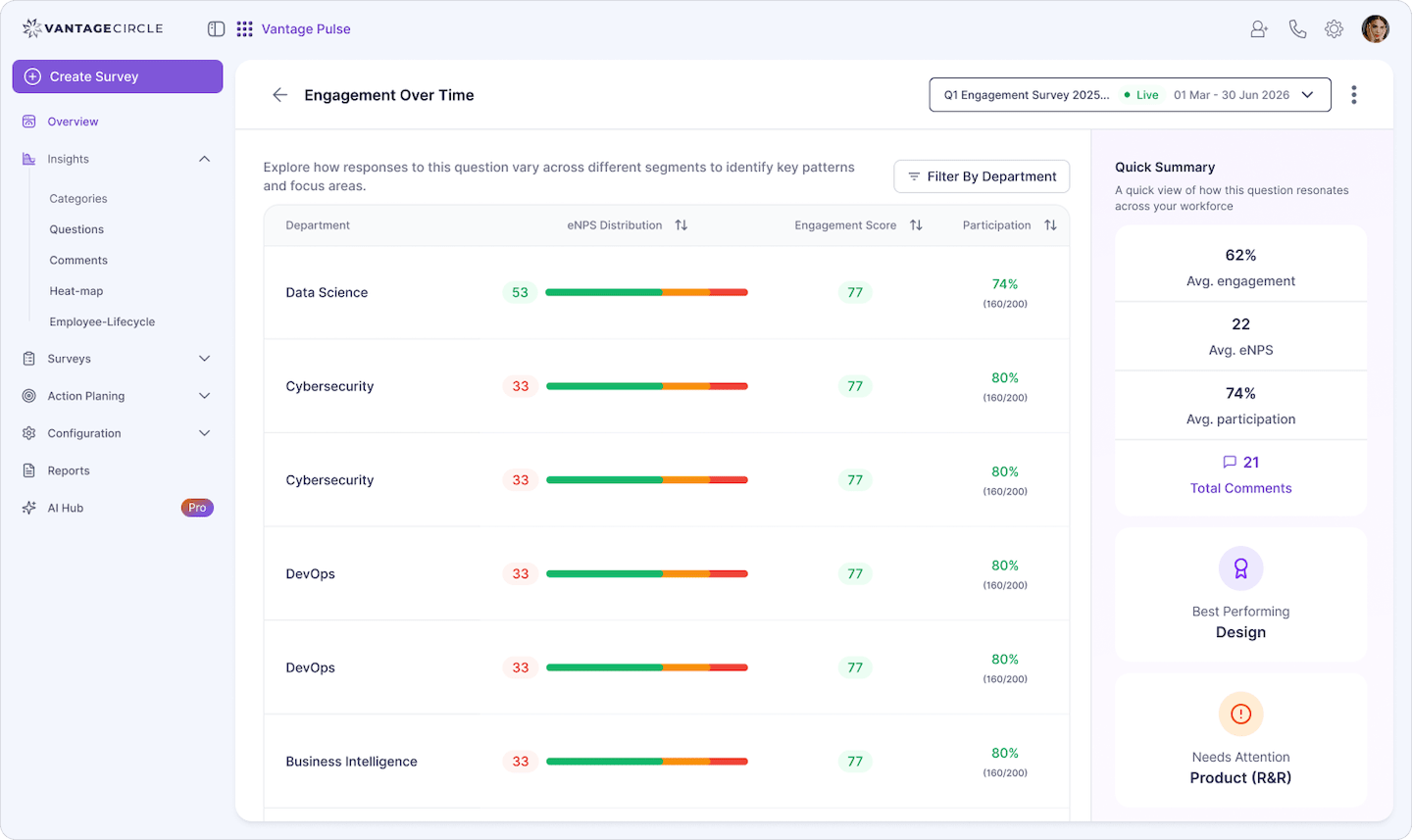
Look at the results by team as well as company-wide. An overall average can hide the real problem. Readiness is often fine in most teams and very low in one or two, and that is usually where the change stalls. Department-wise insights in Vantage Pulse let you compare scores across teams before you plan your next step.
Results Diagnosis Table
| Low score on | What it usually means | First action | Owner |
|---|---|---|---|
| Awareness | People don't know why the change is happening | A senior leader explains the reason in team meetings, in plain words | Senior leaders |
| Communication | Updates are late, unclear or on the wrong channel | Move updates to the channel people picked and set a fixed update day | Internal comms and HR |
| Leadership support | Managers aren't bought in or can't answer questions | Brief managers before the next pulse and give them a short FAQ | HR and senior leaders |
| Readiness and adoption | People want to change but lack the skills, time or tools | Add hands-on practice sessions and name a go-to person in each team | L&D and project team |
| Resistance and concerns | People expect to lose more than they gain, or doubt the reason | Hold small listening sessions and answer the top three concerns openly | Managers and HR |
| Reinforcement | People are slipping back to the old way | Remove old workarounds and recognise the people using the new way | Managers and project team |
A low leadership support score deserves extra attention. Many HR leaders already see the gap: in a July 2024 Gartner survey of 473 HR leaders, 74% said their managers are not equipped to lead change. Yael Irom sees managers as the deciding factor:
Vantage Influencers Podcast
"The success of any change management initiative, any adoption of a tool is in how the managers are adopting. That's the single biggest predictor of whether something's going to stick."
Yael Irom, Tanium, on AI Literacy as the New Workplace Skill (2026)
Listen to the EpisodeWhatever the results show, close the loop quickly. Share what you learned and what you plan to do within two weeks of the survey closing. People keep giving honest employee feedback when they can see it leads somewhere.
Best Practices for Change Management Surveys
Keep surveys short, make them anonymous, run them more than once, and show people what changed because of their answers. Here is how to put that into practice:
- Set a clear goal for each survey. Decide whether you are measuring readiness, finding resistance or tracking adoption, and pick questions for that goal only.
- Mix question types. Use agreement scales for scores you can track over time and open-text questions for the reasons behind them.
- Make it anonymous. People report resistance honestly only when they trust their answers can't be traced back to them. An anonymous survey gets you more candid feedback.
- Follow up without asking who said it. With two-way anonymous conversations in Vantage Pulse, HR can reply to an anonymous comment and ask what would help, while the employee stays anonymous.
- Test the survey first. Send it to a small group before the full rollout to catch confusing questions.
- Run one eNPS question before and after. eNPS (Employee Net Promoter Score) asks how likely employees are to recommend your company as a place to work, on a scale of 0 to 10. Ask it two weeks before launch and again at 90 days for a simple before-and-after view.
- Involve employees in the plan. Ask for ideas early and let teams shape how the change fits into their daily work. People support what they helped build.
- Keep the conversation going. Use team check-ins and town halls between surveys so people don't feel the survey is the only way to be heard.
- Recognise early adopters in public. Thanking the people who switched early, and the ones who helped colleagues switch, shows everyone the new way is here to stay. Manager recognition in Vantage Rewards makes this easy to do at each rollout milestone.
- Share results and next steps. Tell people what you found and what you will do about it, even when the news is mixed.

Final Thoughts
Many changes stall because nobody asked employees how it was going until it was too late. Hence, conducting change-management surveys is a must.
Survey at every stage of the change; start with the lowest score and quickly share what you will do about it.
A single survey gives you a snapshot. A series of short surveys, from four weeks before launch to 90 days after, shows you whether the change is taking hold. The questions in this blog give you a starting point for each stage. The diagnosis table tells you where to act when the answers come back.
FAQs
What questions should be asked in a change management survey?
Ask about six areas: awareness, communication, leadership support, readiness, resistance and reinforcement. Use agreement-scale statements such as "I understand why this change is happening" to track scores over time, and add open-text questions such as "What worries you most about this change?" to learn the reasons behind them.
How do you assess readiness for change?
Ask employees to rate 8 statements from 1 to 5, covering why the change is needed, whether they want it, what they need to do, and whether they have the training and tools to do it. Average the scores. An average of 4.0 or above suggests you are ready, 3.0 to 3.9 means ready with extra support, and below 3.0 means you should fix the weakest area first.
When should you send a change management survey?
Send a readiness survey 2 to 4 weeks before launch, short pulse surveys every 2 to 4 weeks during rollout, and a reinforcement survey 60 to 90 days after go-live. Add a resistance survey any time you notice warning signs, such as complaints, low usage or people going back to the old way.
How many questions should a change management survey have?
It depends on the stage. A readiness survey before launch can have 20 to 30 questions. Pulse surveys during rollout work best with 5 to 10. A reinforcement or retrospective survey after go-live usually needs 20 to 25. Shorter surveys sent more often tend to get better response rates than one long survey.
Should a change management survey be anonymous?
Yes. People are more likely to share honest concerns about a change when they know their answers can't be traced back to them. Hide results for groups of fewer than five people, tell employees how their data is protected, and use anonymous two-way conversations if you need to follow up on a comment.
What do you do with change management survey results?
Find the lowest-scoring area first, because each one needs a different fix. Low awareness calls for a clearer explanation from leaders, low readiness calls for more training and practice, and low leadership support calls for a manager briefing. Compare results across teams, then share what you found and your next steps within two weeks.

Riha Jaishi is a Content Marketing Specialist at Vantage Circle and host of the HR Vantage Influencers podcast, sharing insights that help organizations build recognition-rich, people-first cultures!!
Connect with Riha on LinkedIn.