Learning, as they say, is a never-ending process and is very crucial for growth. And as a working professional, indulging yourself in continuous learning paves the way toward success.
The thing with learning is that it has evolved with time. The interesting fact is that learning never stops. It is a continuous process that does end with a degree or when you settle down with a good job.
You will always find something new to learn every day. As human beings, we have adapted to learning through various means in between all the chaotic developments.
Let's delve in and know more about what exactly it is.
What Is Continuous Learning?
Ask ten L&D professionals to define continuous learning and you'll get ten slightly different answers. The ATD definition, a commitment to ongoing professional growth driven by curiosity and personal accountability, is the one that gets cited most. It's not wrong. But it puts the entire weight on the individual, which conveniently lets organizations off the hook.
Curiosity alone doesn't survive a 60-hour week. It doesn't survive a manager who treats development as an extracurricular, or a company that says "we invest in our people" and then schedules learning time that gets canceled the moment a client call comes in. The organizational half of this — protected time, accessible content, actual managerial support — is what determines whether anyone learns anything. Without it, individual commitment goes nowhere.
What actually separates companies with functioning learning cultures from those that just run annual training isn't the size of the content library. Most organizations have more courses than anyone will ever touch. The real dividing line is whether learning has become a normal behavior. When it is, people do it without friction. When it requires special effort every single time, most people eventually stop making that effort. It's not a character flaw. It's just how habits work.
Continuous Learning vs. Traditional Training: What's the Difference?
I want to be clear that traditional training isn't the problem. Compliance modules keep organizations out of legal trouble. A well-built onboarding program can compress a new hire's ramp time meaningfully. Both of those things have real value.
The issue is when episodic training becomes the whole strategy. Traditional training is designed to fill a defined gap at a specific moment, and when that moment passes, the program ends. Whether the gap got filled or not, the intervention is over. Continuous learning is a different animal. It's not a program you add to the calendar. It's how the working environment is designed so that growth is already built into the rhythm.
| Dimension | Traditional Training | Continuous Learning |
|---|---|---|
| Cadence | Periodic, annual, onboarding, compliance | Ongoing, woven into how work gets done |
| Ownership | Organization-driven | Employee-driven, with organizational scaffolding |
| Format | Formal courses, workshops, LMS completions | Microlearning, mentorship, stretch projects, peer knowledge-sharing |
| Measurement | Completion rates, test scores | Skill proficiency change, internal mobility rate, engagement data |
| Outcome | Compliance, onboarding, point-in-time upskilling | Adaptive capability, retention, innovation readiness |
Traditional training gets people ready for the role as it exists today. Continuous learning builds the capacity to figure out what it'll require in two years. That difference matters a lot more than it sounds.
Why Is Continuous Learning Important in 2026?
Skill requirements are changing faster than annual or even quarterly training cycles can absorb. That's been true for a while. What's different in 2026 is the acceleration, several dynamics are now colliding at once, and the organizations that don't have a continuous learning infrastructure are feeling it in ways they can actually measure.
The World Economic Forum's Future of Jobs Report 2025 projects that 39% of existing skill sets will be disrupted or obsolete by 2030. I always think this stat deserves more pause than it gets. The person you hired three years ago — fully qualified, strong reviews — the skills that made them a strong hire are now, statistically, 39% at risk of irrelevance within five years. Building an annual training cycle as your primary response to that is a structural lag you're choosing to maintain.
LinkedIn's 2025 Workplace Learning Report found that 94% of employees say they'd stay longer at a company that invested in their development. HR leaders sometimes dismiss this as survey optimism. Fair. But the same pattern shows up unprompted in exit interview data across industries and seniority levels, and at some point, a pattern that consistent stops being soft signal.
McKinsey's 2025 research on AI and work is the one I find most clarifying. Roles are being augmented faster than new ones are being created to absorb displaced tasks. The employees learning alongside that change stay deployable. The ones who aren't become harder to move, retrain, or retain. And for anyone building tools for HR teams, this isn't future-of-work speculation. It's happening inside the organizations you serve right now.
Gallup's 2025 data adds the expectation dimension: younger employees rank learning opportunities alongside compensation when evaluating employers. Not above a competitive salary. Alongside it. Development has stopped being a retention perk and started being a baseline expectation. If you're not offering it, you're competing in the talent market with a structural disadvantage.
6 Measurable Benefits of Continuous Learning for Organizations
Higher Retention Rates
LinkedIn's 2025 Workplace Learning Report found that companies investing meaningfully in employee development see 57% higher retention than those that don't.
Put that through a cost lens. SHRM benchmarks average cost-per-hire at $4,700 (2022), and that's before you factor in the productivity gap during transition, the manager time spent backfilling, or the institutional knowledge that walked out. For specialist and senior roles, the real number is multiples of that figure. A 57% reduction in turnover is a headcount number with a direct budget line attached. That's the conversation that lands with a CFO, not "culture" and not "engagement."
For more on building a retention-first talent strategy, see our guide on employee retention strategies.
Faster Internal Mobility
High internal mobility is usually a signal that learning is producing something beyond completions.
AT&T's workforce transformation gets cited constantly and deserves to keep being cited, because it actually worked at scale. When the business shifted from hardware to software infrastructure, AT&T invested over $1 billion in internal reskilling, moving people into roles that hadn't existed when they were hired. The alternative was external hiring at scale, which is slower, more expensive, and imports none of the institutional knowledge long-tenure employees already carry. Unilever's "Future Fit" program took modular learning pathways and tied them to lateral moves specifically, so gaps got filled before they became vacancies rather than after. Both programs treated learning as infrastructure. Employees used it.
Closed Skill Gaps
Half the global workforce needs reskilling within the next two years, according to WEF 2025 data. I'd sit with that for a second before moving on. It's not describing a fringe population of workers in uniquely disrupted industries. It's a mainstream projection about how fast capability requirements are shifting across the board.
The organizations closing gaps fastest are not always the best-funded. They're the ones where skill-gap visibility is a regular management habit, where someone can tell you at any given moment what capabilities exist in the team, what's needed, and who's currently building what. Continuous learning is the mechanism that keeps that picture current.
Increased Employee Engagement
The disengagement that follows stagnant learning is slow. That's what makes it expensive.
When people feel like they're growing, they show up differently, more present, more invested, more willing to go past the minimum. When growth plateaus, the disengagement is quiet. They're at their desks. They're completing tasks. They're also mentally drafting their LinkedIn headline. By the time it surfaces in an exit interview, you've been paying their salary for months while they were already somewhere else in their head.
What I've seen work is making learning progress socially visible. A recognition feed that surfaces certifications, skill applications, the mentorship someone is quietly running, and connects those wins to a company value like "growth mindset", sends two signals at once. It rewards the person. It shows everyone else what the organization actually values, as opposed to what it claims to value in an all-hands deck.
For practical ideas on building this reinforcement loop, see our resource on employee engagement activities.
Innovation Velocity
"Innovation" is the benefit I trust least when it appears in L&D frameworks, because it's usually vague enough to mean nothing and impossible to attribute to any specific program. So I'll keep this narrow.
Organizations where employees actively build diverse skills have more varied inputs going into problem-solving. The practical expression of that isn't dramatic. It's a team that asks "how do we build this capability?" before it asks "who do we hire for it?" That reflex, over time, produces a different kind of organization, faster to adapt, less dependent on any single person's knowledge, cheaper to staff through transitions. That's measurable. Innovation as a concept isn't.
Lower Cost-Per-Hire
Most leaders doing ROI calculations on L&D are measuring the wrong thing. They're counting what learning costs. They're not counting the roles they didn't have to recruit externally.
Every internal move generated by a learning culture, someone growing into a role that would otherwise have needed an outside hire, is a direct financial offset against the L&D budget. SHRM benchmarks cost-per-hire at $4,700 on average. For technical and senior roles, the number climbs fast. Internal candidates also ramp faster, which is a second cost saving that rarely makes it into the calculation.
Use our cost per hire calculator to model what internal mobility is actually worth at your scale.
7 Practical Examples of Continuous Learning in the Workplace
What works at 50 people doesn't automatically scale to 5,000. I want to get that caveat in early because most lists of "learning formats" present them as universally applicable, and then organizations implement them without adapting for headcount, workflow, or culture and wonder why engagement is flat.
That said, seven formats show up consistently across high-performing learning cultures regardless of size.
1. Microlearning. Short bursts, 5 to 15 minutes, embedded in the workflow rather than scheduled around it. EdApp and Axonify are designed for this. It works not because short is inherently better, but because it doesn't require employees to find time they don't have.
2. Peer learning. Retrospectives, lunch-and-learns, structured skill-sharing sessions. The thing that kills peer learning programs is consistently the same: no documentation. The insight surfaces in a conversation, everyone nods, and it disappears. Organizations doing peer learning well build capture mechanisms. Simple ones, even just a shared doc. But they build them.
3. Mentorship programs. Pairing people across seniority levels with defined learning objectives and real check-in cadences. The "defined" part is not optional. Informal mentorship produces good relationships. Structured mentorship produces transferable skills. These are genuinely different outcomes.
4. Learning stipends. Employee-controlled development budgets. The signal embedded in this format is as important as the money, you're telling people their development is a personal investment the organization is co-funding. That shifts ownership in a way a company-curated catalog usually doesn't.
5. Internal certifications. Role-specific credentials connected to promotion criteria and mobility pathways. Not a completion badge. An actual marker of capability that means something inside the organization's career architecture.
6. Book clubs. Consistently the most underrated item on this list. Low overhead, high engagement, and they build shared vocabulary around new ideas in a way that a workshop often can't. Especially useful for leadership teams.
7. Stretch assignments. Placing people in projects that require capabilities they don't fully have yet, with enough structural support that they're likely to succeed rather than drown. The support is not optional. Stretch without scaffolding is just overextension with a positive spin.
The organizations doing these well are usually not outspending those that don't. They've made learning time protected time, not theoretically protected in a policy document, but actually protected in practice.
How to Build a Culture of Continuous Learning: A 7-Step Framework
Culture is what people do repeatedly until it stops requiring thought. Not what's on the wall. The actual repeated behaviors. Building a continuous learning culture is an engineering problem, you're designing conditions under which learning becomes the path of least resistance rather than the extra effort.
Step 1: Tie Learning to Business Outcomes
L&D programs that can't explain what they're producing get cut. Not because leadership is hostile to learning, usually they're genuinely supportive, in principle. But when the numbers get hard and someone needs to find budget, "we believe in developing our people" is not a defense. A specific improvement in time-to-productivity, a measurable shift in internal mobility rate, a documented proficiency change in a capability the business explicitly needs, those are defenses.
When L&D speaks the language of business outcomes, it earns protection. When it speaks in program names and completion numbers, it stays permanently vulnerable.
Step 2: Secure Executive Sponsorship
This is where most learning culture initiatives die, not loudly, just gradually.
Leadership is usually supportive in the abstract. The problem is that abstract support doesn't protect budget, doesn't create time, and doesn't change how managers behave. Real executive sponsorship is the CHRO making protected learning time non-negotiable in the operating calendar. It's the CFO treating L&D spend as strategic rather than discretionary. It's managers being told — explicitly, with consequences — that developing their people is part of how their own performance is assessed.
Without the structural version, you get a culture initiative that gets announced at the all-hands and is forgotten by Q4.
Step 3: Allocate Protected Learning Time
Telling employees to find time to learn is advice that only works when the workload allows for it. For most people, it doesn't.
Real protected time means the organization takes structural responsibility, no-meeting blocks, quarterly learning sprints, explicit calendar space that isn't first to get sacrificed when a deadline appears. Google's 20% time is the version everyone knows. Most organizations don't need to go that far. What they do need is to stop treating learning as something that happens in the margins of a full schedule and start treating it as something that gets scheduled before the margins fill up.
Step 4: Democratize the Curriculum
When access to learning concentrates at the senior or high-potential tier, everyone else notices. And the implicit message they receive, whether it's intended or not, is that development is a reward for people who've already proven themselves rather than an investment in people who are still in the process of doing that.
Making pathways accessible at every level and function doesn't demand a massive budget. It demands ruthless curation. Surfacing internal knowledge alongside external content. Treating the frontline employee developing a new capability with the same seriousness as the director completing a leadership program. In a genuine skill-gap environment, those two investments are often equally strategic. The organizations that understand that have a different kind of talent pipeline five years later.
Step 5: Recognize Learning Progress
Here's what I've watched happen enough times that I'd call it a pattern: an organization invests real money in L&D infrastructure. Employees actually use it. They complete courses, earn certifications, and apply new skills in live projects. And then nothing happens. No acknowledgment. No visibility. Not even a notification that the organization noticed.
Within a few cycles, participation drops. The L&D team starts talking about a motivation problem. But it's almost never motivation. It's that the behavior produced no social or professional response, and people are quite good at learning when effort goes unnoticed. They stop.
Peer-to-peer recognition for certifications, skill application, visible knowledge-sharing closes that feedback loop. Themed campaigns like "Skill-Up Month" create concentrated windows of social attention that make learning visible in a way a completion notification in an LMS dashboard will never accomplish.
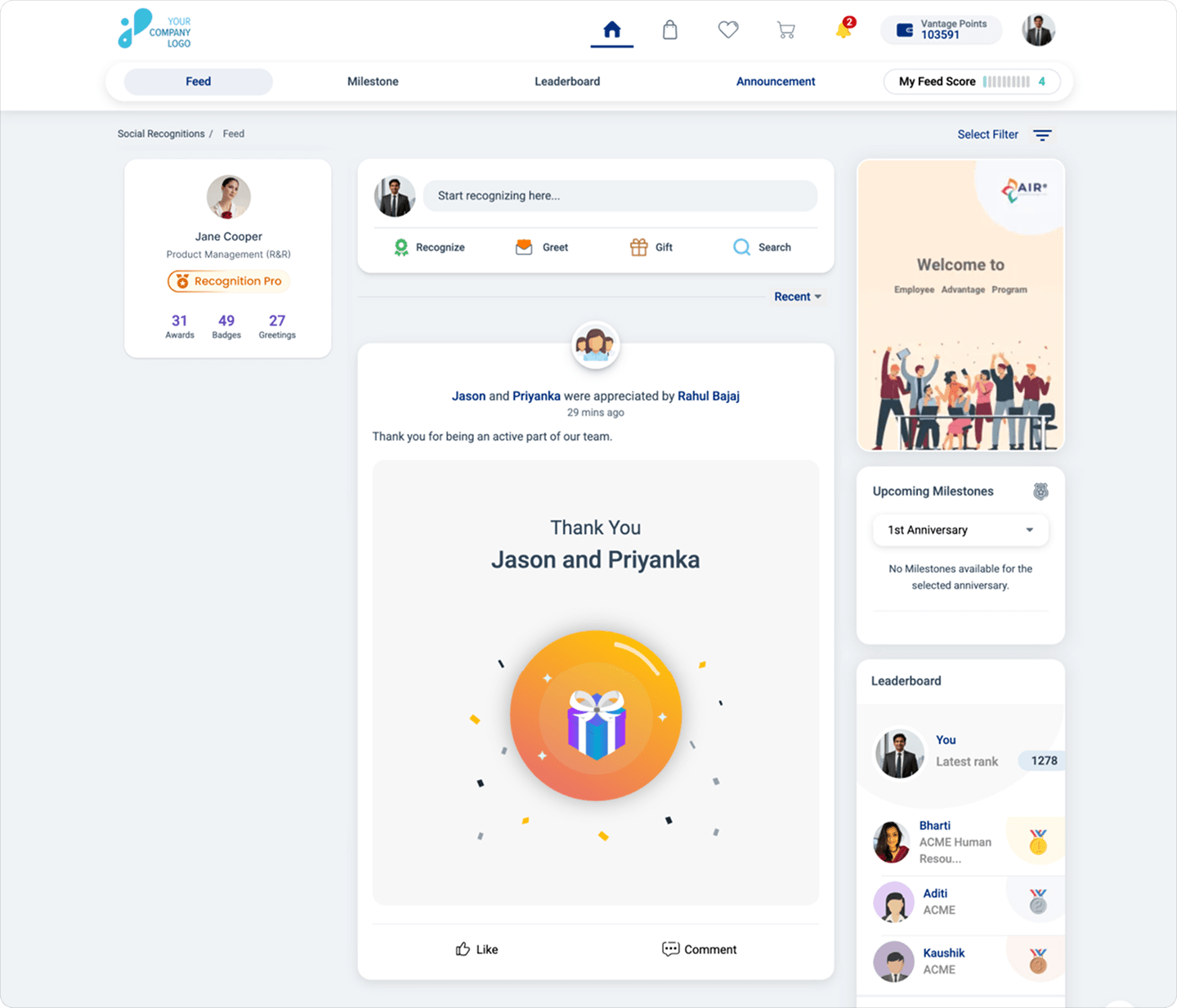
See how Vantage Rewards supports this: employee rewards and recognition.
Step 6: Measure Skill Growth
Vague L&D programs get defunded. It's that simple.
If you can't show what the program produced beyond completion numbers, then when budget cuts come, and they always come, you have nothing to defend with. Skill growth is measurable. Run anonymous eNPS surveys on L&D perception quarterly, track sentiment in open-ended responses, and you'll know where the culture is working and where it's inert before attrition delivers that feedback in a more expensive form. Layer in learning hours per employee, pre/post proficiency data, internal mobility rate. When managers see their department's development investment showing up in actual performance numbers, they stop treating learning time as optional overhead.
For connecting learning goals to measurable performance outcomes, see goal setting for employees.
Step 7: Iterate Quarterly
An L&D program built on 18-month-old assumptions about what the workforce needs is operating blind. The role requirements have shifted. The gaps have moved. The employees who were struggling with one thing are now struggling with something else.
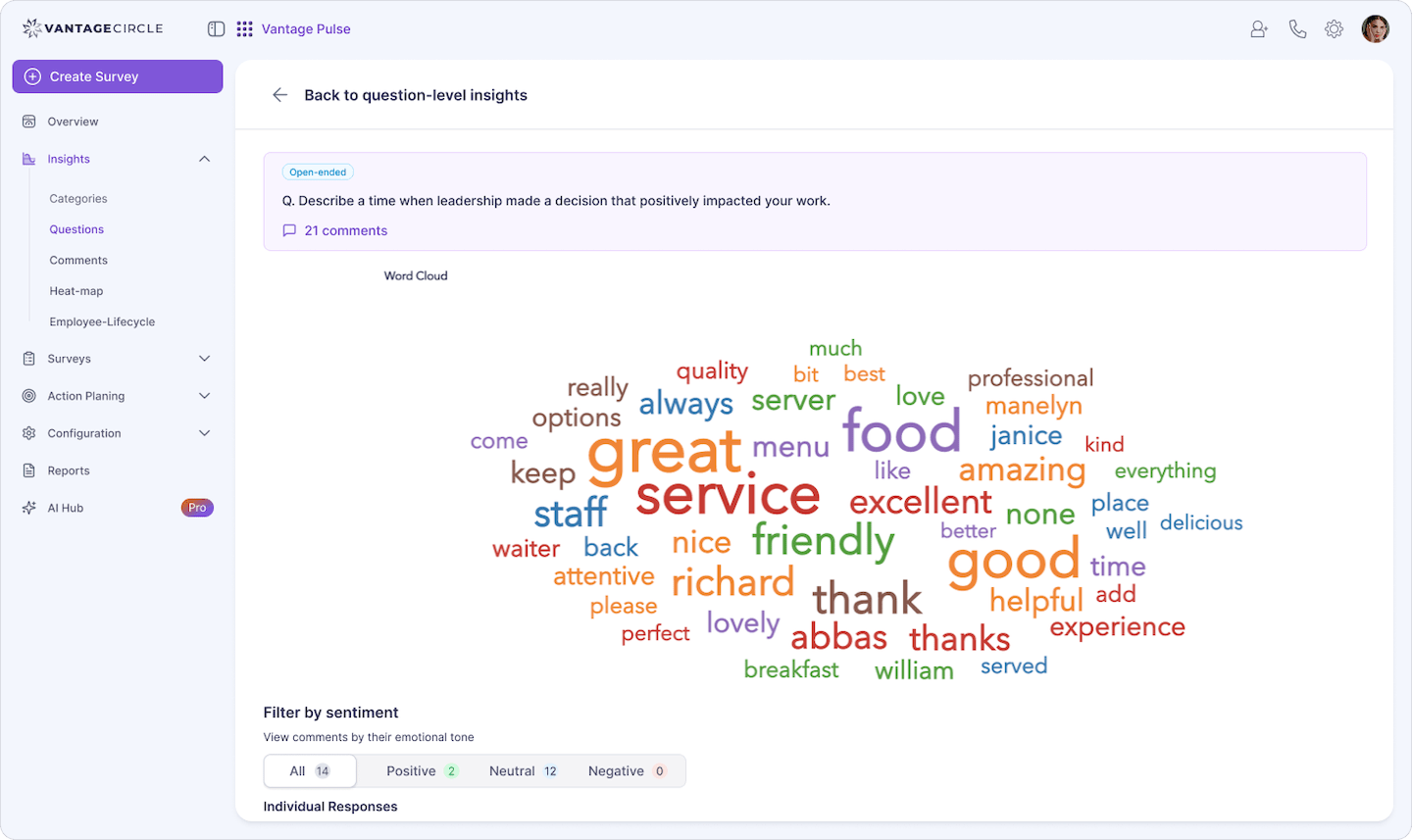
Quarterly word cloud analysis on L&D feedback surfaces what's actually driving disengagement, content that doesn't connect to the job, time constraints that aren't being acknowledged, manager resistance that's never been named directly. Those themes should drive adjustments, not just be read and filed. The organizations running this cycle consistently are the ones where employees still describe their development experience positively after three or four years. The others have libraries with high enrollment and near-zero use.
How Do You Measure Continuous Learning?
Most organizations avoid building a real measurement framework because it feels like overhead. Pre/post assessments require design work. Skill proficiency rubrics require thought. It's much easier to pull a completion report from the LMS and present it as evidence.
Completions tell you whether learning happened. They don't tell you whether it transferred. Those are completely different questions, and only one of them matters when someone in finance asks whether the budget is producing anything.
Five metrics form the honest framework.
1. Learning hours per employee per year. The floor metric. LinkedIn's 2025 L&D Report targets 40-plus hours annually. Formula: total hours logged divided by headcount. Tells you whether learning is occurring at all. Not whether it's working. That's a different question requiring different data.
2. Course completion rate. Target above 80%. Completions divided by enrollments, times 100. When completion is low, the diagnosis almost always traces back to relevance rather than motivation. Getting that right matters because the fixes are completely different.
3. Skill proficiency change. Pre- and post-program assessments against defined criteria. The most direct evidence that a capability shift happened. Chronically underused because it requires assessment design, not just login data. Worth building. The organizations that have it have a very different L&D conversation with their leadership teams.
4. Internal mobility rate. Internal moves — promotions, laterals, project rotations — divided by headcount, times 100. Downstream evidence that learning is producing deployable capability rather than just completed modules. It also predicts retention, which gives it value in two separate strategic conversations simultaneously.
5. Training ROI via the Phillips Model. Net program benefits minus costs, divided by total costs, times 100. Phillips captures Level 4, actual business results, not satisfaction scores or knowledge retention proxies. The only framework credible enough to survive a skeptical CFO. If you're presenting L&D ROI to finance in any other form, you're leaving yourself open to a conversation you won't win.
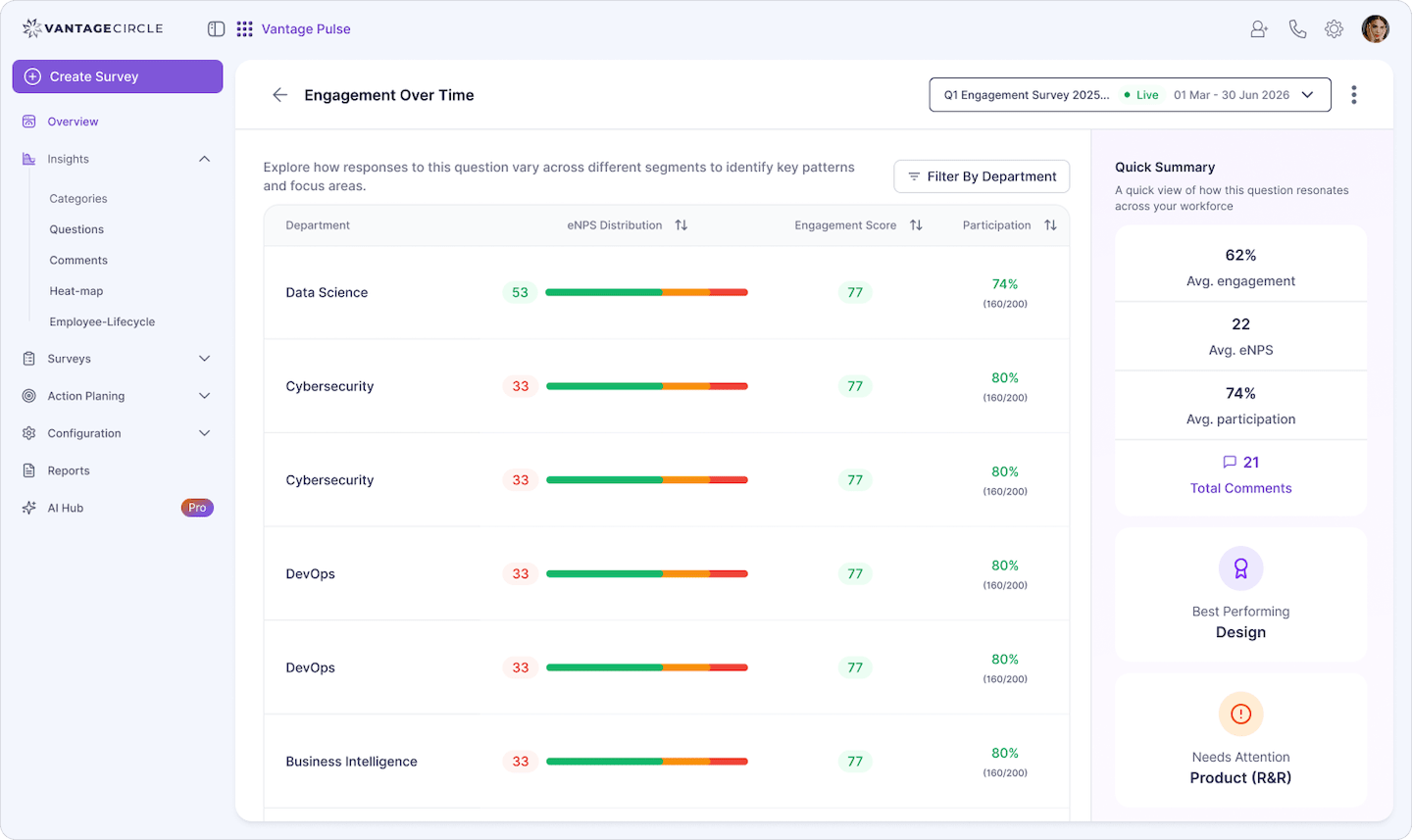
Pair these with recognition analytics to see which teams reinforce learning through peer acknowledgment and which are letting it dissipate quietly. Department-level pulse data shows where L&D investment is returning value, and where it's simply going nowhere.
Common Barriers to Continuous Learning (and How to Remove Them)
| Barrier | Why It Exists | Solution |
|---|---|---|
| Time | Learning is treated as additive to an already full workload | Protect learning time structurally, it goes in the calendar, not the policy document |
| Budget | L&D spend is classified as discretionary, not strategic | Connect ROI to specific outcomes; present with Phillips model data |
| Manager resistance | Managers fear losing team output to learning time | Include development in manager performance criteria, make it a metric, not a suggestion |
| Content overload | Too many courses, too little curation | Build role-specific pathways based on actual skill gap data, not catalog breadth |
| Irrelevance | Content doesn't connect to what employees actually do | Involve employees in selection; use pulse data to find real gaps, not assumed ones |
Of all of these, relevance is the one I see most often and take most seriously. Time is real. Budget is real. But the barrier that actually causes quiet disengagement, where someone just stops logging in and nobody notices for a while, is almost always that the employee looked at what they were being asked to learn and couldn't trace a line between it and anything they actually care about in their job. That gap is fixable. Fixing it requires someone to sit with the content, the role, and the individual's stated career goals at the same time. Most organizations build a catalog instead.
Tools and Platforms for Continuous Learning
Selection is now the harder problem. There's no shortage of technology. The question is whether you're buying something that serves the culture you're trying to build or the culture you already have.
1. Learning Management Systems (LMS), Docebo, Cornerstone on Demand. Built for structured delivery, compliance tracking, completion reporting. The design is optimized for the administrator's reporting needs, which is exactly right for compliance-heavy environments and exactly wrong for cultures trying to make learning feel self-directed. Know which one you're running before you buy.
2. Learning Experience Platforms (LXP), Degreed, 360Learning. Learner-first design. Aggregates internal and external content, supports peer contribution, surfaces skill gaps through ongoing assessment rather than one-time evaluation. The difference from an LMS isn't just UX, it's what question the platform is designed to answer. LMS answers "did they complete it?" LXP answers "did they come back?"
3. Microlearning platforms, EdApp, Axonify. Mobile-first, short-burst delivery designed for frontline and deskless workers without consistent desktop access. Five minutes of targeted content during a shift transition is more valuable than an hour-long module that sits unfinished in a queue for three weeks. Most organizations with large frontline workforces have not solved this problem yet.
4. Coaching platforms, BetterUp, CoachHub. One-to-one professional coaching for the development that content cannot produce, leadership under genuine ambiguity, communication in high-stakes situations, strategic thinking in conditions of incomplete information. These require dialogue and iteration, not completion. Chronically underinvested in most L&D budgets relative to impact.
Technology doesn't build a learning culture. It amplifies what's already there. If the culture isn't there, the platform is just expensive furniture.
Continuous Learning vs. Lifelong Learning vs. Upskilling
These three get used interchangeably in ways that create confusion worth clearing up before it affects how you design an L&D strategy.
| Concept | Scope | Driver | Workplace Application |
|---|---|---|---|
| Continuous learning | Ongoing skill development embedded in working life | Individual habit plus organizational scaffolding | Core operating model for L&D |
| Lifelong learning | Broad intellectual and personal growth across a lifetime | Intrinsic curiosity, not tied to employment | Wider than work; includes personal enrichment |
| Upskilling | Targeted development of specific skills for a defined need | Organizational gap or technology shift | Point-in-time capability intervention |
Upskilling is a subset of continuous learning. Lifelong learning is the container that holds both. Continuous learning in the workplace is the specific version: ongoing, tied to work, connected to what the organization needs from its people. When someone says "we have a continuous learning culture," this is what they mean, not general intellectual curiosity, not a one-time reskilling response to a technology change.
For more on building development paths, see employee development.
Conclusion
The gap between organizations that get continuous learning right and those that don't is rarely about intent. Almost everyone believes in developing their people. The gap is structural, learning keeps losing to urgency because no one with budget authority has decided it shouldn't, and protected time stays protected only until something more pressing arrives.
Making that structural commitment is what actually moves things. It shows up in the calendar before it shows up in the culture. It shows up in how manager performance is assessed before it shows up in how managers behave. The announcement comes last, not first.
Frequently Asked Questions
Q. What is continuous learning in the workplace?
A. Continuous learning in the workplace is the ongoing development of employee skills as a regular part of working life, not a response to a specific performance gap and not a calendar event. It treats skill growth as a core organizational responsibility, not something employees are supposed to pursue on their own time.
What makes it structurally different from traditional training: it's self-directed, embedded in workflow, and not bounded by the start and end of a course. Organizations with strong continuous learning cultures consistently report higher retention, faster internal mobility, and stronger engagement scores than those relying on episodic training. The infrastructure that enables it — protected time, accessible content, visible recognition of progress, measurement beyond completion rates — is less complicated to build than most frameworks suggest. The harder part is making the organizational commitment to maintain it.
Q. What are examples of continuous learning?
A. Microlearning embedded in daily workflow. Peer knowledge-sharing sessions that produce documentation, not just conversation. Mentorship programs with defined objectives rather than open-ended relationship-building. Employer-funded learning stipends. Internal certification pathways tied to career progression criteria. Book clubs organized around professional development. Stretch assignments that develop capability through real work with real consequences.
What unites these: learning becomes part of work rather than something that competes with it. The implementations that last are usually the ones that eventually stop being visible as programs. They've just become how things are done.
Q. How do you practice continuous learning?
A. Protected time first. Without it, urgent work wins. Not occasionally, every single time.
After that, the variable that matters most is whether there's a clear, articulable connection between what someone is learning and what they're actually trying to accomplish. A career goal, a project requirement, a skill gap they've named themselves. The employees who have that connection retain and apply new knowledge at significantly higher rates than those working through a generic catalog because someone above them decided they should. Learning benefits — employer-funded access to platforms, certifications, books — support individual agency here by letting employees pursue that connection on their own terms rather than having development prescribed from above.
Q. What are the three elements of continuous learning?
A. Curiosity, the disposition to keep developing beyond what the current role strictly demands. Structure, the organizational scaffolding that makes learning accessible and actually protected. Application, real opportunities to use new skills in real work, which is the step that converts learning into capability rather than completed coursework.
Most organizations invest in structure and neglect application entirely. They build course catalogs, track completions, and never design conditions for employees to practice what they've learned in a context where it matters. You end up with high completion rates and no meaningful skill change. That outcome is more common than L&D leaders tend to acknowledge publicly.
Q. How do you demonstrate continuous learning?
A. Through behavior. Not credentials, not completion logs.
It shows in how someone handles something they haven't faced before, whether they engage with it or wait for someone else to take the lead. Referencing something you've been studying in a meeting where it's relevant. Volunteering for the project that's slightly beyond your current capabilities. Mentoring a colleague in an area where you've recently built expertise and can offer something real. Managers recognize continuous learners by how those people respond when conditions shift, not by running a report. That responsiveness is what you're actually looking for when you're trying to identify who has it.

He has worked in the human resources environment and has elevated recognition and rewards through his insightful and detailed writing. He aims to enhance the practice of Recognition in the workplace with new ideas and innovation that will help shape the work culture. For any related queries, contact editor@vantagecircle.com