
Diversity management is the organizational practice of recruiting, retaining and deploying a workforce of varied backgrounds so that variety improves business performance. It is narrower than DEI as a philosophy and broader than diversity hiring as a tactic. R. Roosevelt Thomas Jr. introduced the term in Harvard Business Review in March 1990, arguing that companies had to manage unassimilated diversity and get the same commitment, quality and profit from it that they once got from a homogeneous workforce.
Most organizations have figured out diversity hiring. What comes next is where HR leaders struggle.
A signed policy, a monthly committee and a heritage-month calendar do not add up to a program. Most of these efforts stall after a few months. Not because the intent is wrong. Because the operating model underneath is missing. If you are starting further back, the broader picture of diversity and inclusion in the workplace sets up what follows here.
What is Diversity Management?
Diversity management is the deliberate HR (Human Resources) and organizational discipline of building a varied workforce, then aligning policies, culture and leadership so that variety produces better business results.
A decade after Thomas named it, Ivancevich and Gilbert reviewed the field in 2000 for Public Personnel Management and found the evidence base thin. They called for more observation of how workplaces actually react to diversity initiatives, better case studies, and third-party evaluation rather than self-reported success. That last ask is the one programs still tend to skip.
Taylor Cox's 1991 research on the "multicultural organization" gives you a useful test. An organization is genuinely managing diversity when varied perspectives shape strategy. Not when they are tolerated inside a legacy culture. That distinction decides whether a program produces business results or compliance paperwork.
The goal is simple. Represent the communities you serve. Remove friction for people who do not fit the legacy mold. Make inclusion a measurable input, not a value statement on a careers page. Those three jobs sit on top of a model most DEIB programs inherit without ever checking where it came from.
Where the Diversity Framework Actually Comes From
The "dimensions of diversity" model that nearly every HR article repeats began with Marilyn Loden and Judy Rosener in 1991, and the version most often published today does not match what they or their successors proposed.
Loden and Rosener introduced the Diversity Wheel in Workforce America! Managing Employee Diversity as a Vital Resource (Business One Irwin, 1991). They split difference into two rings. Primary or core dimensions, which shape a person's basic self-image. Secondary dimensions, which are shaped by circumstance.
Lee Gardenswartz and Anita Rowe later adapted it for the workplace. They renamed core and secondary to internal and external, added an outer organizational ring, and placed personality at the center. That gave the field the four layers it still works from: personality, internal, external and organizational. Their framing appears in Diverse Teams at Work: Capitalizing on the Power of Diversity (Society for Human Resource Management, 2003).
Here is the part worth knowing. The widely circulated list of "four dimensions" usually reads internal, external, organizational and worldview. Personality has quietly dropped out, and worldview has taken its place. Neither source model contains a worldview dimension. In Loden and Rosener's original framing, worldview is what the primary dimensions produce. It is an outcome of the model, not a category inside it.
If your diversity training deck lists worldview as the fourth dimension, it is not wrong in spirit. It is just not the Gardenswartz and Rowe model it almost certainly credits. Personality is the fourth layer. Worldview is what the other layers add up to.
This matters beyond pedantry. Personality is the layer a manager can act on inside a single meeting, by changing how a decision gets made and who gets asked. Worldview sits further from that kind of intervention. Swapping one for the other drops a layer managers can work with and adds one they mostly cannot.
The 4 Dimensions of Diversity Every Manager Should Know
The four layers are personality, internal, external and organizational, moving outward from the individual to the company. Use them as your mental model before designing any policy.
Internal dimensions
Internal dimensions cover traits people are born with. Race, age, gender, sexual orientation, ethnicity and physical ability sit here. These are where most programs begin, and they are legally protected in most countries.
External dimensions
External dimensions cover traits shaped by life circumstance. Education, marital status, religion, geographic location, parental status and socioeconomic background. Less visible, but they affect career trajectory just as strongly. For a fuller breakdown, see the types of diversity modern workplaces track.
Organizational dimensions
Organizational dimensions are the variety inside the company. Job function, seniority, department, work location and tenure. A room full of senior engineers from the same team is not diverse, even if the internal boxes are ticked.
Personality
Personality sits at the core of the model, and it is the layer most often dropped from the list. Introversion, risk appetite, conflict style and processing speed all shape who speaks in a meeting. You can hire a demographically varied team and still hear from the same three people every week.
| Dimension | Manager's Lever | Risk If Ignored |
|---|---|---|
| Personality | Meeting design, written-first decisions | Loudest voice wins |
| Internal | Inclusive hiring, pay equity | Legal risk, tokenism |
| External | Flexible benefits, inclusive holidays | Invisible attrition |
| Organizational | Cross-functional teams, rotation | Groupthink |
The 2 Types of Diversity Management
Diversity management takes two organizational forms, and the type you pick sets the scope of every policy you write. The Corporate Finance Institute classification is the one most HR programs use.
Intranational diversity management handles diversity inside a single country. Think a US retailer operating across 45 states. The variables are race, ethnicity, gender, age, veteran status, disability and socioeconomic background. Federal law sets the floor, though state anti-discrimination rules still vary, which matters if you employ people in several states.
Cross-national diversity management handles diversity across countries. The variables expand to language, religion, national law, work-hour norms, communication style and power distance. A single policy rarely fits every region.
Most enterprises run both at once. The craft is keeping global principles intact while letting local teams adapt the execution.
DEIB: The 4 Pillars Behind Modern Diversity Management
Most teams now work from DEIB rather than DEI, because belonging is what turns the first three pillars into something an employee actually feels. Diversity, equity and inclusion are the three components most HR academics name. Belonging is the newer fourth.
Diversity
Who is in the room. A representation question, and the only pillar you can answer from a headcount report.
Equity
How decisions get made. Who gets the stretch assignment. Who gets the raise. Who gets promoted. Equity at work is fairness in process, not sameness in outcome.
Inclusion
Whose voice carries weight. A diverse team with no inclusion produces the same decisions as a homogeneous one. It shows up in speaking time and in whose ideas get built.
Belonging
The lived experience of being valued. It is the feeling an employee has on a Tuesday afternoon when no one is watching. You cannot fake it. You can only measure it and design for it.
Vantage Influencers Podcast
"Creating this environment of belonging is a big element of making sure everyone feels seen and heard and has the ability to thrive."
— Victoria Pelletier, Vice President, Consulting at Kyndryl
Listen to the Episode| Pillar | Manager's Question | Measurement | Common Failure |
|---|---|---|---|
| Diversity | Does our team reflect the market we serve? | Headcount by demographic | Hitting quotas, missing culture |
| Equity | Are our processes fair in outcome? | Promotion velocity, pay audit | Equal treatment without equal access |
| Inclusion | Do people speak up here? | Meeting behavior, pulse signals | Diverse hiring, homogeneous culture |
| Belonging | Do people feel valued? | Sentiment, eNPS, stay rates | Measured quarterly, acted on never |
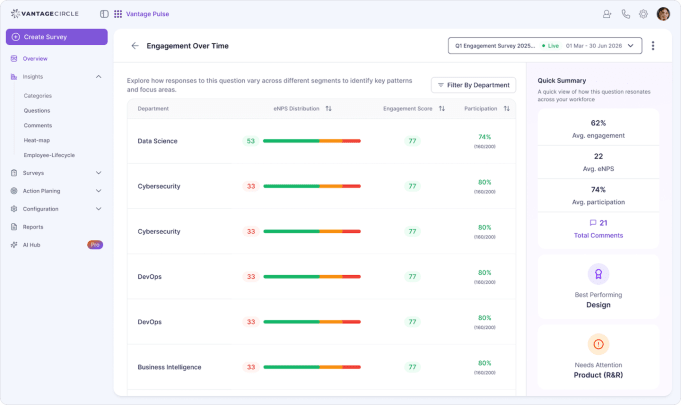
Diversity you can hire for. Inclusion and belonging you have to measure, quarter after quarter. Vantage Pulse, Vantage Circle's employee engagement and pulse survey tool, turns that lived experience into a data point HR can act on. Without something like it, DEIB stays an intention rather than a practice.
7-Step Framework for Effective Diversity Management
The seven steps below move a program from policy to operating model, and each one has an owner and a measurement attached.
Step 1: Audit your current state
You cannot manage what you do not measure. Pull representation data by level, function and tenure. Run a baseline inclusion pulse. Find the gap between what your careers page says and what your headcount shows.
Step 2: Set measurable, time-bound goals
Vague goals die quietly. Write representation targets by level and function. Write inclusion score targets. Write promotion-velocity targets. Attach each to a quarter and an owner.
Step 3: Remove bias from hiring
Anonymize resumes at the screening stage. Build diverse interview panels. Use structured interviews with scored rubrics. Knowing the common unconscious bias examples helps panels catch themselves in the moment.
Step 4: Train managers on inclusive leadership
A manager's daily behavior shapes inclusion scores more than any all-hands speech. Train managers to run inclusive meetings, give equitable feedback, sponsor underrepresented talent and interrupt bias as it happens.
But here is where most programs fade. Training without reinforcement. Pick the diversity training format that fits your cadence, then schedule the reinforcement before you schedule the session.
Step 5: Establish ERGs and sponsor programs
An ERG (Employee Resource Group) is a voluntary, employee-led group built around a shared identity or life experience. Sponsor programs pair underrepresented employees with senior leaders who advocate for them. Both are also among the programs now drawing legal scrutiny, covered further down.
Step 6: Embed inclusion into recognition and reviews
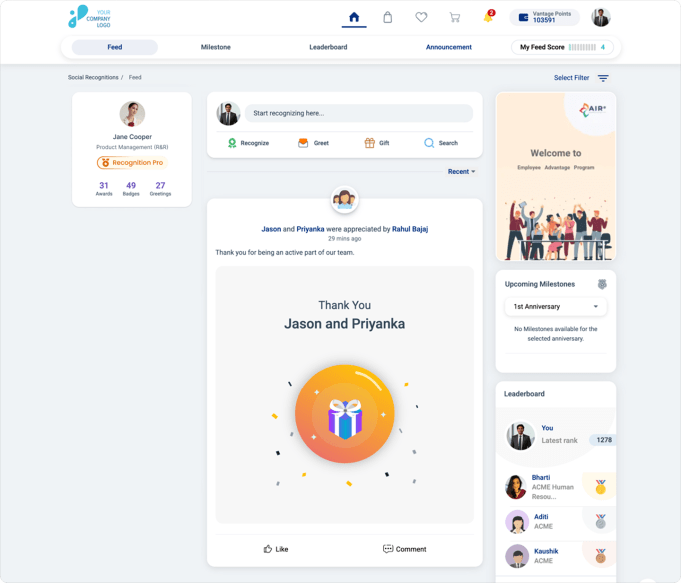
Culture change dies when it lives only in policy documents. Tag recognition to inclusion-related core values. Build DEIB outcomes into manager performance reviews. An employee whose recognition feed shows three peers naming their inclusive behavior this quarter has received a signal no annual review replicates.
Our own view of why that works:
Equal and unbiased recognition is an added value towards creating a diverse and inclusive workforce. When leaders appreciate every action, contribution, attitude and accomplishment irrespective of peoples' identity, we take a step towards workplace equity.

Partha Neog
CEO and Co-founder, Vantage Circle
Step 7: Measure quarterly and publish trend lines
Progress that is not published gets forgotten. Run quarterly inclusion pulses. Publish representation trend lines company-wide. Report progress in board decks. Accountability lives where data is visible.
Diversity Management and US Law: What to Keep, Change and Drop
The diversity programs under the most legal scrutiny in the US are the ones that restrict participation by race or sex.
In February 2026, EEOC (Equal Employment Opportunity Commission) Chair Andrea Lucas wrote to large employers warning that Title VII bars race- and sex-based employment decisions regardless of the DEI label attached to them. The letter went to the 500 largest companies in the United States, addressed to the chief executive, the general counsel and the board chair. Renaming a program does not change its legal status.
Then in late June 2026, the Commission voted two to one to rescind its 1979 interpretive guidance on voluntary affirmative action under Title VII. Read that carefully. The rescission removed the agency's own guidance, not the statute, and it left untouched the Supreme Court decisions holding that voluntary plans can comply with federal law in limited circumstances. What employers lost is the good-faith reliance defense. For decisions made after the rescission, following the old EEOC framework is no longer a defense.
Employment lawyers reading the letter have flagged the same set of exposures: programs restricted by race or sex, ERGs with exclusionary membership, supplier diversity initiatives and recruiting aimed at specific demographic groups.
There is a counterweight worth holding alongside this. EEOLeaders, a group of former EEOC and OFCCP officials, has said that collecting workforce demographic data, running diversity training and supporting employee resource groups remain lawful. The disagreement in the field is real, and anyone telling you it is settled is selling something.
Keep: demographic data collection, pay equity audits, open-to-all ERGs, inclusive meeting practice, manager training. Review: ERG membership criteria, sponsorship selection, supplier diversity targets, demographic-targeted recruiting. Drop: anything that restricts participation or alters an employment decision on a protected trait.
The practical reframe is the same one Thomas argued for in 1990. Diversity management is a business-results discipline, not a politically charged initiative. Drop the slogans and keep the structural work.
The Business Case, Honestly Stated
The most-quoted diversity statistic in HR content does not appear in the report it is credited to. If you are defending a budget, use the real numbers, because someone will check them.
Search for the business case and you will find "39% more likely to outperform" credited to McKinsey across vendor blogs, HR glossaries and conference decks. It is not in the report. McKinsey's Diversity Matters Even More: The Case for Holistic Impact (December 2023) found that companies in the top quartile for both gender and ethnic diversity on executive teams are on average 9 percent more likely to outperform their peers. For boards the figures are 27 percent on gender diversity and 13 percent on ethnic diversity. The report's own "39 percent" is a representation number, not a performance one. It is the average share of executives from historically underrepresented ethnicities at leading US companies.
The sharper finding sits at the other end of the distribution. Companies in the bottom quartile on both dimensions are 66 percent less likely to outperform financially. In McKinsey's 2020 report that same penalty was 27 percent. The penalty for lagging has grown faster than the premium for leading.
The critique deserves airtime too. A quasi-replication in Econ Journal Watch by Jeremiah Green and John Hand re-examined McKinsey's 2015, 2018, 2020 and 2023 studies and found no statistically significant relationship between executive diversity and financial performance in S&P 500 firms. Cite the business case as a correlation under active debate, not a settled causal finding.
The peer-reviewed work gives you a better mechanism than the consultancy work does. A 2024 study of 120 employees across UAE service organizations found that diversity management influences employee engagement, which in turn predicts innovative work behavior, with engagement fully mediating the relationship. It is a small, single-market sample. But it tests a mechanism rather than a correlation, and that is a chain a CHRO can act on.
4 Common Diversity Management Challenges
Four barriers come up repeatedly in stalled programs, and Vantage Circle's global D&I industry report, based on around 347 responses across industries, found all four in play. The full set of barriers to diversity and inclusion goes deeper on each.
1. Lack of awareness
The fix is not a poster campaign. It is structured manager training that lands in the workflow, quarterly rather than annually.
2. Inadequate attention from senior leadership
DEI programs stall when the executive team treats them as an HR side project. Frame diversity management as a business risk question instead. Tie every program goal to a business metric. Retention, innovation revenue, customer trust. Speak the language the CFO reads.
3. No strategic ownership
Without an owner, the program is everyone's job and therefore no one's. Name an accountable owner at VP level or above, with a quarterly KPI (Key Performance Indicator) review at the board.
4. Cross-cultural friction in global teams
Global teams run into silent misalignments. Direct feedback in Amsterdam reads as rude in Tokyo. Teach communication-style awareness and set team norms explicitly. Do not assume the home-office style is the default.
3 Real-World Examples of Diversity Management
The clearest examples are the ones with a mechanism you can copy, not a value you can quote.
- Anonymized resume screening. Candidate names, schools and addresses are hidden at first screen. The decision gets made on skills rather than pattern-matching.
- Manager reviews tied to DEIB outcomes. Representation, inclusion scores and promotion equity inside a manager's own team become part of their annual review.
- Recognition tied to inclusion values. Peer-to-peer recognition tagged to values like allyship or equitable feedback creates dozens of small, public moments of inclusion across a quarter.
For lower-lift starting points, these diversity and inclusion activities work as a first quarter of programming.
How to Measure Diversity Management Success
Measurement separates a real program from a performative one, and reach belongs in the metric set alongside representation. Run these on a quarterly cycle.
- Representation metrics. Headcount by level, function, demographic and geography. Watch the trend line, not the snapshot.
- Inclusion and belonging pulse signals. Anonymous pulse surveys with department-segmented reporting. Take the anonymity seriously, because attributed answers on belonging tend to come back polite.
- Pay equity audit. Controlled and uncontrolled pay gaps by demographic, reviewed at least annually.
- Promotion velocity by demographic. Time-to-promotion by level, cut by demographic. This is where equity shows up or does not.
- Program reach. Who your systems actually touch. Only 31% of US recognition programs cover contract workers, and just under 25% exclude blue-collar workers, according to AIRe Benchmarking Report USA 2023-24 (Vantage Circle).
Reach is the one most measurement frameworks leave out. Representation tells you who joined. Reach tells you who is being seen once they are here. The gap between those two numbers is often where an inclusion problem is hiding, and recognition data turns it into a number rather than a feeling.
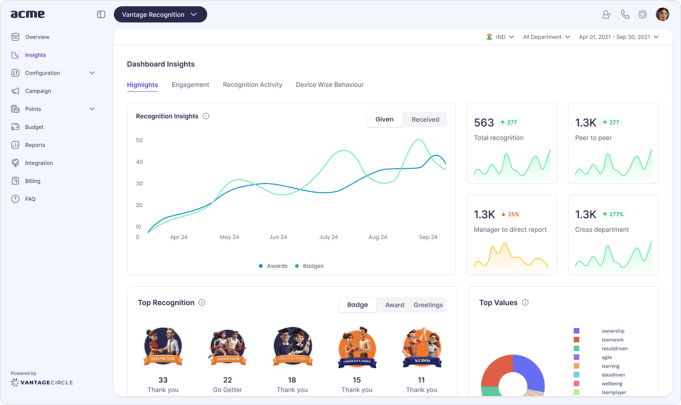
Department-segmented, anonymous reporting is what makes this actionable. It lets HR spot a belonging drop in one team without exposing individual respondents. It is how you act on the data without breaking the trust that produced it. Request a demo if you want to see how the recognition and pulse data line up against each other.
Summing It Up
Diversity management is a measurable business strategy. In the US it is also a compliance question.
Companies that represent the communities they serve, remove friction for people who do not fit the legacy mold and measure the outcome keep winning on retention, innovation and customer trust. Companies that treat it as a communications exercise keep losing talent they cannot afford to lose.
The operating model is simple to state. Hire for diversity. Measure for inclusion. Recognize for belonging. Check what your programs do before you check what they are called.
Frequently Asked Questions
What is the meaning of diversity management?
Diversity management is the organizational practice of recruiting, retaining and deploying a workforce of varied backgrounds so that variety improves business performance. Roosevelt Thomas introduced the term in Harvard Business Review in 1990.
What are the 4 dimensions of diversity?
The four layers are personality, internal, external and organizational dimensions, moving outward from the individual to the company. The model originates with Loden and Rosener in 1991 and was adapted for the workplace by Gardenswartz and Rowe.
What is an example of diversity management?
Anonymized resume screening is a clear example. Candidate names, schools and addresses are hidden at the first screen so hiring decisions rest on skills rather than pattern-matching.
What are the three key components of diversity management?
Diversity, equity and inclusion are the three components most HR academics name. Belonging is the newer fourth pillar that turns the first three into a lived experience, which is why many teams now work from DEIB.
What is the difference between diversity management and DEI?
Diversity management is the operational discipline of building and running the program. DEI is the broader philosophy that the program serves. Diversity management is narrower than DEI and broader than diversity hiring.
How is diversity management measured?
Measure representation by level and function, inclusion and belonging through anonymous pulse surveys, pay equity through annual audits, promotion velocity by demographic, and program reach across worker types. Track all five quarterly and publish the trend lines.

Nilotpal M Saharia is an Assistant Manager, Content Marketing at Vantage Circle and a recognition-and-rewards (R&R) strategist with 9 years of experience spanning Marketing, HR, and content strategy. He helps HR leaders turn employee recognition and leadership research into practical workplace programs.
Connect with Nilotpal on LinkedIn.