
There is a moment, familiar to anyone who has spent time in an office, when you can feel the atmosphere of a room shift. It happens when someone walks in carrying something invisible. It could be a mood, a grievance, or a quiet enthusiasm and suddenly the air is different. Some people call it attitude. But the word hardly does justice to what it actually is.
Psychologists will tell you that attitude is a mental disposition, fluid and context-dependent, expressed through the texture of how people speak, respond, and carry themselves. What they are slower to say is that employee attitude is also, in the deepest sense, a form of influence that is quiet, constant, and far more contagious than any KPI.
HR leaders hear it in exit interviews, in manager escalations, in performance reviews that dance around the real issue. But when it comes time to act, the word turns to smoke. You can't put "bad attitude" in a PIP. You can't build a culture strategy around something you haven't defined.
This blog is about closing that gap. The question is no longer whether mindset and culture shape performance. The question is whether your organization is being intentional enough to shape them, and whether your people can actually feel it.
What are the Four Types of Employee Attitude?
Constructive & solution-oriented
Looks for solutions rather than cataloguing problems. Shows lower absenteeism rates, higher discretionary effort, and models behavior that peers want to copy — creating an attitude multiplier effect across the team.
Blame-shifting & resistant to change
Defined not by mood but by a consistent pattern of behaviors that reduce team effectiveness. The high-performer/negative-attitude profile is the hardest to manage because strong performance complicates the conversation.
Compliant but low-investment
Meets the job description without contributing beyond it. Frequently misread as contentment — the "quietly compliant" segment is the hardest for managers to diagnose because it generates no incident data.
Context-dependent engagement
Positive in familiar domains, negative or withdrawn in others. The most common attitude challenge HR encounters. Role-fit conversations and strengths-based recognition have the highest documented return for this profile.
| Type | Behavioral Signal | Performance Impact | Recommended Response |
|---|---|---|---|
| Positive | Volunteers, problem-solves, adapts | High — discretionary effort routinely above baseline | Recognize specifically, develop intentionally |
| Negative | Complains, resists, blames externally | Low on team productivity and morale | Diagnose root cause before performance managing |
| Neutral | Complies, does not initiate, watches | Meets minimums, misses ceiling | Re-engage through meaning, autonomy, or recognition |
| Mixed / Situational | Engaged in some contexts, resistant in others | Strength in one area, friction in another | Map the context pattern; address the specific trigger |
3 Components of Work Attitudes: Organizational Behavior Framework
Saari and Judge's 2004 review, cited over 3,100 times in Google Scholar, established this three-construct framework as the empirical foundation for managing employee attitude at scale.
Job Satisfaction
Job satisfaction is an employee's overall evaluative response to their role — whether the work, the compensation, the relationships, and the growth opportunities meet their expectations and needs. Edwin A. Locke (1976) famously defines it as a pleasurable emotional state resulting from the appraisal of one's job. Job satisfaction is the most studied attitude in organizational psychology. It predicts turnover intention, absenteeism, and customer satisfaction outcomes.
Job Involvement
Job involvement measures the degree to which an employee psychologically identifies with their work — the extent to which performance at work is central to their self-concept. High job involvement correlates with lower absenteeism and stronger discretionary effort (Lodahl & Kejner, 1965). Low job involvement is the structural root of neutral attitude: the employee is present but not invested.
Organizational Commitment
Organizational commitment, formalized by Meyer and Allen's three-component model, measures the strength of an employee's identification with and engagement in the organization. It includes:
- Affective commitment (wanting to stay)
- Continuance commitment (needing to stay)
- Normative commitment (feeling obligated to stay)
Each of the organizational commitments produces different behavioral patterns and responds to different HR interventions. Employees with high affective commitment consistently outperform those retained by obligation or economic necessity.
Attitude vs Behavior vs Morale vs Engagement: A Clarifier
Attitude, behavior, morale, and employee engagement are related but distinct constructs. Conflating them leads HR teams to measure the wrong thing, intervene with the wrong tool, and draw the wrong conclusions from their data.
This is the confusion that allows attitude problems to go unaddressed for months: the manager reports a "morale problem," HR runs an engagement survey, and the individual whose attitude is driving the team dynamic receives no specific intervention.
Why These Four Are Confusing
All four constructs are invisible, all four affect performance, and all four respond to similar inputs such as recognition, fairness, and leadership quality. But they operate at different levels of analysis, update at different speeds, and require different measurement instruments.
An employee can have a negative attitude and high job satisfaction simultaneously. A team can have low morale driven by one individual's attitude. Engagement scores can be artificially elevated in psychologically unsafe environments where employees answer surveys according to social desirability rather than actual experience.
| Construct | What It Measures | Time Horizon | How HR Measures It | Owner |
|---|---|---|---|---|
| Attitude | Individual's evaluative disposition toward work, people, and organization | Stable but changeable over weeks to months | Attitude surveys, pulse sentiment analysis | Manager + HR |
| Behavior | Observable actions in specific contexts | Immediate, situation-dependent | Performance reviews, manager observation, work performance records | Direct manager |
| Team morale | Collective emotional climate of a team or group | Short-term, responsive to events | Pulse surveys, eNPS, team-level data | Manager + HR |
| Employee engagement | Depth of cognitive, emotional, and behavioral investment in the organization | Medium-term, responsive to culture | Annual engagement surveys, Gallup Q12 | HR + Leadership |
What Causes Negative Employee Attitudes?
Negative employee attitude is almost never a character trait. It is a response — and most often to conditions that organizational behavior research has reliably mapped for decades.
Understanding root causes before initiating a performance conversation is not just a fairness principle. It is a practical one. An attitude conversation that misdiagnoses the cause produces surface compliance and eventual turnover.
1. Manager Friction
Gallup's 2024 data confirms that managers account for 70% of the variance in employee engagement scores. A single toxic or ineffective manager relationship is sufficient to shift an otherwise committed employee toward negative attitude over time. Conflict resolution in the workplace begins with the manager relationship.
2. Perceived Unfairness
Organizational justice research (Colquitt, 2001) identifies perceived unfairness in compensation, opportunity distribution, recognition, or promotion as among the strongest predictors of negative attitude. The perception of unfairness does not need to be objectively accurate to drive attitude decline — it only needs to be sincerely held.
3. Burnout and Overload
Sustained overload depletes the cognitive and affective resources employees draw on to maintain positive attitudes. What looks like a negative attitude in a burned-out employee is frequently emotional exhaustion. Employee burnout and attitude deterioration follow a predictable sequence: increased cynicism, withdrawal, then behavioral resistance.
4. Misalignment With Values or Mission
Employees with strong personal values who work in environments that actively violate those values experience cognitive dissonance that manifests as attitude friction. This is especially visible in organizations undergoing rapid strategic pivots or leadership transitions.
5. Personal Life Stressors
Financial stress, health concerns, family demands, and major life transitions all affect the affective component of attitude. Managers are not therapists, but recognizing that attitude shifts sometimes have origins outside the workplace prevents misdiagnosis and protects the employment relationship.
10 Employee Attitude Examples (Positive + Negative)
Attitude is only observable through behavior. The following 10 examples pair each attitude type with its behavioral signal and a manager observation example.
5 Positive Attitudes With Workplace Examples
| Attitude | Behavioral Signal | Manager Observation Example |
|---|---|---|
| Action-oriented | Identifies a problem and proposes a solution in the same conversation | "When the onboarding process broke down, she drafted a revised checklist without being asked." |
| Collaborative | Actively includes others, attributes team wins to the group | "He consistently routes relevant updates to cross-functional teams before they need to ask." |
| Accountable | Names their own errors, focuses on correction not justification | "When the report was late, she acknowledged her timeline misjudgment and outlined how she would prevent recurrence." |
| Growth-oriented | Seeks feedback, applies it visibly, treats setbacks as data | "He asked for a post-mortem after the failed launch and led the retrospective himself." |
| Customer-first | Defaults to the impact on the end user or stakeholder when decisions are ambiguous | "She advocated for extending the rollout timeline to protect the customer experience, even under internal pressure to accelerate." |
5 Negative Attitudes With Workplace Examples
| Attitude | Behavioral Signal | Manager Observation Example |
|---|---|---|
| Cynicism | Responds to new initiatives with dismissal before engaging with the detail | "Every time a new process is introduced, his first comment is 'this won't work', without specific reasons." |
| Blame-shifting | Consistently attributes problems to others, rarely to self or circumstances within control | "When asked about the missed deadline, she named three other teams but no ownership of her own deliverable." |
| Gatekeeping | Withholds information or resources that would help colleagues succeed | "He does not share project context with new team members, citing that 'they should figure it out like I did.'" |
| Passive resistance | Agrees in meetings, does not act on agreements outside them | "She commits to tasks in team meetings, then reports blockers only when the deadline has already passed." |
| Learned helplessness | Stops initiating when facing repeated setbacks; waits to be told what to do | "Since the Q2 project was cancelled, she no longer proposes ideas in planning meetings, despite previously being one of the team's most active contributors." |
6 Signs of a Bad Attitude You Should Watch-Out For
The behavioral signals of a deteriorating employee attitude are consistent across industries. You can use them as a diagnostic checklist or an early warning system that operates months before a performance issue becomes formal.
Attitude shifts rarely show up in performance dashboards before they show up in language and social behavior. Vantage Pulse sentiment analysis surfaces shifts in open-ended survey responses — words like "frustrated," "stuck," and "underappreciated" cluster in pulse data weeks before the behavioral signals below become visible to a manager.
- Eye-rolling or dismissive non-verbals in meetings. Non-verbal resistance is often the first observable signal and the easiest to rationalize. Document the specific behavior, not the interpretation.
- Refusal or friction in cross-functional collaboration. An employee who previously collaborated across teams and begins declining, delaying, or deprioritizing cross-functional requests is displaying a narrowing of organizational investment.
- Frequent "that's not my job" responses. Discretionary effort is the first casualty of attitude decline. When it disappears, it shows up as boundary-enforcement before it shows up in any performance metric.
- Withdrawal from team rituals. Reduced participation in team meetings, social events, Slack channels, or informal peer interactions signals a loosening of organizational attachment.
- Public complaints about leadership decisions. A single instance is normal. A pattern of public undermining of leadership decisions — especially in front of junior team members — is a behavioral signal with significant team-culture consequences.
- Sudden drop in initiative. An employee who previously raised ideas, volunteered for projects, or flagged problems early, and then stops, without an obvious workload explanation, has likely experienced an attitude shift event. Identify the inflection point.
How to Talk to an Employee About Their Attitude (Manager Script)
The most common mistake managers make in attitude conversations is using the word "attitude." The word is legally ambiguous, personally charged, and behaviorally non-specific. It tells the employee what you think of them, not what you need them to change.
HR Acuity and employment attorney Stephen Hammond both flag "bad attitude" as one of the highest-risk phrases a manager can use in documentation, precisely because it characterizes rather than describes. A characterization is an opinion. A documented behavioral pattern is evidence.
The goal of an attitude conversation is to describe specific observable behaviors, name their impact on the team, invite the employee's perspective, and agree on what observable change looks like. Nothing more. Nothing less.
Open With a Specific Behavior, Not a Label
Name what you observed, when it happened, and who was affected.
"In the last three team meetings, you've responded to new project proposals with 'this won't work' before the presenter finishes the context. I want to talk about that pattern."
Name the Impact on the Team
Be specific about the consequences on team dynamics and output.
"When that happens, the presenter shuts down. I've noticed two team members have stopped proposing ideas in open sessions. That's a loss we can't afford."
Invite the Employee's Perspective
This step is not optional. It determines whether the conversation produces a behavior change or a grievance — and protects the manager legally by showing the employee was heard before any documentation was created.
"Help me understand what's going on from your side. Is there something about how we're running these sessions that isn't working for you?"
Agree on Observable Changes
Define a specific, measurable behavior change — not a general expectation.
"What I need to see change is this: when you have a concern about a proposal, raise it after the presenter finishes, and frame it as a question — 'Have we considered X?' — rather than a conclusion. Can you commit to that?"
Schedule a Follow-Up
Close with accountability on both sides — not just from the employee.
"Let's check in in two weeks. I'll be looking for that change specifically, and I want to give you the chance to tell me if anything on my side needs to change too."
Professional Alternatives to Saying "Bad Attitude"
| Instead of... | Use... |
|---|---|
| "Bad attitude" | "A pattern of behavior that disrupts team collaboration" |
| "Negative" | "Responds to new proposals with dismissal before engaging with the detail" |
| "Difficult" | "Does not follow through on commitments made in team meetings" |
| "Attitude problem" | "Specific incidents on [dates] in which the employee [behavior]" |
| "Unprofessional" | "Used language in a client meeting that did not meet our communication standards" |
| "Not a team player" | "Has declined cross-functional collaboration requests on [dates] without alternative arrangement" |
Recommended Resource: Constructive feedback examples managers can use in real conversations
How to Improve Employee Attitude Across the Workforce
Attitude is not fixed, and it is not incidental. It is a leadership and systems responsibility. The organizations with consistently positive workforce attitudes share six practices.
1. Measure It: Attitude Surveys and Pulse Signals
You cannot manage what you have not measured. Annual engagement surveys capture a snapshot. Pulse surveys at a regular cadence give HR a directional signal on attitude trends in near real-time. Anonymous response options matter: employees will not report manager friction or perceived unfairness if they fear retaliation. Vantage Pulse's anonymous survey architecture gives HR honest signal rather than socially desirable noise.
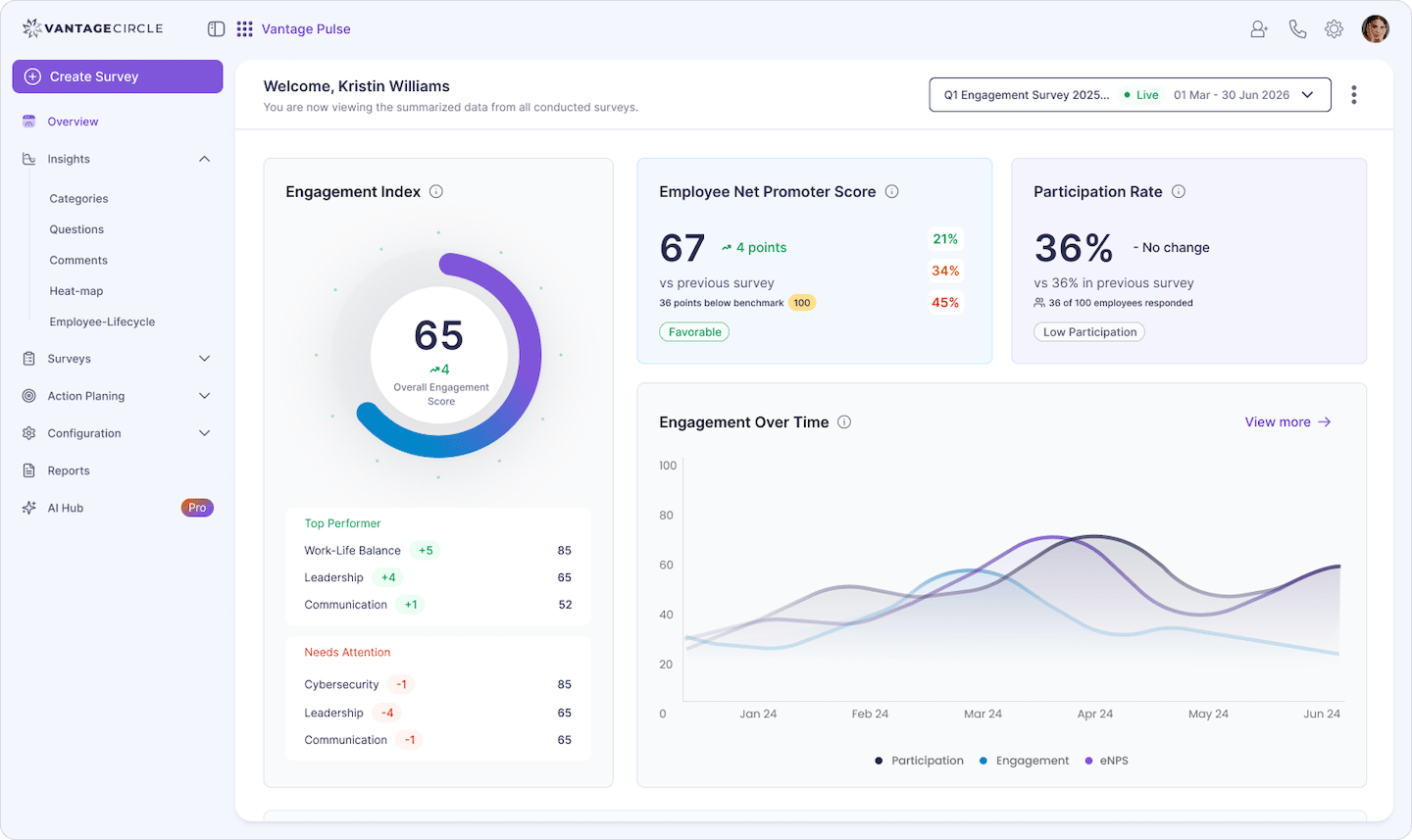
Source: Vantage Pulse
2. Train Managers in Behavior-Based Feedback
Teach managers how to give feedback that focuses on behavior, not personality. This blog's manager script is built on that exact skill and organizations that invest in it often see noticeable improvements. Because employees don't experience culture through HR policies alone — they experience it through their managers. The performance management function should own this training rather than leaving it to individual manager discretion.
3. Build a Recognition Habit
Brayfield and Crockett (1956) documented the correlation between recognition behavior and attitude improvement. Saari and Judge (2004) confirmed that recognition operates primarily through the affective component of attitude — it changes how employees feel before it changes what they believe.
VANTAGE INFLUENCERS PODCAST
"Whatever you recognize will be repeated. It's the most proven principle of management — and it works not just with employees, but in every relationship."
— Dr. Bob Nelson, Inventor of Employee Appreciation Day
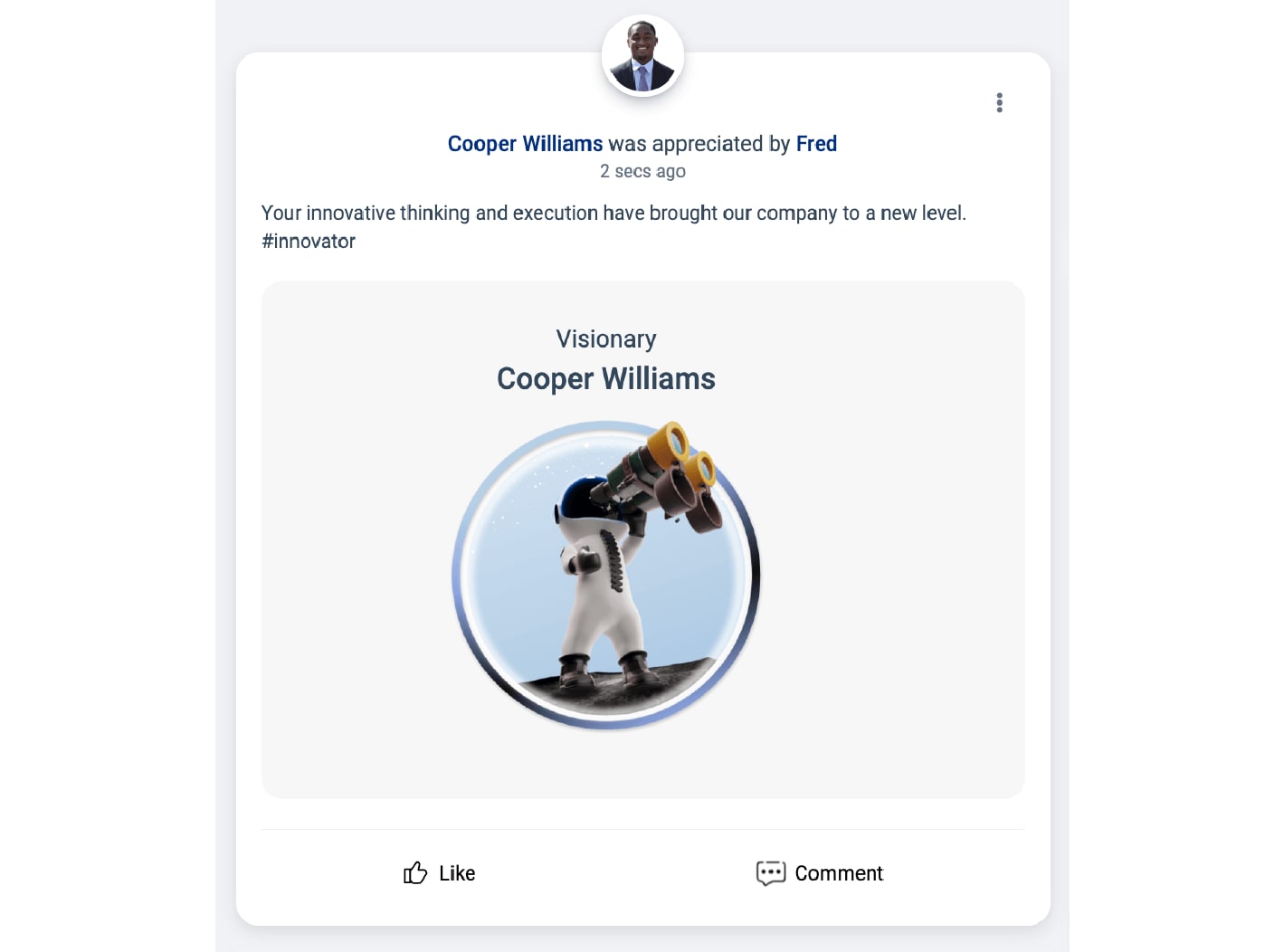
Listen to the EpisodePeer-to-peer recognition makes the loop self-reinforcing: a positive attitude that is named publicly in a recognition feed becomes visible and copy-able by the rest of the team. When recognition is public, specific, and tied to company values, it shifts the culture's definition of what good looks like through visible example.
Source: Vantage Recognition
Words of appreciation for employees that are tied to a specific observed behavior reinforce the cognitive-affective link that Brayfield and Saari-Judge identified.
4. Address Compensation and Fairness Gaps
Perceived unfairness in compensation drives attitude deterioration faster than almost any other single factor. Regular compensation benchmarking, transparent promotion criteria, and visible equity in recognition — who gets recognized, how often, for what — address the cognitive and affective roots of negative attitude at the systemic level.
5. Redesign Jobs for Autonomy and Purpose
Employees bring a more positive attitude to work when they feel trusted, valued, and connected to a larger purpose. Jobs that offer meaningful autonomy — where people have real ownership over how they achieve outcomes — tend to create deeper involvement, stronger motivation, and more lasting engagement.
6. Invest in Psychological Safety
In psychologically safe teams, employees raise problems early, admit mistakes without fear, and engage authentically rather than performatively. Psychological safety is the environmental prerequisite for the kind of growth-oriented, accountable attitude that every organization wants but few actively build.
Final Thought
Attitude is not a background variable. It is the mechanism by which every other HR initiative either amplifies or fails. Recognition programs build culture when they are specific and public. Because culture is rarely built through one big initiative. It is built through repeated moments, reinforced behaviors, and the attitudes leaders choose to tolerate, encourage, and reward every single day.
Employee Attitude Management
Is negative attitude quietly eroding your team's performance?
Vantage Pulse detects the shift. Vantage Recognition turns it around.
Frequently Asked Questions
What are the Four Types of Attitude?
The four types of employee attitude are positive, negative, neutral, and mixed or situational. Each type produces a distinct behavioral signature, performance impact, and recommended management response.
How do you describe an Employee's attitude?
An employee's attitude is best described through specific observable behaviors rather than general characterizations.
Can I Terminate an Employee for Bad Attitude Alone?
Terminating an employee on attitude grounds alone, without documented behavioral evidence, creates legal exposure in most jurisdictions, including at-will states. The risk increases significantly if the employee belongs to a protected class, has recently made a complaint, or has a medical or mental health condition.
What is an Employee Attitude Survey?
An employee attitude survey is a structured instrument that measures how employees feel about their work, their manager, their team, and their organization across the three ABC components of attitude — cognitive (beliefs), affective (feelings), and behavioral tendencies.

This article is written by Shikha Gogoi. Shikha Gogoi is a Content Marketing Specialist focused on SEO-driven content around employee engagement, recognition, and workplace culture, helping build people-first workplaces.
Connect with Shikha on LinkedIn.


