
Peer-to-peer recognition cuts out the middleman: coworkers acknowledge each other's contributions directly. No manager in the chain. Done right, it surfaces the everyday work supervisors miss, and there's genuinely a lot of that work. Every program that's actually moved those numbers has done two things: made recognition easy to give, and grounded it in values people actually practice rather than ones they just post.
I've written about recognition long enough to notice a pattern: the programs that stick are almost never the ones with the biggest budgets. They're the ones where employees actually see each other. There's something different about recognition from a peer. It doesn't land the same way a manager's does. Not better or worse, just stickier somehow. A manager's praise carries authority while the peer's appreciation is harder to name. It can be something like credibility, maybe, because they were in the same room, on the same deadline, dealing with the same pressures, and they still took a moment to say something. That's harder to fake. And employees feel it even when they can't quite put their finger on why.
The data backs this up as O.C. Tanner's 2025 Global Culture Report links peer recognition directly to stronger belonging and lower turnover. But the more interesting question isn't whether it works. It's why so many programs launch well and quietly die by month two. That's what this guide is really about.
What is Peer-to-Peer Recognition?
When employees acknowledge each other's work directly be it any colleague or across teams and levels, it becomes peer-to-peer recognition.
Nothing gets bottlenecked by a manager's attention or calendar here. It is the colleagues who watched someone fix a client crisis at 6 PM. They can publicly praise them for their effort on the spot without having to wait.
In practice it is about:
- Thanking someone on the social feed for covering a difficult sprint.
- Giving a peer a badge after a cross-functional project wraps, or
- Nominating someone for a points award because their documentation single-handedly saved the onboarding process.
Small in form. The impact, less so.
Peer-to-Peer vs Top-Down Recognition
Most organizations default to top-down: a manager notices good work and says so. Works fine for milestone moments. Quietly breaks down for everything else.
Managers simply aren't around for most of what their teams do. They see outcomes, rarely the path. The daily behaviors, the assists, the quiet expertise that shapes culture but never shows up in a performance review. That's the gap peer recognition was built for. If you need starting points, browse these peer-to-peer recognition ideas.
| Dimension | Peer-to-Peer Recognition | Top-Down (Manager-Led) Recognition |
|---|---|---|
| Source | Coworker at any level | Manager or leadership |
| Frequency | Daily, ongoing | Periodic, often tied to reviews |
| What it captures | Day-to-day behaviors, collaboration, effort | Outcomes, milestones, performance targets |
| Perceived authenticity | High (peers witnessed it firsthand) | Variable, can feel evaluative |
| Risk of bias | Popularity contest if not structured | Visibility bias toward extroverts |
| Scalability | Scales with the workforce | Bottlenecked by manager bandwidth |
Neither one replaces the other. You need both running. The ones that get it right tend to use values-tagging on the peer side, keeping the whole thing anchored to behavior rather than personality.
Why Peer-to-Peer Recognition Matters
Most recognition programs have a single point of failure. One person, noticing everything.
What actually happens with peer recognition (and most leaders don't fully clock this) is that it reshapes what gets reinforced, not just how people feel. When peers acknowledge each other for behaviors tied to company values, those behaviors spread. Gallup put the cost of low engagement at $8.9 trillion globally in their 2024 State of the Global Workplace report. That's not a soft HR metric. It's a number that shows up in budgets. And recognition is one of the few levers that can actually move it. I'd push back slightly on framing this as purely a productivity argument, though. More directly: recognition tells people what actually matters in this organization, and that shapes behavior faster than any policy document ever could. But it's a real number, and it lands in budget conversations.
O.C. Tanner's 2025 Global Culture Report: employees who feel genuinely recognized are far more likely to stay and refer others. Headcount and recruiting cost, not a pulse survey metric.
Vantage Circle's own research, run with Great Place To Work for The Recognition Effect report, sharpens the point. Recognition lands when employees feel four things: appreciation, acceptance, validation, and accomplishment. When all four are present, 98% report strong workplace sentiment and 97% intend to stay. Strip it down to a single signal and sentiment collapses to 33%. The same study found that in high-recognition cultures, 91% of employees feel motivated and 94% call their organization a great place to work, against 73% and 78% where recognition is still emerging. Peer recognition is how most of those four signals actually reach people day to day, because peers are the ones present for the moments managers never see.
Worth naming one more thing: when peer recognition becomes normal, employees feel seen by the people they're actually working with every day, not just evaluated by those above them. That shift matters more than most organizations give it credit for, and it does something concrete: it reduces the low-grade anxiety of invisibility that drives a lot of voluntary turnover, particularly among high performers who have options.

VANTAGE INFLUENCERS PODCAST
"Engagement is really driven by things like feeling valued at work, feeling cared for and trusted and appreciated and recognized. And these are all relational constructs. They exist in the context of a relationship with other human beings."
— Jason Lauritsen, Speaker, Author & Employee Engagement Expert
Listen to the EpisodePeer-to-Peer Recognition Examples and Messages
Six weeks after launch is usually when most peer programs start quietly dying. Same story, every time: someone wants to recognize a colleague, opens the platform, stares at a blank field, and closes it. Generic phrases feel hollow, and employees know it, so nothing gets said.
Below are copy-paste messages organized by scenario. Treat the names as stand-ins; the structure's what transfers.
For a project contribution: "Wanted to call out Shreya for how she handled the client brief last week. She caught a data inconsistency the rest of us missed, flagged it early, and restructured the deck overnight. The client meeting went well because of that. Thank you."
For stepping in: "Rohit picked up my entire QA queue for three days when I was out sick. No notice, no complaint, no impact on his own work. That's what this team looks like at its best."
For knowledge sharing: "Priya spent two hours walking me through the CRM migration even though it wasn't her job. I'd have lost a week figuring that out on my own. Her patience made the whole team faster."
For cross-team work: "The design-engineering alignment last quarter was a mess until Arjun started sitting in every handoff meeting, translating between both sides. No formal reason to do any of that. The launch date held because he did anyway."
For consistent excellence: "Not for one single moment, but three months of showing up exactly the same way, every week without fail. James is reliable, thorough, never dramatic when the workload spikes. That steadiness is genuinely rare and it compounds over time."
For values-aligned behavior: "Sarah flagged a client situation that could have been buried. She raised it directly, with a solution already mapped. That's integrity in practice, not in a deck."
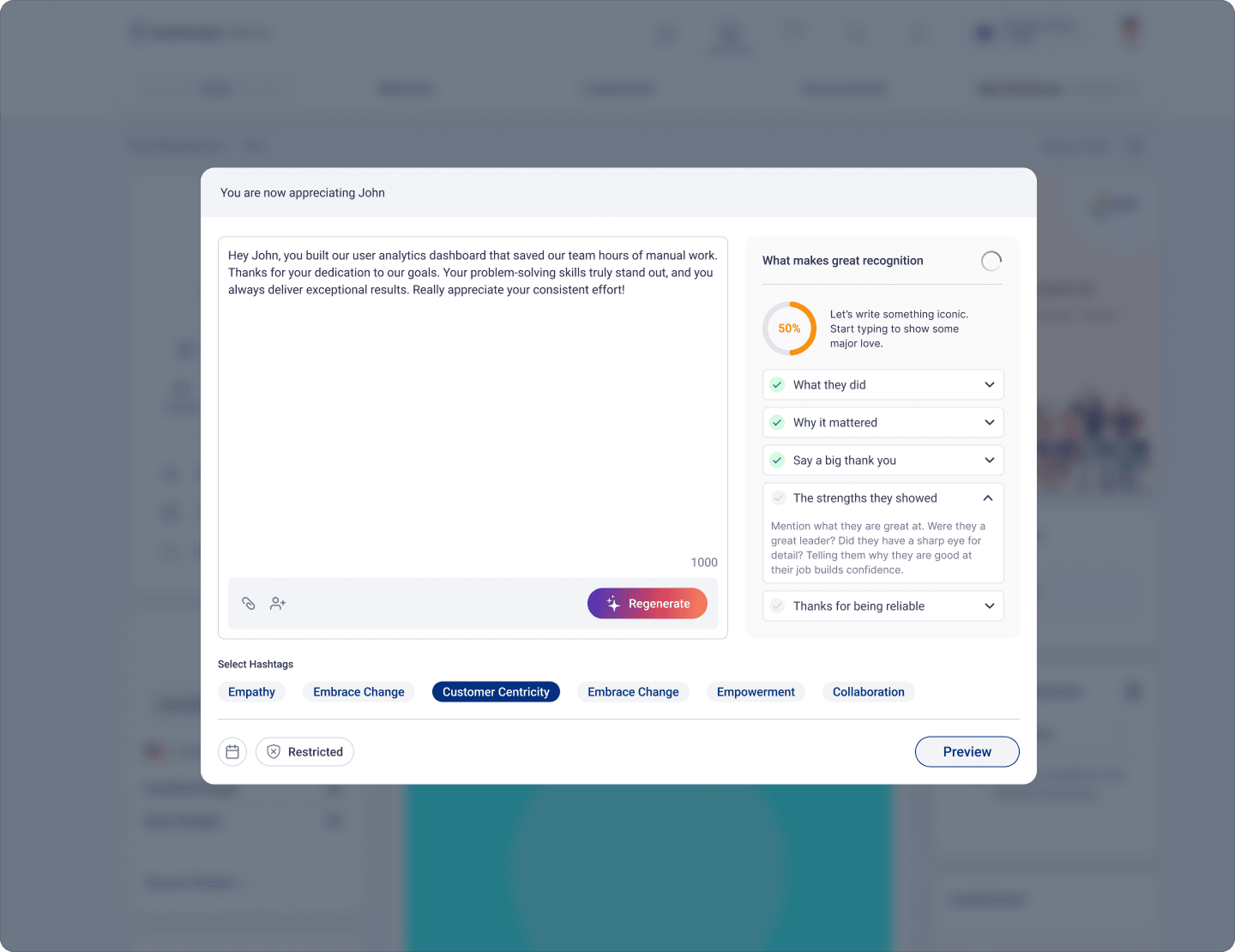
The pattern: name the person, name the specific behavior, name the actual impact. Strip any one of those out and you're left with something that reads more like a greeting.
This is also where the right tool earns its place. Vantage Circle's recognition composer guides people through that exact pattern as they type, with prompts and a quality indicator, so a blank field stops being the reason a good thank-you never gets sent.
(Source: Vantage Recognition)
10 Peer-to-Peer Recognition Ideas That Work
None of these require a large budget. Several cost nothing at all beyond the decision to make them a repeating practice.
1. Social Recognition Feed
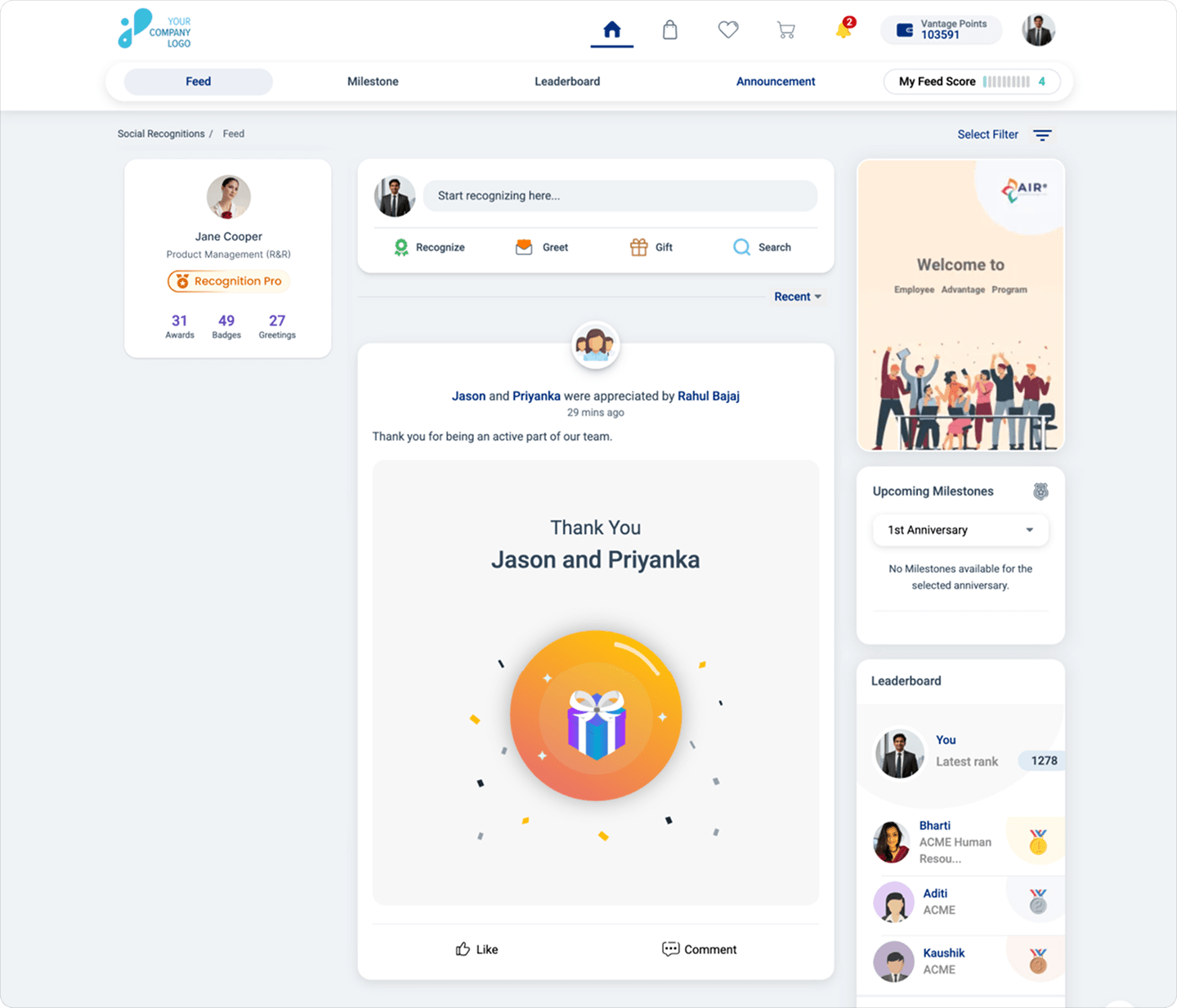
If there's one change that moves the needle faster than anything else, it's a shared public feed. When one person recognizes another and the whole company sees it in real time, the behavior stops being exceptional and starts being normal, which is the actual goal. That's exactly how Vantage Circle's social recognition feed works: individual shout-outs accumulating into something the whole organization starts to feel.
(Source: Vantage Recognition)
2. Point-Based Peer Awards
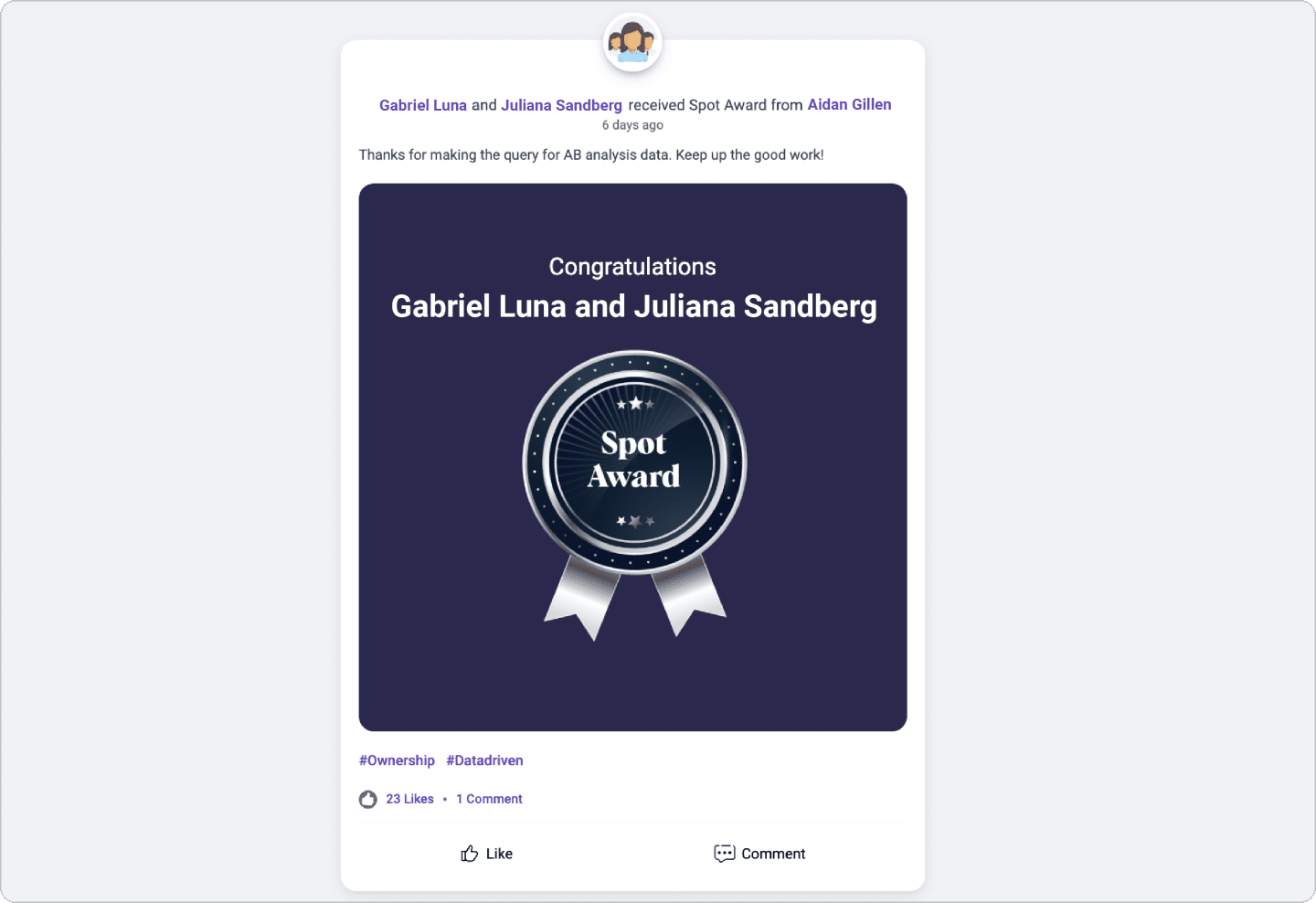
What the recipient gets isn't just a thank-you. It's a reward they choose, which lands differently than a public shout-out for a lot of people. Some employees find praise uncomfortable; tangible acknowledgment reaches them when social recognition doesn't. Redeemable points close that gap. Worth noting the data side too: tracking who gives and receives points surfaces participation gaps well before they calcify into something harder to fix.
(Source: Vantage Recognition)
3. Values-Tagged Recognition
Left unstructured, peer recognition drifts toward popularity. The same high-visibility employees accumulate shout-outs while quieter contributors go unnoticed. Not bias exactly. Just social gravity with no guardrails. Values-tagging disrupts that. When every recognition must be tagged to a company value (Collaboration, Customer Obsession, Integrity), the acknowledgment attaches to behavior rather than personality. HR ends up with actual data: which values live day-to-day versus which ones just appear on the screensaver. Vantage Circle's Core Values Alignment feature handles this by design.
4. Physical Display Boards
For in-office or hybrid teams, a recognition wall does something digital-only systems genuinely can't. Sticky notes, printed cards, brief handwritten messages posted publicly. People walk past them throughout the day, stop, actually read them. Low-tech. In my experience, disproportionately effective.
5. Team Huddle Recognition
Five minutes at the start of the weekly team meeting. No agenda item, just a standing slot for people to name something a colleague did that week. Most peer recognition fails because there's no obvious moment to do it. This creates one. The "I'll do it later" friction that quietly kills most peer programs within a month doesn't survive a predictable, recurring structure.
6. Cross-Department Appreciation
Cross-department acknowledgment is rarer than within-team recognition. Rarer means it tends to land harder. A Marketing person thanking someone in Engineering for help on a shared project signals something most recognition programs never capture: that this organization actually operates as a whole, not as departments managing separate scorecards. Contributions that would otherwise be invisible to leadership start getting named.
7. Peer-to-Peer Learning Sessions
Let employees host short internal sessions on topics where they have genuine depth. Framing it explicitly as recognition ("we're doing this because Rina understands this problem better than almost anyone here") combines knowledge transfer with acknowledgment. Both things happen in the same 45 minutes. Decent return on one calendar slot.
8. Recognition Badges
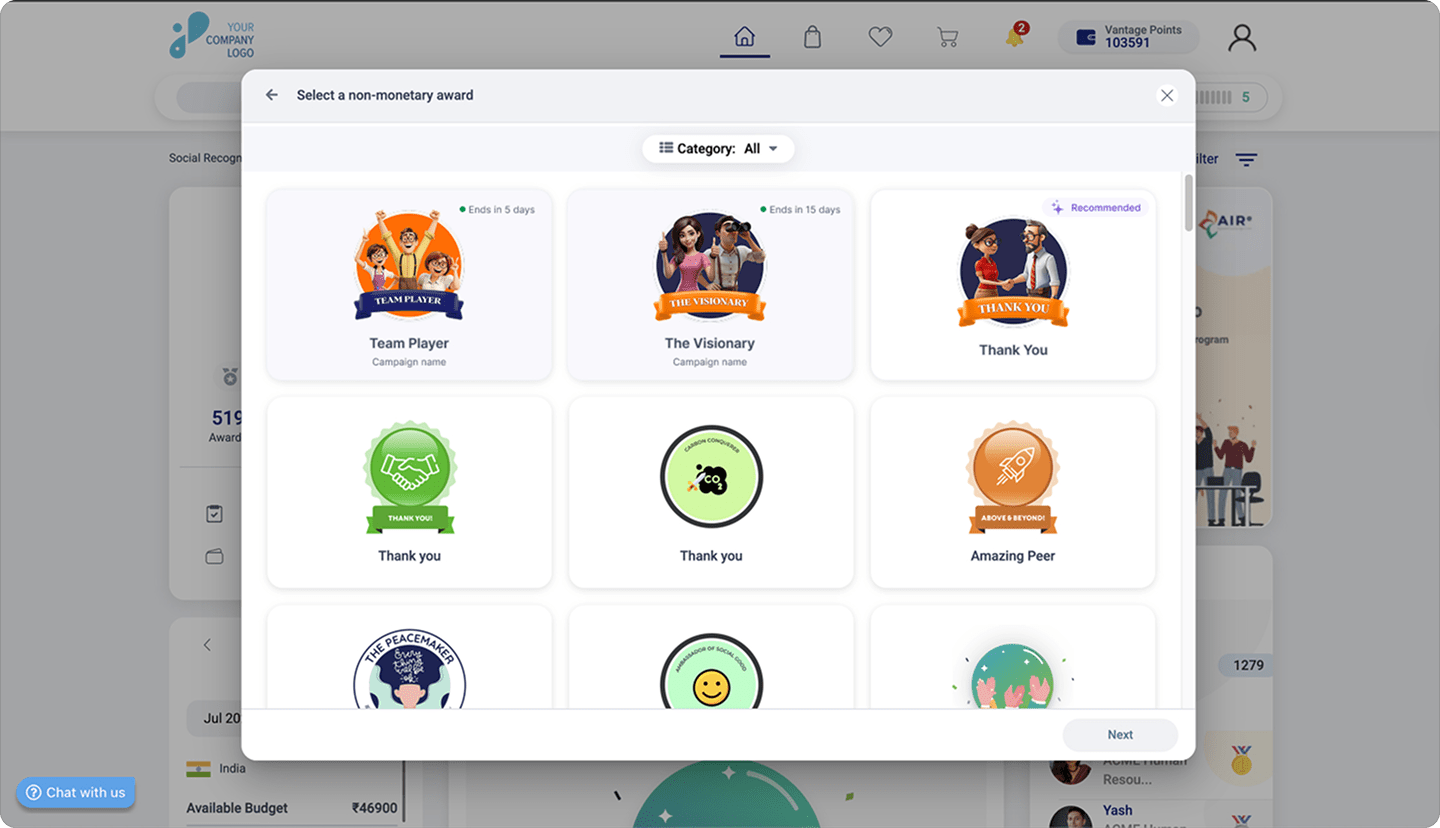
Lightweight, quick, persistent. Employees award "Above and Beyond" or "Team Player" with a click; recipients get a visible record that lives on their profile. The persistence matters: a badge doesn't disappear into a notification feed by mid-morning the way a shout-out does.
(Source: Vantage Recognition)
9. Peer-Nominated Awards
Monthly or quarterly nominations for a specific award category (team contribution, innovation, customer focus) shift recognition authority entirely to the people doing the work. Attach a small reward to the win and it gets real stakes. Writing the nomination has its own value too. People have to think carefully about what a colleague actually did, which tends to sharpen how they observe and talk about contributions going forward.
10. Thank-You Cards
A handwritten note goes home. It ends up on a fridge or a desk corner and stays there. Even the good digital acknowledgment has disappeared from anyone's memory by lunch. There's no efficiency argument for physical notes, but that's not the argument. They land in a different register entirely, and anyone who's received one already understands this.
Best Practices for Peer-to-Peer Recognition
Getting a peer recognition program off the ground? Straightforward enough. Three months later, when the initial curiosity has burned off and it's just another tab nobody opens, that's where most of these efforts quietly stop working.
A. Make It Immediate
Here's something I've seen play out more than once: the same recognition, delivered four weeks late, barely registers. The colleague who finished the difficult project has moved on mentally. The moment is gone, and so is most of the impact. The link between what someone did and the acknowledgment they receive weakens with every day between them.
Teach it as habit, not policy. Recognize while the details are still vivid to both people.
B. Be Specific
"Great work this week, Sarah" is a greeting dressed up as recognition. What actually changes behavior is specificity: what the person did, why it mattered in that specific situation, what was different because of it. I've seen recognition programs lose credibility not because people stopped participating, but because the messages got vague. When recognition tracks to visible personality rather than specific action, employees notice, and the whole program starts reading as political rather than earned.
C. Prevent the Popularity Contest
Values-tagging handles the structural side, but the harder part is what leadership actually does in practice. Every time a manager recognizes the same high-visibility people, they're teaching the team something (implicitly) about what kind of contribution actually counts around here. Peer recognition mirrors that signal, because people watch whoever holds authority. Leaders who make a habit of naming the quiet contributors reshape what the team considers worth recognizing. No poster on a wall does this. What actually reshapes it is the behavior people watch: who gets named, when, and for what.
D. Run It Where People Already Work
Low adoption usually has one cause. The tool is somewhere employees don't already go. Vantage Circle's integrations drop recognition inside Slack, Teams, or wherever the team already lives. The friction that kills most programs by week three never gets a foothold.
E. Incentivize Consistency, Not Compliance
Mandating participation produces the appearance of a program, not a functioning one. Points for giving recognition, leaderboards surfacing active participants, team-level rates visible to managers: these create loops people actually want to be inside. Compulsion produces checkboxes and resentment in roughly equal measure. Habit is what you're after. Mandates don't get you there.

VANTAGE INFLUENCERS PODCAST
"All recognition is more powerful when you provide a context for why it was significant. A lot of the time, people don't know what you saw, what made it to your attention. So tell them what you saw, that you appreciate it, and why it mattered."
— Bob Nelson, Author & Employee Recognition Expert
Listen to the EpisodeHow to Start a Peer-to-Peer Recognition Program
Most programs that fail at launch skipped the same step: figuring out what success actually looks like before picking a tool.
Before announcing anything, HR and leadership need to agree on the actual goal. Retention? Engagement score movement? Culture repair in a specific team? Everything downstream follows from that answer: which behaviors get recognized, what gets measured, what "working" actually means when you check in at six months.
With that clear, the platform question gets simpler. Pick a tool that fits how your employees actually communicate. Feature depth matters less than whether people will use it without being pushed. A platform employees avoid because it's cumbersome is arguably worse than no platform, because it signals the organization didn't think the implementation through.
Most rollouts underinvest in training, and not in the obvious way. What gets skipped is teaching people what good recognition actually looks like in practice. Run a short session specifically on the difference between generic and specific acknowledgment. Give people example messages to reference when the habit is still forming.
Model it from leadership first. When leaders use the same platform to recognize each other and their teams publicly, employees learn that this is how the organization works now, not a program that will fade in two months. Without that visible behavior, most people wait for someone else to go first.
Build in review checkpoints at 30 and 90 days. Pull participation data. Which teams are actively recognizing each other? Which aren't? Who has received nothing at all? That last question is worth sitting with longer than the others.
Challenges of Peer-to-Peer Recognition (and How to Avoid Them)
The failure modes are mostly predictable. Worth knowing them before you launch, not after the program stalls.
Popularity bias. Without structure, recognition concentrates around the most visible, most socially connected employees. The quiet contributor in a support function goes unrecognized. Not because of malice, just because they're not in the conversations where recognition flows. Values-tagging combined with coverage analytics is the structural fix. Review not just total volume but who's being overlooked.
Uneven adoption. Some teams embrace peer recognition immediately. Others (typically the ones whose managers aren't participating) ignore it entirely. Employees in those pockets start treating the whole program as performative. Sharing team-level participation data with managers as a coaching signal, not a metric to be punished against.
Generic recognition at scale. "Great job this week!" drains the program of meaning faster than almost anything. Give employees the three-part formula upfront and revisit it at 90 days: what they did specifically, the context around it, what actually changed. That's the whole formula. Most people just need to be reminded it exists.
Manager resistance. Some managers feel that a peer-driven recognition culture takes something away from their role. Worth addressing directly rather than hoping it resolves on its own. Peer recognition extends the reach of acknowledgment into interactions managers were never present for to begin with. It doesn't compete with what they do. It covers ground they can't.
How to Measure Peer Recognition Success
Most programs can tell you how many recognitions were given. Very few can tell you whether any of it mattered.
Coverage before volume. Track who has given recognition and who has received it within a rolling 30-day window. A program where 80% of recognition flows to 20% of employees has a structural problem regardless of how high the total count looks. Vantage Circle's Recognition Analytics surfaces coverage at the team level so HR can spot where recognition pools around a few names and address it before it calculates into a disengagement trend.
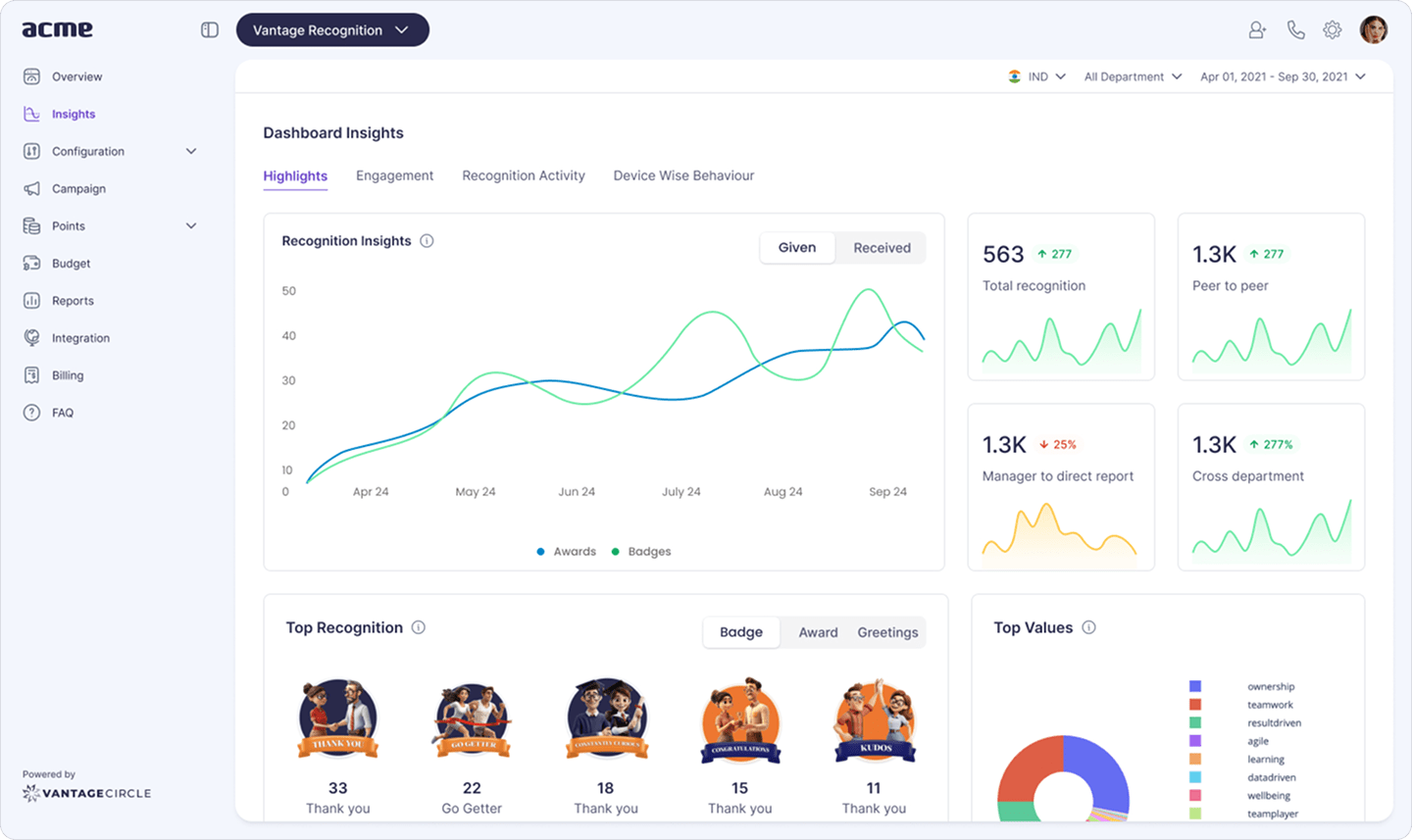
(Source: Vantage Recognition)
Engagement correlation over time. Run Pulse surveys at regular intervals and compare eNPS movement in high-recognition teams against low-recognition teams. Vantage Pulse makes this comparison possible without manual data-joining: recognition activity sits alongside engagement measurement in the same system.
Retention signal (the slow one). Takes two to three quarters to validate, but it's the most commercially meaningful metric. Compare voluntary turnover rates between high-participation and low-participation teams across enough time to let a pattern emerge. If it's working, it shows up here.
Message quality. Quarterly, pull a sample of recognition messages and read them. Specific and values-linked? Or generic and obligatory? Volume metrics don't capture this. The text does.
How to Choose a Peer Recognition Platform
Most HR teams spend too much time on feature comparisons and too little on whether employees will actually use the tool without being asked. That's the question that determines whether you have a program or an artifact.
A few things genuinely filter the field. Start with where the tool lives: inside Slack, Teams, or your HRIS already, or somewhere new that requires employees to change their daily behavior? Standalone platforms ask for that change. Most employees won't make it. Integrated ones remove the friction that kills programs by week three, which is where most of them actually die.
Values-tagging is the next filter. Without it, the popularity-contest problem is built into the design from day one, and training won't fully compensate for a structural gap in how the tool works.
Coverage analytics matter more than recognition counts. The question HR actually needs answered is who's giving, who's receiving, and who's absent from both lists, broken down by team and tenure. If the platform only returns totals, it's not giving HR what it needs to act.
And can it connect recognition to engagement measurement in the same system? Vantage Circle links Vantage Rewards data directly with Vantage Pulse. That correlation is already built in. A meaningfully different situation from exporting CSVs and hoping the date fields align.
Conclusion
Peer recognition isn't a supplement to your recognition program. For most organizations, it's the part that makes the whole thing function the way it's supposed to.
Top-down recognition catches outcomes. Peer recognition catches the behavior underneath them: the effort, the collaboration, the help that never appears in a performance review but absolutely shapes whether someone stays or eventually leaves. Programs that last treat these as complementary systems and equip employees with both the structure and the language to use them. Most programs skip the language part. That's usually where the gap is.
Start with clarity on what you're recognizing and why it matters. Build the habit before building the infrastructure.
Frequently Asked Questions
Q: What is the meaning of peer-to-peer recognition?
A: Employees acknowledging each other's work directly, outside the management chain, for the behaviors managers typically can't observe: the assists, the extra hours, the collaboration that happens between formal check-ins. Most organizations run recognition systems designed around outcomes. Peer-to-peer fills the gap for everything that precedes them.
Q: What are the 4 types of recognition?
A: Peer-to-peer (colleague to colleague), manager-to-employee (top-down), employee-to-manager (upward), and organizational (company-wide, usually tied to formal awards or milestones). Most organizations operate mostly in the top-down mode. The frequency argument for peer-to-peer is significant and often underappreciated: a manager can realistically recognize each direct report a handful of times a month. Peers can recognize each other every single day, for the small things that actually drive culture.
Q: How do you give peer-to-peer recognition?
A: Three things: name the specific behavior, explain why it mattered in context, and do it soon after it happened. The timing piece matters more than people expect. A recognition delivered the same week as the behavior is a qualitatively different experience from one delivered a month later. The connection has faded by then. And "you caught the error that would have cost us the client relationship" is a different thing entirely from "nice work lately."
Q: Who has the best peer-to-peer recognition platform?
A: Depends heavily on your communication environment, company size, and whether you need recognition tied to engagement measurement or just acknowledgment infrastructure. The criteria worth filtering on: integration with your existing tools, values-tagging capability, coverage analytics rather than just recognition counts, and whether recognition activity can be connected to engagement data over time. A platform that can show you whether recognition is actually moving retention numbers is worth considerably more than one that just counts recognitions given.
Q: What is an example of peer-to-peer recognition?
A: A colleague posts on the team feed: "Kavya reworked the entire client analysis overnight after we found a data issue in the final review. Nobody asked her to. The presentation went well, and that's on her." Specific, timely, visible to everyone on the team. That combination is what makes it work. Not the platform. Not the format. The specificity and the timing.
Q: What are the disadvantages of P2P recognition?
A: Three worth taking seriously: popularity bias (recognition gravitates to high-visibility employees unless you build against it structurally), participation inequality across teams (which almost always tracks back to whether the manager is participating), and quality degradation when employees treat the program as a social obligation. None of these are fatal. Values-tagging addresses the first. Manager participation modeling addresses the second. Clear upfront training on what specific recognition looks like addresses the third. The programs that fail are usually the ones that launched without thinking about any of these in advance.

He has worked in the human resources environment and has elevated recognition and rewards through his insightful and detailed writing. He aims to enhance the practice of Recognition in the workplace with new ideas and innovation that will help shape the work culture. For any related queries, contact editor@vantagecircle.com