
Most companies do not have a communication problem. They have a broadcasting problem: messages go out, nothing comes back, and nobody measures the difference. Employee communication is the exchange of information, feedback, and ideas between an organization and its people, in four directions: top-down, bottom-up, lateral, and cross-functional. Effective employee communication is measured by loops closed, not messages sent. This guide covers the 4 directions, a 5-step strategy framework, channel selection, and the 5 metrics that prove your messages actually land, including how employee feedback closes the loop that most leadership announcements leave open.
Sound familiar? If your last all-hands recap got zero replies, you already know the difference between sending and communicating. Let's walk through what the term actually covers, then get into fixing it.
What Is Employee Communication?
Employee communication is the two-way exchange of information, feedback, and ideas between an organization and the people who work there, moving top-down, bottom-up, laterally, and across functions. It is not one channel or one campaign. It is the sum of every leadership update, team standup, peer message, and survey response that keeps a workforce oriented toward the same goals.
Most conversations about employee communication default to top-down messaging: the all-hands email, the CEO memo, the policy rollout. That is only one direction of four. Communication that never returns information to leadership is not communication, it is broadcasting. The distinction matters because organizations that treat communication as one-way consistently under-invest in the channels employees use to talk back, and then wonder why engagement scores stall without an obvious cause.
If communication is not your top priority, all of your other priorities are at risk. ~Bob Aronson
Aronson isn't exaggerating. Get this right and nearly everything else on an HR leader's plate, engagement, retention, even change management, gets a little easier.
Employee Communication vs Internal Communication
The terms overlap by design: internal communication is the organizational function, employee communication is the actual exchange that function exists to produce. A company can staff an internal communications team, run a content calendar, and maintain an intranet, and still have poor employee communication if none of it produces a two-way exchange employees can act on. This guide treats the terms as interchangeable in practice, since most people searching for one mean the other. The distinction only really matters when you're assigning ownership of a channel, not when you're diagnosing why a message failed to land.
The 4 Directions of Employee Communication
Employee communication moves in four distinct directions, top-down, bottom-up, lateral, and cross-functional, and most communication failures trace back to an organization relying on only one.
| Direction | What It Carries | Workplace Example |
|---|---|---|
| Top-down | Strategy, policy, leadership updates | A CEO's quarterly town hall recap emailed to all staff |
| Bottom-up | Feedback, concerns, ground-level insight | A pulse survey response flagging a broken handoff process |
| Lateral | Peer coordination, recognition, day-to-day updates | A teammate publicly thanking a colleague for covering a shift |
| Cross-functional | Shared context between departments | Sales briefing Support before a product launch |
Top-Down (Leadership to Employees)
Top-down communication carries strategy, policy, and direction from leadership to the workforce, and it is the direction most companies already handle reasonably well. Town halls, all-hands emails, and policy memos exist in nearly every organization of any size. The risk here is rarely absence, it is volume: when every update arrives with the same urgency and format, employees stop distinguishing what matters from what is routine, and important messages get the same half-attention as reminders.
Bottom-Up (Employees to Leadership)
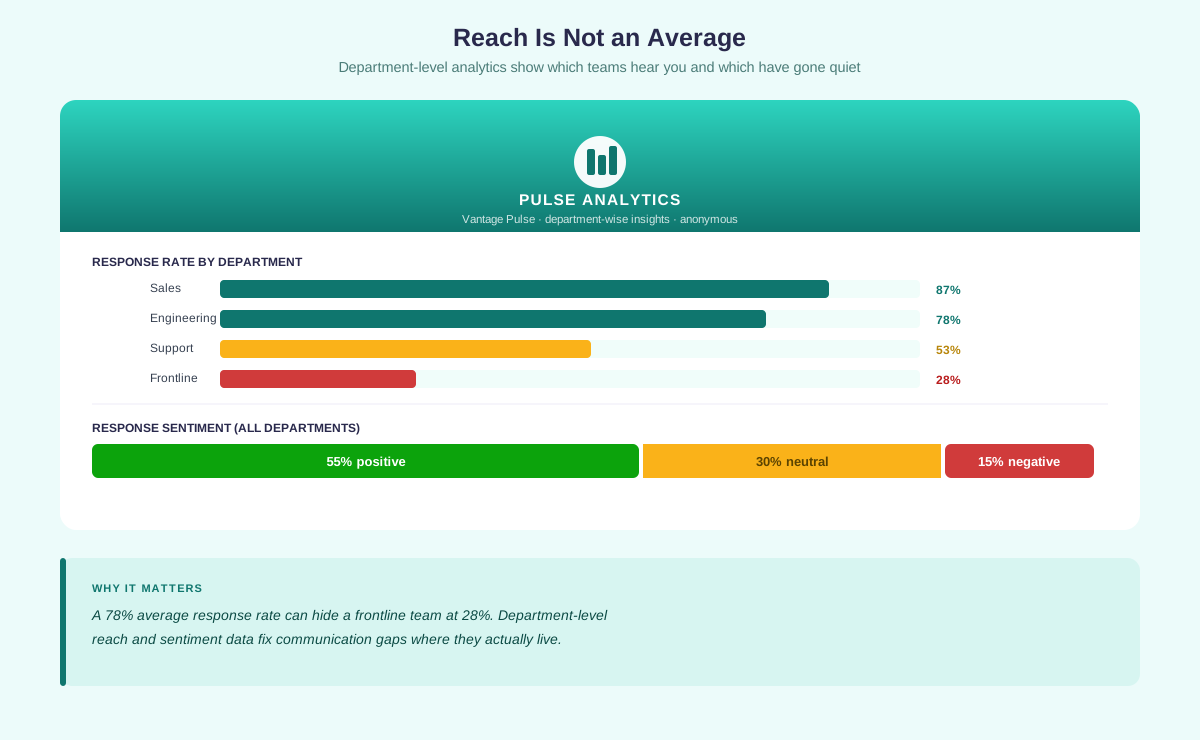
Bottom-up communication carries feedback, concerns, and ground-level insight from employees back to leadership, and it is the direction most organizations under-build. An anonymous eNPS, or employee Net Promoter Score, survey removes the career tax on telling leadership what is not working, which is why anonymous channels surface problems that town halls never do. Employee listening strategy exists specifically to formalize this direction: structured channels, like the anonymous pulse surveys Vantage Pulse runs on, turn scattered opinions into a trackable signal instead of leaving leadership to infer morale from attrition data months later.
Lateral (Peer to Peer)
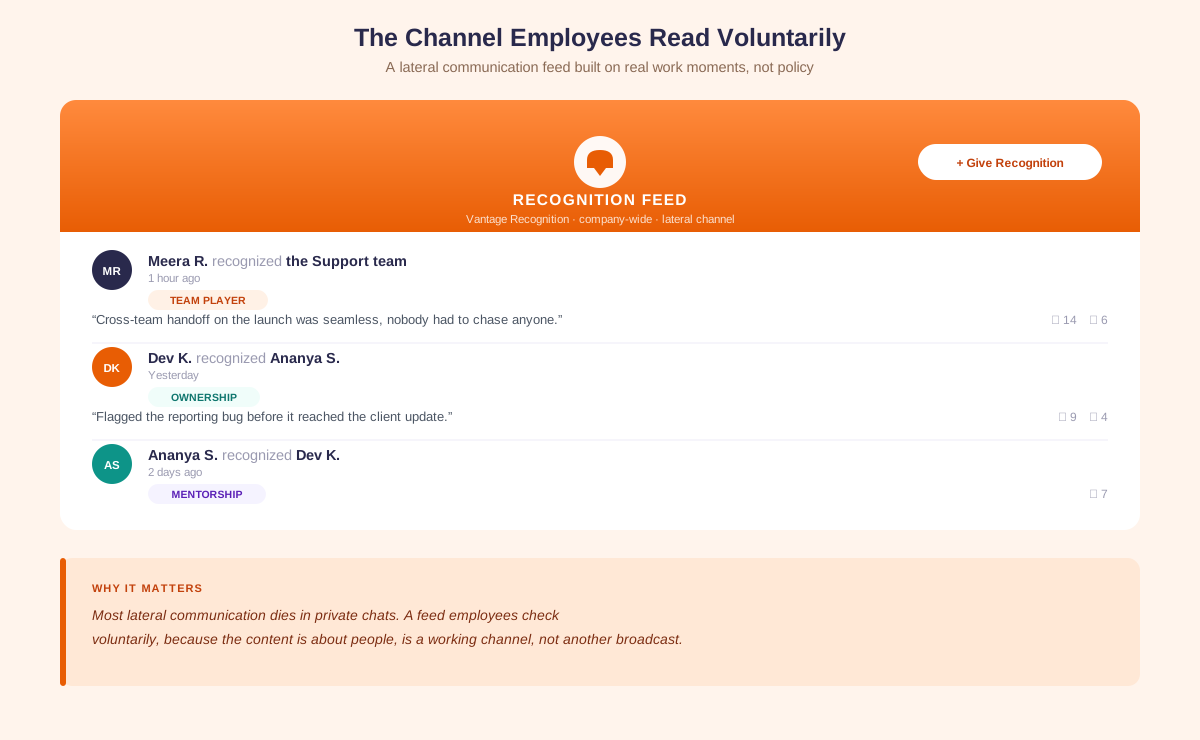
Lateral communication carries coordination, context, and recognition between peers, and it is the direction most likely to happen informally, in private chats leadership never sees. Team communication tools formalize project-level coordination, but a large share of lateral exchange, recognition especially, still dies in one-on-one messages instead of reaching the wider team. Most lateral communication needs a channel employees check voluntarily, because the content is about people, not policy. That is what makes Vantage Recognition's public feed a working lateral channel rather than another broadcast.
Cross-Functional
Cross-functional communication carries shared context between departments that do not report to each other, and it fails silently more often than any other direction because no single manager owns it. Sales briefing Support before a product launch, or HR looping Finance in on a policy change, are cross-functional exchanges that either happen deliberately, on a defined cadence, or do not happen at all until a customer notices the gap first.
Why Employee Communication Matters
Employee communication now ranks as the second-largest driver of workplace disengagement, behind only culture itself. Gallup's 2025 analysis of U.S. engagement data found that 29% of employees cite a lack of clear, honest, or consistent communication from leadership as a reason for disengaging, trailing only workplace culture at 32%, and put the national cost of disengagement at close to $2 trillion in lost productivity (Gallup, "Anemic Employee Engagement Points to Leadership Challenges," 2025).
This should not feel surprising. Most of us have sat through a meeting that changed nothing and quietly disengaged a little more afterward. That cost shows up in the same three places every time. Employees who cannot connect their daily work to company direction disengage first. Managers who never receive upward feedback keep repeating the same mistakes because nobody tells them otherwise. Departments that never hear from each other duplicate effort nobody asked for. Workplace communication breakdowns rarely start as one dramatic failure; they start as a slow accumulation of updates that went out and were never confirmed to have landed.
None of this means employees want more communication. It means they want communication that closes a loop. A leadership update that never asks for a reaction, and never gets one, teaches employees that their read is optional too. Over enough quarters, that lesson generalizes: employees stop expecting a response, stop giving one, and the entire exchange degrades into leadership talking and everyone else half-listening. Reversing that pattern is the actual goal of the strategy below, not simply communicating more often.
Building an Employee Communication Strategy: 5 Actionable Steps
A working employee communication strategy has 5 actionable steps: audit what you currently send, segment your audience, match each message to the right channel, build a two-way feedback loop, and set a cadence that kills redundancy.
It does not need a communications degree, a new budget line, or a sign-off from someone three levels up. It needs someone willing to look honestly at what's actually being sent, and to whom.
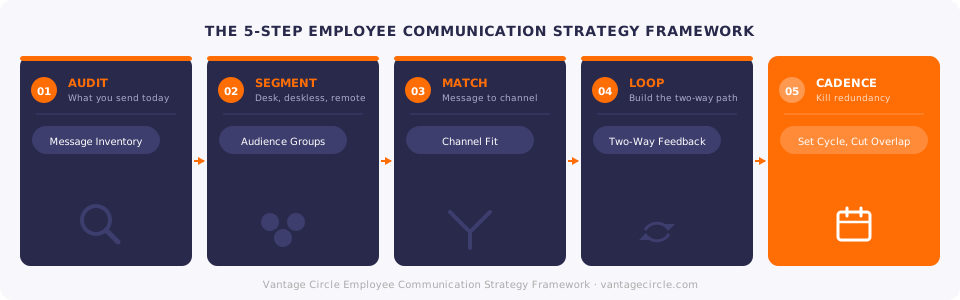
Step 1 - Audit What You Send Today
Before adding a single new channel, list every recurring message your organization already sends and who actually opens it. Most companies discover the same pattern: three overlapping channels announcing the same all-hands recap, a newsletter nobody reads past the subject line, and a Slack channel with muted notifications. An audit turns a vague sense of "too much noise" into a specific list of what to cut, consolidate, or keep, which makes every later step easier to justify.
Step 2 - Segment Your Audience (Desk, Deskless, Remote, Shift)
A single all-hands email assumes everyone works the same hours at the same desk, and for a growing share of the workforce that assumption is simply wrong. Desk-based staff, deskless and frontline teams, remote employees, and shift workers each need a different delivery window and format, or the message arrives after the moment it mattered has passed. Map each segment once, and every message after that gets built for a specific audience instead of an imagined average employee.
Step 3 - Match Message to Channel
Sensitive topics need a synchronous, human channel; routine updates need an asynchronous one, and confusing the two is a common source of employee mistrust. A restructuring announcement delivered only by email reads as leadership avoiding the conversation, while a routine policy update delivered as a mandatory meeting wastes everyone's calendar. Communication styles in the workplace differ by team and by topic, and matching the two deliberately is what separates a channel strategy from a channel list.
Step 4 - Build the Two-Way Loop
A message is not complete until the sender knows whether it was received, understood, and actionable, which is what makes the feedback loop the step most strategies skip. Axios HQ's 2025 Internal Communications Report found that 72% of leaders believe employees have an easy, accessible way to share feedback about internal communication, but only 46% of employees agree, a 26-point perception gap that explains why so many "open door" policies produce silence rather than dialogue. Closing that gap starts with active listening: a defined channel, a stated response window, and a visible action taken on what came back.
Step 5 - Set Cadence and Kill Redundancy
Pick a fixed rhythm for each message type, weekly team updates, monthly all-hands, quarterly strategy reviews, and retire anything that does not fit the calendar. A strategy without cadence drifts back into ad hoc messaging within a quarter, because someone always has an "urgent" update that breaks the schedule. A strategy with cadence gives employees a predictable rhythm to expect, which is itself a form of communication.
A one-page communication plan needs five things: audience segments, channels, cadence, ownership, and the metric each message is judged on. Put those five in a single shared document, and this 5-step framework stops being an idea and starts being something a team can actually run against.
Internal communication best practices covers the day-to-day habits that keep this 5-step framework from decaying back into noise once the initial rollout excitement fades.
Choosing Employee Communication Tools and Channels
The right channel mix follows the workforce you actually have, not the vendor with the most features. A five-channel stack is not a strategy if nobody has defined which message type goes where.
| Channel Category | Best For | Watch Out For |
|---|---|---|
| Messaging & intranet | Daily updates, quick questions | Message overload without segmentation |
| Formal announcements, policy detail | Low open rates for anything routine | |
| Town halls & 1:1s | Sensitive topics, two-way dialogue | Does not scale past a certain team size alone |
| Recognition feed | Lateral, voluntary, peer-to-peer visibility | Needs real participation or it feels empty |
| Survey & listening tools | Structured bottom-up feedback | Useless without a visible action on the results |
A recognition feed works on the same voluntary logic Vantage Recognition is built around: participation because employees want to see it, not because a policy requires it. An eNPS pulse, meanwhile, is the simplest structured version of the survey and listening category, one recurring question that gives every employee a low-effort way to talk back and gives HR a trendline instead of scattered anecdotes.
Slack and Microsoft Teams remain the default for daily messaging and quick coordination. Neither replaces the recognition feed or the listening tool, since both are built for tasks, not for the lateral or bottom-up communication that keeps a workforce feeling heard between task updates.
How to Measure Employee Communication
Employee communication is measured by loops closed, not messages sent: track reach by segment, response rate, feedback-loop closure time, and sentiment trend rather than counting how many emails went out.
| Metric | What It Tells You | How to Track It |
|---|---|---|
| Reach by segment | Which teams actually received and engaged with the message | Department-wise open or response rates in your survey or intranet tool |
| Response rate | Whether employees engage with communication or ignore it | Percentage of employees who respond within a set window |
| Feedback-loop closure time | How fast a submitted concern gets a visible answer | Days between a concern being raised and a documented response |
| Sentiment trend | Whether the emotional tone of responses is improving or worsening | Automated sentiment classification on open-text answers, tracked over time |
| eNPS movement | Whether trust in leadership communication is rising or falling | Quarter-over-quarter change in eNPS score |
Reach is not an average, and neither is sentiment. A positive overall trend can quietly hide the one team that has gone silent, and open-ended responses are where employees say, in their own words, whether a message actually landed. Vantage Pulse flags recurring, anonymized patterns within a specific team or department and classifies open-text responses as positive, neutral, or negative, turning thousands of free-text comments into a readable signal instead of a spreadsheet nobody has time to read.
When Communication Becomes Noise: What to Stop Sending
Over-communication fails the same way silence does: employees stop paying attention, just for a different reason. 2026's practitioner discourse on communication has shifted from "send more" to "send less, better," and Grammarly and The Harris Poll's 2024 State of Business Communication Report backs that shift with data: knowledge workers now spend 88% of their workweek communicating across multiple channels, and 78% report the frequency of communication increasing over the past year alone. More channels and more frequency have not produced more clarity.
Ever asked to skip a meeting because it could have been an email? That instinct is usually correct, and it's worth listening to more often than most managers do. Four habits are worth cutting on sight:
- Duplicate announcements across channels. The same all-hands recap in email, Slack, and the intranet is not redundancy for reach, it is three chances to be ignored instead of one chance to be read.
- "FYI all" threads. A message copied to everyone because segmenting the audience felt like more work trains employees to skim, not read, everything that arrives with that label.
- Status meetings that could be a feed. A recurring meeting whose entire purpose is one-way updates belongs in an asynchronous channel; meetings should be reserved for discussion the update itself cannot resolve.
- Unsegmented blasts. A single company-wide message covering three unrelated topics forces every reader to filter out the two-thirds that do not apply to them.
Most of these habits exist because segmenting an audience or picking the right channel takes more upfront effort than sending one message to everyone. Miscommunication examples shows how that shortcut compounds into confusion that costs far more time to untangle later than the segmentation would have taken upfront.
Cutting these four is not about communicating less overall. It is about protecting the attention employees give to the messages that actually need it. A workforce that has learned to skim everything will skim the one update that mattered, and no amount of additional channels fixes that once the pattern sets in.
One-question overload audit: for every recurring message you send, ask "would anyone ask for this if it stopped arriving?" If the honest answer is no, cut it.
FAQ
What are the 5 C's of communication?
A. The 5 C's of communication are clear, concise, concrete, correct, and complete. Clear means one idea per message; concise means no unnecessary words; concrete means specific rather than vague; correct means factually accurate; and complete means the reader has everything they need to act without asking a follow-up question.
What are the 4 types of communication in the workplace?
A. The 4 types of workplace communication are verbal, non-verbal, written, and visual. Verbal covers meetings and calls; non-verbal covers tone, body language, and facial expression; written covers email, chat, and documentation; and visual covers charts, diagrams, and dashboards. This is a different framework from the 4 directions covered earlier in this guide, which describe who a message flows between rather than its format.
What are the 7 C's of communication in the workplace?
A. The 7 C's extend the 5 C's with consideration and courtesy. Consideration means writing with the audience's viewpoint, background, and emotional state in mind, not just your own; courtesy means the tone respects the reader regardless of how difficult the content is. Together, the 7 C's function as a pre-send checklist for any message above routine importance.
What are 5 good communication skills in the workplace?
A. Five good workplace communication skills are active listening, clarity, empathy, giving and receiving feedback, and reading non-verbal cues. Good communication skills in the workplace covers how to build each of these deliberately rather than treating them as a fixed personality trait some employees simply have and others do not.
Conclusion
Employee communication is not won by sending more messages through more channels. It is won by closing loops: an announcement that gets a response, a concern that gets a visible answer, a recognition feed employees check because they want to, not because a policy told them to. Values-tagged recognition keeps company language alive between formal announcements, so when leadership does send the next big update, it lands on ground employees already trust, and a listening tool tells you whether any of it is actually landing.
You don't need to fix all of this by Friday. Pick one loop, close it well, and the rest gets easier from there.

Lupamudra is a content marketing specialist at Vantage Circle, where she has written 50+ articles on employee recognition, rewards, and workplace culture, alongside employee engagement, diversity and inclusion, and HR compliance topics, including how India's tax rules apply to recognition and rewards programs.
Connect with Lupamudra on LinkedIn.