
Employee engagement theory is the body of psychological and organizational models that explain why employees invest discretionary effort at work. It all traces back to one paper. William Kahn wrote it in 1990, and the claim was almost stubbornly plain: people bring themselves to a role only when the work feels meaningful, feels safe enough to be honest in, and leaves them something in the tank to give. Take one of those away and they hold back.
Reads academic, I know. What it describes is something every manager has watched happen in front of them. Two people. Same job, same pay, same boss. One throws themselves at the work. The other checked out around mid-morning and is quietly running down the clock. The theory is how you name that gap. The models are how you close it, and the closing is the only part your engaged employees will ever actually feel.
Key Takeaways
- The 7 core theories of employee engagement, compared in one table.
- How each theory becomes an engagement model you can actually run.
- What every model tells you to do, and how to measure whether it worked.
What Is Employee Engagement Theory?
Employee engagement theory is the set of frameworks that explain the conditions under which employees commit their energy, focus, and emotion to their work. Different theories grab different levers. Kahn goes after the psychological conditions, Locke after goals, Herzberg splits the whole thing down the middle into what irritates people and what actually moves them. Stitched together, they are the bridge between "our people seem checked out" and a plan that does something about it.
One line the theories hold that the rest of us keep smudging: engagement is not satisfaction. A satisfied employee is comfortable. An engaged one is bought in. You can be perfectly content and still coast at the bare minimum, which is why "our satisfaction scores look fine" is one of the more expensive things a leadership team ever tells itself.
These models earn their keep because they diagnose, they do not just describe. Gallup's Q12 meta-analysis found that business units in the top quartile of engagement out-earn the bottom quartile by 23% on profitability. Honestly, I would not treat that as a clean lever you pull. Companies already doing well can afford to treat people better, so the causation runs both directions. But the pattern has held across too many studies to shrug off. For the wider definition, before you go theory-deep, our employee engagement pillar covers the ground.
The Major Employee Engagement Theories and Models, Compared
Seven theories carry most of the weight in this field: Kahn's psychological conditions, Locke's goal-setting theory, Maslow's hierarchy of needs, Herzberg's two-factor theory, Vroom's expectancy theory, Gallup's Q12 framework, and the Job Demands-Resources model. The table below sets each one against what it actually tells you to do.
The lineage: seven theories, 1943 to 2007. Different eras, one question.
| Theory | Theorist and Year | Core Idea | What It Means in Practice |
|---|---|---|---|
| Psychological Conditions | William Kahn, 1990 | People engage when work feels meaningful, psychologically safe, and adequately resourced. | Design roles and recognition so contribution feels meaningful and safe to give. |
| Goal-Setting Theory | Edwin Locke, 1968 | Specific, challenging goals drive higher performance than vague or easy ones. | Set clear stretch goals, then feed back on progress often. |
| Hierarchy of Needs | Abraham Maslow, 1943 | Motivation climbs as needs from basic security to self-actualization are met. | Cover pay and safety first, then belonging, esteem, and growth. |
| Two-Factor Theory | Frederick Herzberg, 1959 | Hygiene factors prevent dissatisfaction; motivators create satisfaction. | Fix pay and conditions, then add recognition, growth, and responsibility. |
| Expectancy Theory | Victor Vroom, 1964 | Effort follows the belief that effort leads to performance and performance to a valued reward. | Make the effort-to-reward link visible, fast, and fair. |
| Q12 Framework | Gallup, 1990s | Twelve measurable workplace conditions predict engagement and business outcomes. | Survey on a cadence and act on the weakest items first. |
| Job Demands-Resources | Bakker and Demerouti, 2007 | Engagement rises when job resources offset the demands a role places on people. | Add resources (support, autonomy, wellbeing) to balance the load. |
Laid out like that, they look like rivals fighting over the same crown. They are not. They are different lenses aimed at one thing, and the strategies that work borrow from several at once. Kahn tells you what engagement feels like from the inside. Gallup hands you a way to measure it. JD-R tells you what to add when people are running on empty. The mistake is reading any one of them alone.
William Kahn's Engagement Theory (1990)
William Kahn's theory, introduced in his 1990 study "Psychological Conditions of Personal Engagement and Disengagement at Work," holds that employees engage when they express their physical, cognitive, and emotional selves in a role, and only when three conditions are present at once: meaningfulness, safety, and availability. Almost everything the field has argued about since is a footnote to those three.
Meaningfulness
The sense that the work matters, and that you matter for doing it. You feel it when your small piece connects to something bigger, and you feel it more when someone says, out loud, that it counted. That second half is where recognition stops being a nicety and turns structural. A contribution nobody names stops feeling like it mattered, and it stops fast.
Safety
Kahn meant something narrower than the buzzword it later became: the freedom to show up as yourself, to float a half-baked idea without bracing for the wince. Psychological safety is what lets a mixed team put its differences to work instead of filing them down to keep things smooth. It shows up hardest in high-stakes work. A flight crew that feels safe flagging fatigue is running on this condition.
Availability
The dull-sounding one that quietly sinks more engagement than either of the others. It is simply whether people have anything left, in body and in head, to put in. Run the tank dry and there is nothing there to engage with, which is why work-life balance sits inside an engagement conversation, not off in a wellness brochure. Under-resourced teams smack into this one first.
Three conditions, and they do not average out. You cannot bank a surplus of meaningfulness to cover a shortfall of safety. Miss one and engagement drains straight out through the gap it leaves.
Goal-Setting Theory (Locke, 1968)
Edwin Locke's goal-setting theory, first laid out in his 1968 paper "Toward a Theory of Task Motivation and Incentives," says specific and difficult goals pull more real performance out of people than vague or easy ones. Locke and Gary Latham later boiled it into five principles, and they have aged unusually well.
Clarity has to come first, because nothing downstream works without it. People who know precisely what is being asked line their effort up behind it, which is why OKRs work beautifully right up until they curdle into theatre, at which point they do more harm than no goal at all. Challenge is the next dial. A goal has to stretch or nobody moves, but crank it past what feels possible and you do not get effort, you get a shrug. Finding that line is most of what a good manager does all day.
The one people underrate is commitment. An assigned goal and a goal someone chose for themselves produce completely different behavior, and the difference is mostly whether they had a say in it. Feedback is what keeps any of it breathing; a goal with no progress signal is just a wish with a date stapled to it. And task complexity is the guardrail at the far end, hard enough to make people think, not so knotted they seize up. Complex goals get chopped into milestones people can actually reach, or the whole effort stalls out around month two.
Get those five pulling in the same direction and goals quit being a box you tick. They start doing what Locke said they would.
Motivation Theories Behind Engagement
Three older motivation theories sit under most of this. None was built for engagement, exactly. But each one grabs a corner of the same question, which is what makes a person bother to try at all.
Maslow's Hierarchy of Needs
Abraham Maslow's hierarchy of needs, from 1943, says motivation climbs in order. People chase the basics, pay and security, before belonging or esteem or self-actualization can move them at all. Put to work, engagement rises as an organization satisfies those needs bottom-up. The upper rungs are where companies love to spend, all development paths and mental health support. Fine. But that ladder is not one-size-fits-all. Try lifting a team that is quietly braced for layoffs with a growth webinar and watch it land wrong. Polish the top rung while the bottom one wobbles, and you have spent good budget on nothing.
Herzberg's Two-Factor Theory (1959)
Frederick Herzberg's two-factor theory came out of 1959, and it made one cut nobody has bettered since. The things that make people miserable at work and the things that make them care are not the same list. Hygiene factors, pay, policy, working conditions, buy you the absence of complaints and nothing more. Fix them and the grumbling stops. Nobody lights up. What lights people up lives on the other list, the motivators, recognition and responsibility and the feeling of getting somewhere. Hence the blunt line Herzberg is remembered for: you cannot bonus your way out of a motivation problem. And the budgets least able to afford raises are precisely the ones where a steady recognition habit does the heaviest lifting.
Vroom's Expectancy Theory (1964)
Victor Vroom's expectancy theory, from 1964, runs on a chain of three beliefs: that effort will produce performance, that performance will produce a reward, and that the reward is one you actually want. All three links have to hold. Snap any of them and the effort walks out with it. The link I see snap most is the middle one. People do the work, watch it land nowhere or land somewhere random, and after enough of that they simply stop spending themselves. Which makes fairness in how rewards get handed out a motivation question, not an HR-admin footnote.
None of the three actually fights the others, which is easy to miss when they get taught as competitors. Maslow tells you what people want. Herzberg sorts which of those wants move performance. Vroom explains the conditions under which anyone bothers chasing them at all.
The Job Demands-Resources (JD-R) Model
The Job Demands-Resources (JD-R) model, built by Arnold Bakker and Evangelia Demerouti in 2007, treats engagement as a balancing act: what a job takes out of you against what it gives you to cope. Demands are the draining side. Workload, deadlines, the emotional freight of the work itself. Resources are whatever refills the tank, and that list runs longer than people expect. Autonomy. Support. Feedback that is actually useful. Room to grow. Whatever the company does about wellbeing instead of just talking about it.
Engagement lives in the space between those two columns. Keep resources level with demands, or a little ahead, and people stay switched on and absorbed. Let demands run out in front for months and those same people tip into burnout, which is not a slump you can fix with a rousing all-hands.
Here is what makes the model genuinely useful instead of just tidy. It is a design tool. You often cannot dial the demands down, since a trauma nurse's shift is going to be brutal no matter what you do to the org chart. What you can do is stack the resource side on purpose: more control over the how, help that shows up before someone is already underwater, recovery treated as part of the job rather than a prize for surviving it. That flip, from demands you wish away to resources you deliberately add, is why burnout-conscious teams reach for JD-R ahead of almost anything else.
Saks' Model and the Gallup Q12 Framework
Alan Saks gave engagement its first full antecedents-and-consequences model in 2006, and it is the piece most overview articles skip. Where earlier theories described what engagement is, Saks mapped what produces it and what it produces in return. On the input side he named things like job characteristics, perceived organizational support, recognition, and fairness. On the output side, higher job satisfaction, stronger commitment, lower intention to quit. His sharpest contribution was distinguishing job engagement from organization engagement, since a person can be absorbed in the work itself while quietly disengaging from the employer, or the reverse.
That distinction matters because the two failures need different fixes. Redesign the role for the first. Repair trust and belonging for the second.
Gallup's Q12 framework is the measurement counterpart to all of this. Gallup's approach to employee engagement is built on twelve survey questions that gauge whether the everyday conditions for engagement are actually present: clear expectations, the materials to do the work, recognition in the last seven days, someone who encourages development, and a sense that opinions count. The genius of the Q12 is not the theory behind it. It is that the twelve items are concrete enough to act on. "I have received recognition in the last seven days" is a diagnosis and a to-do list in a single line, which is why it is the most-run engagement instrument in the world.
From Theory to Practice: What Each Model Tells You to Do
Theory tells you what drives engagement. It almost never tells you what to do on Monday morning. This section is the translation layer, and it is the part no page ranking for this term actually bothers to build.
The move is to take each theory's core driver, name the practice lever that operationalizes it, and name how you would know it worked. Kahn's meaningfulness becomes values-tagged recognition, measured by whether recognition is actually happening across the team and not just from three enthusiastic managers. Herzberg's motivators become recognition and growth paths, measured by movement on the motivator items in your pulse. Gallup's Q12 becomes a survey cadence you act on. Vroom's expectancy becomes a visibly fair link between effort and reward. Maslow's upper rungs become development plus esteem, and JD-R's balance becomes wellbeing and autonomy support you add on purpose.
| Theory | Practice lever | How to measure it |
|---|---|---|
| Kahn (meaningfulness) | Values-tagged recognition that names why the work mattered | Recognition frequency and reach across the team |
| Herzberg (motivators) | Recognition, responsibility, and growth paths | Movement on motivator items in the pulse |
| Gallup Q12 | A regular, acted-on pulse cadence | eNPS and Q12-style item trends |
| Vroom (expectancy) | A transparent, fair effort-to-reward link | Fairness and reward-perception items |
| Maslow (esteem, growth) | Development plans plus visible esteem | Growth and belonging pulse items |
| JD-R (resources) | Wellbeing and autonomy support | Wellbeing and workload pulse items |
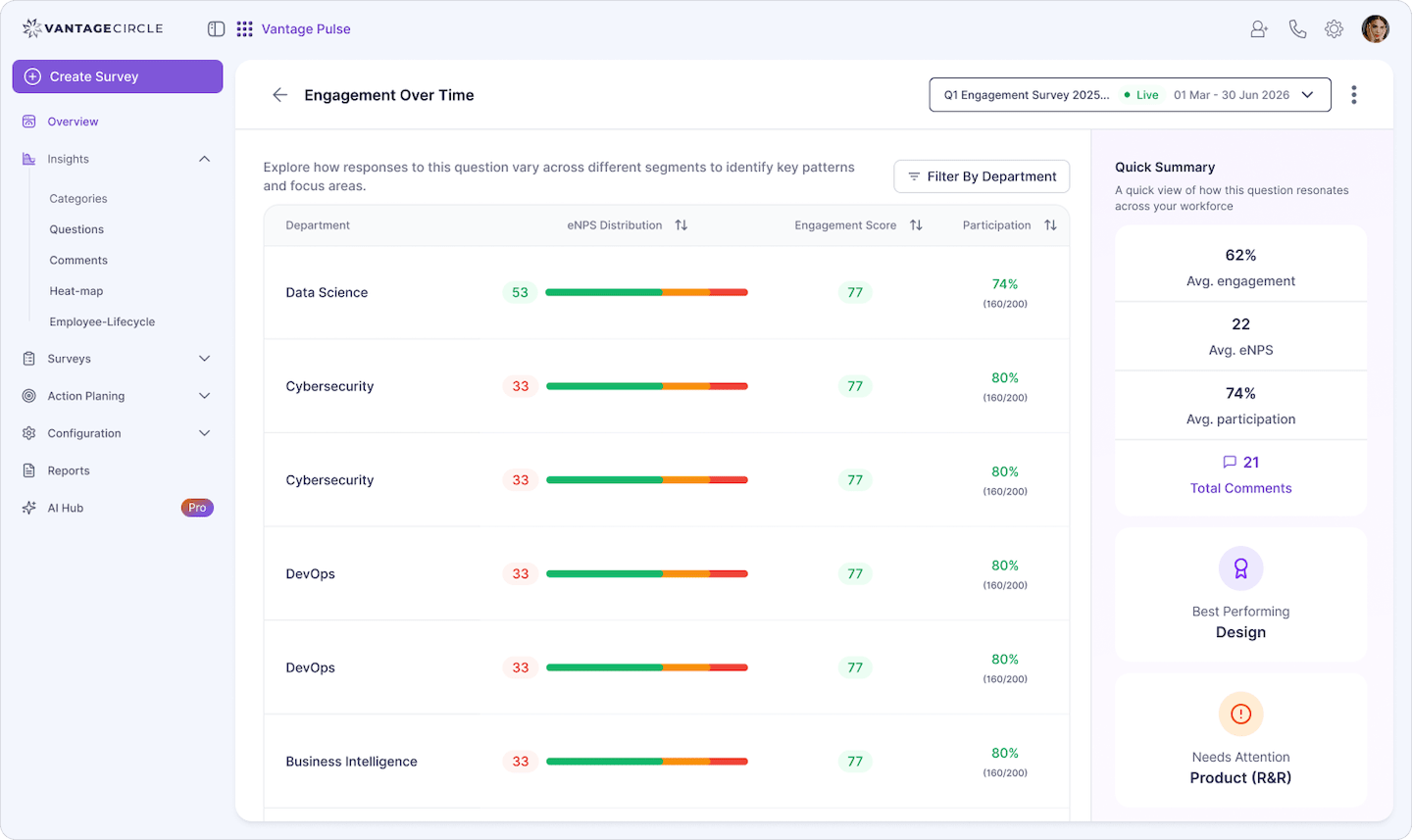
Source: Vantage Pulse
This is where a recognition platform stops being a nice-to-have and starts being the instrument the theory implied all along. Vantage Rewards makes Kahn's meaningfulness condition operable: values-tagged, peer-to-peer recognition names why a contribution counted, and a social recognition feed makes that visible at team scale. Vantage Pulse turns Gallup's Q12 from a concept into an eNPS cadence you can actually run, and Engagement Analytics is what closes Vroom's and Saks' loop, showing whether the drivers each model predicts are moving real outcomes. On the JD-R side, wellbeing support through Vantage Fit is a resource you add to offset demand, not a perk you bolt on.
Read the theories side by side and the same lever keeps surfacing. Meaningful, visible recognition is what Kahn's meaningfulness, Herzberg's motivators, and the Q12's seven-day recognition item all quietly point to.
Which raises the obvious question. If recognition is the lever, how do you know yours is any good? "Do more recognition" is exactly the limp kind of advice this whole section is trying to avoid. That is where Vantage Circle's AIRe framework earns its keep. It breaks recognition into four dimensions, Appreciation, Incentivization, Reinforcement, and Emotional Connect, and lets you check whether a program actually lands them or just runs. And the four line up with the theory almost too neatly. Emotional Connect is Kahn's meaningfulness wearing work clothes. Reinforcement takes Vroom's effort-reward link and makes it deliberate. Incentivization is the tangible side Herzberg told you not to lean on too hard, and Appreciation is really just the Q12's seven-day item turned into a routine. The theories tell you recognition matters. AIRe is how you find out whether yours is doing what they predicted.
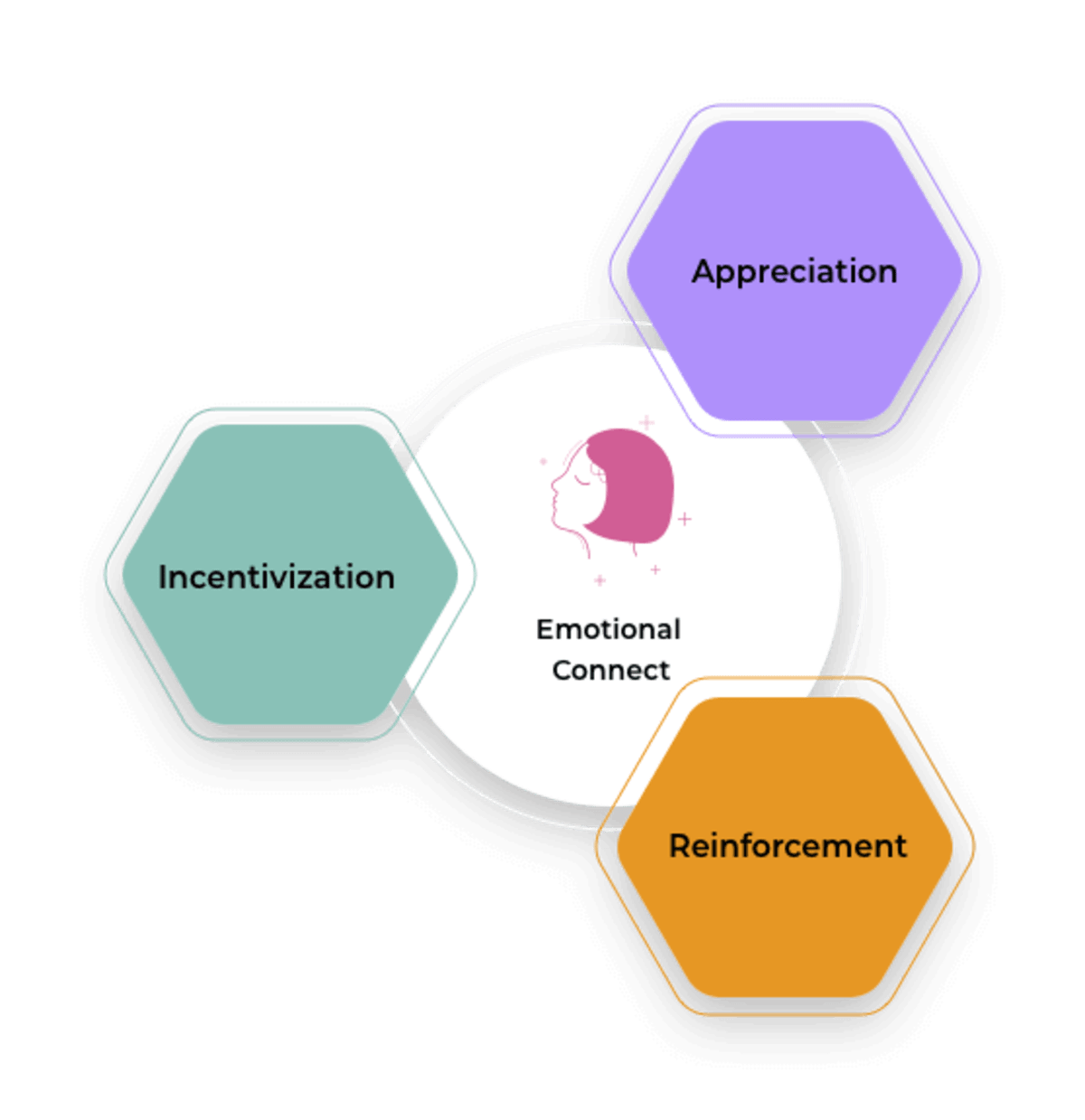
Source: Vantage Circle AIRe Framework
I want to be honest about the limit of that through-line, because it is easy to oversell. Recognition is not a universal solvent. If people are underpaid or drowning in demands, recognition without the hygiene and resource fixes reads as hollow, and they will tell you so in the comments of your next survey. The point is not that recognition replaces the rest. It is that recognition is the highest-leverage lever most organizations are underusing while they wait for a bigger budget. For where this is heading next, see our take on employee engagement trends.
🎯 Turn theory into a recognition habit
The theories all point to the same lever. Pull it.
Kahn's meaningfulness, Herzberg's motivators, and Gallup's seven-day recognition item converge on one thing. See how Vantage Rewards makes values-tagged recognition a daily practice, not a survey line.
Explore Vantage Rewards →Conclusion
The gap between an engaged employee and a disengaged one rarely comes down to the person. It comes down to whether the conditions these theories describe are actually in place. Kahn named the conditions, Locke and the motivation theorists sorted the drivers, Gallup made them measurable, and JD-R showed how they tip toward burnout. None of it matters until you translate it into what you do and how you check it. That translation, theory into practice into measurement, is the whole job. The rest is just vocabulary.
Frequently Asked Questions
Q1. What is Kahn's theory of employee engagement?
A. Kahn's theory says employees engage by expressing their physical, cognitive, and emotional selves in a role, and only when three conditions are met: meaningfulness, safety, and availability. He introduced it in a 1990 study, and pretty much every framework that came after is building on ground he laid.
Q2. What are the 4 pillars of employee engagement?
A. The four pillars, drawn from the widely cited "four enablers" of engagement, are a strategic narrative, engaging managers, employee voice, and organizational integrity. Read them as the conditions leadership has to put in place: a clear story people believe, managers who actually develop their teams, real channels for input, and stated values the company does not quietly ignore.
Q3. What are the 5 C's of employee engagement?
A. The 5 C's of employee engagement are Care, Connect, Coach, Contribute, and Congratulate. They boil engagement down to things a manager does: caring about people as individuals, connecting them to purpose and to each other, coaching their growth, opening the door for real contribution, and congratulating the results out loud.
Q4. What is Gallup employee engagement theory?
A. Gallup's employee engagement approach is built on the Q12, twelve survey questions that measure whether the everyday conditions for engagement exist. The items are deliberately concrete, clear expectations, recognition in the last week, someone invested in your growth, and Gallup links movement on them to hard outcomes like profitability and retention.
Q5. What is Maslow's theory of employee engagement?
A. Maslow's theory holds that engagement rises as employees' needs are met in order, from basic security through belonging, esteem, and self-actualization. In practice that means the lower needs, fair pay and basic safety, come first; until those are handled, the higher motivators like growth and purpose have very little to grab onto.

He has worked in the human resources environment and has elevated recognition and rewards through his insightful and detailed writing. He aims to enhance the practice of Recognition in the workplace with new ideas and innovation that will help shape the work culture. For any related queries, contact editor@vantagecircle.com