Employee engagement has hit a wall
Gallup's 2025 State of the Global Workplace Report shows that only 31% of U.S. employees are actively engaged, the lowest level in a decade. Seventeen percent are actively disengaged. Sixty-two percent are present at work, but not fully invested.
Disengagement costs an estimated $438 billion in lost productivity each year. More than half of employees say it's a good time to look for a new job, putting employee retention at the top of every HR agenda. This isn't a short-term dip. It signals a broader reset in how people experience work. So in 2026, leading organizations are rethinking engagement at its core.
The following 8 trends reflect what's changing, and what HR leaders need to act on now.
Key Takeaways
- Employee engagement hit a 10-year low in 2025: only 31% of U.S. employees are actively engaged (Gallup, 2025).
- Three structural forces drive the decline: a trust deficit, manager burnout at 56%, and recognition programs that miss most employees.
- AI is closing recognition gaps. 80% of organizations are implementing AI-enhanced recognition in 2026, surfacing overlooked employees before they disengage.
- Continuous employee listening outperforms annual surveys: organizations with real-time listening are 4x more likely to retain talent (Perceptyx, 2025).
- Manager enablement is the highest-leverage intervention. Managers account for 70% of variance in team engagement (Gallup).
- Skills-based internal mobility has replaced job-title progression as the primary retention lever for high-potential employees.
Why Employee Engagement Is Declining
Three structural forces are converging. And if you want to build a real response, understanding them is where you have to start.
The Trust Deficit
Only 21% of employees say they trust their organization's leadership (Gallup, 2025). Trust is the operating system beneath every engagement effort. So without it, recognition feels performative, feedback becomes procedural, and culture initiatives feel scripted. When employees notice the gap between stated values and lived experience, and that gap persists, engagement erodes quietly.
Manager Burnout
56% of managers report being burned out (Deloitte). Burnout cascades directly to teams. A burned-out manager recognizes less, responds slower, and pulls back from the coaching conversations that keep employees invested. When the person responsible for team engagement is depleted, the whole system weakens.
Recognition Programs Stuck in the Past
Only 23% of employees strongly agree their recognition program meets their expectations (Gallup). Most still rely on annual awards, manager-only recognition, and top-down models designed for a workforce that no longer exists. When you combine low trust, manager burnout, and outdated recognition, engagement weakens at the foundation, and so does leadership resilience. If your program needs a refresh, start with rewards and recognition ideas that work for today's teams.
8 Employee Engagement Trends Reshaping the Workplace in 2026
Trend 1: People-First Culture Powered by Data-Driven Engagement
Almost every company calls itself people-first. In 2026, what separates them is not what they say. It is what they measure. Only 27% of executives believe their HR team effectively advises them on human capital risks (Mercer Global Talent Trends, 2026). The gap between people-first intent and people-first action is, almost always, a measurement problem. Data and empathy are not opposites.
Key Actions
- Move from annual surveys to regular pulse checks
- Give managers direct visibility into their team's engagement data
- Track engagement gaps across teams and demographics and address them early
Trend 2: AI-Powered Recognition and Feedback Loops
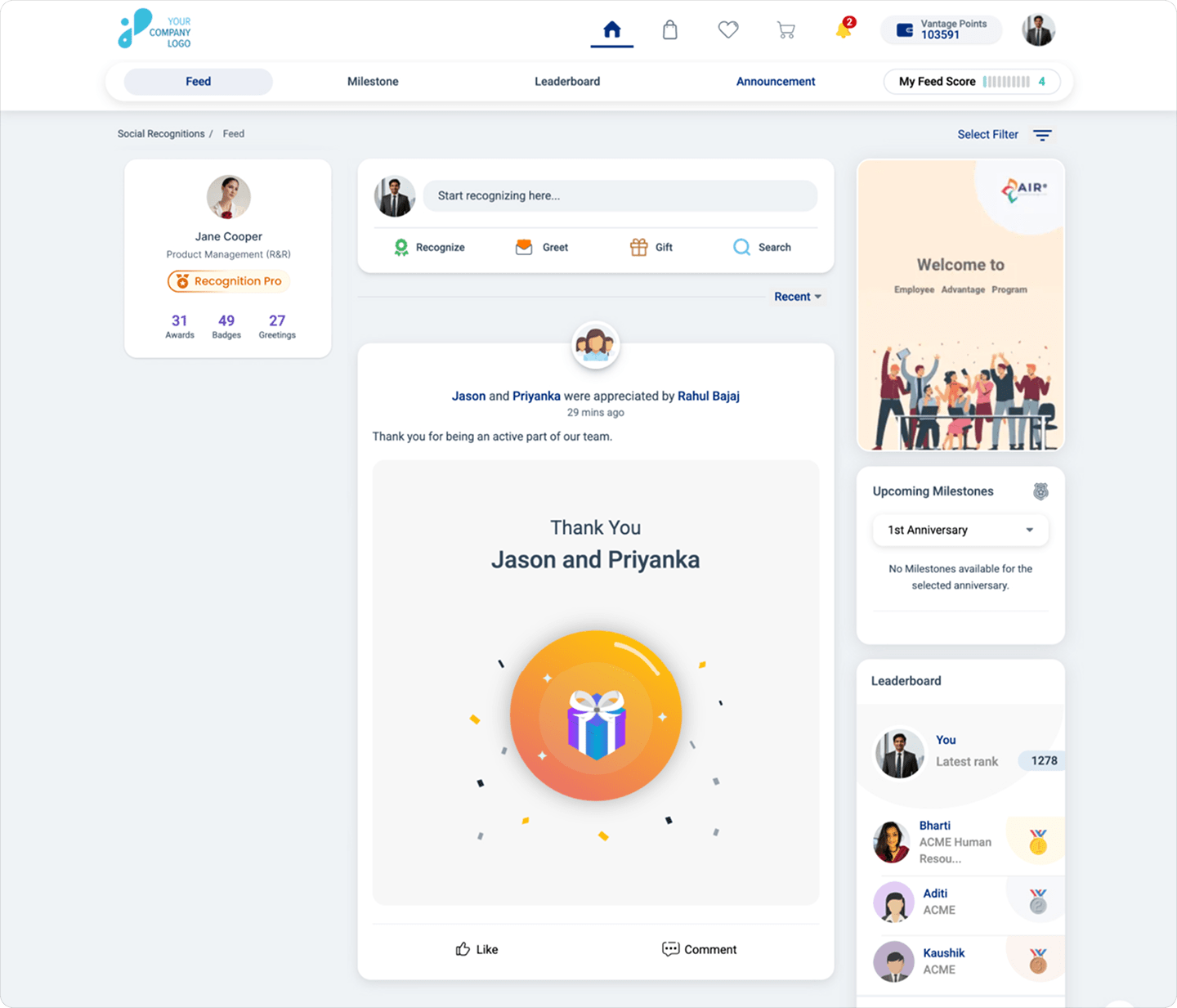
AI is entering employee recognition software fast, reshaping how recognition programs are run. 80% of organizations are already implementing AI-enhanced recognition in 2026 (Capgemini). Used well, AI surfaces employees who haven't been recognized recently and nudges managers before anyone slips through the cracks.
Platforms like Vantage Recognition, when integrated with M365 Copilot and Microsoft Teams, can surface overlooked employees and close recognition gaps without increasing manager workload.
Trend 3: Holistic Wellbeing Goes Beyond Gym Memberships
Burnout is becoming structural. 76% of employees experience burnout at least sometimes (Gallup, 2025). 72% say financial stress impacts their work performance (PwC). Burnout in 2026 is emotional, financial, and social. Not just physical.
Integrating a system such as Vantage Fit connects physical, mental, and financial wellness into a single platform, giving HR teams clear visibility into employee wellbeing data alongside engagement metrics.
Trend 4: Hybrid Work Models Demand New Engagement Playbooks
Hybrid work is not the experiment anymore. It is the expectation. 61% of employees say they would reject a job that harms their work-life balance (Randstad). Too many engagement systems were built for the office and digitized for remote. Recognition still favors visibility. That is how two-tier workforces form quietly.
Trend 5: Real-Time Employee Listening Replaces Annual Surveys
Annual engagement surveys fail because they lack speed, not insight. Organizations with continuous listening practices are 4x more likely to retain talent (Perceptyx, 2025). By the time annual results are shared, the moment to intervene has often passed.
Key Actions
- Shift from annual surveys to short monthly pulses (3 to 5 questions)
- Close the loop visibly. This one habit rebuilds trust faster than any program
- Combine survey data with recognition patterns and early attrition signals
Trend 6: Skills-Based Organizations and Internal Mobility
Skills are expiring faster than job titles. 39% of current job skills will be disrupted within five years (WEF Future of Jobs Report, 2025). 47% of employees say L&D opportunities drive their commitment (Randstad). Internal mobility is proof of opportunity.
Trend 7: Manager Enablement as the #1 Engagement Driver
Managers drive engagement more than any other factor. Gallup estimates they account for 70% of the variance in team engagement. Yet 56% of managers report being burned out (Deloitte). The shift in 2026: from managers being responsible for engagement to organizations enabling managers.
Key Actions
- Provide managers with real-time, team-level engagement data
- Embed recognition prompts into tools they already use (Slack, Teams, email)
- Tie team engagement outcomes to performance reviews
- Address manager burnout directly and support them as actively as they support others
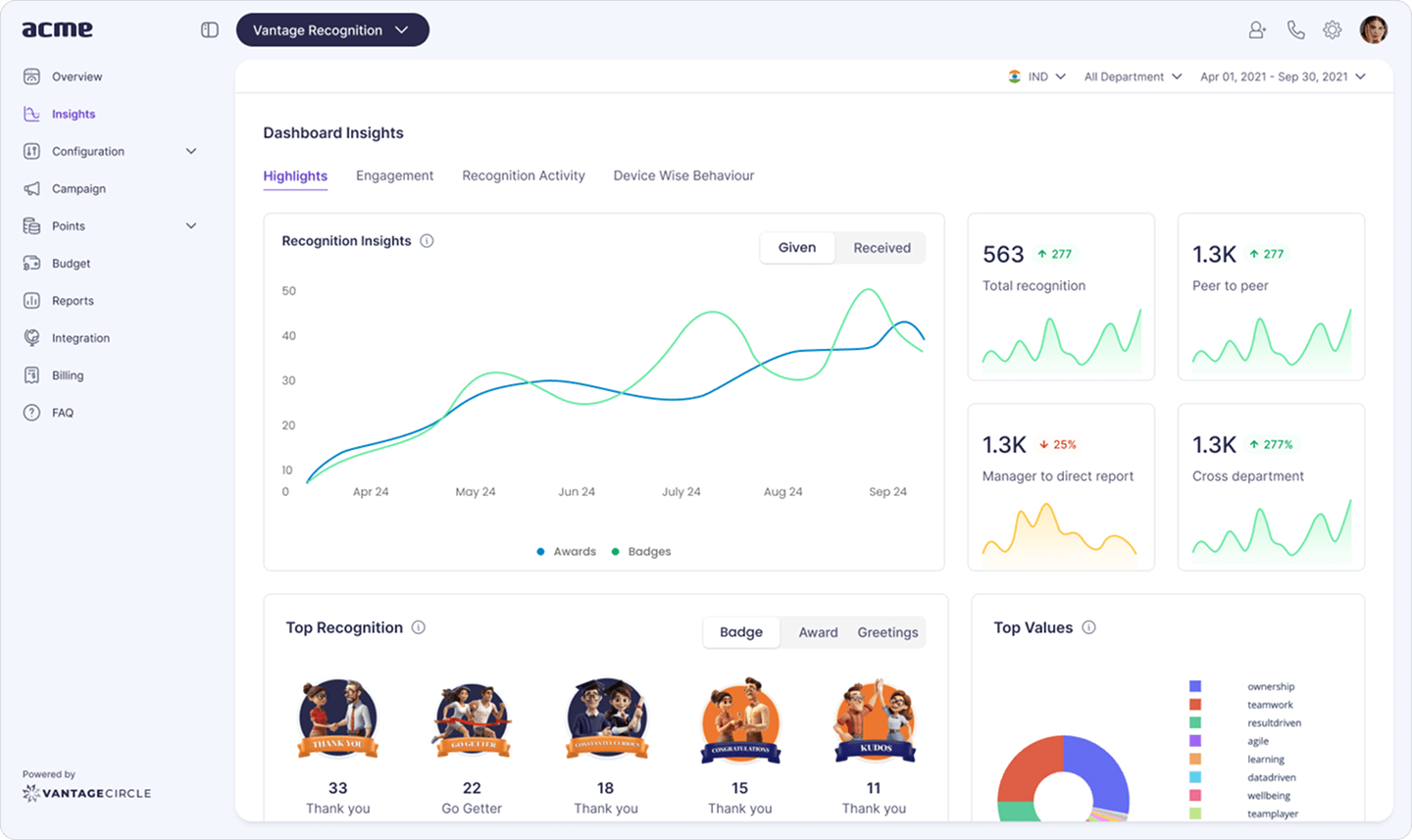
Effective rewards and recognition starts with giving managers the right tools. Vantage Recognition delivers team-specific insights directly inside the tools managers already use.
How Recognition Builds Resilient Leadership: 5 Research-Backed Mechanisms
Trend 8: Financial Wellness and Total Rewards Redesign
Compensation is no longer just about salary. It is about stability. 72% of employees say financial stress impacts their work performance (PwC). Yet many total rewards packages still reflect priorities from a decade ago. A fixed benefits model no longer signals care.
Employee Engagement Trends: 2024 vs. 2025 vs. 2026
Understanding the direction of travel helps you get ahead of the curve rather than catch up to it. Know where each trend is headed and you can act early, not late.
| Trend | 2024 | 2025 | 2026 |
|---|---|---|---|
| Data-Driven Culture | Annual surveys | Quarterly pulse cycles | ↑ Real-time team dashboards |
| AI Recognition | AI-generated messages | AI-assisted nudges | ↑ AI spots who's being missed |
| Wellbeing | Physical wellness | Mental health integration | ↑ One platform for mind, body & finances |
| Hybrid Work | Hybrid as exception | Hybrid as standard | → Same experience in-office or remote |
| Employee Listening | Annual surveys | Semi-annual surveys | ↑ Continuous listening, not just surveys |
| Skills & Mobility | Internal job boards | Skills mapping begins | ↑ Skills replace job titles; mobility as retention |
| Manager Enablement | Managers own engagement | Manager training programs | ↑ Orgs enable managers with data + tools |
| Total Rewards | Millennial-centric perks | Generational preference surveys | ↑ Flexible, life-stage-aware design |
How Leading Companies Are Responding
Here's an organization that didn't just adopt an engagement program. It redesigned its approach from the ground up.
Wipro: Building a Recognition Culture at Enterprise Scale
230,000 employees · 66 countries
Wipro needed a recognition culture that could travel. One that didn't depend on managers having bandwidth or employees being in the same office as the people who could recognize them.
Wipro deployed Vantage Circle's "Winners' Circle" peer recognition program to democratize appreciation at scale. The core insight: recognition at enterprise level has to be peer-driven, because no top-down system can reach 230,000 people consistently.
FAQs About Employee Engagement Trends
What are the biggest employee engagement trends in 2026?
The 8 key trends are: data-driven people-first culture, AI-powered recognition, holistic wellbeing, hybrid work playbooks, continuous employee listening, skills-based internal mobility, manager enablement, and multigenerational total rewards redesign.
Why is employee engagement declining in 2026?
Three structural forces: trust deficit (only 21% of employees trust their leadership), manager burnout at 56% which cascades directly to team engagement, and recognition programs that only 31% of employees rate as effective. Together, they create a compounding drag that annual surveys and one-off initiatives can't fix.
What role does AI play in employee engagement in 2026?
AI's primary role is supporting managers, not replacing them. It surfaces overlooked employees, flags recognition gaps, and identifies patterns that predict disengagement before it becomes attrition. The key is AI-assisted recognition, not AI-generated: human intent stays at the center.
How do you build an employee engagement strategy from scratch?
Start with diagnosis, not programs. Run a short pulse survey, identify your biggest gap (trust, recognition, listening, or wellbeing), give managers real-time team-level data, and close the feedback loop visibly: "You told us X, we did Y." Track one metric monthly. The biggest mistake is launching a program before you understand the root cause.

Supriya is a Content Marketing Lead at Vantage Circle, where she writes on employee engagement, recognition, workplace communication, and culture. Her work on remote team recognition draws on primary research from Vantage Circle's platform data and customer deployments across distributed workforces. She spent the earlier part of her career in corporate communications at Burson, ESPN Star Sports, and CBRE, advising organizations on the messages employees actually hear.
Connect with Supriya on LinkedIn.