
Let's be honest, in 2026, employee recognition can make or break your workplace.
Do it right, and you inspire loyalty, motivation, and performance.
Do it wrong, and you watch your best people walk out the door.
- Remote and hybrid teams mean fewer "spontaneous thank-you" moments.
- Employees expect recognition that's personal, frequent, and genuine.
- A strong culture and emotional connection matter just as much as salary.
This is where the AIRe Framework comes in. Built around four pillars, Appreciation, Incentivization, Reinforcement, and eMotional Connect, AIRe bridges the gap between human connection and data-driven impact.
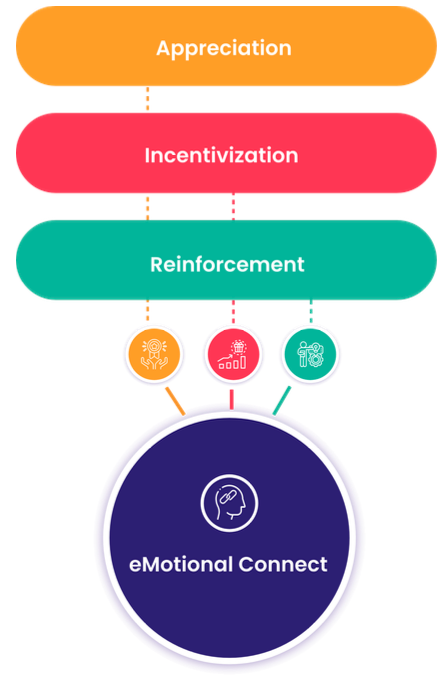
In the meantime ask this question: Is recognition about generic rewards?
If your answer is yes then you need to re-evaluate your approach towards recognition. However, my answer will always be no, it's not. It's about creating a recognition system so intentional and impactful that it becomes your competitive edge.
Because in today's workplace, recognition isn't an HR checkbox. It's a culture multiplier, and AIRe is the blueprint.
Key Takeaways
- Recognition is business-critical, not optional: Companies with strong recognition see 31% lower turnover and 21% higher profitability.
- Only 55% of employees feel truly recognized: Vantage Circle's 2025 study with Great Place to Work® India found a massive recognition gap across 5.7 million employees.
- The AIRe Framework works: Appreciation, Incentivization, Reinforcement, and eMotional Connect form the blueprint for modern recognition.
- Specificity beats frequency: "Your solution saved us three weeks" sticks; "great job" disappears in hours.
- Remote and hybrid teams need deliberate design: Spontaneous recognition moments don't happen naturally in distributed teams.
Employee Recognition at a Glance
| Aspect | Detail |
|---|---|
| Definition | Intentional acknowledgment of employee contributions, achievements, and behaviors |
| Key Benefits | 31% lower turnover, 21% higher profitability, 98% strong workplace sentiment |
| AIRe Framework | Appreciation, Incentivization, Reinforcement, eMotional Connect |
| Core Principles | Be specific, timely, frequent, and tied to values |
| Best For | HR leaders, people managers, and executives building high-performance cultures |
What is Employee Recognition?
Employee recognition is the intentional act of acknowledging and appreciating employees for their contributions, achievements, and positive behaviors at work.
It can be as simple as a verbal "thank you" or as structured as a formal rewards program, the goal is always the same: to make people feel valued and seen for the work they do.
Smart companies use all three, but appreciation is the foundation. Without it, the other two feel fake and transactional.
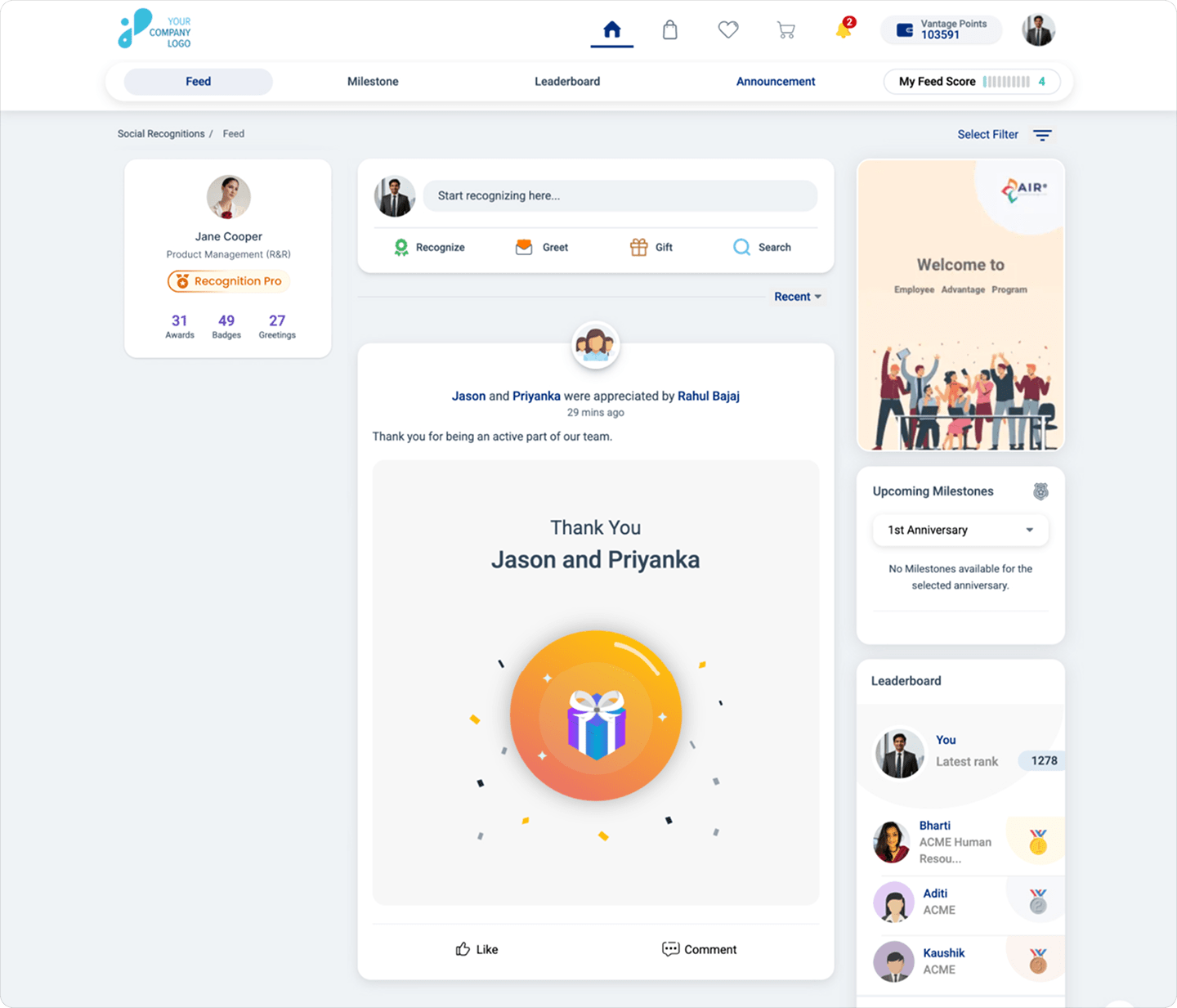
What does that actually look like in a workplace? When appreciation, recognition, and rewards run together as one stream, you stop scheduling "recognition moments" and start surfacing them as they happen. A social recognition feed is one way to make that visible, every appreciation post, badge, or peer shoutout becomes part of a shared, public stream the rest of the team can react to and amplify.
Why is Employee Recognition Important for Business
After years in the recognition sector, I've learned one hard truth: employee recognition isn't touchy-feely HR nonsense. It's business survival. The companies that get this right dominate their industries. The ones that don't? They're constantly bleeding talent.

VANTAGE INFLUENCERS PODCAST
"Whatever you recognize will be repeated. It's the most proven principle of management, and it works not just with employees, but in every relationship."
Dr. Bob Nelson, Inventor of Employee Appreciation Day, Author of 1,501 Ways to Reward Employees
Listen to the Episode1. Boosts Employee Retention
Companies with recognition programs lose 31% fewer employees. The reason is simple: people don't leave companies, they leave the feeling of being invisible. Recognition creates an invisible tether that makes leaving feel like abandoning something earned, not just a job.
2. Lifts Engagement and Productivity
69% of employees say they'd put in more effort if they felt more appreciated. When people feel valued for the work they're already doing, they don't just produce more, they start to identify with the work. Average performers become standouts because someone finally noticed the talent that was always there.
3. Strengthens Company Culture
Culture isn't what you put on posters, it's what you celebrate. Values statements about "innovation" and "collaboration" die quietly when only safe, predictable wins get rewarded. Recognize the bold attempt (including the failure that taught you something) and you'll see teams take the risks your strategy actually depends on.
4. Drives Financial ROI
A Harvard study found that businesses with highly engaged teams see 21% higher profitability, 20% better sales productivity, and 40% better output quality. Happy employees don't just work harder, they work with heart, and customers feel the difference in every interaction. Estimate the impact for your own team with our recognition ROI calculator.
The AIRe Framework
Think of the AIRe Framework as your GPS for building recognition that actually works. No more generic "employee of the month" nonsense that makes everyone cringe.
The Psychology of Appreciation
Appreciation isn't about what someone accomplished, it's about who they are. "Great job hitting your quota" recognizes performance; "I value how you always support struggling teammates" appreciates character. The first celebrates the outcome, the second celebrates the person.
Appreciation vs. Recognition vs. Rewards
- Appreciation = acknowledging inherent worth
- Recognition = celebrating specific achievements
- Rewards = tangible benefits for performance
Use all three, but appreciation is the foundation, without it, the others feel transactional.
Building Appreciation into Daily Operations
Micro-moments matter more than grand gestures. Build appreciation into your rhythm, one-on-ones, team meetings, casual conversations. Systematic, not sporadic.
Appreciation Measurement
Track it like any business metric: pulse surveys, manager coaching sessions, psychological safety scores. If people don't report feeling valued for who they are, your efforts aren't landing.
Motivational Theory in Practice
People aren't motivated by what you want to give, they're motivated by what they actually want. Daniel Pink's Drive confirms it: autonomy, mastery, and purpose consistently beat money as motivators. Design incentives that feed those, and performance follows.
Designing Desirable Incentives
Stop guessing what motivates people, ask them. A new parent wants flexible scheduling over a bonus; a junior employee craves mentorship with executives over a gift card.
Non-Monetary Incentive Strategies
Some of the most effective incentives cost almost nothing: learning sabbaticals, lunch with the CEO, first pick on interesting projects. They create lasting value that outlives any cash bonus.
Incentive Personalization
One-size-fits-all incentives fit no one. Build a menu, a conference seat for one person, extra PTO for another, and let people choose what lights them up.
Behavioral Psychology Applications
You can't manage results, you can only manage the behaviors that create them. Catch people doing things right and reinforce immediately. Wait too long and the moment loses its power.
Linking Recognition to Company Values
Values without recognition are wall decorations. Define what each value looks like in action, then recognize those behaviors when you see them. That's what turns corporate speak into lived culture.
Performance Behavior Mapping
Don't just celebrate the touchdown, celebrate the plays that led to it. If collaboration drives innovation, recognize collaborative behaviors before they produce breakthrough results.
Continuous Reinforcement Loops
The best recognition creates momentum. High performers get stretch assignments, which create new recognition opportunities, which drive continued growth.
Building Emotional Intelligence
Recognition without relationship is just transaction. Identical programs produce wildly different results depending on whether managers actually understand their people. Train leaders in emotional intelligence or the framework won't save you.
Peer-to-Peer Connection
The strongest recognition comes sideways, not down from above. Create structured ways for teammates to recognize each other, it feels more authentic and builds the bonds that prevent turnover.
Manager-Employee Relationships
Strong relationships make recognition meaningful instead of mechanical. Invest in manager training beyond performance reviews, real conversations about fears, aspirations, and growth.
Cross-Team Collaboration
Recognition breaks down silos faster than any org-chart restructure. When departments collaborate successfully, celebrate both teams publicly: we win together, we get recognized together.

How to Build the Best Recognition Program (Step by Step Approach)
Building an employee recognition program isn't rocket science, but it's not plug-and-play either. You need a solid foundation before you worry about the fixtures. Here's the seven-step build that holds up under pressure.
1. Define Clear, Measurable Objectives
a. SMART Goal Setting
"Make people happier" is a wish, not a goal, and wishes get cut first when budgets tighten. Set specific targets: raise engagement scores by 15% in six months, cut top-performer turnover by 20%. Vague goals produce vague results.
b. Business Outcome Alignment
Recognition has to drive behaviors that matter to your business. If innovation is your edge, recognize smart risks. If customer service is, celebrate the client saves. Anything else is funding expensive thank-you notes.
c. Success Metric Definition
Pick 3–5 metrics, engagement scores, turnover rates, performance indicators, culture survey results, and track them obsessively. More than five and you drown in data; fewer than three and you miss the story.
VANTAGE INFLUENCERS PODCAST
"Recognition is something which is emotion. It is intangible. Recognition is about that vibe that you bring in as an ecosystem. A warm greeting, hello, or a warm thank you when somebody is helping you makes a difference."
Binni Rai, Chief HR Officer at Omnipresent Robot Tech
Listen to the Episode2. Establish Recognition Criteria & Guidelines
a. Values-Based Criteria
Abstract values are wall art. Translate each into a behavioral example, "collaboration" becomes "Mark shared his design skills to help marketing hit deadline." People remember stories, not abstractions.
b. Behavior-Specific Recognition
"Great job this quarter" disappears in hours. "Your communication with that angry client turned them into our biggest advocate" sticks for years. Specificity is what makes recognition land.
c. Fairness and Equity
Bias is everywhere, remote workers, introverts, and support roles get overlooked while sales gets celebrated. Track recognition by department, role, location, and tenure; fix the gaps before they cost you people.
d. Cultural Sensitivity
Public recognition is reward for some and punishment for others. Always ask preference upfront, some want the spotlight, others want a quiet word.
3. Choose the Right Mix of Recognition Types
a. Peer-to-Peer
The strongest recognition often comes sideways, not down. No agenda, no performance-review weight, just appreciation from someone who lived the work with you.
b. Top-Down Formal Awards
When the CEO acknowledges your work, it becomes a story you tell for years. Use sparingly; overuse from the top makes it feel scripted.
c. Spot Awards & Real-Time Recognition
Recognize within 24–48 hours. Wait a week and the brain decouples the action from the acknowledgment, costing you most of the motivational power.
d. Milestone & Anniversary Programs
Service anniversaries, project completions, personal milestones, celebrate the person, not just this quarter's numbers.
e. Team & Cross-Departmental
When wins are collective, celebrate the team, singling one person out makes the winner awkward and the rest invisible. Recognizing collaboration across departments publicly breaks silos faster than any reorg.
4. Budget Planning and Resource Allocation
a. Industry Benchmarking
1% of payroll is the SHRM benchmark, not a ceiling, tech often runs 3%, manufacturing makes 0.5% work. But big budgets aren't the differentiator: 84% of leaders in Vantage Circle's 2025 global study spend under $100 per employee per year. (State of R&R 2025)
b. Cost-Benefit Framework
A $50K program that retains two key engineers (replacement cost: $300K) is 500% ROI before you count productivity. Run that math for executives, it shifts the conversation fast.
c. Platform vs. Manual
Under 50 people, handwritten notes beat any platform. Over 500, manual programs burn out HR and miss half the org. Know which camp you're in before you spend.
d. ROI Calculation
Track hard numbers (turnover, productivity) and soft (engagement, satisfaction) together. Solid programs show 200–400% ROI in year one; if yours doesn't, either the approach or the measurement is wrong.
5. Technology Platform Selection
a. Platform Evaluation
The best platform is the one people actually use. Test demos with frontline managers under deadline pressure, not just decision-makers, feature-rich platforms fail when they're clunky in the moment.
b. Integration Requirements
Platforms that don't talk to HRIS, performance management, and Slack/Teams become islands no one visits. Recognition should live inside existing workflows, not next to them.
c. Scalability
A platform that handles 100 people elegantly often breaks at 500. Pick for where you'll be in three years, not where you are today.
d. User Experience
Intuitive beats feature-rich every time. A simple platform used daily beats a complex one collecting dust.
6. Launch Strategy and Change Management
a. Stakeholder Buy-In
If executives don't visibly recognize people, no one else will either. Make leadership adoption a launch requirement, not a hope.
b. Communication Planning
Over-communicate the why. People need purpose, not just mechanics. Share early wins loudly, skeptics convert when they see it working.
c. Training
Most managers were never taught how to give meaningful recognition. Provide scripts, examples, and role-play before expecting consistent quality.
d. Pilot Program
Always start in one department. Catch issues before they go company-wide, and the pilot group becomes your loudest advocates at full launch.
7. Measure, Iterate, and Optimize
a. KPIs and Feedback
Track usage (frequency, participation) and impact (engagement, turnover) together, usage alone tells you nothing. Add quarterly pulse surveys with specific questions about frequency, quality, and personal impact.
b. Continuous Improvement
Review effectiveness quarterly. Early programs optimize for frequency; mature programs optimize for quality and personalization. Plan for that shift before you hit it.
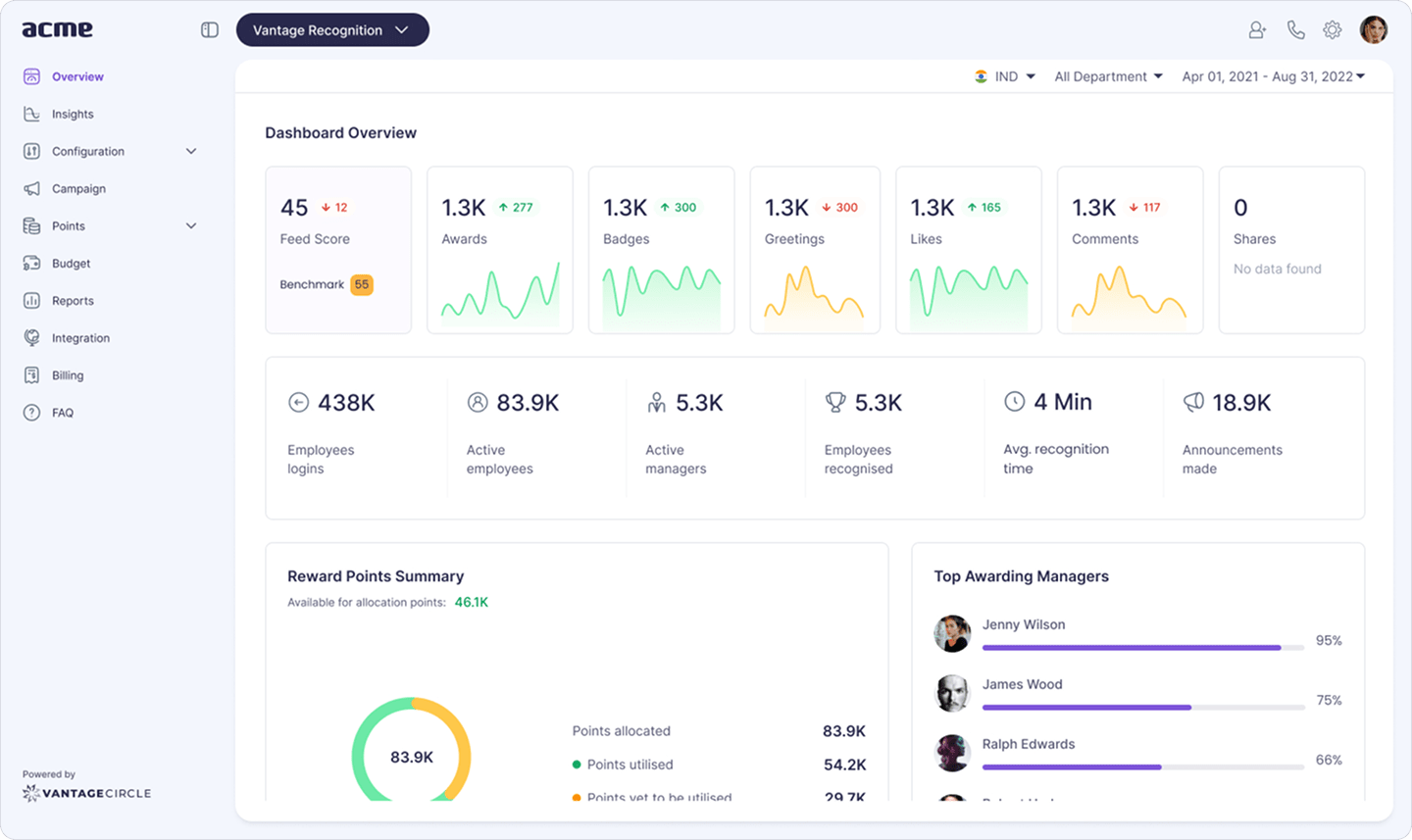
Once you've worked through those seven steps on paper, you'll need somewhere for the program to actually live. This is the part most teams underestimate, a beautifully designed program dies when it's stitched together from spreadsheets, Slack DMs, and HR's email inbox. A purpose-built employee recognition software consolidates everything you just designed (awards criteria, budgets, badges, milestones, manager activity) into one daily-use interface, which is also how you keep the manual-program "72% failure rate" we mentioned earlier from becoming your story.
How to Recognize the Remote, Hybrid and Multi-Generational Team
The in-person recognition systems that worked for decades broke when teams went distributed. The same plaque, the same Friday shoutout, the same "Employee of the Month" wall, none of it carries the same weight when half your team works from somewhere else and spans four generations.
1. Remote Recognition Reality Check
a. When Great Work Goes Invisible
Remote workers do their best work when no one's watching, and those contributions vanish into the digital void if you don't surface them deliberately. Create structured showcases so invisible wins become visible.
b. Time Zones Kill Momentum
Recognition delivered while half your team sleeps doesn't land. Plan ceremonies for overlapping hours, or record personal video messages people can watch when they're awake.
c. Cultural Differences Matter
What motivates Tokyo can embarrass Mumbai. Offer multiple ways to acknowledge great work, some employees thrive on public praise; others want a private word.
d. Tech Comfort Varies
Boomers struggle with fancy apps; Gen Z dismisses "outdated" emails. Provide multiple recognition paths, the method matters less than the consistency.
2. Digital Recognition That Actually Works
a. Virtual Ceremonies Done Right
Screen fatigue is real, but virtual celebrations still create impact when they're short, interactive, and personal. Use breakout rooms, music, custom backgrounds, small effort signals real care.
b. Social Platforms as Recognition Hubs
Slack and Teams can carry real-time recognition. The trick is making it feel authentic, not like corporate cheerleading.
c. Video Beats Text
A 30-second personal video beats any lengthy email. Seeing someone's face and hearing genuine appreciation creates connection text can't match.
d. Mobile or Bust
If recognizing someone takes more than 30 seconds on mobile, people stop doing it. Keep the flow short, simple, and one-tap.
3. Hybrid Workplace Equity
a. The Office Advantage Problem
Office presence shouldn't equal more recognition, but it often does. Track recognition patterns obsessively to ensure remote workers get equal acknowledgment.
b. Everyone Participates or No One Does
Live-stream office celebrations and add interactive elements for remote attendees. No one should feel second-class because of their postcode.
c. Recognize at the Moment
Don't wait for the next team meeting to acknowledge great work. Recognize as close to the action as possible, delay kills the emotional connection.
4. Generational Truths
a. Gen Z, Fast and Public
They thrive on social recognition tied to transparent career progression. Link recognition to growth opportunities and they stay engaged.
b. Millennials, Purpose
Highlight how their work creates positive change. They want to know their effort matters beyond the bottom line.
c. Gen X, Respect for Results
Keep recognition straightforward and results-focused. Professional and meaningful beats elaborate celebrations every time.
d. Boomers, Face-to-Face
Acknowledge their mentorship and institutional knowledge. A phone call often resonates more than any digital channel, they've earned the personal touch.
The Best High-Impact Employee Recognition Ideas That Actually Work
Let's be honest, most employee recognition programs are terrible. They're either generic "employee of the month" plaques that nobody cares about, or expensive perks that miss the mark completely. But here's what I've learned: great recognition isn't about your budget. It's about being intentional and authentic. Some of the highest-impact ideas cost nothing because they come from colleagues, not managers, so start with these peer-to-peer recognition ideas.
Some of the most meaningful recognition costs almost nothing. I've seen CEOs bring grown employees to tears with a $2 thank-you card.
Personal Touch Recognition
Team-Focused Ideas
Digital Amplification
Flexibility That Matters
This is where you start making deeper investments in people's growth and wellbeing.
Growth-Focused Recognition
Life Enhancement Recognition
Work Quality Recognition
Family-Inclusive Recognition
Save these for your stars and major milestones. They should feel significant.
Career Investment Recognition
Experience Creation Recognition
Ownership Recognition
Values-Driven Recognition
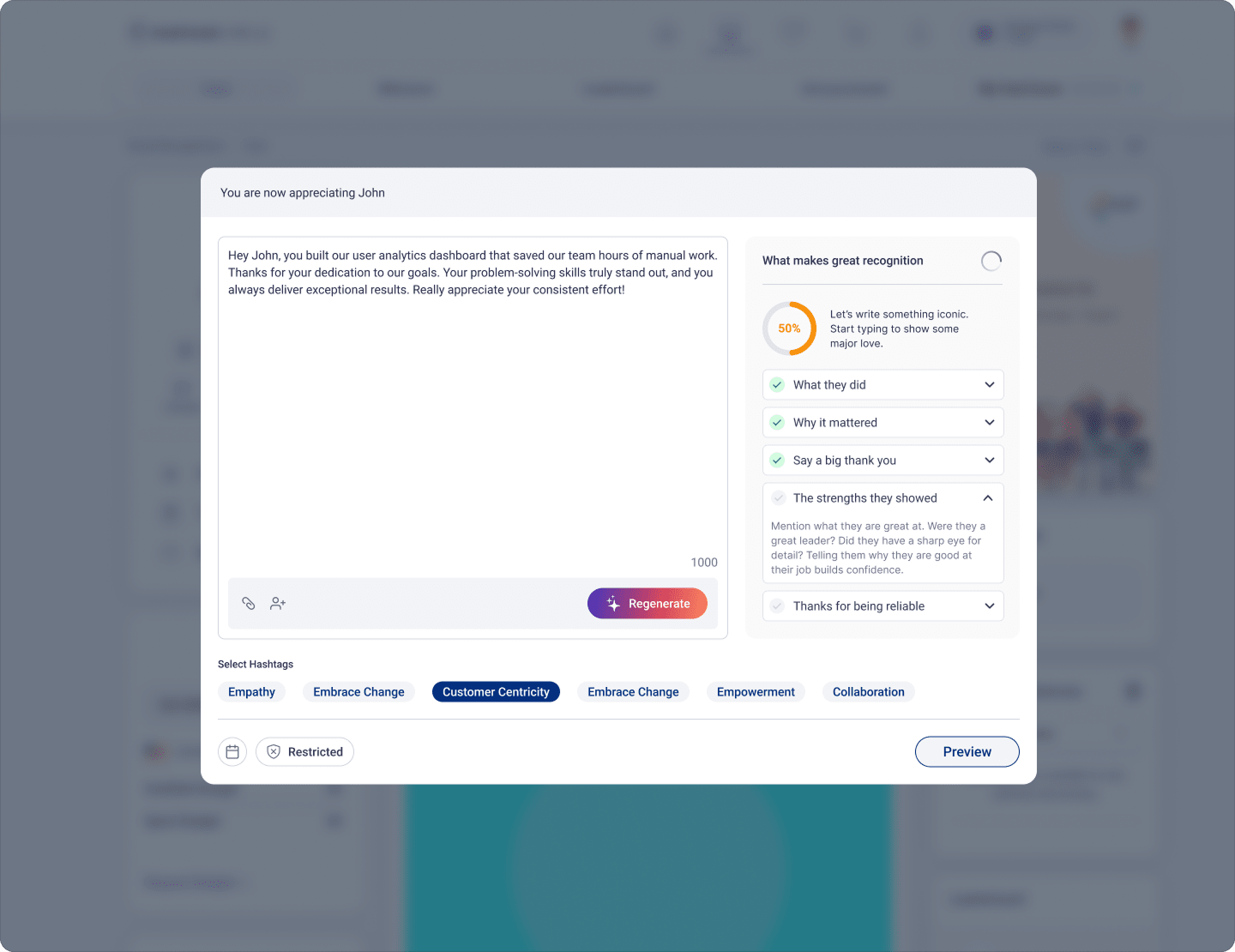
Even the best idea above falls flat if the manager writing it rushes a one-line "great job, team!" The hardest part of recognition is being specific, timely, and tied to actual behavior, exactly when you're juggling everything else. This is where software earns its keep: a guided composer that prompts impact, behavior, and outcome lifts the floor on what gets sent, even on the busiest days.
How to Measure the Success of Employee Recognition
Most companies launch recognition programs then have no idea if they're working. They spend on platforms and rewards but can't tell you whether recognition is actually driving retention, engagement, or performance. The fix is measurement, and the four pieces below are what separates a tracked program from a hopeful one.
1. Key Performance Indicators That Actually Matter
a. Participation Metrics
Start here, participation reveals everything about program health. Track weekly active users by segment, recognition frequency per manager (to spot who needs coaching), and peer-to-peer rates. Horizontal recognition often matters more than top-down praise.
b. Engagement Metrics
Connect recognition to how people actually feel. Use engagement scores with specific "feeling valued" questions, pulse surveys for sentiment trends, and sentiment analysis on the recognition messages themselves, quality, not just quantity.
c. Business Impact Metrics
Tie recognition to outcomes: retention by recognition level, 90-day new hire retention (early recognition sets the tone), and performance ratings comparing recognized vs. unrecognized employees over time.
d. ROI
Weigh program costs (platform, rewards, admin time) against avoided turnover and measurable productivity gains. Solid programs land at 200–400% ROI in year one.
2. Smart Data Collection Strategies
a. Automated Platform Analytics
Modern platforms capture usage patterns, award distribution, and behavioral trends with no extra effort. Use them to predict engagement issues before they become retention problems.
b. Employee Surveys
Quarterly pulse surveys with targeted recognition questions ("How often do you feel recognized? Does it align with your impact?") catch what no platform can. Five targeted questions beat twenty generic ones.
c. Manager Feedback
Monthly check-ins where managers share recognition wins, flag disengaged team members, and suggest fixes often reveal blind spots that data alone misses.
d. Business Performance Correlation
Look for patterns between recognition frequency and performance spikes, project completion rates, customer satisfaction, and quality scores. The correlations are usually stronger than you'd expect.
3. Reporting That Drives Action
a. Executive Dashboards
C-suite leaders need strategic insight, not operational detail. Three metrics they can understand in thirty seconds, business impact, ROI trends, culture indicators, beat a 20-tile dashboard nobody reads.
b. Manager Dashboards
Managers need actionable intelligence: team participation rates, under-recognized employee alerts, and recognition suggestions based on performance and peer signals. Make it easy to act, not just consume.
c. Employee Transparency
When people see fair recognition distribution, they trust the system and participate more. Show company-wide trends and team achievements without creating unhealthy competition.
4. Building Continuous Improvement
a. A/B Testing
Test recognition approaches across similar employee groups to learn what actually drives engagement. Vary frequency, reward types, and delivery methods while keeping measurement consistent.
b. Feedback Loops
Run monthly review cycles where feedback drives specific program changes, then communicate those changes back to the people who suggested them. People need to see their input matter.
c. Smart Program Evolution
Plan quarterly reviews with annual major updates based on data trends. Tweak frequently; save major changes for thorough analysis and pilot testing.
d. Industry Benchmarking
Compare against industry standards for participation rates, ROI expectations, and engagement correlation, but adapt the insights to your culture, not the other way around.
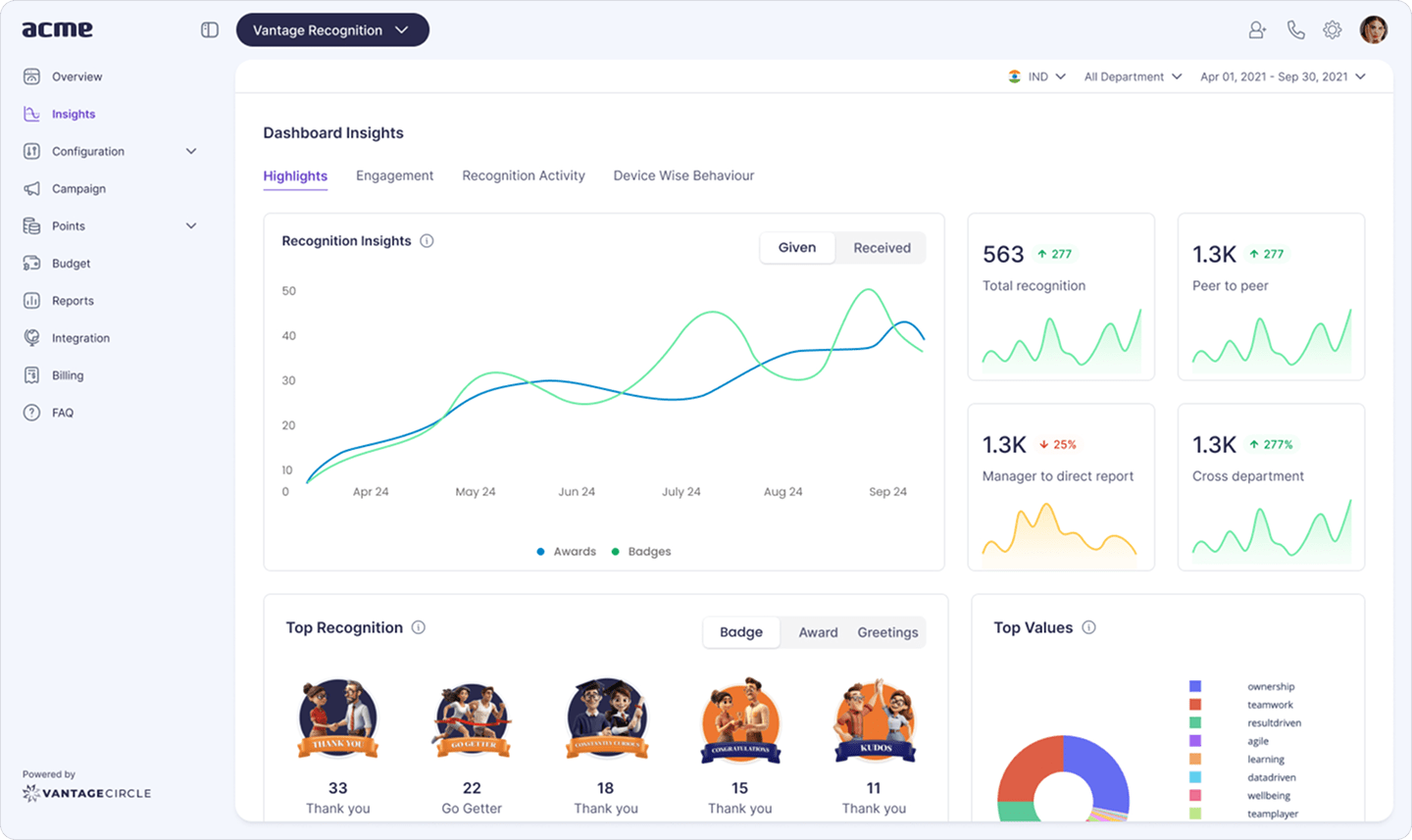
Looking at those KPIs in isolation is how recognition programs end up with dashboards no one reads. Bring them into one view and the patterns become obvious, like which managers are receiving recognition without giving any back, which is the early-warning sign of a culture that praises tenure over contribution. The "given vs. received" cut is the fastest way to find the dormant managers and lopsided peer networks before they show up as turnover.
Your 90-Day Employee Recognition Implementation Roadmap
Launching a recognition program can feel like juggling while riding a unicycle. With 42% of employee turnover preventable but often ignored, a structured rollout pays off fast. Use the matrix below as your week-by-week playbook.
| 🚀 Phase | 📅 Week | ✅ Key Actions | 🎯 Outcome |
|---|---|---|---|
| 1 · Foundation & Alignment Days 1–30 |
Week 1 | 🤝 Executive buy-in · 💰 Secure budget · 👥 Assemble HR + IT allies | Leadership locked in |
| Week 2 | 📊 Run AIRe assessment · 📝 Employee pulse survey · 🔍 Map recognition gaps | Baseline + gap analysis | |
| Week 3 | 🎯 Define behavioral criteria · 🎨 Choose recognition mix · 🛒 Shortlist platforms | Program design v1 | |
| Week 4 | 🧪 Demo platforms with real users · ✍️ Negotiate contract · ⚙️ Begin configuration | Platform signed + SOW | |
| 2 · Build & Test Days 31–60 |
Weeks 5–6 | 🔌 Wire up HRIS + Slack/Teams · 🔐 Set permissions · 🧩 Design simple workflows | Platform configured |
| Weeks 7–8 | 📚 Manager training · 🎉 Build internal buzz · 🧑🤝🧑 Choose pilot cohort (50–200) | Pilot ready to launch | |
| 3 · Launch & Learn Days 61–90 |
Weeks 9–10 | 🧪 Pilot rollout · 🏆 Amplify early wins · 👂 Gather pilot feedback | Pilot wins documented |
| Weeks 11–12 | 🌍 Company-wide launch · 📣 Clear "why" comms · 🛟 Real-time adoption support | Full rollout live | |
| Post-Launch Day 91+ |
30 / 60 / 90 | 📊 Adoption check · 🔬 Usage deep-dive · 📈 90-day impact report (retention + engagement delta) | ROI proven, plan v2 |
Employee recognition is not about generic rewards or scheduled appreciation days. It is about building a system so intentional and impactful that it becomes a competitive advantage.
When appreciation, recognition, and rewards run together as one stream, you stop scheduling recognition moments and start surfacing them as they happen. That is the difference between a program that checks a box and one that transforms culture.
Frequently Asked Questions
What's the difference between recognition and rewards?
Recognition is the acknowledgment of someone's contribution or character; rewards are tangible benefits like bonuses, gift cards, or experiences. Both work together, but appreciation is the foundation. Without it, rewards feel transactional and recognition feels hollow.
How often should employees be recognized?
Weekly for small wins, monthly at minimum for each employee, and quarterly for major milestones. Most people start to feel undervalued if more than four weeks pass without any meaningful acknowledgment of their work.
How much should a company budget for employee recognition?
Roughly 1% of payroll is the industry benchmark (SHRM), but design and execution matter more than spend. Vantage Circle's 2025 global study found 84% of leaders spend under $100 per employee per year, and effective programs routinely show 200–400% ROI through reduced turnover.
How do you measure the ROI of a recognition program?
Track usage metrics (recognition frequency, participation rate, peer-to-peer activity) alongside business impact (retention, engagement scores, productivity). The "recognition given vs. received" view is the fastest way to spot dormant managers and lopsided peer networks before they show up as turnover.
How do you avoid bias in recognition programs?
Track recognition by department, role, location, gender, and tenure to see where it's flowing. Define behavioral criteria for each value so recognition is tied to specific actions, not personality. Train managers on unconscious bias, and pull data quarterly to spot patterns before they harden.
What are the most common recognition program mistakes?
Being too generic ("great job, team!"), recognizing only top performers, making the submission flow too complicated, and launching without training managers on how to write specific, behavior-based recognition. The fourth one is the silent killer of most programs.

He has worked in the human resources environment and has elevated recognition and rewards through his insightful and detailed writing. He aims to enhance the practice of Recognition in the workplace with new ideas and innovation that will help shape the work culture. For any related queries, contact editor@vantagecircle.com