


Gift cards for employees are prepaid cards or digital codes an employer gives as a reward, either for one brand (closed-loop) or usable almost anywhere (open-loop). They work best when the employee chooses the brand and the card comes with a specific thank-you. In the US, they are taxable wages at any amount.
This guide covers the four types of employee gift cards, how much to give by occasion, what they actually cost after tax, the tax rules for the US, India and the UK, and how to stop them from feeling like a generic handout.
Why Companies Use Gift Cards as Employee Rewards
Gift cards are popular because they give employees choice, arrive instantly, and are easy to budget. Unlike choosing a physical gift for everyone on a team of 300, a gift card lets each employee decide what matters to them.
4 Types of Employee Gift Cards (and How They Combine)
The four types are closed-loop, open-loop, digital and physical. The first two describe where a card can be used; the last two describe how it is delivered. A card is always one of each: a digital closed-loop Amazon code, say, or a physical open-loop Visa card. Many programs use digital multi-brand catalog cards because they combine choice with instant delivery and no physical logistics. In the US, all types are taxable wages at any amount.
| Type | Describes | Example | Best for | Watch out for |
|---|---|---|---|---|
| Closed-loop | Where it's used | Amazon, Starbucks, Nike | Known preferences | Low value if they never shop there |
| Open-loop | Where it's used | Visa, Mastercard prepaid | Flexibility for domestic teams | Fees, breakage; most US cards work in USD only |
| Digital / e-gift | How it's delivered | Catalog code, retailer e-gift | Large or remote teams | Multi-brand needs a platform |
| Physical | How it's delivered | Retailer or Visa plastic | In-person moments; frontline | Shipping, storage, loss |
Closed-loop cards
Closed-loop cards are redeemable at one retailer or chain. Simple to procure, but they limit the employee to one brand. Use them when you have strong signal about an employee's preferences, or when a category fits your company culture.
Open-loop cards
Open-loop cards (Visa, Mastercard, Amex) are accepted at most merchants within their supported currency and geography. The tradeoffs are fees and breakage. Consumer cards cannot charge inactivity fees in the first 12 months under the CARD Act; certain qualifying award or promotional cards may be excluded from some protections; check the cardholder agreement. Most US-issued cards are USD-denominated and may not work outside the US. Breakage (unspent balance) commonly runs from low single digits to around 10% of card value and benefits the issuer, not the employee. Factor both into your true cost.
Digital and multi-brand catalog cards
Digital catalog cards let an employee choose from thousands of brands in one redemption experience. The format scales easily, eliminates physical logistics, and gives HR visibility into which brands employees actually prefer.
Physical cards
Physical cards work for in-person recognition, frontline employees, or milestone events where a tangible item adds weight. Best for planned occasions rather than spot rewards.
What Are the Best Gift Cards for Employees?
The best gift card for employees is the one the employee chooses, usually from a multi-brand catalog. If you must select one brand, choose everyday categories: groceries, fuel, dining and large retail marketplaces that most people use regularly, regardless of personal taste.
| Category | US examples | India / UK examples |
|---|---|---|
| Grocery and everyday | Whole Foods, Walmart, Target | BigBasket, Blinkit (IN); Tesco, Sainsbury's (UK) |
| Dining and delivery | Starbucks, DoorDash, Grubhub | Swiggy, Zomato (IN); Pizza Express, Deliveroo (UK) |
| Large marketplace | Amazon | Amazon.in, Flipkart (IN); Amazon.co.uk (UK) |
| Fuel and transport | Shell, Chevron | Indian Oil (IN); BP (UK) |
| Entertainment and streaming | Netflix, Spotify, Fandango | BookMyShow (IN); Vue Cinema (UK) |
| General open-loop | Visa Prepaid, Mastercard Gift Card | Local prepaid options (RBI rules cap gift cards at ₹10,000 per card in India) |
A multi-brand employee reward catalog lets each employee choose from the options you approve. Vantage Recognition's catalog covers thousands of brands and international gift cards across 100+ countries.
How Much Should an Employee Gift Card Be?
Most companies give $10 to $25 for peer thank-yous, $25 to $100 for spot awards and $25 to $75 for holiday gifts, with milestone amounts scaling by tenure. The ranges below reflect common practice, not a mandated benchmark. Present them to managers as guidance, not policy.
| Occasion | Typical range | Best card type | Note |
|---|---|---|---|
| Peer thank-you or shout-out | $10 to $25 | Digital, multi-brand | Pairs best with a public social recognition post |
| Manager spot award | $25 to $100 | Digital, multi-brand | Tie to a specific behavior or outcome |
| Holiday or seasonal gift | $25 to $75 | Digital or physical multi-brand | Same value for the whole team keeps it inclusive |
| Birthday | $10 to $25 | Digital, multi-brand | Small and personal; pair with a birthday message; some companies offer a day off instead |
| Work anniversary (1 to 4 years) | $25 to $100 | Digital, multi-brand | Scale up with tenure |
| Work anniversary (5 or more years) | $100 to $500+ | Digital, multi-brand, or open-loop | Gift cards do not qualify for the US tangible personal property tax exclusion. Consider a formal service award program instead. |
| Project win or team milestone | $50 to $200 | Open-loop or multi-brand | Give the same amount to every team member |
For longer service milestones, see spot awards and service awards.
Are Gift Cards Taxable to Employees?
Yes. In the US, gift cards are treated as cash equivalents and are taxable wages at any amount, including $25. They cannot be excluded as a de minimis fringe benefit under IRS Publication 15-B, regardless of card type or value.
| Country | Rule | What HR should do |
|---|---|---|
| United States | Gift cards are cash equivalents. Taxable as wages at any value. Never qualify as de minimis (IRS Publication 15-B). | Process through payroll. Withhold or gross up. Report as supplemental wages, typically at the 22% flat supplemental rate (employers may also use the aggregate method). |
| India | Non-cash gifts and vouchers from an employer are exempt if the year's total stays below Rs. 15,000 per employee (from April 2026, up from Rs. 5,000; Income Tax Rules 2026, Rule 15). Once the aggregate reaches or exceeds that threshold, the full amount becomes taxable as a perquisite. | Track cumulative annual value per employee. Report taxable amounts on Form 130 (the new salary TDS certificate under Income Tax Rules 2026, replacing Form 16). See our India tax guide for detail. |
| United Kingdom | Gift cards given as a recognition award are taxable benefits in kind. The trivial benefits exemption (up to £50 per occasion) does not apply when the benefit is given in recognition of services. Cards exchangeable for cash are treated as pay: PAYE and Class 1 NIC through payroll. Employers can bear the tax on non-cash gift cards themselves via a PAYE Settlement Agreement (PSA), paying the tax and Class 1B NIC on the employee's behalf. | Income tax via P11D or payrolling; NIC through payroll; or settle both via a PSA. Verify current HMRC guidance and consult a tax adviser before finalizing your program. |
The US approach most HR teams settle on is a gross-up: the employer pays the tax on the employee's behalf so the employee receives the full face value.
Gross-up example: $50 gift card (US, 2026)
To put $50 in the employee's hands after federal tax, the employer's total federal cost is roughly $77. State income tax and employer state taxes increase this further. For employees above the Social Security wage base ($184,500 in 2026), the 6.2% Social Security portion no longer applies, reducing the combined withholding rate to 23.45%.
Tax disclaimer: The information above is a general summary for HR planning purposes, not tax advice. Gift card tax treatment varies by jurisdiction, program structure, and individual circumstances. Consult your payroll provider or tax adviser before finalizing your program.
For US tax detail, see employee recognition tax rules in the US. For India, see recognition and rewards tax rules in India.
What Gift Cards Really Cost
The real cost of a gift card is the face value plus the tax gross-up, any purchase or activation fees, and admin time. Unused balances (breakage) are money the employee never receives and usually benefit the issuer or provider, not the employee.
| Cost component | Estimate for a $50 gift card |
|---|---|
| Face value | $50.00 |
| Tax gross-up (employee taxes, federal only) | ~$21.07 |
| Employer FICA on grossed-up amount | ~$5.44 |
| Activation fee (open-loop cards) | Typically a few dollars; check your card issuer's terms |
| Platform or processing fee | Varies by provider |
| Admin time (procurement, distribution) | Negligible with a platform; significant for manual processes |
| Estimated employer cost | About $79 to $83 for open-loop cards (federal only; add state tax). Closed-loop and catalog cards with no activation fee land closer to $77. |
Building tax gross-up into your recognition budget from the start avoids mid-year surprises.
Gift Cards for Global and Remote Teams
For teams in several countries, give the same value in local terms, not the same dollar amount. A $50 gift card has very different purchasing power in New York versus Pune versus Manchester.
Among US companies, 62% rely on monetary recognition as their primary mechanism, and 60% also use social recognition to reinforce awards (AIRe Benchmarking Report US 2023-24, Vantage Circle). Both are easier to execute globally when the reward is digital and locally redeemable.
Vantage Recognition's SOLI feature (Standard of Living Index) calibrates award values to local purchasing power, so the same recognition feels equally meaningful regardless of where the employee is based.
For remote employees, digital cards are the practical default. See gifts for remote employees.
When Gift Cards Don't Work (and How to Fix It)
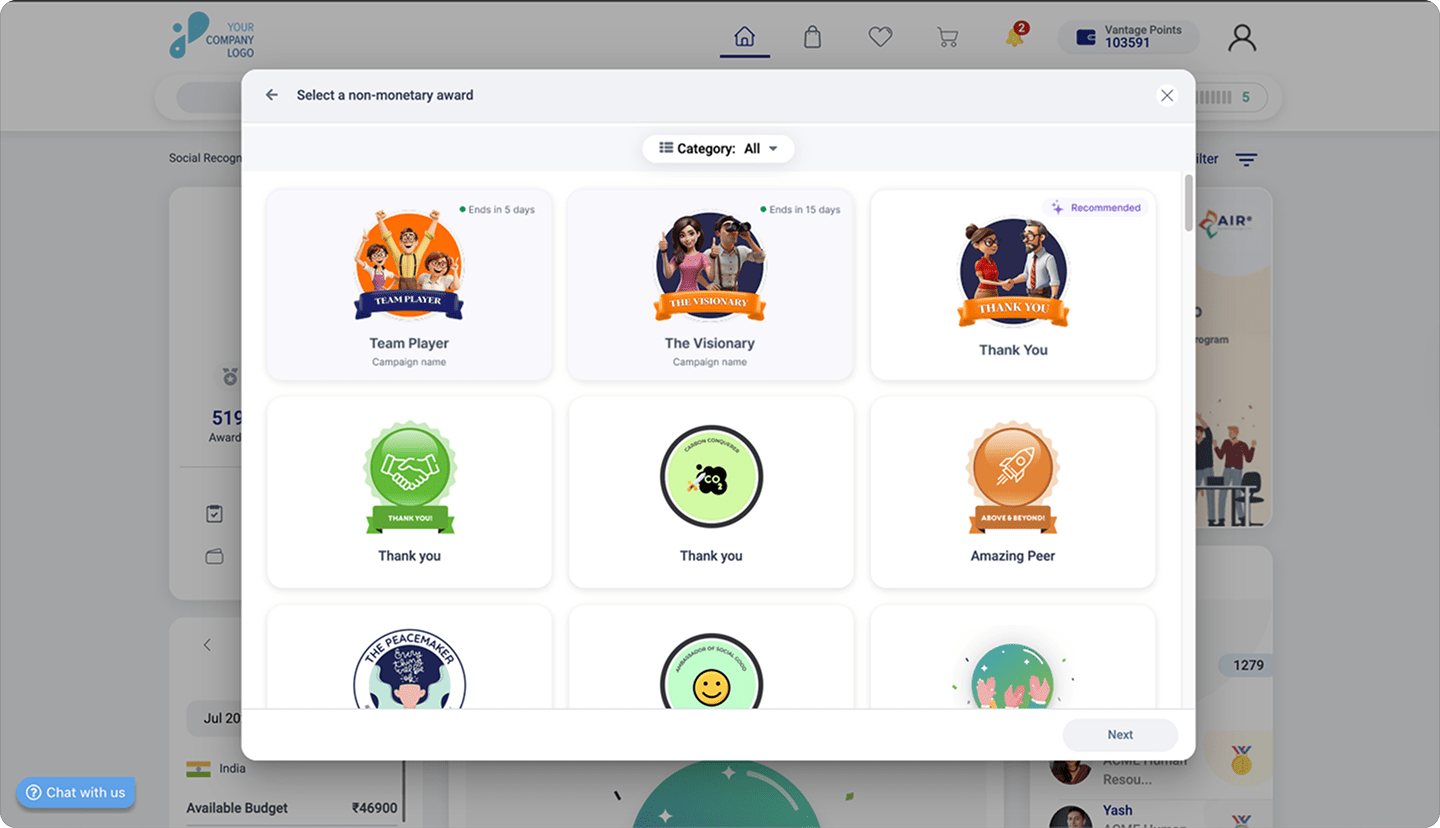
Gift cards fail when everyone receives the same card with no explanation attached. They work when they come with specific, public recognition for a named achievement.

Vantage Influencers Podcast
"You're not going to get that by going from a $25 gift card to a $50 gift card. It's still a gift card, you know, and everyone gets one. So just the nature that if everyone's getting the same thing, then you're not distinguishing performance."
Dr. Bob Nelson · Author, 1001 Ways to Reward Employees · "Wrap it up with Fun: Year-End Recognition that Sticks" (Vantage Influencers Podcast, 20 December 2024)
Listen to the EpisodeAmong Indian companies, 70% lean on monetary value as their primary recognition mechanism, while social recognition is used by just 50% and fewer than 25% incorporate emotional connection (AIRe Benchmarking Report India 2024-25, Vantage Circle). The gap is not the gift card itself; it is the absence of emotional and social value around it. Four ways to close that gap:
- Name the reason. "Here is what you did and why it mattered" turns a transaction into recognition. Vague praise ("for your great work") has less impact than specific acknowledgment ("for staying on the APAC rollout until it went live cleanly").
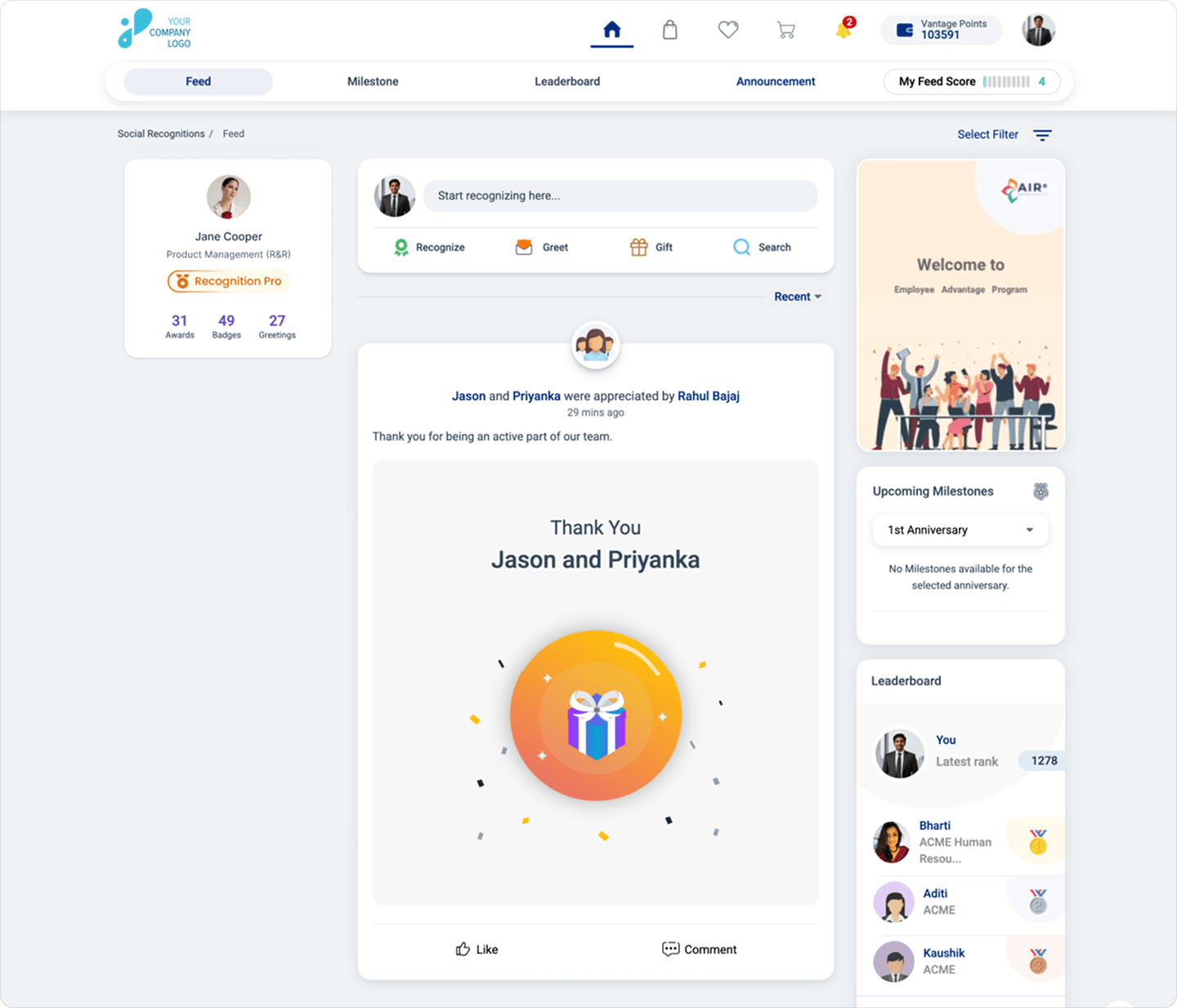
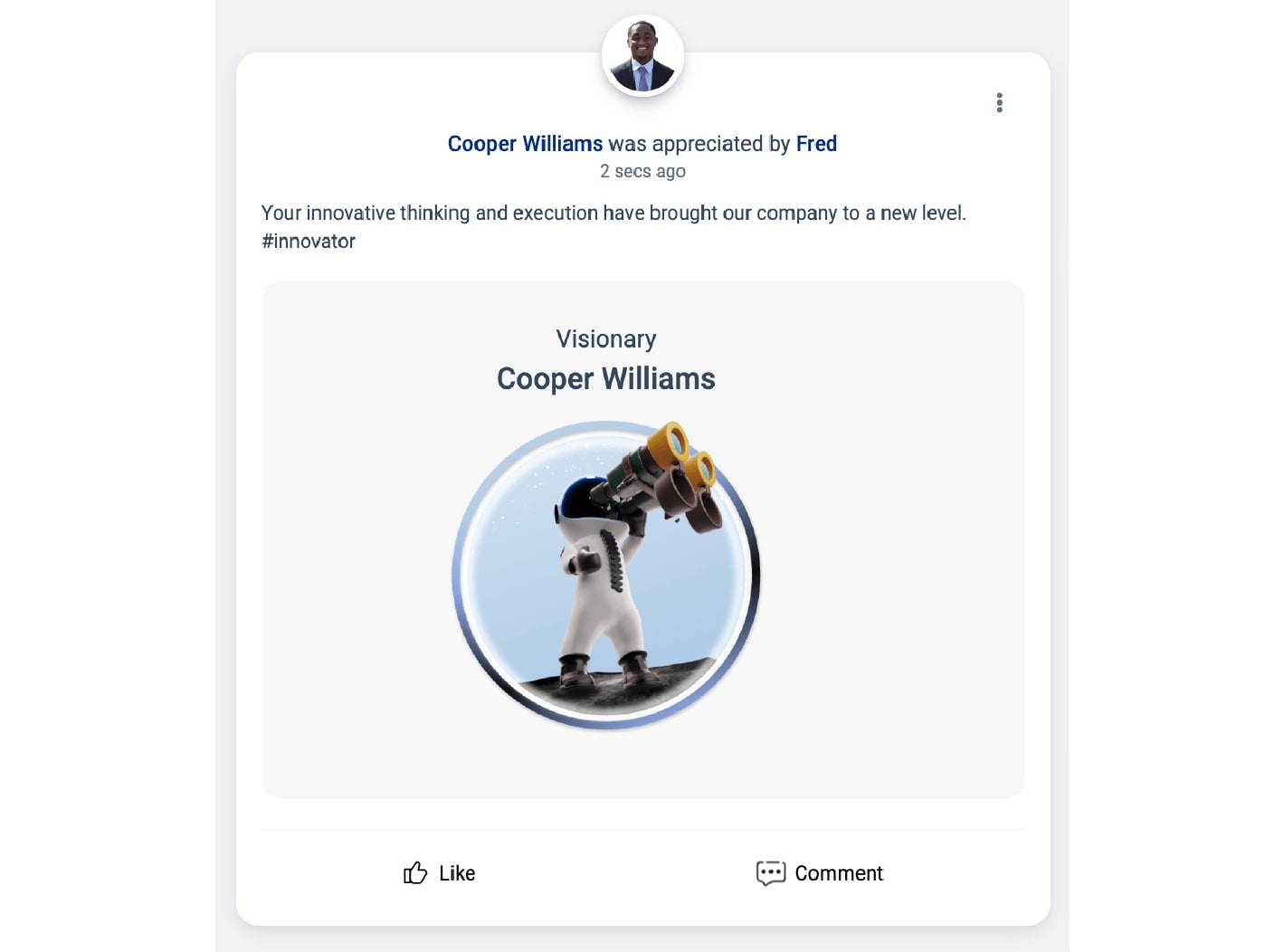
- Make it public. Post the thank-you on the social recognition feed. The card is private; the recognition does not have to be.
- Let them choose. A catalog beats a single brand pick. When the employee selects the card, the act of choosing makes the recognition feel personal rather than automated.
- Mix with non-cash recognition. A gift card alongside a handwritten note and a public shout-out lands differently than a card in an envelope. Recognition and reward are separate acts; combining them strengthens both.
For decisions about when gift cards are the right format versus other options, see cash vs non-cash incentives and non-monetary incentives.
How to Run a Gift Card Reward Program: 5 Steps
Set the occasions and amounts, choose a catalog or provider, decide how tax is handled, attach recognition to every card, and track redemption.
Define occasions and amounts
Document which occasions qualify and what the value range is for each. Use the amount table above as a starting point to reduce inconsistency across managers.Choose a delivery method
For teams of more than 50, a multi-brand catalog or recognition platform is easier to administer than procuring individual cards manually.Decide how to handle tax
US employers must withhold or gross up; build the gross-up into the per-award budget from the start. For India, track each employee's annual total against the Rs. 15,000 threshold (see the tax table above).Attach the recognition
Every card should come with a message that names the specific behavior or result being recognized. A card without a reason is a voucher. A card with a reason is recognition.Track redemption
Most platforms show which brands employees actually choose and how much budget remains unused. Vantage Recognition's analytics dashboard surfaces redemption patterns by team and region, so you can see exactly where budget is going and which categories employees prefer. High breakage rates are a signal that the card selection is not resonating.For broader program design principles, see employee rewards and recognition.
Running a gift card program at scale?
See how Vantage Recognition handles catalog, tax, and global teams in one place.
Already on Vantage Circle?
Find out how to redeem your reward points for a gift card in the Vantage Circle Help Centre.
The Bottom Line
Gift card programs work when each card is tied to a named achievement, the employee has real choice in what they receive, and tax is handled from the start rather than discovered at year-end. The card is the vehicle. Recognition is the point.
Frequently Asked Questions
What's a good gift card for employees?
The best gift card is one the employee chooses, from a multi-brand catalog or an open-loop card. If you must pick a single brand, choose everyday categories: groceries, dining, fuel, or a large marketplace most people use.
Are 25-dollar gift cards taxable to employees?
Yes. In the US, gift cards are taxable wages at any amount and cannot be excluded as de minimis under IRS Publication 15-B. Withhold through payroll or gross up so the employee receives the full face value.
What should I gift my employees?
Gift cards work well because they give employees choice; pair them with a specific thank-you to turn the transaction into recognition. For non-gift-card ideas, see employee appreciation gifts.
What gifts do employees really want?
Vantage Circle's State of Recognition and Rewards 2025 found that programs rated highly effective are about twice as likely to use selective-spend awards compared to lower-effectiveness programs. Employees want to choose what they receive, and they want the recognition to be specific to what they did.
What is the 5 gift rule?
The 5 gift rule extends the four-gift rule (want, need, wear, read) with a fifth category: something to experience. It is a personal gifting framework, not a formal standard, but the underlying idea applies to employee recognition: think about what the individual values, not just what is easy to procure.
Written by