
It's Tuesday morning. You have a 1:1 in an hour with someone whose work has been slipping for three weeks. You've rehearsed the conversation a dozen times. You still don't know exactly what to say.
Most managers default to one of two modes: they go soft ("I just wanted to check in...") or blunt in a way that puts the person on the defensive before the feedback even lands. Neither changes behavior.
Negative feedback at work is corrective input that names a specific behavior, its impact on the team or customers, and the change expected. Done well, it targets actions, never personality. The 30 scenario-based examples below are part of a broader employee feedback practice. They include 12 rewritten pairs, a 3-tier escalation ladder for when informal feedback is the wrong tool, and 5 scripts for when the behavior repeats after the first conversation.
What Makes Negative Feedback Constructive?
Negative feedback becomes constructive when it gives the person something to act on. That requires three things: the specific behavior named, its impact on the team stated, and the expected change made clear.
Here's the part most managers get backwards: specificity feels more confrontational, so they soften feedback into something vaguer. But vague feedback is actually more personal, not less. "You have a bad attitude" is a statement about who someone is. "You interrupted three people in Tuesday's meeting" is a statement about something they did. One can be changed. The other just lands as a verdict.
Take "You sent the report four days late, which pushed the finance team's board prep by half a day. I need it by Wednesday at noon going forward." The person knows what they did, why it mattered, and what changes next.
Before any corrective conversation, ask: could the person repeat back exactly what you need them to change? If not, you're expressing frustration, not giving feedback. See constructive feedback examples for the full delivery framework. HBR's guide on how to give negative feedback covers the delivery side in depth.
12 Poor Negative Feedback Examples, Rewritten
Each row below shows a common feedback failure, why it breaks down, and how to say the same thing so it can be heard. These 12 rewritten pairs cover the patterns that show up most in manager conversations.
| Poor Version | Why It Fails | Rewritten |
|---|---|---|
| "You have a bad attitude." | Labels personality, not behavior | "In three meetings this month, you interrupted colleagues mid-sentence. I need you to let teammates finish before responding." |
| "Your reports are always late." | "Always" triggers defensiveness; no reference point | "The last two weekly reports came in Friday evening instead of Wednesday noon. The marketing team missed their planning cycle. I need reports by Wednesday noon." |
| "You're not a team player." | Abstract verdict; no incident named | "When the Jenkins project ran over budget, you didn't flag it until Friday. Two colleagues scrambled over the weekend. I need blockers raised in Monday standup, not after they've caused problems." |
| "Your presentations are terrible." | No specific error; "terrible" can't be fixed | "In yesterday's client deck, three slides had 2021 data. The client asked for current numbers and we didn't have them. Confirm all data is current before any client-facing presentation." |
| "You're too slow." | Slow compared to what? No standard cited | "The onboarding checklist due Monday arrived Wednesday afternoon. Two new hires waited on credentials. I need each checklist submitted by end of day Friday the week before a hire starts." |
| "You never listen." | Absolute language; no clear change required | "I asked in two one-on-ones for a summary paragraph in each report. Neither of the last two included one. Can you walk me through what's getting in the way?" |
| "Your communication is terrible." | No incident named; nothing actionable | "You sent the updated timeline to the client before sharing it internally. The sales lead was caught off-guard on a call. Share timeline changes internally 24 hours before they go to the client." |
| "You're not proactive enough." | Vague; no failure standard cited | "The server outage ran two hours before I heard about it. The SLA says escalation within 30 minutes. Page me directly if a P1 issue isn't resolved in the first half hour." |
| "Your work is sloppy." | Personality framing; no specific incident | "The contract had the wrong company name on page 3 and a blank clause on page 7. This is the third document this month with errors reaching external parties. Use the document checklist before anything leaves the team." |
| "You're not leadership material." | Labels, not behavior | "You haven't contributed in the last two sprint retrospectives. Leadership here means surfacing problems early. Come to the next retro with at least two things that slowed the team down." |
| "You're difficult to work with." | Character verdict; impossible to act on | "Three people mentioned you respond defensively before they finish explaining a problem. That's making them reluctant to come to you early. I'd like to talk through what's happening in those moments." |
| "I'm not seeing the improvement I expected." | Too vague after a prior conversation | "We talked about client response time three weeks ago. The standard was 24 hours. Three responses this week took 48 or more. Tell me what's blocking you." |
Many of the "poor" versions aren't false. They're just stated at the wrong level. They describe a conclusion, not the evidence behind it. That's also where most miscommunication examples start: a real concern, framed in a way the other person can't hear.
18 Negative Feedback Examples by Scenario
The 18 examples below are organized by where the behavior shows up. Each one is standalone: specific, single-behavior, and ready to adapt.
Missed Deadlines and Work Quality
"The Q3 analysis was due Monday at 9 a.m. and arrived at 4 p.m. The finance team had to delay board prep by half a day. I need to know by Friday if anything is likely to slip so we can adjust upstream."
"The product spec had three sections marked TBD when you sent it. Dev started scoping off an incomplete document. Flag incomplete sections before sharing with other teams."
"The client deliverable was missing the executive summary we agreed on in the kickoff. The client had to ask for it separately. Use the deliverable checklist before anything goes to the client."
"You submitted the monthly report four days late for the second month running. Other teams plan their workflows around it. What's blocking you?"
Communication and Meeting Behavior
"In the last three team meetings, your camera has been off and you haven't contributed. I need you present and participating. What's getting in the way?"
"You replied all to the vendor thread with internal pricing context still in the message. The vendor now has our margin figures. Review recipients before replying on any thread that mixes internal and external contacts."
"You messaged the team about the reorg before the details were confirmed. Three people came to me anxious the next morning. Timing and channel matter as much as content."
"In the retrospective, you named two colleagues directly in critical feedback in front of the team. That kind of feedback should come to me privately first. I want to talk about what was behind it."
Collaboration and Team Dynamics
"You changed the campaign launch date without looping in product or sales. Both teams had commitments built around the original date. Decisions that affect multiple teams need sign-off before they're confirmed."
"When Priya flagged a blocker in standup, you jumped in before she finished explaining. She had to restart twice. Let people finish before you respond, even when you already know the answer."
"You haven't responded to three of Marcus's review requests this sprint. He's blocked. Clear your review backlog before picking up anything new this week."
Every example above names what happened — not what kind of person you are. That's the line between feedback that opens a conversation and feedback that ends one before it starts.
Attitude and Receptiveness
"I gave you feedback on the draft last week. You revised it but didn't address two of the three points. I need to know whether the feedback wasn't clear or whether you disagreed with it."
"In the client call Thursday, your tone shifted visibly when they pushed back on the timeline. They noticed. I'd like to practice this scenario before the next call."
"You've been arriving 20 to 30 minutes late to standup for three weeks. The team waits before starting. This needs to be fixed starting Monday."
In a Performance Review
"You missed four of six agreed milestones this review period. The pattern suggests either the goals were set wrong or something else is in the way. I want to understand which before we set next quarter's targets."
"Your technical output is strong, but three peers flagged that you pull back from planning conversations. At the senior level, influencing direction is part of the job. We need to work on that in the next cycle."
Giving Negative Feedback Upward
"I want to flag something directly. In the last two all-hands, my team's project wasn't mentioned despite hitting all targets. That's affecting morale. I'd appreciate a conversation about how visibility gets distributed."
"Decisions about our roadmap are reaching my team through third parties before I've been briefed. I can't manage expectations well in that situation. Can we agree on how I get looped in earlier?"
All 18 examples above are first-conversation tools. They work when the behavior is new, the impact is clear, and the person has room to change. When the same behavior repeats after a direct conversation, the tool changes.
When Negative Feedback Isn't Enough: The Escalation Line
Negative feedback stays informal the first time a behavior appears. It becomes a documented performance conversation when the same behavior repeats after clear feedback, or when it affects customers, safety, or other people's work.
This distinction matters more than most managers realize. Treating a first offense like a formal performance issue damages trust. Treating a repeated pattern like a first offense leaves both the manager and the organization exposed.
| Tier | Trigger Conditions | What Changes |
|---|---|---|
| Tier 1: Informal Feedback | First occurrence; low-to-moderate impact; no customer or safety risk | Verbal conversation only; no HR involvement; you document for your own records |
| Tier 2: Documented Performance Conversation | Same behavior repeats after clear feedback; or first occurrence with high stakes (customer impact, safety, another team's work derailed) | Written summary shared with the employee; HR notified; clear timeline and measurable change agreed |
| Tier 3: HR or PIP Referral | Behavior persists after Tier 2; or a single serious incident (misconduct, harassment, integrity breach). PIP stands for performance improvement plan (a formal HR-led process with defined milestones and consequences). | HR leads; outcome may include disciplinary action or termination |
One practical check before any feedback conversation: ask yourself which tier this is. Tier 1 and already involving HR? You've escalated too fast. Tier 3 and no written record? You've waited too long.
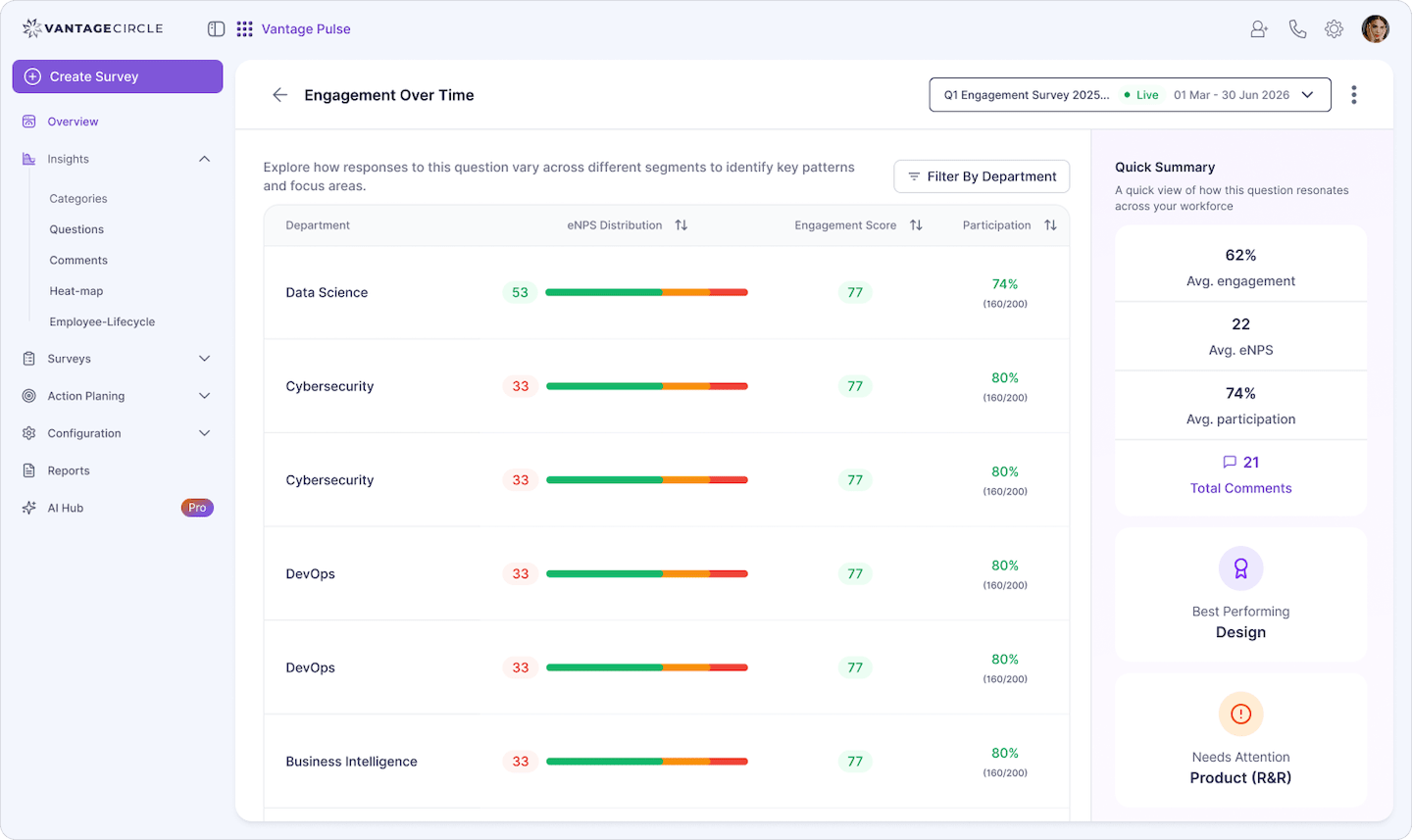
Department-level survey data helps you calibrate faster. When a behavior pattern surfaces in open-ended feedback from multiple team members, it's usually already a Tier 2 situation, even if the individual conversations haven't started. An employee survey tool that captures team sentiment by department makes that signal visible before it reaches HR — so managers can act at Tier 1 instead of discovering the pattern at Tier 3. SHRM's guide to performance documentation covers what a defensible written record looks like at each tier.
The Second Conversation: 5 Scripts for When Nothing Changed
The second conversation references what was said before, names the gap between that conversation and what actually happened, and states a consequence honestly.
Every feedback playbook covers the first conversation. Almost none covers what to say when the behavior repeats.
Script 1: When you're not sure what went wrong: "We talked about [behavior] three weeks ago. Since then, [specific incident]. That tells me either something wasn't clear or something else is getting in the way. Which is it?"
Script 2: Before it becomes formal: "After our last conversation, I expected to see [specific change]. I've been watching for it and I haven't. Before this becomes a formal performance issue, I want to understand what's blocking you."
Script 3: When you suspect disagreement: "I gave you feedback on [behavior] in our last one-on-one. The same thing happened in [specific situation]. I need to know whether you disagree with the feedback or whether you're struggling to implement it."
Script 4: When you need to name the next step: "This is the second time we've talked about [behavior]. If it happens a third time, I'll need to document this and bring in HR. I don't want that outcome. What do you need from me to make the change?"
Script 5: When you're at the limit: "We've had this conversation before and I haven't seen the change. I have to either escalate or accept that the behavior won't change. Neither is what I want. Tell me what's actually happening."
After every feedback conversation, document: the date, the specific behavior observed, a summary of what was discussed, the agreed next steps, and both names. A three-sentence note is enough. You'll want it if Tier 2 becomes necessary.
Why Negative Feedback Lands in Some Teams and Bounces Off Others
Corrective feedback lands when a positive baseline exists in the team. It bounces off when correction is the only feedback the team ever hears.
Before any hard conversation, ask yourself: when did I last catch this person doing something right? If you can't answer that, it matters. Not because you need to soften the blow, but because people who only hear from their manager when something's wrong stop being able to hear the correction at all. The feedback stops registering as guidance and starts feeling like confirmation that you're out to get them.
A genuine acknowledgment before a corrective conversation isn't the compliment sandwich. It's making sure the relationship context lets the feedback land. "Your client communication has been strong this quarter. I want to talk about the report deadlines, because that pattern is affecting the finance team." That's not softening the message. That's making sure the person is in a state where they can actually hear it. HBR's research on psychological safety in high-performing teams explains why this trust foundation determines whether feedback lands or gets rejected.
Tracking this at scale means having visibility into who is being recognized, by whom, and how often — by team, not just company-wide. That's where most managers are flying blind. Vantage Recognition surfaces exactly that pattern: awards and badges given versus received, peer-to-peer activity, manager-to-report recognition, and cross-department engagement in one view.
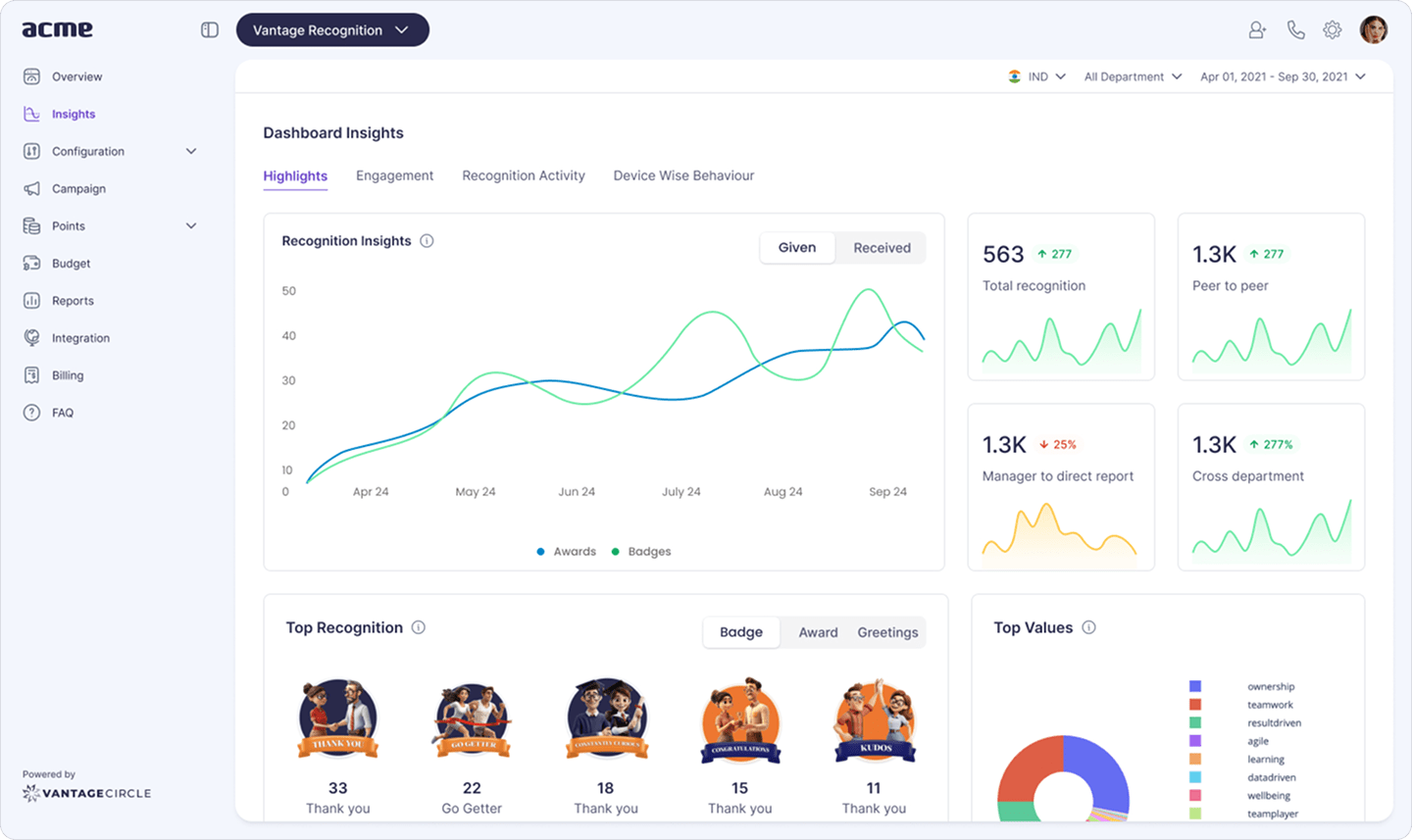
Without that data, most managers go into corrective conversations guessing at whether the relationship context is actually there — and often getting it wrong.
FAQ
1. What is an example of giving negative feedback?
"The last two status reports came in two days after the agreed deadline. The project lead had to delay client updates both times. I need the report by Tuesday morning. What would help you hit that consistently?" It names the behavior, the impact, and the expected change. And it ends with a question that invites the employee into the solution.
2. How to respond to a negative performance review?
Clarify the specific gap before you agree or disagree. "When you say my communication needs improvement, can you give me a recent example?" Acknowledge the impact without over-accepting. Then leave with a written action plan: what changes, by when, and how progress gets measured. A negative review is most useful when it produces a next step, not just a verdict.
3. What are examples of negative feedback?
In a workplace context: "You submitted the proposal without the financial appendix the client requested. Include it before we resubmit." Or: "You've arrived 15 to 20 minutes late to the last four sprint reviews. The team waits before starting. I need you on time from Monday." Both name a behavior, its impact, and the expected change. See employee feedback examples for more.
Start With the Behavior, Not the Person
Most negative feedback fails not because managers are too harsh or too soft, but because it's aimed at the person instead of the behavior. Name what happened. State the impact. Say what needs to change.
If the behavior repeats after a clear first conversation, that's a Tier 2 situation. Document it, name the consequence honestly, and don't treat it like a first offense again.
And before the next hard conversation, ask yourself: does this person hear from me when things go well, or only when something's wrong? The answer shapes whether feedback lands or bounces, before you've said a word.

Susmita Sarma is a Digital Marketer at Vantage Circle, making employee recognition less of a checkbox and more meaningful - helping organizations say we value our people and truly mean it.
Connect with Susmita on LinkedIn.