
Most managers know feedback matters. What trips them up is the moment itself. What do you actually say when a strong performer misses a deadline? What about when a new hire is still finding their feet, or when the person who needs the feedback is your own manager?
Employee feedback examples are ready-to-adapt phrases you use to reinforce strong work or redirect a problem. The most useful ones are grouped by situation, because the right words depend on the moment, not just the message.
This guide is organized that way. Each situation below gives you a positive example and a constructive one, plus a link to a deeper list when you need more. If you want the bigger picture of what employee feedback is and why it drives performance, we break that down separately. Here, we get straight to what to say.
So, let's get into it.
Key Takeaways
- The two types of feedback: positive and constructive
- Feedback examples for eight common workplace situations
- How to route to deeper example libraries when you need more
- Four principles for delivering feedback that lands
- Answers to the most-asked feedback questions
Positive vs Constructive Feedback: The Two Types That Matter
Employee feedback comes in two forms. Positive feedback reinforces what is working. Constructive feedback redirects what is not. Every example in this guide is one or the other.
Positive feedback is more than a quick "good job." It names the specific behavior, explains the impact, and encourages the person to keep going. It builds confidence and makes strong performance repeatable.
Constructive feedback is often confused with criticism. It is not. The goal is not to point out what went wrong. It is to guide someone toward a better outcome. It stays focused on the behavior, not the person, and it comes paired with a way forward.
| Type | What it does | When to use it | One-line example |
|---|---|---|---|
| Positive | Reinforces a behavior you want to see more of | After a win, a strong effort, or growth you want to lock in | "Your prep made that client call land. Keep doing that." |
| Constructive | Redirects a behavior toward a better outcome | When a result fell short and you want a course correction | "The report had errors we caught late. Let's build in a review step." |
Keep both in balance. Lean only on positive feedback and people stop growing. Lean only on constructive feedback and people stop feeling valued. The examples below draw on both, matched to the situation you are in.
Employee Feedback Examples by Situation
The examples below are grouped by the situation you are in, not by a category label. Find the moment that matches yours, adapt the wording to your voice, and follow the link when you want a longer list.
Feedback for a missed deadline
When someone misses a deadline, address the impact first, then move straight to the fix. Blame stalls the conversation. A clear next step moves it forward.
Positive (they hit a tough deadline): "You turned that around under real time pressure and it still held up. That kept the whole launch on track. I noticed the effort it took."
Constructive (they missed one): "The proposal missed Friday's deadline, which pushed the client review to next week. Let's look at what got in the way and set a checkpoint midweek so we catch slippage earlier next time."
Related Read: More constructive feedback examples →
Feedback for a new hire in their first 90 days
New hires need feedback that is frequent, specific, and low-stakes. Early feedback shapes habits before they set. Frame it as coaching, not evaluation.
Positive (fast ramp): "You picked up our workflow faster than most. Asking questions early instead of guessing is exactly the habit that will serve you here. Keep it up."
Constructive (still learning a process): "A few steps in the handoff process got missed this week. That is normal this early. Let's walk through the checklist together so it becomes second nature."
Feedback for a remote or hybrid teammate
For remote and hybrid teams, feedback has to be intentional because the hallway moment is gone. Be specific about behavior you cannot see in person, and never let silence stand in for approval.
Positive (proactive async communication): "Your written updates in the project channel are clear enough that nobody has to chase you for status. That saves the whole team time. It is a real strength on a distributed team."
Constructive (goes quiet or misses check-ins): "I have noticed a few check-ins slipping and updates going quiet for a day or two. On a remote team that creates uncertainty for the rest of us. Can we agree on a simple rhythm for staying visible?"
Because remote feedback needs its own care, the constructive examples guide has a full section on giving feedback across digital and hybrid teams.
Peer-to-peer feedback
Peer feedback works best when it is direct, respectful, and free of any manager-style authority. You are a colleague, not a boss. Keep it about the shared work.
Positive (public appreciation): "I want to call out how you jumped in on the deployment yesterday when I was underwater. You did not have to. It made a real difference, and I appreciated it."
Constructive (a respectful peer redirect): "Can I share something? When the specs change without a heads-up, it makes my side hard to plan. Could we flag changes in the channel as they happen? It would help me a lot."
Positive peer feedback compounds when it is easy and visible. That is the idea behind peer-to-peer recognition, where appreciation becomes a daily habit instead of a once-a-year event. For a wider set of upbeat scripts, see these positive feedback examples.
Upward feedback: giving feedback to your manager
Upward feedback is the hardest to give and the most valuable to receive. Lead with respect, be specific, and frame it around what would help you do your best work.
Positive (your manager unblocked the team): "The way you cleared the approval bottleneck last sprint made a huge difference. It let us ship without the usual back-and-forth. More of that would help us move faster."
Constructive (they need to set clearer priorities): "I want to flag something so I can prioritize better. When several things land as urgent at once, I am not always sure what comes first. A quick weekly steer on the top priority would help me focus."
If you want a structured way to gather feedback in every direction, including upward, 360-degree feedback is built for exactly that.
Feedback for strong performance or a big win
For a strong result, be specific about what the person did and tie it to the impact. Vague praise fades. Precise praise reinforces the behavior you want repeated.
Positive (a standout result): "Your rework of the onboarding flow cut drop-off in the first week noticeably. That is a direct result of the questions you asked before building. This is the kind of thinking we need more of."
When you catch great work, feedback lands harder when it is paired with recognition the rest of the team can see. That connection between feedback and recognition is what turns a single good moment into a pattern.
Feedback on communication or collaboration
For communication and collaboration issues, name the specific breakdown and its effect on the team, then invite the person to solve it with you. Keep it about the work, not their personality.
Constructive (a breakdown affected the team): "There were a couple of moments this week where updates did not reach the whole group, and it slowed us down. Let's figure out a way to keep everyone in the loop that works for you."
Positive (they defused a tense moment): "I saw how you kept that disagreement in the review focused on the problem instead of letting it get personal. That is not easy. It kept the meeting productive."
Feedback in a performance review or one-on-one
In a review or one-on-one, balance is what makes feedback credible. Open with a genuine strength, then move to one clear growth area with a concrete next step. Never save all the hard feedback for the annual review.
Balanced example: "Your delivery this quarter was consistently strong, especially under pressure. The one area to build on is delegation. You take on too much yourself. Let's pick one project next quarter where you hand off more and coach the team through it."
Feedback for a high performer who wants to grow
High performers often get the least feedback, because managers assume they are fine. That is a mistake. Your best people need stretch feedback and a clear path, or they start looking for one elsewhere.
Positive with a stretch: "You have outgrown your current scope, and the quality has been consistent all year. The next step for you is influence. I want you mentoring two of the newer team members and owning the roadmap for this area. That is where you grow next."
Constructive (a blind spot): "You deliver at a high level, and that is exactly why this matters. You move so fast that the team sometimes cannot keep up or learn from you. Slowing down to bring people along is the skill that takes you to the next level."
Feedback on attendance or a recurring behavior
For a recurring issue like lateness or missed commitments, address the pattern rather than a single instance, and lead with concern before consequence. People often have a reason you cannot see.
Constructive: "I have noticed a few late starts over the past couple of weeks, and it is starting to affect the morning handoffs. Before anything else, is everything okay? I want to understand what is going on and work out how to make it right together."
How to Deliver Feedback So It Actually Lands
Good feedback is less about the perfect words and more about how you deliver them. Four principles carry most of the weight.
- Be specific and objective. Name the exact behavior and its impact. "You need to communicate better" gives someone nothing to act on. "Sharing the status update a day earlier would let the team plan" does.
- Focus on the behavior, not the person. Critique the action, never the character. This keeps the conversation constructive and stops the other person from getting defensive.
- Be timely. Feedback close to the moment is far more useful than feedback saved for a quarterly review. Regular feedback from managers makes employees 3.6 times more likely to be motivated to do outstanding work.
- Make it a two-way conversation. Invite the other person's perspective. Feedback is a dialogue, not a verdict.
These four cover most situations. If you want the full methodology, from framing the conversation to closing the loop, our guide to effective feedback goes deeper.
Frequency is the multiplier here. Vantage Circle's research with Mercer, The Future of Total Rewards, highlights that continuous reinforcement is linked to a 12% gain in productivity compared with relying on annual feedback cycles. Feedback works when it is a habit, not an event.
The most useful feedback happens in the flow of work, not once a year. If you can only change one thing, make feedback more frequent before you make it more formal.
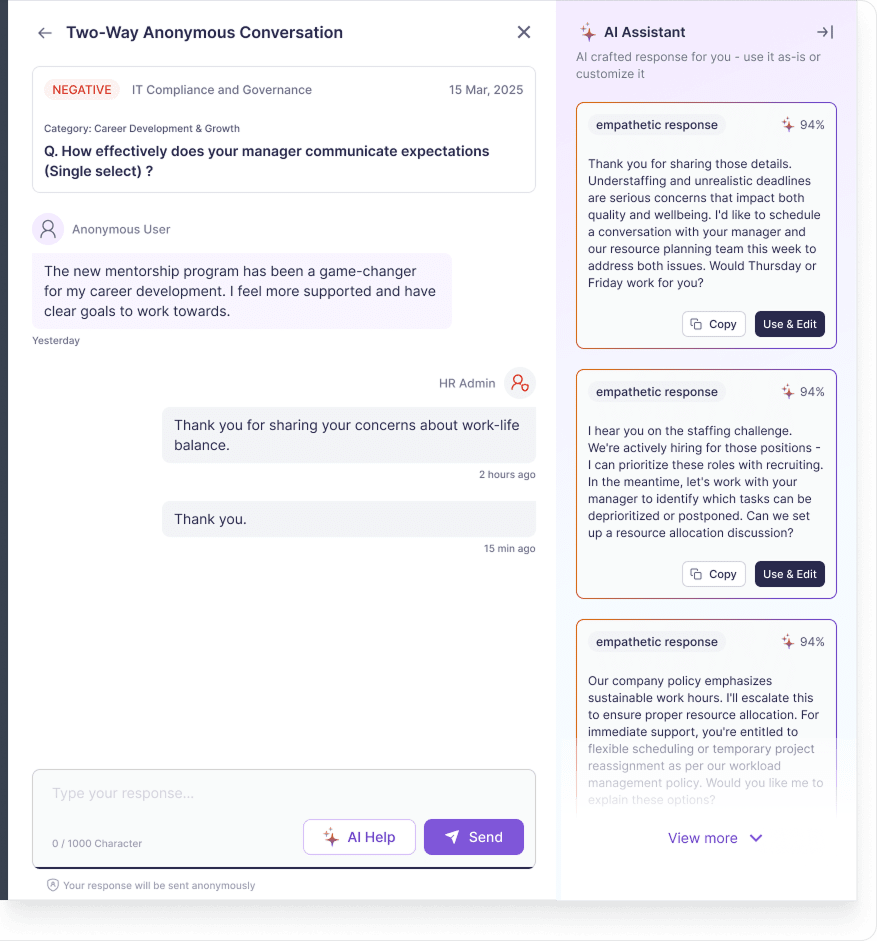
Doing this at scale is where most teams struggle, because the most honest feedback often never reaches leadership. Vantage Pulse, Vantage Circle's employee engagement and pulse survey tool, is built for that gap. Anonymous responses surface the upward feedback people will not say to a manager's face, and sentiment analysis turns open-text comments into themes HR can act on before they turn into attrition.
Summing It Up
Feedback is not a script you memorize. It is a habit you build. The examples here give you a starting point for the situations that come up most, from a missed deadline to a peer redirect to feedback for your own manager.
Adapt them to your voice, deliver them close to the moment, and keep the balance between reinforcing what works and redirecting what does not. Do that consistently and feedback stops being an awkward event. It becomes part of how your team gets better every week.
Want to see how continuous employee listening works in practice? Book a demo with Vantage Circle.
Frequently Asked Questions
What are the 5 R's of feedback?
The 5 R's of feedback are Request, Receive, Reflect, Respond, and Resolve. Request means asking for input in a way specific enough to get a useful answer, rather than a vague "any feedback for me?"; our guide on how to ask for feedback covers that step in full, with scripts for every relationship. The remaining four R's are the receiving side: listen without interrupting, process what you heard, react constructively, and act on it.
What are the 3 C's of feedback?
The 3 C's of feedback are most commonly clear, concise, and constructive. Clear means the behavior and its impact are unambiguous. Concise means you get to the point without burying it in preamble. Constructive means the feedback comes with a path forward, not just a complaint.
What is a good example of positive feedback?
A good example of positive feedback names a specific behavior and its impact. For instance: "The way you handled that frustrated customer today was calm and thorough, and it clearly turned their experience around. That is exactly the standard we want." The best positive feedback is specific and timely, not a generic "good job."
What are some examples of positive feedback for a company?
Positive feedback for a company highlights something the organization does well. Examples include: "The flexibility to work when I am most focused has made a real difference to my output," or "The onboarding process made me feel supported from day one." Company-level feedback like this often surfaces through anonymous employee surveys, where people answer more honestly.
How do you give feedback to a new employee?
Give new employees feedback that is frequent, specific, and framed as coaching rather than evaluation. Reinforce good habits early, like asking questions instead of guessing, and correct process gaps gently while they are still forming. Early feedback shapes habits before they set.
How often should you give employees feedback?
Give feedback continuously, in the flow of work, rather than saving it for an annual review. Frequent feedback is more relevant and more motivating. Continuous reinforcement is linked to measurably higher productivity than relying on once-a-year performance cycles.

Nilotpal M Saharia is an Assistant Manager, Content Marketing at Vantage Circle and a recognition-and-rewards (R&R) strategist with 9 years of experience spanning Marketing, HR, and content strategy. He helps HR leaders turn employee recognition and leadership research into practical workplace programs.
Connect with Nilotpal on LinkedIn.