
A job can offer competitive pay, attractive benefits, and a well-designed workplace and still leave employees exhausted, undervalued, and looking for the exit. The reason is simple. A good job and a good quality of work life are not necessarily the same thing.
Quality of Work Life (QWL) looks beyond what an organization offers to examine what employees actually experience. Can they earn a fair living without sacrificing their well-being? Do they have a reasonable degree of control over their work? Are they treated with dignity, given opportunities to grow, and able to maintain a life outside the office?
These questions matter because employee experience is shaped as much by the conditions under which people work as by the work itself. A wellness program cannot compensate for chronic overwork. A recognition platform cannot make up for an unfair compensation structure. And a generous benefits package means little if employees have no say in decisions that affect their working lives.
For HRs, QWL is therefore more than an employee satisfaction measure. It is a way to examine whether workplace policies, management practices, and organizational priorities create conditions in which people can perform well without compromising their well-being.
Vantage Influencers Podcast
Crafting A People-First Culture
What is Quality of Work Life?
Quality of work life (QWL) is the degree to which a job meets employees' physical, psychological, social, and financial needs while also supporting the organization's goals. A workplace that burns people out to hit its numbers has poor QWL. So does one that keeps everyone comfortable while the business drifts.
The idea is older than most HR job titles. Researchers and union leaders spent the late 1960s worrying that factory work was becoming dehumanized. That worry came to a head at an international conference held at Arden House in Harriman, New York, from September 24 to 29, 1972, where the phrase "quality of working life" entered the vocabulary. Within a year, Richard Walton was publishing the criteria that still anchor the field.
One distinction matters before going further. QWL is a condition of the organization, not a mood inside a person. An employee can feel satisfied on a good Tuesday in a workplace with poor QWL. QWL asks whether the structure itself (pay, hours, safety, voice, growth) is built to support people over time.
Quality of Work Life Definitions by Authors
There is no single agreed definition of QWL, so the most useful approach is to know the 4 definitions that HRM courses and researchers cite most often. Each one emphasizes a different side of the same idea.
| Author and year | Definition in one line (paraphrased) | Emphasis |
|---|---|---|
| Louis E. Davis, 1972 | Introduced QWL as the quality of the relationship between workers and their total working environment | Origin of the term; job and work design |
| Richard E. Walton, 1973 to 1975 | QWL is defined by 8 conceptual categories, from fair pay to the social relevance of work | Measurable dimensions |
| J. Richard Hackman and J. Lloyd Suttle, 1977 | The degree to which members of an organization can satisfy important personal needs through their experiences at work | Individual needs |
| David A. Nadler and Edward E. Lawler III, 1983 | A way of thinking about people, work, and organizations that cares about work's effect on people and invites employee participation in decisions | Participation and philosophy |
Walton's 8 Dimensions of Quality of Work Life
Richard Walton defined QWL through 8 dimensions. He first laid them out in a 1973 Sloan Management Review article and expanded them in 1975.
However, each dimension becomes useful only when it has an indicator someone tracks, a question employees answer, and an owner who acts on the result. This is the version of Walton's model that an HR team can actually run.
1. Adequate and Fair Compensation
Pay must be enough to live on and fair relative to peers and the market, and perceived unfairness damages QWL more than the absolute number does. People rarely leave over a salary figure alone. They leave when the figure stops making sense next to someone else's.
The definition of "compensation" has also widened. On the Vantage HR Influencers podcast, Kriti Mehrotra, Senior Lead, Total Rewards, described the shift this way:
"It has shifted from pay centric to experience centric... the aspects of flexibility, the aspects of holistic wellbeing and the aspect of inclusive benefits have become a major, major important point. Employees are asking about it. It's almost become non-negotiable."
2. Safe and Healthy Working Conditions
Safe conditions mean reasonable hours, a hazard-free environment, and the freedom to raise a risk without being penalized. In office jobs, the hazard is usually workload. On a factory floor, it is literal.
Ana Carolina Mason, Head of HR, UAE, at Americana Foods, put the leadership responsibility plainly when discussing culture in high-pressure operations:
"The leadership should say, no, I cannot keep an employee working 16 hours. It's affecting the well-being of the person. He will lose the focus. He will be tired. He can do much more mistakes."
Notice the logic. The case against the 16-hour shift is made on both QWL counts at once: the person's health and the quality of the work. For frontline teams, the practical checklist is shift patterns, rest areas, hydration, and noise.
For desk teams, it's realistic deadlines and real support for stress management. Programs like Vantage Fit's team wellness challenges help when they reach frontline and office staff equally, but no challenge fixes a broken roster.
3. Opportunity to Use and Develop Human Capacities
Jobs score higher on QWL when they offer autonomy, a variety of skills, and a view of the whole task rather than a fragment of it. The quickest test is to ask someone what happens to their work after it leaves their desk. If they don't know, the job is probably too narrow.
Managers control most of this dimension. Letting people plan their own sequence of work, rotate across tasks, and see the end customer costs little and changes how the job feels.
4. Opportunity for Continued Growth and Security
Employees need a visible path to grow and reasonable confidence that their job will still exist next year. Growth without security feels like a ladder over a gap. Security without growth feels like a waiting room.
Published career paths, funded learning, and honest communication during restructuring all sit here. So does recognizing tenure. Long service awards in Vantage Rewards are a small but visible signal that the organization values people who stay.
5. Social Integration in the Work Organization
Social integration means being accepted, respected, and recognized by colleagues, without prejudice or status barriers getting in the way. It is the dimension most people describe when they say they like where they work.
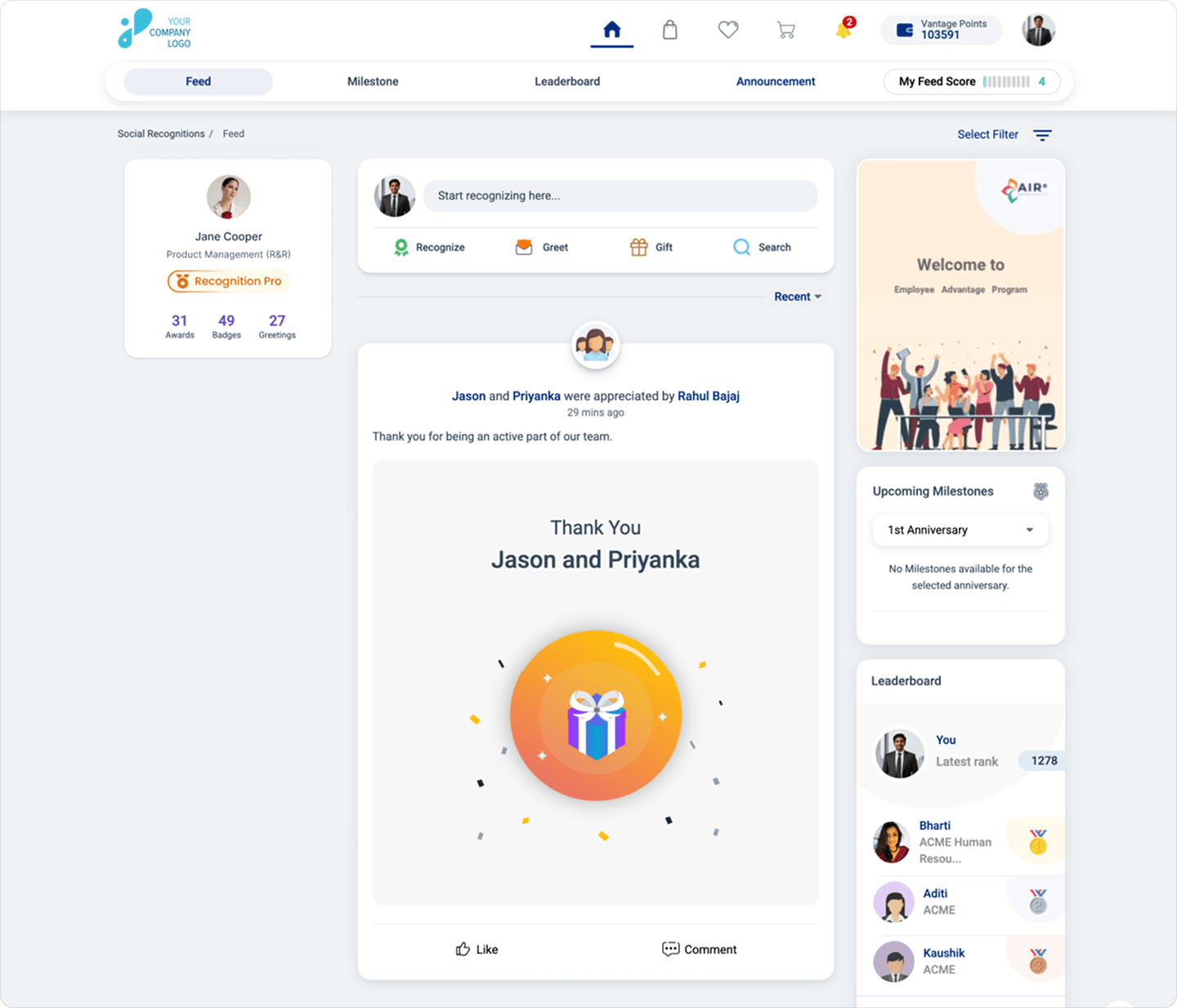
Recognition is one of the clearest everyday expressions of it, and the connection to retention shows up in the data. The Recognition Effect 2025, research by Vantage Circle and Great Place To Work covering more than 5.7 million employees, compared organizations by the strength of their recognition culture. The gap in intent to stay was hard to miss.
Organizations with strong recognition habits tend to get other things right too. But it does suggest that being seen by colleagues is part of why people choose to remain. Peer-to-peer recognition makes those moments visible across teams and locations, including for frontline staff who rarely see senior leaders.
(Source: Vantage Recognition)
6. Constitutionalism in the Work Organization
Constitutionalism means employees have rights at work, including privacy, free expression, fair treatment, and due process when something goes wrong. Walton borrowed the word from politics on purpose. A workplace is a small government, and people judge it by how it treats dissent.
The warning signs are familiar: complaints that disappear, retaliation that nobody names, policies applied differently by rank. Left alone, they harden into a toxic work environment.
7. Work and Total Life Space
Work should leave room for family, rest, and personal life, and long hours, constant travel, and after-hours messages all erode QWL. The question is not whether people work hard. It's whether work keeps spilling into the hours that were supposed to belong to something else.
HR has several tools here, and they suit different jobs: work-life balance policies for clear boundaries, work-life integration for roles that blend, and flexible working hours where the work allows it.
8. Social Relevance of Work Life
Employees rate QWL higher when they see their organization act responsibly toward customers, communities, and the environment. People want to explain their job at dinner without wincing. When the company's behavior contradicts its values page, every other dimension loses credibility.
Why Quality of Work Life Matters?
Quality of Work Life (QWL) is not simply about making employees happier at work. It is about creating working conditions in which people can perform, grow, and sustain their well-being over time. For HRs, investing in QWL is both a people priority and a business decision.
Here is why it deserves strategic attention.
It Helps Organizations Retain Good People
Employees rarely leave for one reason alone. Unmanageable workloads, unfair compensation, limited growth opportunities, poor management, and a lack of recognition can gradually weaken their attachment to an organization.
A strong quality of work life addresses these conditions before dissatisfaction turns into a resignation. When employees feel fairly treated, supported by their managers, and able to build a future within the organization, they have stronger reasons to stay.
It Creates the Conditions for Sustained Performance
Productivity is often discussed in terms of output, efficiency, and deadlines. But these measures tell only part of the story. Employees also need the physical energy, psychological safety, resources, and autonomy to do their jobs well.
A workplace that consistently pushes people beyond their capacity may produce short-term results, but it risks fatigue, disengagement, and declining work quality. QWL encourages organizations to look beyond immediate output and consider whether their operating practices support sustainable performance.
It Strengthens Employee Engagement and Commitment
Engagement is difficult to manufacture through campaigns or occasional workplace activities. It develops through everyday experiences: whether managers listen, contributions are acknowledged, decisions are communicated fairly, and employees have a meaningful voice.
QWL provides the foundation for these experiences. When employees feel respected and included, they are more likely to invest their effort, participate in organizational goals, and take ownership of their work.
It Supports Physical and Psychological Well-being
Workplace well-being extends beyond health insurance and wellness initiatives. It also depends on manageable workloads, reasonable working hours, safe working environments, adequate rest, and access to support when employees need it.
This is particularly important for organizations with frontline, shift-based, and physically demanding roles. A desk-based employee and a warehouse associate may experience entirely different workplace pressures. Effective QWL practices recognize these differences rather than applying a one-size-fits-all approach.
It Promotes Fairness, Inclusion, and Belonging
Employees evaluate the quality of their working lives partly through how they are treated in comparison with others. Unequal access to opportunities, inconsistent recognition, pay disparities, and exclusion from important decisions can undermine trust.
A strong QWL framework encourages HR teams to examine whether workplace policies and opportunities are accessible and equitable across roles, locations, and employee groups. It also reinforces a culture in which people feel respected, regardless of their position or background.
7 Practical Steps to Improve Quality of Work Life
Improve QWL by fixing the lowest-scoring dimension first, not by adding perks across the board. Spreading budget evenly feels fair. It's also how organizations end up with a meditation app and an unresolved pay gap.
Run Baseline QWL Survey and Share the Results
A survey nobody hears back about teaches people that answering is pointless. Share the 2 lowest dimensions openly, along with what leadership plans to do about each.
Audit Pay Fairness by Role and Gender
Compare pay across similar roles, levels, and genders, and close gaps that have no defensible reason. Fairness is the part of compensation employees judge most harshly. Publishing pay bands, even broad ones, removes a surprising amount of suspicion.
Cap Hours and Redesign Shift Patterns
Set a firm ceiling on regular overtime and redesign rosters that routinely break it. Track overtime by team, not just in aggregate. Where 16-hour days have become normal, the fix is staffing and scheduling, not a resilience workshop.
Build Recognition Habit at the Team Level
Make recognition a weekly team practice rather than an annual event. Specific, timely appreciation from peers and managers strengthens social integration more than a year-end award. Give teams a shared feed where that appreciation is visible to everyone, including frontline staff.
Publish Growth Paths and Fund Learning
Show every role at least one realistic next step and fund the skills it requires. A career framework that lives in an HR folder does nothing. Managers should discuss it in regular check-ins, and learning budgets should be easy to use.
Give Employees Formal Voice and Fair Grievance Process
Create a clear channel for complaints, set response deadlines, and protect people who use it. Employee councils, skip-level meetings, and anonymous reporting all help. What matters most is that cases are resolved visibly and on time.
Offer Flexibility that Fits the Job
Design flexibility around what each role can realistically support, because frontline and office jobs need different options. Remote work means nothing to a machine operator. Shift swapping, predictable schedules, and advance notice of changes often matter more.
Done consistently, these steps build the kind of organizational commitment that no perks budget can buy.
Finally
Quality of Work Life should not be treated as an isolated HR initiative or an annual employee satisfaction exercise. It is an ongoing measure of how well an organization balances business expectations with the needs of the people responsible for meeting them.
The strongest workplaces understand that employee well-being and organizational performance are not competing priorities. They are mutually reinforcing ones.
FAQs
What is the Importance of Quality of Work Life?
Quality of work life matters because it affects both people and performance. Strong QWL is linked to better health, lower stress, and higher engagement for employees, and to lower turnover, fewer absences, and higher productivity for organizations.
What is Quality of Work Life in HRM?
In human resource management (HRM), quality of work life is the set of practices that make jobs fair, safe, and fulfilling while supporting business goals. HR teams use it as a framework for pay policy, safety, career development, recognition, grievance handling, and flexibility, usually measured through dimension-based employee surveys.
What is the Scope of Quality of Work Life?
The scope of quality of work life covers every working condition an employer controls, for every type of worker. That includes pay, hours, safety, growth, relationships, rights, and flexibility, applied to permanent, contract, remote, and frontline employees alike, not only to staff at headquarters.
What are the Objectives of Quality of Work Life?
The objectives of quality of work life are to improve employee well-being and organizational effectiveness together. In practice, that means fair and safe jobs, a real employee voice, skill development and growth, stronger trust and belonging, and, as a result, better retention and productivity.
What are Examples of Quality of Work Life?
Examples of quality of work life programs include flexible scheduling, pay equity reviews, wellness support, recognition programs, learning budgets, and employee councils. A strong example is a manufacturer that caps overtime, publishes rosters in advance, and lets workers flag safety risks anonymously.

Shikha Gogoi is a Content Marketing Specialist focused on SEO-driven content around employee engagement, recognition, and workplace culture, helping build people-first workplaces.
Connect with Shikha on LinkedIn.