
Choosing an employee rewards program is easy to get wrong, and the cost of getting it wrong is higher than the price tag suggests.
In Vantage Circle's State of Recognition and Rewards 2025, 79% of U.S. rewards and recognition programs were rated low to moderate in effectiveness. In other words, most organizations are already spending on recognition without much to show for it.
The reason usually isn't the software. Programs tend to fail quietly. Adoption plateaus a few months after launch, participation narrows to a handful of enthusiastic managers, and eventually HR is left defending the spend to finance.
What separates the programs that stick from the ones that fade is rarely a single feature. It comes down to how well the program fits:
- Your organization's size
- Your real budget
- The way people actually work once the launch excitement wears off
This guide is built to help you make that call. It walks through what actually predicts whether a program succeeds, a framework of 10 practical selection criteria, and budget guidance matched to your company's size.
Key Takeaways
- What an employee rewards program is, and how rewards differ from recognition
- Why a strong program matters, from morale and retention to a lasting culture of appreciation
- What actually predicts success: broad, frequent, and measured participation, not the feature list
- A framework of 10 practical selection criteria for choosing the right platform
- Budget guidance by company size, anchored to the 1–2% of payroll benchmark
What is an Employee Rewards Program?
An employee rewards program is a formal system that turns appreciation into something tangible:
- Points employees can redeem
- Milestone awards for service anniversaries
- Spot bonuses for standout work
- Public peer-to-peer recognition
It gives structure to what would otherwise be scattered, inconsistent gestures.
Rewards and recognition are related but not identical. Recognition is the acknowledgment itself: the shout-out, the thank-you, the badge. Rewards are the tangible layer attached to it: the points, the gift card, the experience. A strong employee recognition and rewards platform combines both, because recognition gives rewards meaning and rewards give recognition weight.
And you know what, tagging every reward to a specific company value gives the program a defensible reason beyond personal preference, and it turns each reward into a small, visible reminder of what the organization actually cares about.
It also helps to distinguish formal programs from informal habits. A manager occasionally buying the team lunch is appreciation, but it is not a program. A program has defined award types, a budget, eligibility rules, and a delivery platform, which is what makes it consistent, fair, and measurable across the whole organization rather than dependent on individual generosity.
Most programs today combine four reward categories: monetary awards, non-monetary recognition, service milestone awards, and perks or discounts that stretch the budget further.
Why is it Important to have a Good Employee Rewards Program?
We cannot emphasize enough how having a good employee rewards program can benefit an organization. Not only does it make a workplace culture strong, but it also improves the quality of work performance.
In fact, did you know, Gallup in its research tracked 3,447 employees from 2022 to 2024 and found that well-recognized employees were 45 percent less likely to have left their jobs two years later.
But if you are still in doubt about facilitating an employee rewards program, below is a list of benefits that will change your doubt into belief.
1. Improves Employee Morale
Employee morale is an important factor in developing a productive workforce. Employees with high morale indicate that the organization is doing something right.
It ensures and fosters the belief that employees will be appreciated and recognized for their contributions.
2. Creates a Culture of Appreciation
Building a culture of appreciation isn't easy. It takes thoughtful planning, consistent effort, and constant alignment with your organizational goals. But the payoff is worth it: once a solid recognition system is in place, employees feel acknowledged in the moment their contributions matter most. Getting there is much easier with the right tools.
A good employee engagement platform, like the AI-based solution from Vantage Circle, can take a lot of the manual work off your plate. It lets teammates recognize one another through both monetary and non-monetary rewards, and helps you stay on top of the moments that build connection, from service anniversaries to birthdays and other special occasions.
Read more: 8 Unique Ways You Can Build A Culture of Appreciation In 2023
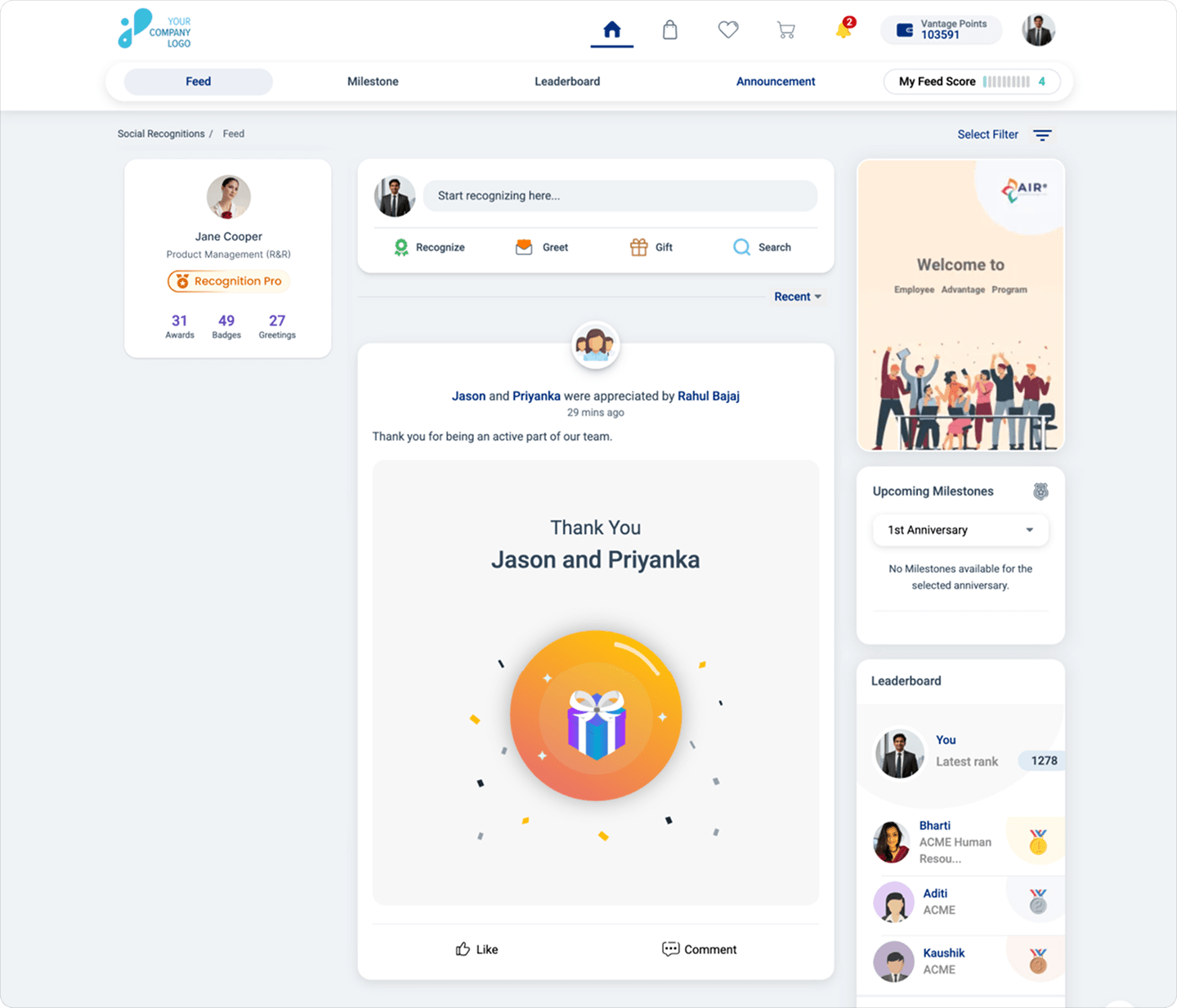
(Source: Vantage Recognition)
3. Builds Positive Workplace Relationships
When you invest in a strong employee rewards program, the emphasis is more on empowering employees. And as we know, such a system allows the employees to show their appreciation toward their co-workers.
When employees acknowledge each other for their efforts and support, it develops mutual understanding and respect. Doing so enables them to build positive workplace relationships in the long run.
4. Boosts Employee Retention
It's an open secret; employees love getting acknowledged. And with an efficient employee rewards program, you can make the employees fall in love with the workplace. You need to be consistent and frequent with your reward process.
Doing so will ensure that the employees stay loyal, improving employee retention in the organization.
5. Drives Employee Satisfaction
Recognizing employees makes them feel valued and creates a sense of self-belief. On top of that, this also makes employees feel they are carrying out their responsibilities well. Doing so will ensure that the employees are satisfied with their workplace and job roles. In the long run, it positively impacts their overall satisfaction levels.
You need to choose the right tool and have a good strategy to support the employee rewards program.
Read more: 9 Best Practices to Keep Employee Satisfaction High

Vantage Influencers Podcast
"Recognition is something which is emotion. It is intangible. Recognition is about that vibe that you bring in as an ecosystem. A warm greeting, hello, or a warm thank you when somebody is helping you makes a difference."
Binni Rai, Chief HR Officer at Omnipresent Robot Tech
Listen to the EpisodeNot Sure Which R&R Platform Is Right for You?
Our Buyer's Guide covers everything you need — evaluation criteria, must-ask vendor questions, and a side-by-side comparison framework.
Download the Buyer's GuideWhat Makes a Rewards Program Actually Work?
A rewards program works when participation is broad, frequent, and measured. It fails when recognition stays concentrated in a small group of givers, arrives only at annual moments, and goes untracked. The feature list matters far less than these three behaviors.
That claim comes from real program data, Vantage Circle's State of R&R 2025 report, not theory.
What we see across rewards-program adoption (Vantage Circle's research data):
- Adoption stalls without structure. Programs that launch without a sustaining structure typically see participation plateau at 30 to 40 percent of employees once launch momentum fades.
- Concentration kills programs quietly. Our report found that in low-effectiveness programs, 40 percent of employees receive recognition from fewer than 10 percent of eligible recognizers.
- Measurement separates leaders from the rest. In the same report, 89 percent of high-effectiveness programs actively track participation and recognition frequency, compared with 45 percent of the rest. And over 60 percent of low-effectiveness programs have no structured approach to building excitement around the program at all.
The pattern is consistent: the programs that work distribute recognition widely, schedule it into the rhythm of work, and watch the data. This is not just a vendor's view.
Gallup's research found that more than half (55 percent) of all United States employees receive no recognition at all, or recognition that does not satisfy any of Gallup's five pillars of strategic recognition. Broad, frequent, structured recognition is rare, which is exactly why it is a competitive advantage.
A program can look active on paper while actually being used by a small fraction of employees. Usage analytics show HR exactly which teams are engaging with the program and which need attention, before it becomes a budget-renewal problem. That is why analytics appears twice in this guide: once here, and once in the selection criteria below.
For a buyer, this reframes the entire evaluation. Instead of asking "which platform has the most features," ask "which platform makes broad, frequent, measured participation the default." The 10 practical criteria that follow are built around that question.
How to Pick the Right Employee Rewards Program?
Selecting the right reward program for your organization that aligns with the organizational goals is crucial. It will determine the long-term success of your efforts while empowering the employees. Let's look at what you need to look for to choose the appropriate program.
1. Ease of Integration
Digitization and technology have become a quintessential part of managing people. The chances are that your organization is already using an HRMS for various HR functions.
You don’t want to invest in a program that will not become part of the existing workflows. It will add hassles for both you and your employees. It also minimizes admin time when you can integrate your rewards program with other SSO software that you’re using.
Hence, it is essential to ensure that the employee recognition program can be seamlessly integrated into the existing system.
2. Customization
Every organization is different from the other.
Since you’re choosing a Rewards platform and not building one on your own, it is important to fit your company effortlessly. Customizable features will give you the freedom to tailor-make the program for your employees. It can be in the form of the number of employees, award titles, allocation of points, etc. Your employees shouldn’t feel like they are joining a completely new and unknown program.
Providers like Vantage Rewards let you white-label the program, so it carries your company's identity. You control the look and feel, from the name to the interface.
Look for a solution provider who can provide complete customization.
3. Smooth Point-based Rewarding Process
Gone are the days when you could apply a one-size-fits-all policy in rewarding your employees.
Point-based rewards for employee recognition are gaining popularity for all the right reasons.
Here employers can buy reward points and distribute these points to employees as rewards. Employees can then redeem the points earned by them and purchase items or experiences, or subscriptions of their choice. This gives employees flexibility and a sense of freedom. And for managers, it reduces their headache in deciding what gifts to give on what occasion.
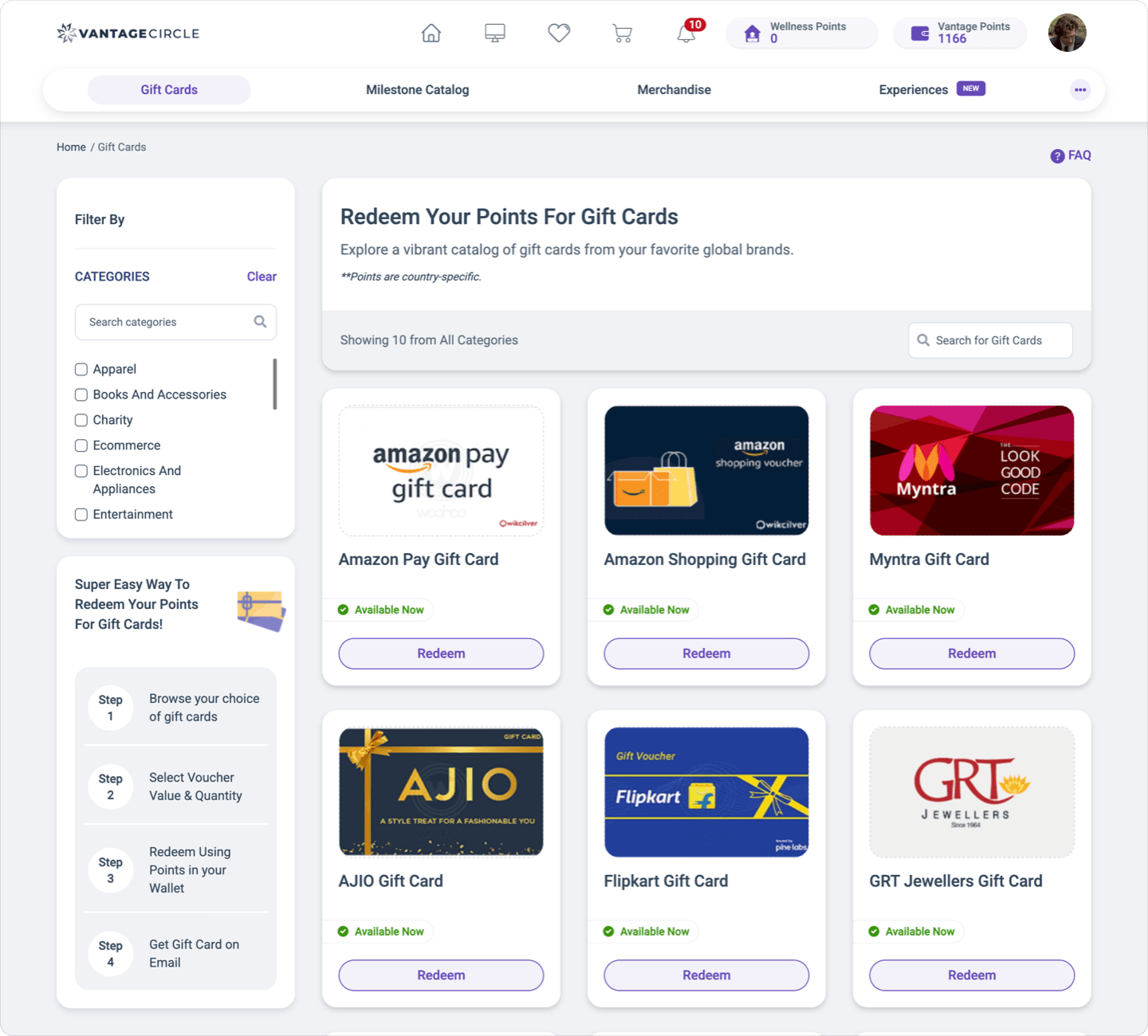
So, you must ensure that your chosen program follows a point-based rewarding system. Also, have a look at the points to currency conversion beforehand.
And if you are in search of such platforms, then you can opt for Vantage Circle. The platform provides a point-based system and currency conversion according to geographical location. This enables organizations to reward and recognize their employees based out of different locations.
4. The Program Should Suit Your Organization
A company’s recognition program must suit the company culturally.
Recognition programs are a great way to spread and articulate your company’s core values. Before choosing a program, you must ensure that you can tie the Rewards program with the company values and ideologies. Research on the message that the program wants to emphasize and the unique ways they are trying to achieve the same.
For example, if the program claims to promote social recognition, look at their portal or the social feed and similar features.
5. Cost Factor
One of the preliminary criteria while choosing an R&R program is the cost.
Before you go about investing in a program, you should plan a proper budget. The budget will differ according to the size and needs of the enterprise. Make a reasonable estimation of how much you are willing to pay the external vendor for the program. Investigate what all will be taken care of by them and what will not.
The Vantage Circle Center of Excellence recommends allocating 1–2% of payroll to recognition programs, a payroll-anchored benchmark that scales with your organization rather than a flat per-head figure.
Watch for hidden costs: transaction fees, processing fees, and taxes that do not appear in the quoted price. Prefer flat, transparent fees, and make sure you control when and how reward points are purchased.
A rewards budget also does not have to be entirely cash-based. Layering in discount-based perks, like Vantage Perks, stretches a fixed budget further without reducing how meaningful a reward feels to the person receiving it
6. Alignment with Desired Outcomes
One of the biggest challenges of building a culture of employee recognition is a lack of means to determine the ROI.
To tackle this, you must set quantifiable outcomes and expectations. And more importantly, you should be able to capture the results of the program with sound analytics. Have a close look at the analytics dashboard that will come with the program. All the data you need should be displayed in a systematic and hassle-free manner and in real-time.
To ensure transparency of your rewards program, take a detailed review of the product before making a choice.
7. The Program should be Fun and Engaging
The success of the Recognition program comes down to the degree of engagement of your people. While considering the factors for choosing a program, there is one thing that is often overlooked, and that is making it fun.
The program interface should be simple, smooth, and user-friendly. Since everyone in the company will be using the program, the features should be easy to understand.
Secondly, make sure the program is fun (and not boring) to use. Having gaming elements makes a program instantly more interesting. Gamification in the R&R module can be having a leaderboard, points allocation, badges, tags, etc.
Go for a tool that has mobile access to ensure regular participation and engagement.
8. Industry Knowledge and Experience of Vendor
Choosing the right external vendor for the organization’s recognition needs comes down to various factors. You should ensure that the vendor is experienced and capable of delivering the results and meeting the goals. You might want to look at their industry presence and previous experiences with companies on the same scale as yours.
You should stick with the brand name that offers top quality and has shown commendable results in the past.
9. Scalability
Scalability in cloud computing or cloud tools is the ability to quickly and easily increase or decrease the size or power of an IT solution.
A scalable cloud makes it possible to sign in and start using a cloud solution in a matter of seconds. When your rewards program is scalable, even sizeable changes in the organization can be handled in a few minutes. It doesn’t require the program to change the entire structure according to your company size.
Make sure that the cloud-based program of your choice is scalable to meet the diverse needs of your organization.
10. Global Deployment
A multi-country workforce needs one consistent program, not regional workarounds. A rewards program that only works in a single country becomes a second system to manage the moment you hire internationally.
Multi-currency and multi-language support, with locally relevant reward catalogs, avoids that fragmentation from day one.
Matching a Program to Your Company's Size and Budget
The right rewards program looks different at 50 employees, 500, and 5,000. Match the program's complexity to your size and let the 1–2% of payroll benchmark set the budget at every stage.
| Company Size | Typical Budget Anchor | What to Prioritize |
|---|---|---|
| Small (under 100 employees) | 1–2% of payroll, weighted toward non-monetary and spot awards | Simplicity and peer-to-peer participation; minimal admin; mobile-first experience |
| Mid-size (100–1,000 employees) | 1–2% of payroll, with a defined split across award types | HRIS integration, recognition analytics, and campaign flexibility by team or department |
| Enterprise (1,000+ employees) | 1–2% of payroll, managed by cost center | Global deployment, multi-currency support, scalability, and vendor advisory experience |
Company Size: Small (under 100 employees)
Typical Budget Anchor: 1–2% of payroll, weighted toward non-monetary and spot awards
What to Prioritize: Simplicity and peer-to-peer participation; minimal admin; mobile-first experience
Company Size: Mid-size (100–1,000 employees)
Typical Budget Anchor: 1–2% of payroll, with a defined split across award types
What to Prioritize: HRIS integration, recognition analytics, and campaign flexibility by team or department
Company Size: Enterprise (1,000+ employees)
Typical Budget Anchor: 1–2% of payroll, managed by cost center
What to Prioritize: Global deployment, multi-currency support, scalability, and vendor advisory experience
The size dimension matters because programs fail differently at different scales. Small companies mostly fail on budget discipline, mid-size companies on participation consistency across teams, and enterprises on regional fragmentation.
Campaign flexibility is the capability that grows in value fastest as you scale. A 50-person company and a 5,000-person company should not run identical reward campaigns. Campaign management lets a growing company target reward initiatives by department, region, or team instead of taking a single blanket approach, which is how mid-size programs keep participation consistent as they grow.
One build-versus-buy note for smaller teams: running rewards manually through spreadsheets and gift cards looks cheaper until you price the admin time, the tax reporting on rewards, and the inconsistency that creeps in. Once your team grows too big for one person to track every award by hand, a platform pays for itself.
Frequently Asked Questions (FAQs)
1. What is the best reward system for employees?
The best reward system for most organizations is a point-based system with peer-to-peer recognition built in. Points let each employee choose rewards that are meaningful to them, and peer-to-peer participation keeps recognition frequent instead of dependent on managers alone. The best system is ultimately the one your employees actually use consistently.
2. How to set up a rewards program for employees?
Set up a rewards program in 5 practical steps: define the behaviors you want to reward, set a budget anchored to 1–2% of payroll, choose a platform that fits your size and systems, launch with a structured campaign, and track participation from week one. Programs that skip the last step usually stall after the launch excitement fades.
3. What are the top 3 most sought after employee benefits?
Employee surveys consistently place flexible work arrangements, health and wellness coverage, and financial or retirement support among the most sought-after benefits. Rewards programs complement rather than replace these: benefits meet baseline needs, while rewards recognize individual contribution, which benefits alone cannot do.
4. What are the 4 types of rewards?
The 4 common types of employee rewards are monetary rewards, non-monetary rewards, experiential rewards, and social recognition. Monetary rewards include bonuses and points with cash value. Non-monetary rewards include badges and extra time off. Experiential rewards cover events and travel. Social recognition is public acknowledgment, which costs nothing and is often valued the most.
Summing it Up!
How you choose the right employee rewards program will depend on what you want to achieve with the program. The general idea is to make the workforce more productive by recognizing and rewarding them for their efforts.
But the approach should be done with an open and positive mindset that will allow you to heed on feedbacks. You can also take suggestions from your employees on how they want the program to be designed. At the end of the day, you would want to empower your employees without having to compromise on their morale and satisfaction.

Sanjeevani Saikia is a Senior Content Strategist at Vantage Circle, where she leads end-to-end content strategy across SEO, thought leadership, brand storytelling, podcasts, and video. She is also the host of the Vantage Influencers Podcast, where she brings conversations with HR and business leaders from top global organisations, including Fortune 500 companies.
Connect with Sanjeevani on LinkedIn.