
Have you seen someone getting recognized for their out of the box thinking? Or maybe helping someone out during a difficult period? If yes, then you have the right workplace culture.
A true culture of appreciation makes this a daily habit. It is frequent, specific, and visible, acknowledging effort at every level rather than saving it for an annual event.
The era of treating appreciation as a once-a-year HR checkbox is over. When employees feel consistently valued for their contributions they become more invested in the outcome. And that commitment is reflected directly in the quality of their work.
So, where does your organization stand? If your strategy is limited to an annual awards night, it's time for a shift. This guide explores what a genuine culture of appreciation looks like, why it is a critical lever for retention and employee recognition, and eight practical ways to build a culture that thrives under pressure.
What Is a Culture of Appreciation at Work?
At its core, a culture of appreciation is simply about making recognition a daily habit rather than a once-a-year HR event. It's about weaving gratitude into the rhythm of your day-to-day work, ensuring that people don't just feel 'managed,' but truly seen.
Managers and leaders are the heartbeat of such a culture. They need to make sure that employees are acknowledged for a job well done. They also need to keep a check whether things are consistent and specific.
When people are praised for their contribution, especially when it is specific they understand that their work matters. Doing this has an immediate effect as they become more engaged, active in problem solving, loyal, and spend less time scrolling through job postings.
In the long run it also enhances the reputation and branding of the company which can attract talent.

Why a Culture of Appreciation Matters at Work
Now the next big question is why does a culture of appreciation matter so much?
Imagine yourself as an employee who is appreciated regularly for every little or big meaningful work. What would you do? You would stay committed to your work, work harder, and disengage less.
And numbers do not lie.
PwC's 2022 Global Hopes and Fears survey found that one in five workers worldwide were planning to quit their job, with a lack of fulfillment cited as one of the leading reasons. And if you consider that number, it is a big one. The same survey found that 75% of employees wanted to work for an organization that has a positive impact on society, not just a bigger paycheck.
I'd push back slightly on reading that as pure idealism. What it really signals is that employees are done separating "the job" from "the place they spend most of their waking hours." They want the two to mean something together.
Here's what most leaders miss: appreciation is the cheapest lever available for closing that gap, and most organizations still under-invest in it. Vantage Circle's 2025 joint study with Great Place to Work® India, covering 5.7 million employees across 2,000 organizations, found that only 55% of employees feel truly recognized at work, and organizations in the top quartile for recognition saw 21 percentage points higher intent to stay than those in the bottom quartile. That's not a soft metric. That's a retention number your CFO understands.
Benefits of a Culture of Appreciation
The main benefits are higher retention, stronger engagement, better performance, and lower burnout, and each one has a specific signal you can track instead of guessing.
| Benefit | Signal to track |
|---|---|
| Higher-performing teams | Recognition-quality score. Gallup and WorkHuman found employees whose recognition meets even one of five quality pillars are 2.9x more likely to be engaged (Gallup & WorkHuman, Sept 2024) |
| Stronger loyalty | Voluntary turnover rate. The same study found well-recognized employees are 45% less likely to have left their job within two years (Gallup & WorkHuman, Sept 2024) |
| Lower stress and absenteeism | eNPS and reported loneliness. Employees whose recognition meets four or more quality pillars are 66% less likely to feel lonely at work daily (Gallup & WorkHuman, Sept 2024) |
| Better morale and job satisfaction | Job satisfaction rate. 94% of employees who received recognition from a supervisor daily or more often were satisfied or very satisfied with their job (SHRM) |
| Stronger team dynamics | Peer-recognition participation rate. Peer-to-peer recognition increases the likelihood of a strong team culture by 2.5x (O.C. Tanner, 2025 Global Culture Report) |
The pattern across all five: appreciation compounds. Do it consistently, without playing favorites, and the list keeps growing on its own.
8 Practical Ways to Build a Culture of Appreciation at Work
To build a culture of appreciation, make it frequent, specific, peer-driven, and visible. These eight methods cover the necessary mechanics.
1. Celebrate Milestones
Milestones are natural, low-effort moments to build appreciation into the calendar.
Milestones can include anything from completing a difficult task to reaching a significant service anniversary. Celebrating them gives people a sense of purpose and helps them picture a future with the organization.
To make this more personal, Vantage Circle's Service Yearbook lets you mark milestones meaningfully, and you can automate the process as well. Hence, letting you acknowledge significant achievement without any slips, especially important once you're managing a large, distributed workforce.
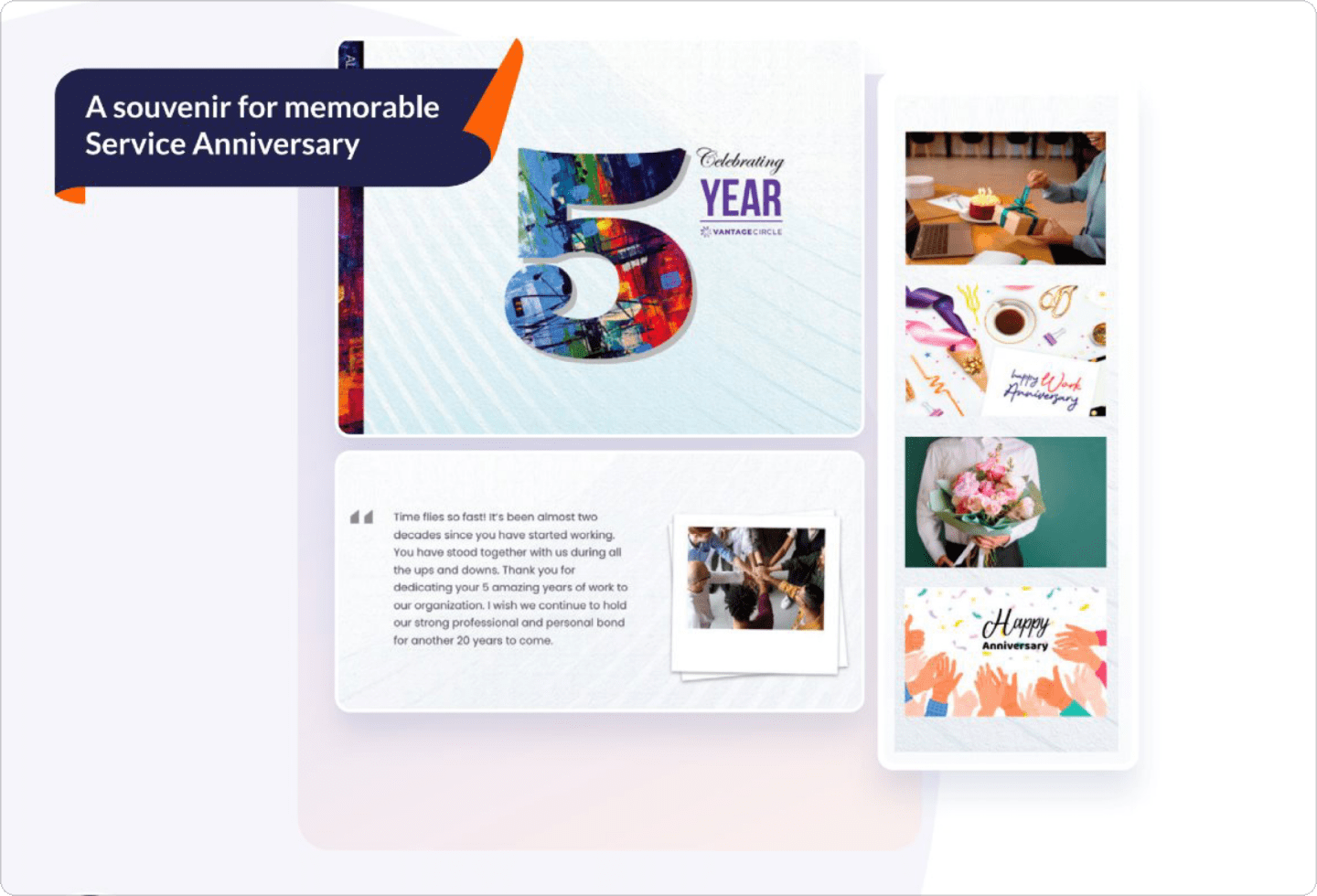
(Source: Vantage Recognition)
2. Give Thoughtful, Meaningful Rewards
Recognition and rewards need to be specific and value-based instead of it being generic.
A culture of appreciation goes beyond acknowledgment. Sometimes it means giving employees rewards with real weight behind them, chosen thoughtfully and given promptly rather than batched into an annual cycle. Deloitte's 2025 High-Impact Total Rewards research found that mature rewards organizations are 7.2x more likely to use data and analytics to personalize recognition than less mature ones.
And if you are using a recognition and rewards platform it should give you the flexibility to offer meaningful, customizable rewards, from spot awards to social recognition, while keeping the process consistent. It should also allow you to personalize the message when you give a reward to keep things meaningful. It's a small change that makes the gesture land.
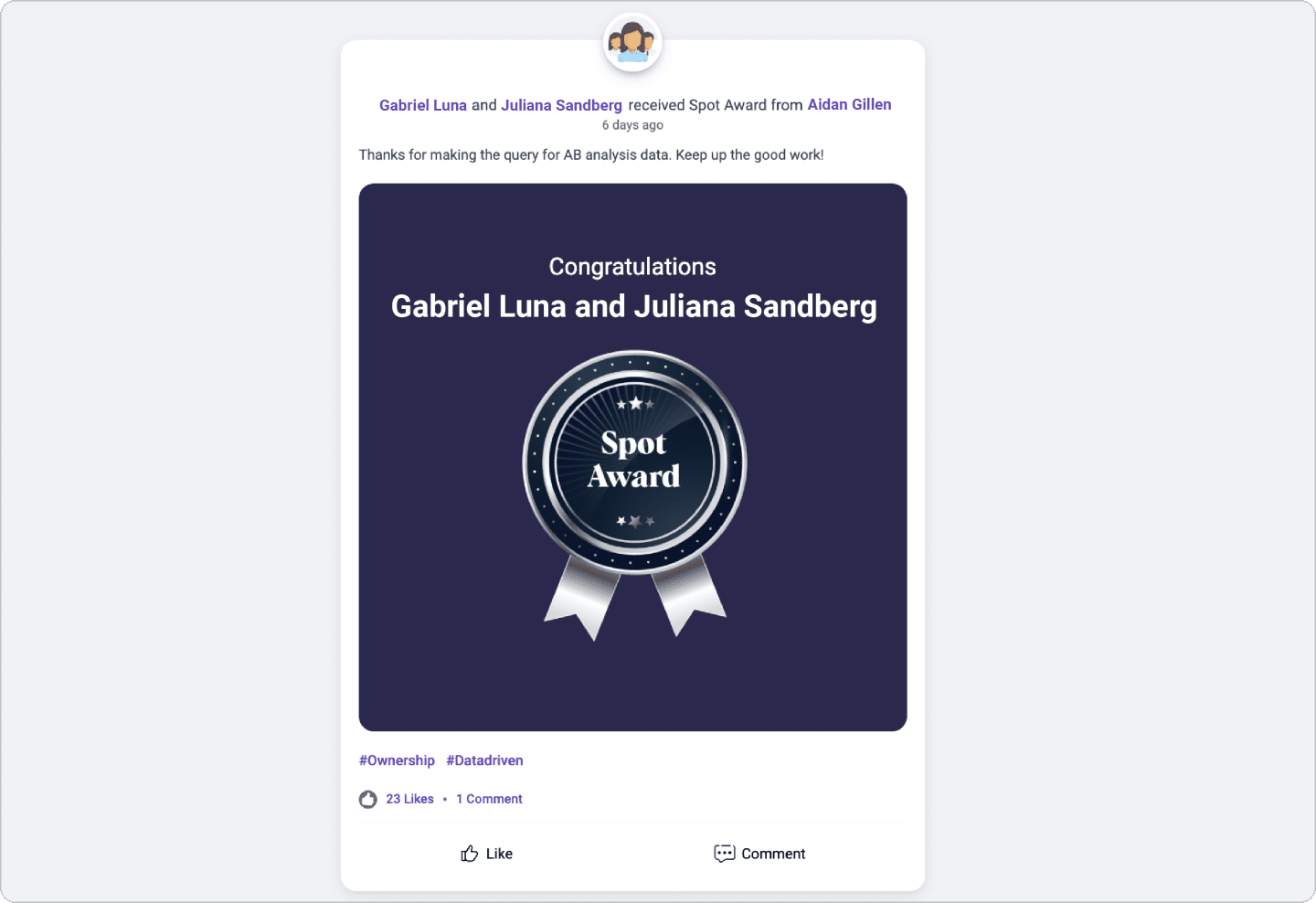
(Source: Vantage Recognition)
Use personalized phrases while rewarding to make it more impactful.
3. Enable Peer-to-Peer Recognition
Appreciation that only flows top-down misses most of what actually happens day to day. Peers see the work managers don't.
Employees should be able to recognize each other directly, not just receive recognition from above. O.C. Tanner's 2025 Global Culture Report found that 89% of employees agree peer recognition improves workplace culture, and 86% say giving recognition helps them connect better with colleagues. (O.C. Tanner, 2025)
A culture of peer recognition builds a more positive work environment and reduces day-to-day friction on teams. Recognition platforms should allow automated peer-to-peer recognition, with AI-assisted prompts and customizable badges. This makes it easy for employees to recognize colleagues the moment it happens instead of waiting for a manager to notice.
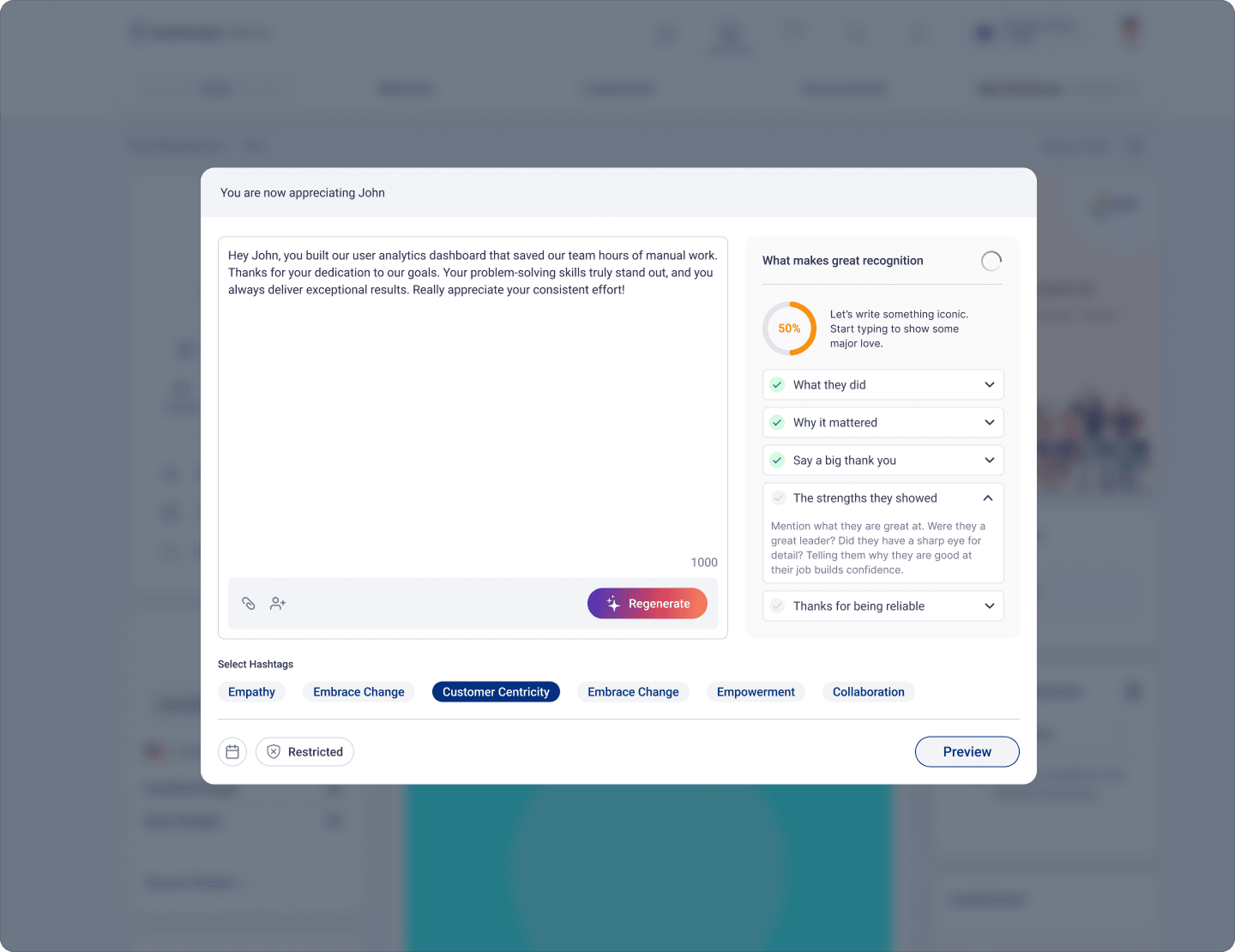
(Source: Vantage Recognition)
4. Acknowledge Small Wins, Not Just Big Ones
Big wins get celebrated by default. Small wins need someone to notice on purpose.
Recognizing major achievements matters, but the small, everyday wins are what actually build the culture, since they happen far more often. A pat on the back or a mention in front of the team costs nothing and adds up over a year in a way one big annual award never will.
As a manager, be part of these small moments. Stay inclusive and neutral about who gets noticed. The goal is fewer people quietly disengaging because their work goes unseen.
5. Solicit Employee Feedback
Appreciation isn't only about giving. It's also about listening, and a culture that only broadcasts recognition without asking for feedback is having half a conversation.
Run regular surveys to understand what appreciation actually means to your team, since it's not the same for everyone. Hence, a survey tool like Vantage Pulse automates this, giving you an ongoing read on participation and sentiment instead of a once-a-year guess.
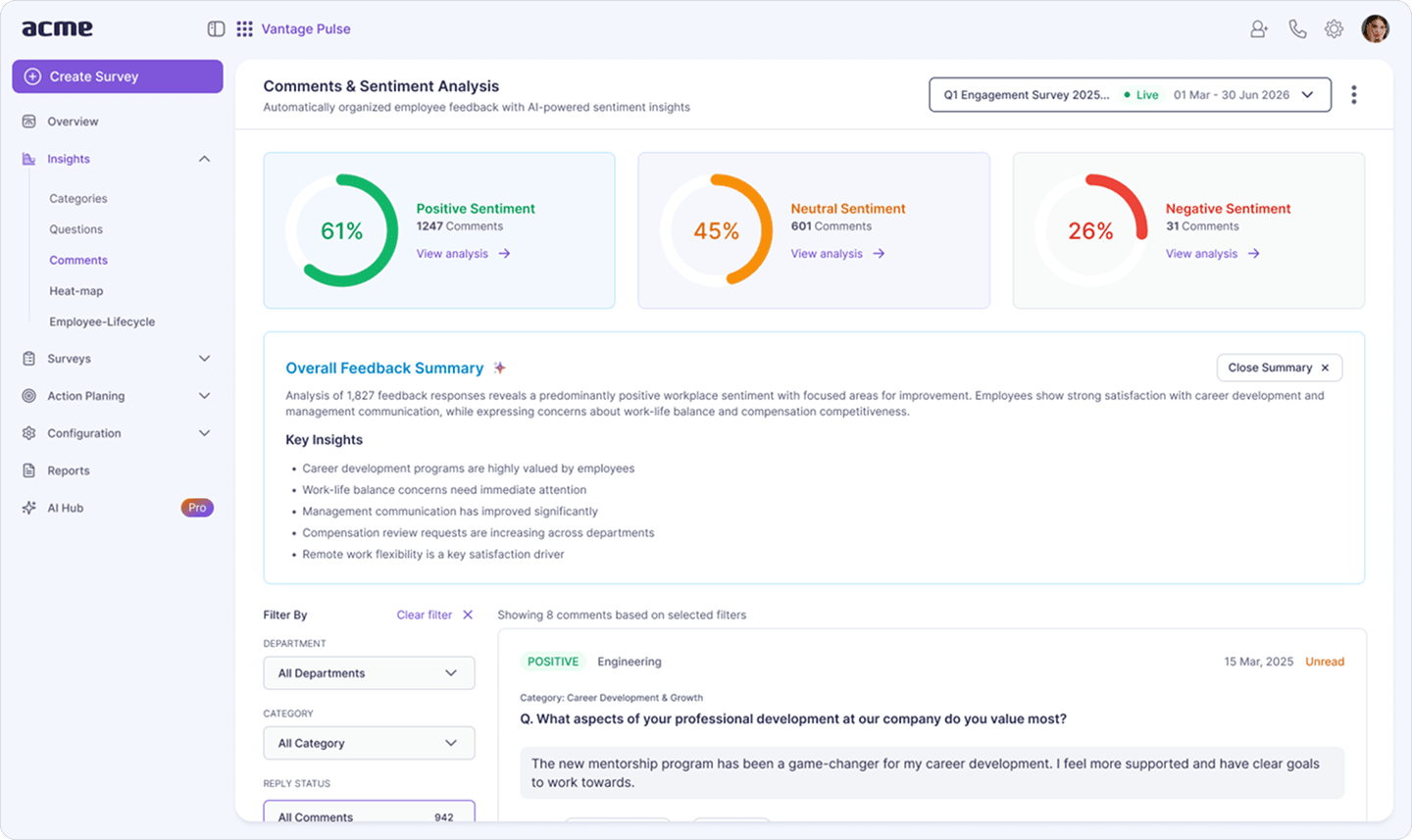
(Source: Vantage Pulse)
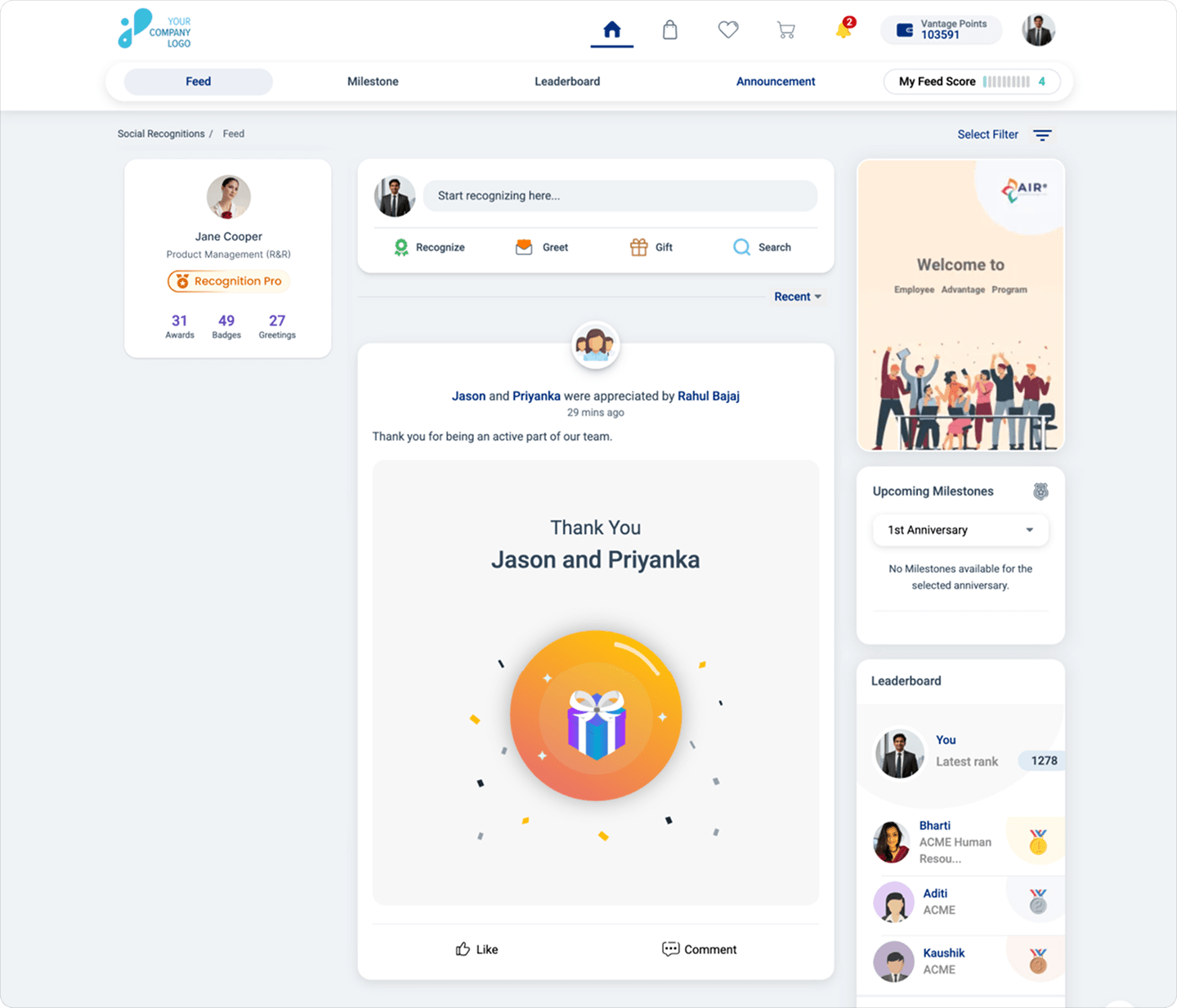
6. Make Recognition Social and Visible
Recognition works best when it's seen, not just given.
The same Gallup and WorkHuman research that shows recognition drives engagement found employees are 2.9x more likely to be engaged when their recognition hits even one quality marker, and visibility is one of the fastest ways to make that marker land: a public shout-out reaches far more people than a single private thank-you ever could (Gallup & WorkHuman, Sept 2024).
In-house, one-on-one recognition is a good starting point, but making it visible, on a team feed or through your company's social channels, adds a layer that shapes what the rest of the team believes is valued.
(Source: Vantage Recognition)
I'd add one caveat here: not everyone wants to be recognized publicly. Pushing a quieter employee onto the company Instagram isn't appreciation, it's exposure. Ask first, and keep it a continuous habit rather than a one-off moment.
Not everyone would want to be publicly recognized.
7. Give Timely Breaks to Reset
Burnout doesn't announce itself. It shows up as declining output from people who used to be your most reliable.
Modern work culture pushes employees to constantly perform, and that takes a toll on mental and physical health over time. Left unaddressed, it produces the opposite of what you're trying to build: frustrated, less productive people instead of appreciated ones.
Watch for the early signs and give people timely breaks to recover. It signals that you see the effort behind the output, not just the output itself.
8. Encourage Employees to Think Out of the Box
Innovation dies quietly in cultures where new ideas feel risky to voice. Only 28% of employees strongly agree that their opinions count at work (Gallup, 2025), which means most people are sitting on ideas nobody ever asked for. Building a workforce that's genuinely innovative takes independence and confidence, which means investing in people's growth so they're equipped to contribute ideas, not just execute tasks.
As a manager, that can look like training and development programs, funding side projects, incentivizing impactful ideas, running round-robin meetings to widen participation, or simply changing the room you meet in. None of this is expensive. It's a psychologically safe environment where people expect to be wrong sometimes and aren't punished for it.
| Way | Effort | Best for |
|---|---|---|
| 1. Celebrate milestones | Low, once automated | Tenure and project completions |
| 2. Give thoughtful, meaningful rewards | Medium | Individual, value-based recognition |
| 3. Enable peer-to-peer recognition | Low | Everyday, bottom-up appreciation |
| 4. Acknowledge small wins | Low | Day-to-day morale |
| 5. Solicit employee feedback | Medium | Understanding what appreciation means to your team |
| 6. Make recognition social and visible | Medium | Setting team-wide norms |
| 7. Give timely breaks to reset | Low | Preventing burnout |
| 8. Encourage out-of-the-box thinking | Medium | Innovation and psychological safety |
How to Measure Whether Your Appreciation Culture Is Working
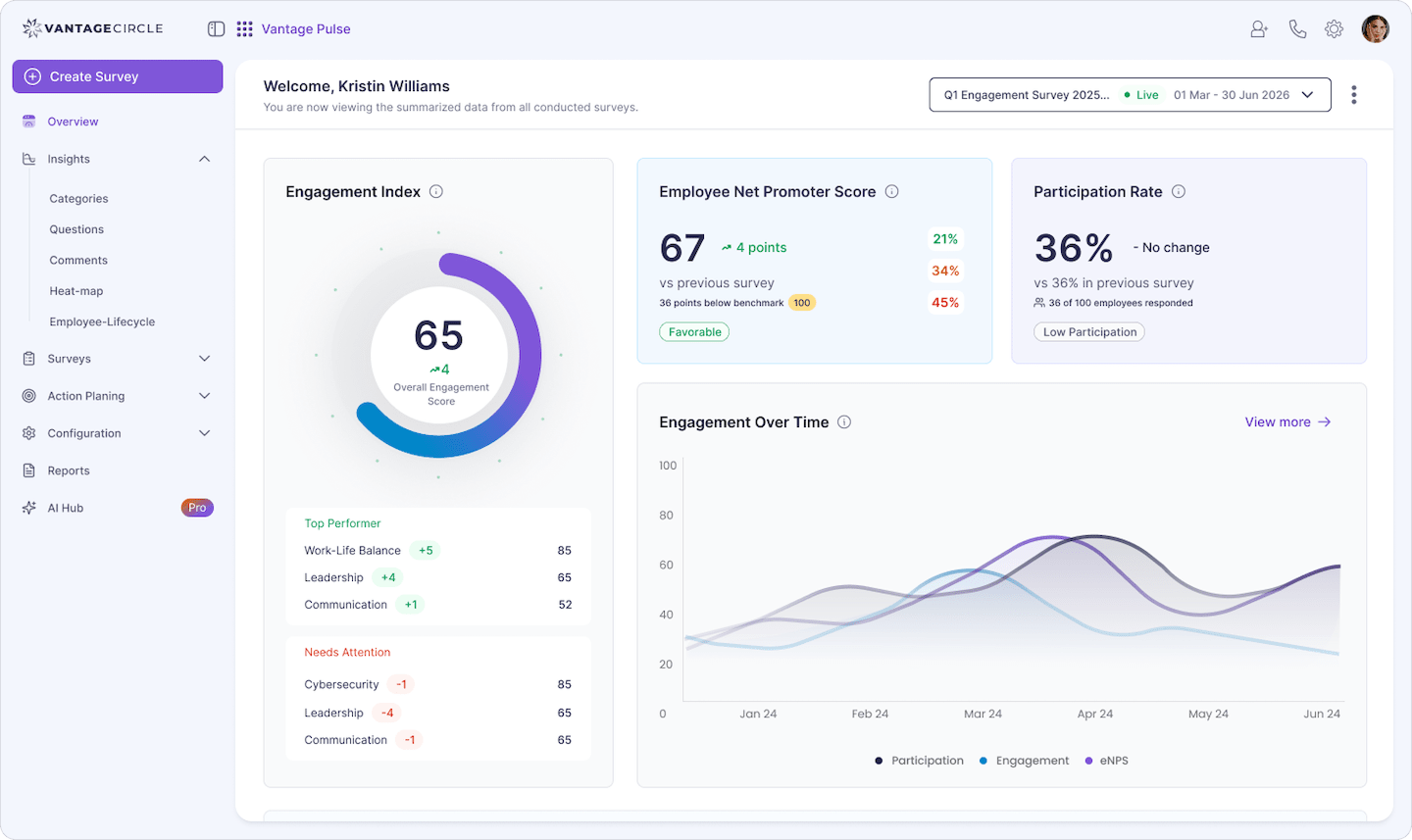
Measure your appreciation culture with three signals: recognition participation rate, eNPS, and the share of employees who say they feel valued.
Participation rate tells you whether appreciation is reaching everyone or clustering around the same five people every quarter. If your top performers get recognized weekly and half your team hasn't been mentioned all year, you don't have a culture. You have a fan club.
eNPS, or employee Net Promoter Score, gives you a number you can track over time instead of a gut feeling. Run it quarterly with a tool like Vantage Pulse's eNPS survey, and watch how the score moves as you change how often, and how publicly, you recognize people.
(Source: Vantage Pulse)
The third signal is qualitative: ask people directly whether they feel seen. Vantage Circle's 2025 joint study with Great Place to Work® India found that only 55% of employees feel truly recognized at work. If your number is anywhere near that, the fix isn't a bigger budget. It's frequency.
Summing It Up
Building a culture of appreciation isn't complicated, but it does take intention. Leaders and managers need to understand what their people actually need and follow through consistently, not just during a good quarter. Use the eight ways above as a starting point, or build your own version that fits your organization's actual culture, not the one on the careers page.
Just be mindful of the process. How you show appreciation matters almost as much as whether you show it at all.
FAQ
1. What is a culture of appreciation?
Ans: A culture of appreciation is a workplace where recognizing effort and contribution is a daily habit, not a once-a-year event. It shows up in peer-to-peer thanks, manager recognition, and visible acknowledgment of good work, and it's different from the version of the phrase used to describe habits in a marriage.
2. How do you build a culture of appreciation at work?
Ans: Start by making appreciation frequent, specific, peer-driven, and visible. Celebrate milestones, give meaningful rewards, enable peer-to-peer recognition, acknowledge small wins alongside big ones, ask for feedback, make recognition visible, protect people from burnout, and reward creative thinking. None of it requires a large budget. It requires consistency.
3. What is the difference between appreciation and recognition?
Ans: Appreciation is about who someone is: their effort, character, and consistency over time. Recognition is about what they did: a specific outcome or milestone. Strong cultures use both, since recognition without appreciation feels transactional, and appreciation without recognition can feel vague.
4. Why is appreciation important in the workplace?
Ans: Appreciation directly affects whether people stay, how hard they work, and how connected they feel to their team. Vantage Circle's 2025 research with Great Place to Work® India found that only 55% of employees feel truly recognized at work, and closing that gap is one of the highest-leverage things a leader can do without new budget.

He has worked in the human resources environment and has elevated recognition and rewards through his insightful and detailed writing. He aims to enhance the practice of Recognition in the workplace with new ideas and innovation that will help shape the work culture. For any related queries, contact editor@vantagecircle.com