Most peer-to-peer recognition programs are dead by month four.
Not killed by leadership. Not defunded. They just quietly stop. The recognition feed scrolls less. Manager mentions of peer recognitions trail off. By Q2, the platform is a line item nobody can defend in a budget review.
The failure pattern is identical across companies of every size. A strong launch, a quiet month three, and an HR director who cannot tell their CHRO whether the program changed anything inside the workplace. The fix is not better launch energy. It is a structured rollout that builds measurement in from day one.
🎯 The 3-Phase Playbook at a Glance
Starting a peer-to-peer recognition program takes 3 phases: Pilot (weeks 1–8) to validate the model with one team, Scale (weeks 9–24) to roll it out company-wide with a points platform, and Optimize (quarter 2 onward) to track participation, equity, and engagement KPIs. Most programs fail in the Scale phase because they skip recognition criteria and a manager-pairing model.
- 🧪 Pilot — Test the model on one team before committing org-wide
- 🚀 Scale — Roll out with a platform, communication plan, and budget mechanics
- 📊 Optimize — Measure what's working, fix what isn't, and layer in deeper maturity
What Is a Peer-to-Peer Recognition Program (and Why It Beats Top-Down Alone)
A peer-to-peer recognition program lets non-managerial employees acknowledge each other's contributions directly. With points, badges, or a public message on a recognition feed, without routing through a manager.
That last part matters more than most organizations realize.
Manager-led recognition captures maybe 20% of the daily moments worth recognizing. The other 80% are the teammate who stayed late to debug a release, the person who de-escalated a client call before it became a fire, the one who quietly onboarded three new hires while running their own project. Those happen out of any single manager's line of sight. They go unrecognized by default.
The cost of that gap shows up in disengagement data: 77% of employees globally are not engaged or actively disengaged, with only 23% thriving at work (Gallup, *State of the Global Workplace*). For younger cohorts specifically, Gen Z and younger millennials are 73% more likely than Baby Boomers to say they want recognition at least a few times a month (Gallup & Workhuman) — and they're the cohort most likely to leave when that cadence isn't delivered. The fix is structural, not motivational, and peer-to-peer recognition is the most studied structural intervention HR has.
By the Numbers — What Peer Recognition Actually Moves
In another rollout, peer-to-peer recognition grew 74% over a two-year stretch (Source). A more mature program crossed 93% employee participation, meaning almost everyone on payroll had given or received recognition from someone outside their reporting line (Source). The exact numbers move at different speeds depending on industry and starting point. The pattern doesn't: structured peer recognition is one of the very few HR interventions that changes a curve over years, not a survey response over weeks. Explore the AIRe Framework research →
The more honest case is that peer recognition changes who is seen inside your organization. Visibility is what moves engagement. Retention follows from that, not the other way around.
What separates programs that last from programs that die in month four is whether you build them on a rollout framework or on enthusiasm alone. Enthusiasm runs out. This is the employee recognition program rebuild playbook for HR teams about to launch, or trying to salvage something that stalled.
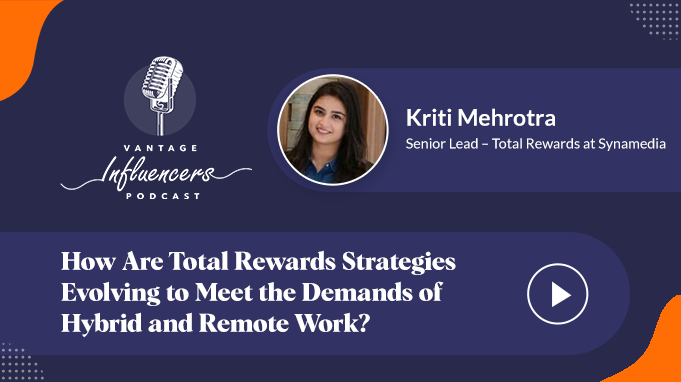
VANTAGE INFLUENCERS PODCAST
"In remote and hybrid setups, visibility tends to drop. We have to avoid proximity bias. When you sit closer to the manager, your chances of being seen are higher, and you get more recognition. Strong systems are what keep recognition from being limited to the loudest or most visible people."
— Kriti Mehrotra, Senior Lead, Total Rewards
Listen to the Episode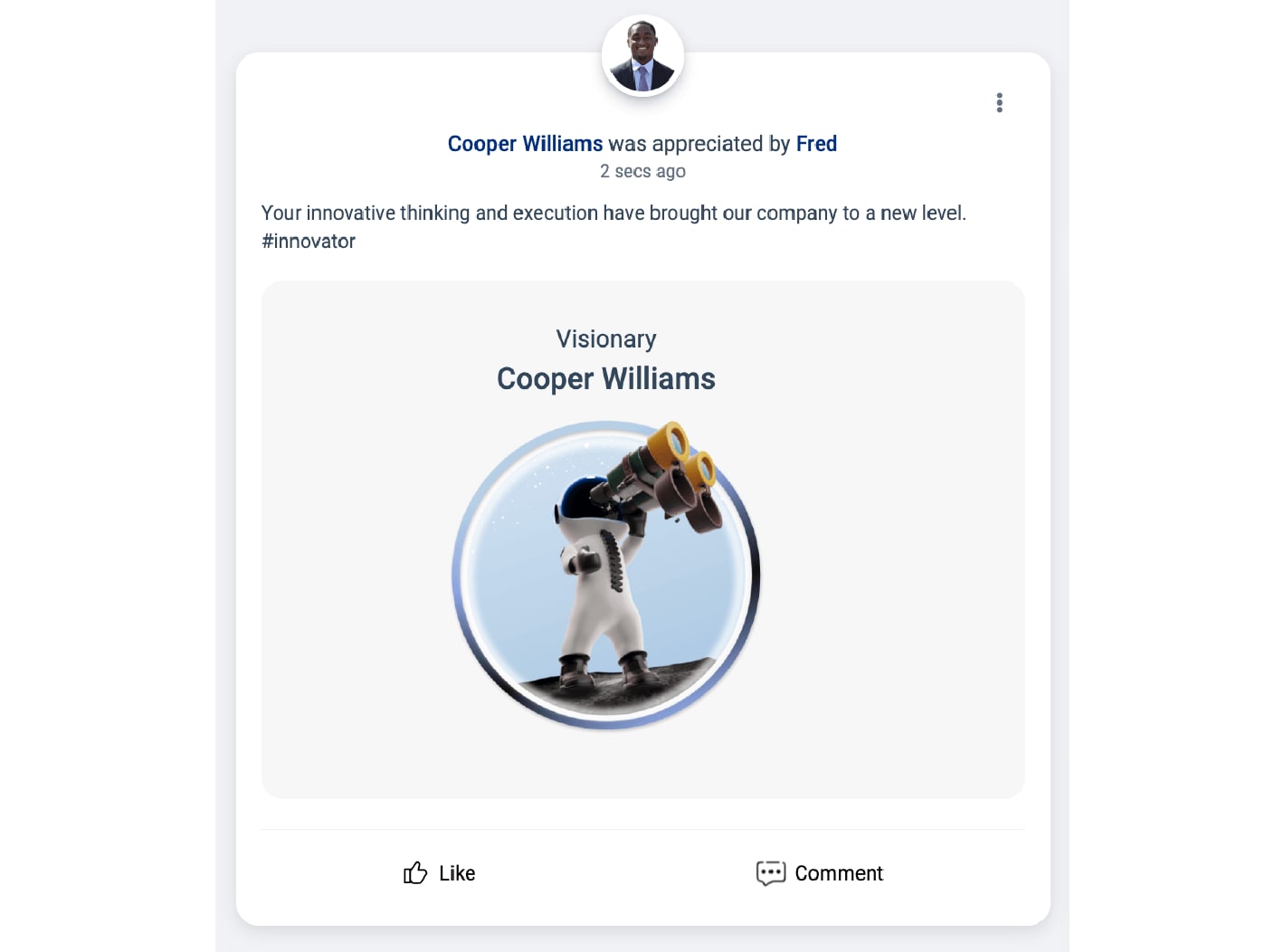

15 Peer Recognition Message Templates (with Examples)
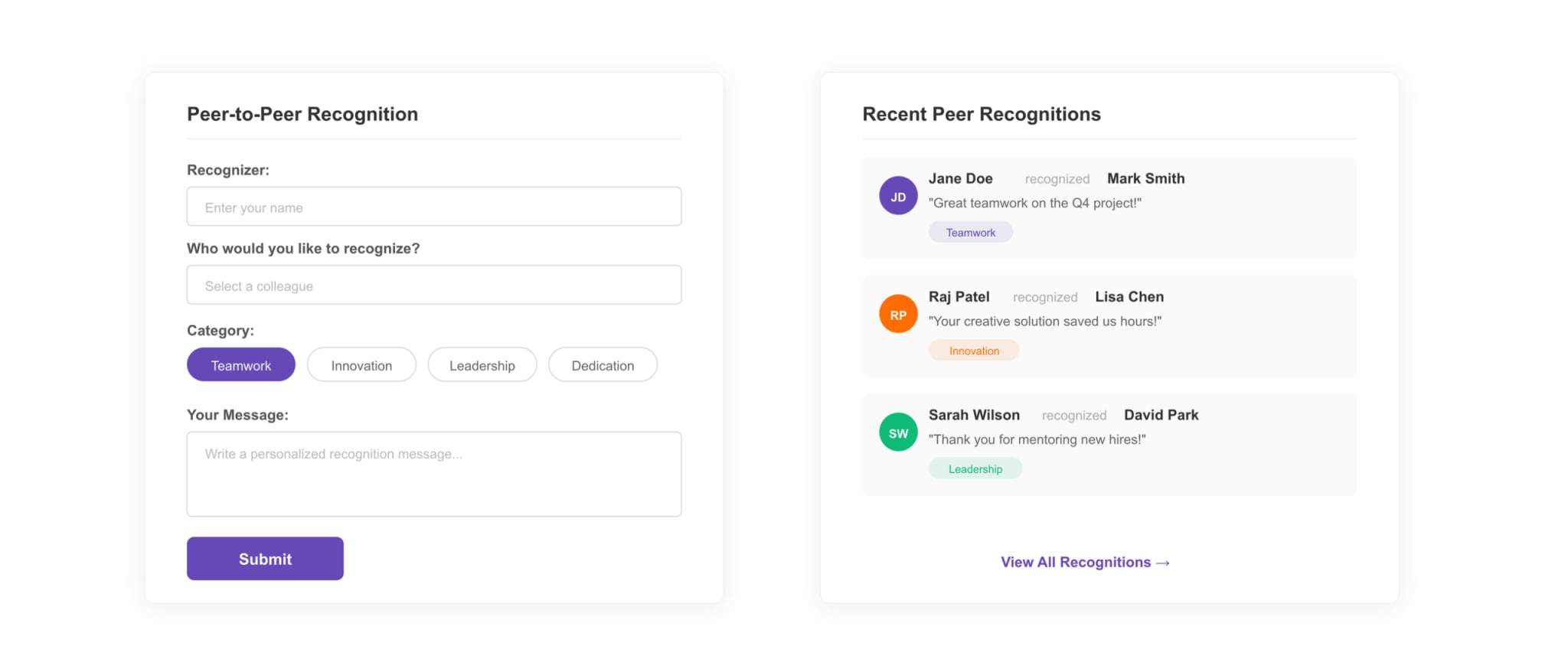
Templates lower the activation cost of recognition. The hardest part of sending a peer recognition message isn't wanting to recognize someone. It's knowing what to say that doesn't feel generic.
"Great work!" is meaningless. What moves people is specificity: what they did, why it mattered, and what it made possible. Peer recognition posted to a public social recognition feed inspires roughly 3x more reciprocal recognition than recognition delivered privately, based on participation patterns observed across 700+ Vantage Circle customer programs and 3.2M+ platform users. These templates are designed to be specific enough to feel real on a public feed.
4 Templates for Project Completion
| Template Type | Sample Message | When to Use | |
|---|---|---|---|
| ✅ | Short completion | "[@Name] delivered the Q3 report two days early and caught a data discrepancy that would have been embarrassing to miss. That's [Value: Ownership] in action." | Single clean deliverable |
| 🏔️ | Milestone | "[@Name] led the migration project over six weeks while onboarding two new team members simultaneously. I've never seen someone carry that load and still make time for every question. [Value: Collaboration + Ownership]" | Sustained multi-week effort |
| 🎭 | Behind-the-scenes | "[@Name] held the technical side of the launch together this week while the rest of us focused on the client side. That work is invisible when it goes right. Thank you. [Value: Reliability]" | Invisible-to-leadership contributions |
| 🔀 | Cross-functional | "[@Name] jumped in from a different team to troubleshoot the integration issue at the worst possible time. We would have pushed the deadline by a week without that. [Value: Collaboration]" | Cross-team contributions |
4 Templates for Going Above and Beyond
| Template Type | Sample Message | When to Use | |
|---|---|---|---|
| 🚨 | Crisis response | "[@Name] spent three hours on Saturday helping a client work through a setup issue blocking their launch. Nobody asked. They just did it. [Value: Customer Focus]" | Unasked-for action in an unexpected situation |
| 💎 | Quality | "[@Name] rewrote the onboarding guide three times until it was actually clear to someone reading it cold. That extra effort saved every new hire hours of confusion. [Value: Excellence]" | Effort driven by quality rather than speed |
| 🛡️ | Coverage | "[@Name] covered the afternoon shift when two teammates were out sick, without being asked, and didn't drop a single task. [Value: Reliability]" | Covering for a colleague |
| 🌱 | Mentoring | "[@Name] has been quietly mentoring two junior team members this quarter without it being in their job description. Both said it changed how they approach their work. [Value: Growth]" | Informal coaching and mentoring |
4 Templates for Peer Support and Team Morale
| Template Type | Sample Message | When to Use | |
|---|---|---|---|
| 💛 | Emotional support | "[@Name] noticed I was having a rough week and checked in twice. Once to ask if they could help, once just to say something kind. That matters more than most people realize. [Value: Empathy]" | Genuine human support moments |
| 🤗 | Inclusion | "[@Name] made sure [@New Hire] felt included in every meeting this week. Introduced them to the right people, checked in after calls, remembered details. That's how teams actually build culture. [Value: Inclusion]" | Inclusion behaviors, especially with new hires |
| ⚡ | Team energy | "[@Name] brought the energy this week when the rest of us needed it. Sometimes the most valuable contribution on a hard sprint is the person who keeps everyone from burning out. [Value: Resilience]" | Contributions to morale during difficult periods |
| 🔇 | Quiet work | "[@Name] has been handling the scheduling, notes, and follow-ups behind this project without anyone asking and without any recognition. It's the work that disappears when it's done well. Thank you. [Value: Ownership]" | Behind-the-scenes contributions |
3 Templates for Cross-Functional Collaboration
| Template Type | Sample Message | When to Use | |
|---|---|---|---|
| 🌉 | Bridge-building | "[@Name] spent two hours walking our team through their process so we'd stop creating rework on their side. That kind of transparency across teams is rare. [Value: Collaboration + Transparency]" | Cross-team alignment investment |
| 🎯 | Shared outcome | "The product launch worked because [@Name] kept engineering and marketing timelines in sync when they kept pulling apart. They never made it anyone's fault. They just fixed the gap. [Value: Ownership]" | Coordination role across competing teams |
| 📚 | Knowledge transfer | "[@Name] documented their entire workflow so our team could cover during their leave. That's a significant gift of time that won't show up on any performance review. [Value: Generosity]" | Proactive documentation and knowledge-sharing |
Download all 15 templates as a PDF (no email required) →
See more in the appreciation message guide.
8 Common Mistakes That Kill Peer Recognition Programs
Programs don't fail because the idea is bad. They fail because the implementation ignores a small number of predictable problems that show up at the same points in the lifecycle, every time.
Most of these mistakes aren't visible at launch. They surface at the 90-day mark, after the pilot energy has worn off. The gap is well-documented in the broader data: across recognition programs surveyed, only 2% of US programs and 11% of India programs are rated "Very High" in R&R effectiveness, while the majority sit in low-to-moderate effectiveness bands (The State of Recognition & Rewards 2025, Vantage Circle). The mistakes below are how programs end up there.
| Mistake | Why It Kills the Program | ✓ Fix | |
|---|---|---|---|
| ❌ | No recognition criteria | Employees default to generic messages or nothing | Define 3–5 recognition-worthy behaviors tied to company values before launch |
| 🏃 | Skipping the pilot | Company-wide rollout without validation makes failure expensive and visible | Pilot with 1–2 teams for 8 weeks before committing platform budget |
| 😐 | Manager neutrality | When managers ignore the feed, employees conclude it doesn't matter | Give managers a specific role: reference one peer recognition per team meeting |
| 💸 | No monetary floor | Non-monetary recognition loses momentum after 8–12 weeks in most orgs | Add a $5–$10/employee/month points budget by Phase 2 if participation drops |
| 👁️ | Recognizing the same people | 15% of employees receive 80% of recognitions; visibility bias recreates the original problem | Track recognition equity and intervene in outlier departments quarterly |
| 📉 | No measurement framework | Activity metrics don't show whether the program is changing the workplace | Implement the 5 KPIs in Phase 3 before the program is 6 months old |
| 🔧 | Generic platform selection | Tools with no peer-to-peer native flow or equity analytics cap out quickly | Use the 5-criterion rubric in Phase 2 before signing a contract |
| 📅 | No cadence after launch | Programs without recurring activation lose momentum by month 4 | Schedule one recognition campaign every 6–8 weeks through the Scale phase |
If you only recognize the loud achievers, you've built a popularity contest, not a recognition program.
How to Measure Peer Recognition Program Success
Participation rate is where most organizations stop measuring. It shouldn't be where you stop.
The 3 KPIs to activate on day one of Scale phase are peer-vs-manager recognition ratio (are peers actually driving the program?), reciprocity index (are the same 20 people sending all the recognitions, or is it genuinely lateral?), and values-tagged share (are people using recognition to signal what the organization values?).
Those three numbers tell you, within 30 days of Scale launch, whether you have a program or a politely used feature.
The full measure recognition success framework, all 9 KPIs with formulas and benchmarks, lives in the dedicated measurement post. Use it once Phase 3 metrics are stable and you're ready to build a recognition ROI model for leadership reporting. See the 9-KPI measurement framework.
FAQs on Starting a Peer-to-Peer Recognition Program
❓ How to create a peer-to-peer recognition program? +
Create a peer-to-peer recognition program in 3 phases: Pilot (weeks 1–8), Scale (weeks 9–24), and Optimize (quarter 2 onward). In the Pilot, select one team of 15–30 people, define recognition criteria tied to company values, and set a 60% participation target before broader rollout. In Scale, select a platform with native peer-to-peer flow, build separate communication for employees, managers, and executives, and add monetary mechanics of $5–$10 per employee per month. In Optimize, track the 5 peer-recognition-specific KPIs and run quarterly audits to fix equity and participation gaps.
❓ How to introduce a recognition program? +
Introduce a recognition program by communicating to 3 audiences separately. Employees need to know what to recognize and how to do it in under 60 seconds. Managers need to understand their specific reinforcement role and what the data will show them. Executives need to see the connection to engagement and retention numbers they already care about. Avoid launching with a single all-hands email. Brief the manager before the employee launch so the team lead is already using the platform when employees first log in.
❓ What are common peer recognition mistakes? +
The 8 most common peer recognition mistakes: launching without recognition criteria, skipping the pilot phase, treating managers as neutral bystanders, using no monetary floor in a non-monetary program, allowing visibility bias to concentrate recognition on the same employees, measuring only activity metrics, selecting a platform without native peer-to-peer flow, and failing to build recurring activation campaigns after launch. The equity issue kills the most programs. Programs that recognize the same 15–20% of employees consistently recreate the visibility problem they were designed to solve.
❓ What is an example of a peer-to-peer recognition letter? +
A strong peer recognition message names what the person did, why it mattered, and what value it exemplifies. Example: "[@Name] covered the afternoon shift when two teammates were out sick, without being asked, and didn't drop a single task. That's the kind of reliability that makes teams work. [Value: Reliability]." Generic messages like "great job this week!" erode recognition culture over time because they signal that recognition is social nicety rather than organizational signal. See the 15 templates above, organized by occasion type.
❓ What are the 5 types of rewards? +
The 5 types of rewards used in peer recognition programs are: monetary rewards (points redeemable for gift cards, experiences, or merchandise), non-monetary recognition (public acknowledgment, values badges, certificates), social recognition (public feed posts, team shoutouts, company-wide announcements), experiential rewards (time off, team events, learning opportunities), and developmental recognition (stretch assignments, mentorship access, leadership visibility). Most effective peer programs combine monetary and social recognition in the same event. A points award without a public message loses most of its cultural impact.
❓ How long should the pilot phase last? +
The pilot phase should last 8 weeks for most organizations. That's long enough to see a second natural recognition cadence (most employees recognize once per month in a working program), to check whether values-tagging behavior holds, and to see whether participation plateaus or grows. For project-based work on 6–12 week cycles, extend to 12 weeks so you capture at least one full cycle. Don't run a pilot shorter than 6 weeks. You're measuring behavior change, not software adoption, and behavior change takes time to appear in data.
Most peer recognition programs that fail don't fail because the idea is wrong. They fail because the rollout was one phase instead of three, the criteria were too vague to generate real signal, and the measurement stopped at participation rate.
The Pilot-Scale-Optimize framework solves those three problems in sequence. Pilot validates your model before you commit budget. Scale builds the structural scaffolding that keeps the program alive past month four. Optimize turns recognition from an activity log into an outcome model your CFO can read.
The template library and KPI framework in this guide remove the two biggest friction points in peer recognition programs: employees who want to recognize but don't know what to say, and HR teams who can see recognition volume but can't connect it to business outcomes.

He has worked in the human resources environment and has elevated recognition and rewards through his insightful and detailed writing. He aims to enhance the practice of Recognition in the workplace with new ideas and innovation that will help shape the work culture. For any related queries, contact editor@vantagecircle.com