Employee pulse survey tools collect short, recurring, usually anonymous feedback and turn it into real-time engagement, eNPS, and sentiment data. For most HR teams the shortlist comes down to fit, not price: Vantage Pulse and Workday Peakon for continuous listening with strong anonymity and reach across the whole workforce, Culture Amp and Qualtrics for enterprise analytics, 15Five and Lattice for engagement bundled with performance, and CultureMonkey for enterprise and multilingual listening. Only three of the fifteen publish a per-user price; the rest are custom.
Most HR teams don't really choose a pulse survey tool. They inherit one, usually the cheapest seat bundled into a platform they already pay for, and then spend the next two years quietly wondering why nobody fills it out. The tool decides something bigger than its feature list. It decides whether feedback shows up as a number you can act on this week, or a report that loads in under a second and tells you nothing in time to matter. The fifteen platforms below all promise the same thing. They mean very different things by it.
An employee pulse survey tool is software that runs short, recurring, usually anonymous surveys and turns the responses into engagement, eNPS, and sentiment data you can track over time. The good ones reach everyone, including the people without a company laptop, protect anonymity well enough that employees actually say what they think, and connect what they hear to a next step. The rest just collect responses.
The payoff for getting this right is not abstract. Employees who feel their voice is heard are nearly five times (4.6x) more likely to feel empowered to do their best work, by Salesforce's 2017 measure. Feeling heard depends on being asked often, and asked in a way you trust enough to answer honestly.
How we evaluated these tools
Most "best tools" lists rank on features and price. Those are the easy things to compare and the wrong things to decide on. A pulse program succeeds or fails on whether people answer honestly, whether everyone can answer at all, and whether anything happens after they do. We weighted five dimensions accordingly.
- Reach (30%). Can it survey your whole workforce, not just the people at desks? Email-and-Slack-only tools quietly skip frontline and deskless staff, who are often the people you most need to hear from. Kiosk, QR, SMS, and WhatsApp are what close that gap.
- Anonymity (25%). Honest answers depend on employees believing their responses are private. There is a real difference between truly anonymous (responses not tied to identity), confidential (tied to identity but protected by group-size thresholds), and opt-in. We note which model each tool uses.
- Action (20%). A score nobody acts on is just a number. We looked at whether results connect to follow-up: manager dashboards, suggested actions, and a way to respond to feedback without breaking anonymity.
- AI (15%). Open-ended comments are where the real signal lives, and reading thousands of them by hand does not scale. We looked at what the AI actually does, from sentiment and summaries to theme detection, and how much manual analysis it removes.
- Price and fit (10%). What it costs, whether that price is published or quote-only, and whether the tool is sized for your team rather than three tiers above it.
Pricing reflects what each vendor published as of June 2026. Where a vendor only quotes custom pricing, we say so rather than guess. Product descriptions and capabilities draw on vendor documentation and verified reviews on G2, checked in June 2026. We do not take payment for placement, and every tool is measured against the same five dimensions.
Quick comparison
| Tool | Best for | Anonymity | Frontline reach | AI features | Starting price |
|---|---|---|---|---|---|
| Vantage Pulse | Continuous, anonymous feedback tied to action | Yes | Kiosk, QR, SMS, Teams, no-login link | Sentiment, AI summaries, AI reply drafting, attrition risk | Custom |
| CultureMonkey | Enterprise and multilingual teams | Yes | SMS, WhatsApp, QR, kiosk | Sentiment analysis, AI action recommendations | Custom |
| Culture Amp | Science-backed enterprise benchmarking | Yes | Web, Slack, Teams | Comment summaries, AI Coach | Custom |
| 15Five | Engagement plus performance management | Yes | Mobile app, web, Slack | Predictive Impact Model, AI feedback synthesis | From $4/user/mo |
| Workleap Officevibe | Small teams inside Slack or Teams | Yes | Slack, Teams, web | AI highlights, recommended actions | Custom |
| Amber by inFeedo | Always-on conversational chatbot listening | Yes (separate channel) | SMS, WhatsApp, Teams, Slack, email | Conversational NLP, attrition prediction | Custom |
| Qualtrics | Deep, configurable enterprise EX | Yes | Email, SMS, QR, offline app | Sentiment, predictive flight-risk, theme analysis | Custom |
| Microsoft Viva Glint | Engagement analytics inside Microsoft 365 | Limited (not anonymous) | Email, web | Copilot open-text summaries and Q&A | From $2/user/mo |
| Workday Peakon Employee Voice | Workday HCM customers, benchmarking | Yes | Email, SMS, Slack, Teams, kiosk, app | Illuminate gen-AI summaries | Custom |
| Lattice | Engagement tied to performance and goals | Yes | Slack, Teams, email, app | AI Analysis, comment sentiment | From $4/seat/mo |
| Leapsome | Performance plus engagement in one suite | Yes | Web, Slack, email | Sentiment, summaries, AI action plans | Custom |
| TINYpulse by WebMD | Feedback plus recognition with well-being | Yes | Not documented | Not documented | Custom |
| Quantum Workplace | Survey rigor with guided action planning | Yes | Web, kiosk, SMS, email | Narrative Insights summaries, AI action ideas | Custom |
| QuestionPro Workforce | Survey flexibility with an EX layer | Yes | Email, SMS, portal | Watson AI sentiment | Custom |
| Leena AI | Agentic AI HR service delivery with listening | Not stated | Teams, Slack, iOS, Android, web | Sentiment, attrition prediction, conversational VoE | Custom |
One thing the table makes obvious: very few tools do all of it well at once. Plenty are strong on analytics, or sit neatly inside Slack and Teams. Far fewer pair genuine anonymity with the reach to survey frontline staff and a built-in way to act on what comes back. That combination, more than any single feature, tends to separate a tool you are still using in two years from one you quietly stop opening.
See how Vantage Pulse fits your team
Answer three quick questions and we'll map Vantage Pulse to how your team actually works.
1 Where do most of your people work?
2 What's your biggest challenge right now?
3 How big is your team?
Our top 7 picks
- Vantage Pulse: best for organizations of any size that want anonymous, real-time feedback they can act on.
- Qualtrics: a heavyweight enterprise platform for teams with the budget and time to configure it.
- Culture Amp: benchmarking-focused, and built mainly for desk-based workforces.
- Workday Peakon Employee Voice: mostly worth it if you already run Workday HCM.
- 15Five: a performance-management tool first, with lighter survey depth.
- CultureMonkey: broad multilingual listening for enterprise teams, with engagement-only scope and quote-only pricing.
- Amber by inFeedo: a conversational chatbot, with anonymity only through a separate channel.
Tool-by-tool overview
1. Vantage Pulse
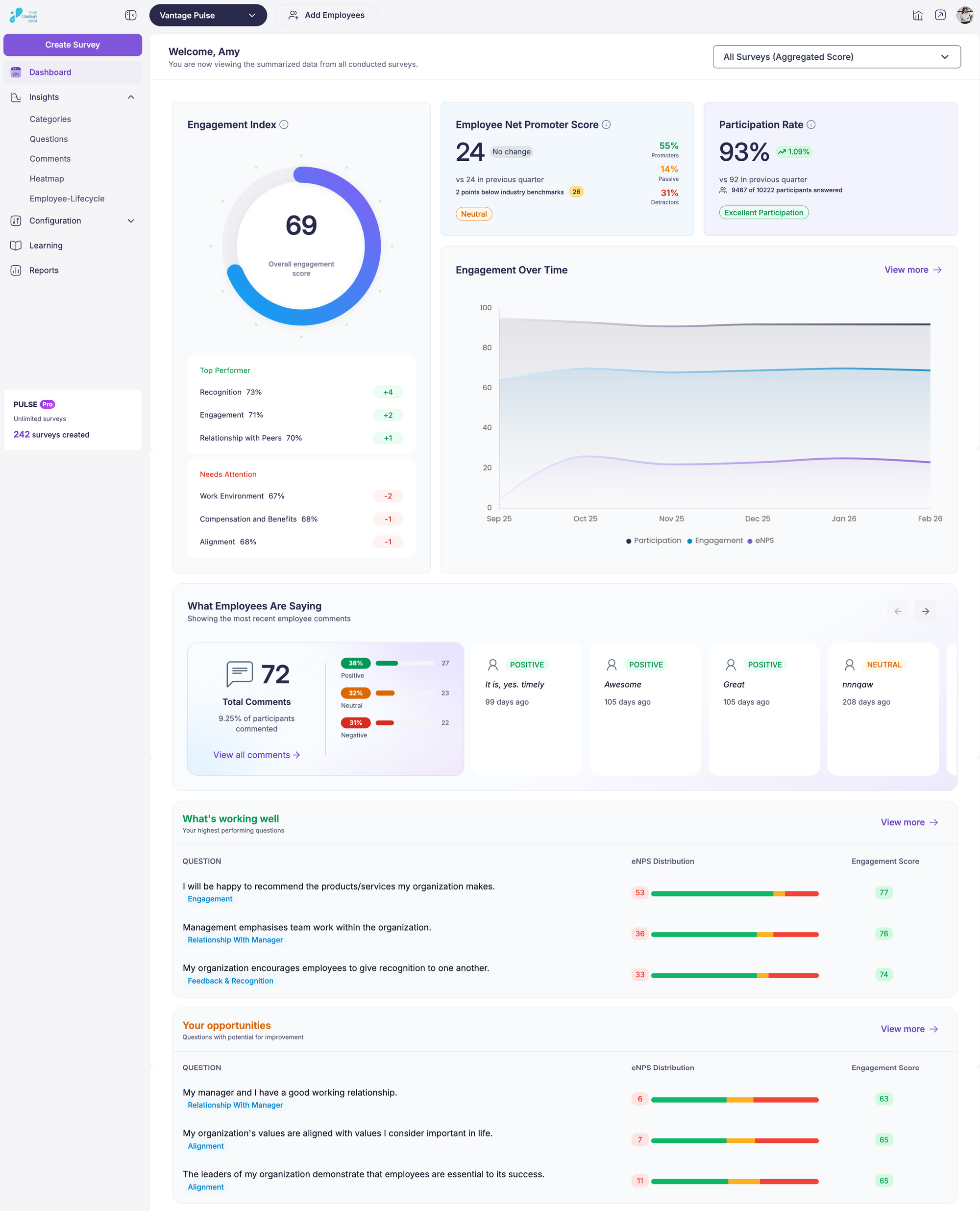
Vantage Pulse is an automated pulse survey platform built to collect, measure, and act on employee feedback in real time. It tracks employee engagement and eNPS, flags attrition risk by department through a filterable heatmap, and keeps every response anonymous. Its two-way anonymous conversation lets HR reply to a specific comment without ever learning who wrote it.
Best for: Organizations of any size that want continuous, anonymous feedback tied to a clear next step, including frontline and deskless teams.
Key features:
- Automated lifecycle surveys triggered at onboarding milestones (Day 7 through 90) and tenure anniversaries (Year 1 through 10)
- A library of validated questions and pre-built templates, with rated, multiple-choice, and open-ended formats
- eNPS tracking with promoter, passive, and detractor breakdowns alongside an engagement score
- Per-comment AI sentiment analysis with an AI-generated overall feedback summary
- AI key highlights and improvement recommendations drawn from the highest and lowest rated questions
- Two-way anonymous conversations, where HR replies to a specific comment with AI-drafted suggestions and still never learns who wrote it
- Heatmap with multi-level filtering by department, location, business unit, tenure, gender, and nationality
- Word cloud per open-ended question, filterable by sentiment
- Segment-level reports across department, location, BU, tenure, and employee type, exportable to PDF and CSV
- Benchmark data to compare scores against industry norms
- Surveys in multiple languages with right-to-left support, plus optional Vantage Points incentives
- Delivery across web, Microsoft Teams, SMS, no-login links, and kiosk or QR access for deskless and frontline workers
Pricing: Custom, based on team size and business needs.
Vantage Pulse fits teams that want feedback to end in a decision, not a dashboard. The reach across desk and frontline staff and the anonymous reply thread are where it separates from lighter tools. The trade-off is focus: it specializes in engagement, so teams that also need full performance-review or OKR tooling will pair it with another system.
2. CultureMonkey
CultureMonkey is a dedicated employee engagement platform built around pulse surveys, lifecycle listening, and manager dashboards. It supports enterprise and multilingual workforces at scale, with anonymity kept central to every program.
Best for: Enterprise and global multilingual teams that want anonymous feedback across many channels.
Key features:
- Recurring pulse, engagement, onboarding, and exit surveys
- 100% anonymous feedback as a survey type
- Delivery across SMS, WhatsApp, QR code, and kiosk
- AI sentiment analysis and action recommendations
- HRIS sync and manager-effectiveness dashboards
Pricing: Custom, contact sales.
One of the stronger options on this list for enterprise-wide and multilingual listening, with anonymity built into its core positioning. Like most dedicated platforms here, pricing is quote-only, so total cost usually scales with headcount.
3. Culture Amp

Culture Amp is an enterprise employee-experience platform built on people-science benchmarks, spanning engagement, performance management, and development. Its benchmarking data lets organizations compare their scores against industry norms.
Best for: Mid-market to enterprise organizations that want science-backed benchmarking alongside performance and development.
Key features:
- Engagement and lifecycle surveys with industry benchmarks
- AI comment summaries and text analytics
- Separate AI Coach and Skills Coach modules
- Slack and Microsoft Teams delivery
Pricing: Custom, contact sales.
Strong on benchmarking and data depth for organizations with a measurement culture. Delivery is desk-oriented, with no documented SMS or kiosk reach, and custom pricing skews it toward larger budgets.
4. 15Five

15Five is a continuous performance and engagement platform that combines surveys with weekly check-ins, one-on-ones, OKRs, and reviews. Engagement and performance live in the same place.
Best for: SMB and mid-market teams that want engagement plus performance management and manager coaching.
Key features:
- Engagement surveys and weekly check-ins
- Goal and OKR tracking
- Predictive Impact Model and AI-synthesized feedback
- Mobile app, web, and Slack
Pricing: Engage from $4 per user/month, billed annually. Higher tiers add performance tooling (Perform at $11, Total Platform at $16).
A good pick when performance and employee development matter as much as listening. The pure survey depth is lighter than dedicated listening tools, but the published pricing is refreshingly clear.
5. Workleap Officevibe

Workleap Officevibe, formerly Officevibe, is an engagement and feedback tool aimed at smaller teams. It runs pulse surveys, collects anonymous feedback, and adds peer recognition through its Good Vibes feature, mostly inside Slack and Teams.
Best for: Small and mid-sized teams that want a lightweight engagement tool inside Slack or Microsoft Teams.
Key features:
- Anonymous pulse surveys with privacy thresholds
- Peer recognition (Good Vibes)
- AI highlights and recommended actions
- Slack, Teams, and HRIS integrations
Pricing: Custom, available through a demo request.
Simple to roll out and easy for managers to use day to day. It documents no SMS or kiosk reach, so it is a weaker fit for frontline or deskless workforces.
6. Amber by inFeedo

Amber by inFeedo is an AI chatbot that checks in with employees through one-to-one conversations, reads sentiment from open-ended replies, and flags early signs of disengagement so HR can act before issues grow.
Best for: Mid-to-large enterprises, with a strong India and APAC base, that want always-on conversational listening across chat tools.
Key features:
- Conversational, chatbot-style check-ins
- Real-time sentiment and emotion analysis
- Attrition-risk prediction with HR alerts
- Channels across SMS, WhatsApp, Teams, Slack, and email
- Anonymous Ally, a separate anonymous feedback channel
Pricing: Custom, contact sales.
The conversational format lifts response rates, and the channel reach is wide. One thing to confirm: anonymity comes through its separate Anonymous Ally channel rather than the default check-ins, so check the setup if sensitive feedback is your priority.
7. Qualtrics

Qualtrics runs one of the deepest employee-experience platforms available, now organized around People Engage and People Lifecycle. It covers engagement, pulse, lifecycle, and passive listening, analyzed with advanced AI.
Best for: Large enterprises that need a deep, configurable lifecycle platform with advanced analytics.
Key features:
- Engagement, pulse, lifecycle, and passive-listening studies
- Sentiment analysis and predictive flight-risk scoring
- Verbatim theme analysis with manager action recommendations
- Distribution by email, SMS, QR code, and an offline app
Pricing: Custom, behind a pricing request.
The most analytically deep option on this list. That depth comes with setup time and enterprise pricing, so it is overbuilt for teams that just want a quick recurring pulse.
8. Microsoft Viva Glint

Microsoft Viva Glint is Microsoft's engagement and lifecycle survey platform, built into the Microsoft 365 and Viva environment. It remains active and sold standalone in 2026; it was Viva Goals, a different app, that Microsoft retired.
Best for: Large enterprises that want engagement analytics deeply integrated with Microsoft 365.
Key features:
- Engagement, onboarding, exit, and 360 surveys
- Microsoft 365 Copilot open-text summarization and interactive Q&A in 60+ languages
- HR and manager dashboards with Power BI and Teams integration
Pricing: From $2 per user/month as a standalone add-on, or $12 per user/month within the Viva Suite (which also includes Viva Pulse).
A natural fit for Microsoft-heavy organizations at a low published price. The key limitation is candor: responses are confidential but tied to identity rather than fully anonymous, which can hold some employees back.
9. Workday Peakon Employee Voice

Workday Peakon Employee Voice uses recurring surveys and AI to surface themes and benchmark engagement, retention, and culture. It is confidential by design, with minimum-segment thresholds and masked kiosk submissions.
Best for: Mid-to-large enterprises, especially Workday HCM customers, that want science-backed listening with strong benchmarking.
Key features:
- Continuous pulse surveys with True Benchmark comparisons
- Workday Illuminate generative-AI comment summaries in 60+ languages
- Rules-based questions for key lifecycle moments
- Channels across email, SMS, Slack, Teams, kiosk mode, and a mobile app
Pricing: Custom, contact sales.
Continuous listening with wide reach and serious benchmarking. The value peaks for existing Workday customers, where the data sits alongside the rest of their HR stack.
10. Lattice

Lattice offers an engagement module inside its broader people-management platform, covering pulse surveys, engagement, and eNPS with AI insights. It works best when surveys live next to reviews and goals.
Best for: Mid-market and growth companies that want engagement tied to performance and goal-setting.
Key features:
- Anonymous pulse surveys without fear of repercussions
- AI Analysis covering drivers, trends, and suggested next steps
- Comment sentiment analysis
- Slack, Teams, email, and a mobile app
Pricing: Engagement module from $4 per seat/month, billed annually; enterprise plans are quote-based.
A strong choice when you want engagement data sitting next to performance and goals in one system. Reach is desk-oriented, so it leans toward office-based workforces.
11. Leapsome

Leapsome is a modular people-enablement suite spanning reviews, goals, learning, and compensation, with a Surveys module that handles engagement and pulse surveys with benchmarking.
Best for: Mid-market companies that want performance management and engagement surveys in one modular suite.
Key features:
- Anonymous-by-default surveys with benchmarking
- AI response summaries and themes
- AI-generated action plans
- Slack and email reminders, with Slack, Teams, and Jira integrations
Pricing: Custom, modular and per-user, with a 14-day trial.
Flexible and capable once you buy several modules. The breadth means a steeper start, so plan for setup time before the team is fully onboarded.
12. TINYpulse by WebMD Health Services

TINYpulse is now part of WebMD Health Services rather than an independent vendor, following its acquisition by Limeade and then WebMD. It pairs pulse surveys with peer recognition and anonymous two-way communication inside WebMD's broader well-being offering.
Best for: Organizations that want feedback and recognition tied to a wider well-being program.
Key features:
- Pulse surveys to track engagement and morale
- Anonymous two-way communication channels
- Cheers for Peers recognition
- Onboarding, coaching, and action planning
Pricing: Custom, contact sales.
Simple listening plus recognition with a long track record. Because it now sits within WebMD's well-being suite rather than as a standalone product, how you buy and deploy it depends on that wider relationship.
13. Quantum Workplace

Quantum Workplace centers on engagement measurement and benchmarking, with surveys, performance, goals, and recognition in one HR suite. It offers both confidential and fully anonymous response modes.
Best for: Mid-to-large US employers that want survey rigor plus expert-guided action planning.
Key features:
- Engagement, pulse, and lifecycle surveys
- Confidential and fully anonymous options
- Narrative Insights and Smart Summary AI comment summarization
- Reach across web, kiosk, SMS, and email
Pricing: Custom, contact sales.
Strong on survey rigor and benchmarking, and the kiosk plus SMS reach helps it cover frontline staff. Best suited to organizations that want guidance turning results into action.
14. QuestionPro Workforce

QuestionPro Workforce is the employee-experience arm of QuestionPro, measuring engagement, eNPS, and culture across the employee lifecycle with real-time analytics and role-based dashboards.
Best for: Organizations that want enterprise survey flexibility with an employee-experience layer at survey-tool economics.
Key features:
- Engagement pulses, 360-degree feedback, eNPS, and lifecycle surveys
- Respondent Anonymity Assurance
- Watson AI sentiment analysis on open-ended responses
- Distribution by email, SMS, and portal, with action planning
Pricing: The Workforce product is quote-based. The per-user tiers on QuestionPro's public pricing page apply to its core survey platform, not the Workforce product.
Flexible and survey-rich for teams that want depth without enterprise pricing on the core platform. Just note that the public prices you see online are not for the employee-experience product.
15. Leena AI

Leena AI has repositioned as an agentic enterprise AI platform for HR, IT, and Finance service delivery. Employee engagement is now one module within that, covering pulse, eNPS, and D&I surveys with sentiment and attrition prediction.
Best for: Large enterprises that want conversational, AI-driven HR service delivery with listening built in, rather than a standalone pulse tool.
Key features:
- Conversational Voice of the Employee surveys
- Real-time sentiment and mood measurement
- Attrition prediction with theme and demographic trends
- Works across major chat tools, mobile apps, and web, in all major languages
Pricing: Custom, enterprise; contact sales.
Makes the most sense as part of a wider agentic HR automation purchase. Anonymity is not clearly stated on its engagement pages, so confirm it before using Leena AI for sensitive feedback.
How to choose the right pulse survey tool
The best tool is the one that matches how your organization is shaped and how you plan to use feedback. A few factors carry most of the weight.
Team size and structure
Smaller teams under 50 people usually want something quick to set up that does not bury HR in features they will never use. Mid-sized teams of 50 to 500 start needing segmentation and deeper reporting to compare departments. Large organizations of 500 or more need analytics, predictive signals, and the ability to scale across locations.
Where your people work
This is the factor most teams underweight. If a meaningful share of your workforce is frontline or deskless, the channels a tool supports decide whether they ever get surveyed at all. Kiosk, QR, and SMS reach matter far more than another dashboard view. A platform limited to Slack and Teams will quietly skip everyone without a laptop.
Anonymity and trust
Honest answers depend on whether employees believe their responses are private. Some platforms are anonymous by default, some are confidential but tied to identity, and a few make anonymity an opt-in setting. Match the model to how sensitive your questions are.
Integration with your HR stack
A survey tool that syncs with your HRIS lets you read engagement data next to tenure, role, and performance. If you run a complex stack, check for an open API rather than a fixed list of connectors.
Budget and how it is priced
Only a handful of tools publish per-user rates. Most are quote-based, which means total cost depends on headcount and the modules you add. Decide what you actually need before a sales call, so you are not paying for a performance suite when you wanted a pulse.
What good pulse data actually changes
Low engagement is not a soft cost. Gallup puts it at roughly $10 trillion in lost productivity a year, about 9% of global GDP. A pulse tool earns its keep on the day that kind of number starts changing a decision, not the day it produces a chart. The two are easy to confuse.
When AccessOne rolled out Vantage Pulse, the headline numbers looked great. Participation hit 67% in the first month, against an industry benchmark of 30 to 50%. Their eNPS came in at 45, where most companies sit somewhere between 10 and 30. But the number that mattered was a small, ugly one. A Relationship with Peers score of 20 inside the Customer Success team, flagged red on the heatmap. An annual survey would have found it eventually, sometime after the first few people had already handed in their notice.

Seeing honest feelings in real numbers? Priceless. We could actually watch morale lift after each change.
Cassidi Ross, HR Coordinator, AccessOne
Rolling out your first pulse
Buying the tool is the easy part. Getting people to answer, and keeping it useful, takes a little planning. A rollout that works usually looks like this.
- Start small and short. A first pulse of four to eight questions, taking two to five minutes, beats a 44-question survey nobody finishes. You can go deeper once people trust the process.
- Tell people what happens to their answers. Participation rises when employees know the survey is anonymous and that someone will act on it. Say so before the first invite goes out.
- Reach everyone from day one. If you have frontline staff, set up kiosk, QR, or SMS access before launch, not after the desk-based response rate comes back lopsided.
- Share results fast, even the bad ones. The gap between collecting feedback and responding to it is where trust dies. Aim to share a summary and one or two actions within a couple of weeks.
- Pick a cadence you can sustain. Monthly or quarterly is fine. Surveying constantly without acting is the quickest way to kill your response rate.
Most tools ship templates to skip the blank-page problem. Vantage Pulse, for instance, includes short ready-made pulses (a two-minute Back to Office check, an eight-question wellness pulse) alongside longer engagement templates, so you can launch in an afternoon and refine from there.
Conclusion
None of these fifteen tools is the best one. They are good at different things, for different shapes of company. Enterprises with budget for deep analytics will look hard at Qualtrics, Culture Amp, and Workday Peakon. Teams that want engagement and performance in one place have 15Five and Lattice. Microsoft shops have Viva Glint at a low published price, anonymity caveat and all. Organizations that want anonymous, real-time feedback they can act on, whoever and wherever their people are, are the reason Vantage Pulse exists. The honest first step is not comparing features. It is deciding where your people actually work, how sensitive your questions really are, and what you will do with an answer you do not want to hear. Pick the tool that fits those three. The rest is detail.
FAQs
1. What is an employee pulse survey tool?
It is software that runs short, recurring surveys, usually anonymous, and turns the responses into engagement, eNPS, and sentiment data you can track over time. Pulse surveys are typically two to ten questions and take employees a few minutes, which is what lets you run them often.
2. How often should you send pulse surveys?
Most teams run them monthly or quarterly. The right cadence is frequent enough to catch shifts early but spaced enough that employees do not tune them out. Many organizations pair a short monthly pulse with a deeper engagement survey once or twice a year.
3. Which pulse survey tools work best for frontline or deskless employees?
Look for kiosk, QR code, or SMS delivery, since email and chat-app surveys miss anyone without a company laptop. Vantage Pulse, Workday Peakon, Quantum Workplace, and Qualtrics all document frontline-friendly channels, while tools limited to Slack and Teams are weaker fits.
4. Are there free employee pulse survey tools?
Some general survey platforms offer free tiers with limited responses and features, and a few engagement tools include small free plans. Most dedicated pulse platforms are paid, because the value sits in analytics, anonymity controls, and action planning that free tiers usually cap.
5. How much do employee pulse survey tools cost?
Pricing splits two ways. A few publish per-user rates, such as 15Five from $4 per user/month, Lattice from $4 per seat/month, and Microsoft Viva Glint from $2 per user/month standalone. Most others are quote-based, so the cost depends on headcount and the modules you choose.
6. Can pulse survey tools track changes in engagement over time?
Yes. Tracking trends is the main reason to run a pulse instead of a one-off survey. Most tools chart engagement, eNPS, and participation across periods, and the better ones let you segment those trends by department, location, and tenure to see exactly where sentiment is moving.
7. What is a good participation rate for a pulse survey?
A healthy pulse lands between 30 and 50% participation, and strong programs push past 60%. Rates climb when the survey is short, genuinely anonymous, and visibly acted on. They fall when employees suspect their answers go nowhere.
8. What is the difference between anonymous and confidential surveys?
Anonymous means responses are never tied to an individual's identity. Confidential means responses are linked to identity behind the scenes but reported only in aggregate, usually with a minimum group size before results show. Genuinely sensitive topics need anonymity. For most engagement tracking, confidential with thresholds is enough.
9. How many questions should a pulse survey have?
Most pulse surveys run between two and ten questions and take under five minutes. Short and frequent beats long and rare. Save the 40-plus-question deep dives for an annual or biannual survey.
10. How is eNPS calculated?
Employee Net Promoter Score asks how likely employees are to recommend the company as a place to work, on a 0 to 10 scale. Subtract the percentage of detractors (0 to 6) from the percentage of promoters (9 to 10). The result runs from -100 to +100, and most companies land between 10 and 30.
11. Can pulse survey tools integrate with our HRIS?
Most can. Look for native connectors to your HRIS, such as BambooHR, Workday, or SAP, or an open API. Syncing tenure, department, and role lets you segment results without uploading employee lists by hand every cycle.
12. Do pulse survey tools work for multilingual or global teams?
The better ones serve surveys in each employee's language and support right-to-left scripts. If you operate across regions, check both the number of supported languages and the delivery channels, since the channel people actually respond on varies by country.
13. How do you act on pulse survey results?
Share a short summary with the relevant teams, name one or two specific actions, and assign owners. Tools with manager dashboards, suggested actions, and a way to reply to feedback make this faster. The act of responding, even to bad news, is what keeps people answering next time.
14. Do you still need an annual engagement survey if you run pulses?
Often, yes. A pulse tracks how sentiment moves between deeper measurements. An annual survey goes wide on drivers and benchmarks. Many teams run frequent short pulses plus one thorough survey a year, rather than choosing between them.

People, culture, and what makes employees genuinely engaged, I write about it all, with practical insights HR teams can actually use.
Connect with Sahil on LinkedIn.