
Search "types of rewards" and you will be told there are four. Also six. Also seven, and twelve.
Those lists are not contradicting each other. They are answering four different questions and presenting the answers as one list.
- Origin. Where does the value come from? The work itself, or outside it.
- Currency. What form does it take? Money, or not.
- Timing. When was it promised? Before the work, or after.
- Relationship. What does it leave behind? A closed exchange, or a standing one.
Every reward answers all four. Different sources land on different numbers because each one picks a question and stops there. That is why the count never settles, and why comparing two reward articles side by side rarely helps you design anything.
This is not a vocabulary problem. If you cannot say how your own program answers those four, you cannot say what it is supposed to change, and every budget conversation about it becomes a guess. How a reward system works covers the mechanics. The four questions decide what those mechanics are for.
What Counts as an Employee Reward?
An employee reward is anything an organization gives in response to contribution, whether or not it carries a cost. That definition is deliberately wide, because the useful distinctions happen below it, not at the boundary.
Three adjacent terms get used interchangeably and should not be.
A reward is the thing given. A recognition is the act of noticing and naming the contribution. An incentive is a reward promised in advance, on a condition.
So a gift card is a reward. Telling someone in a team meeting why their work mattered is recognition. Promising the gift card if the team hits 110% of target is an incentive. One recognition moment can carry no reward at all, and frequently should.
That three-way split is where most reward programs go wrong. They fund rewards, measure incentives, and assume recognition will happen on its own. If you want the parallel breakdown on the recognition side, see types of employee recognition.
Why Every List Gives a Different Number
Reward lists disagree on the count because each source answers a different question and presents the answer as a complete taxonomy. Four, six, seven and twelve are all defensible. They are also not comparable.
Look at what the disagreement actually looks like. One vendor article opens with six types: intrinsic, extrinsic, monetary, non-monetary, and two more. Another lists twelve, starting with verbal praise and peer recognition. A careers site lists four: monetary, non-monetary, assistance and recognition. A consultancy lists seven, all of them intrinsic.
Now notice the problem. "Intrinsic" and "monetary" are not alternatives to each other. They answer different questions. The first four items on that six-item list are answers to two separate questions, stacked on top of each other and renumbered.
This is not a new observation. In 1979, Richard Guzzo published Types of Rewards, Cognitions, and Work Motivation in the Academy of Management Review, arguing that the grounds used to split work rewards into categories were inadequate. The field largely moved on from flat lists after that. Vendor content did not.
The count is not the answer. The question is. Before you ask how many types of rewards exist, ask which of the four you are actually trying to answer about your own program.
The 4 Questions That Classify Every Employee Reward
Four questions classify any employee reward: where its value comes from, what form it takes, when it was promised, and what it leaves behind. Every reward answers all four, which is why no single list of types can hold them.
The four are not fully independent, and one pairing is worth flagging up front. An intrinsic reward cannot be monetary, because nobody can pay you a sense of mastery. Every other combination is live.
| Question | What it asks | One answer | The other | Why it matters |
|---|---|---|---|---|
| Origin | Where does the value come from? | Intrinsic | Extrinsic | Determines whether the reward can be administered at all |
| Currency | What form does it take? | Monetary | Non-monetary | Sets the budget ceiling and the frequency ceiling |
| Timing | When is it promised? | Forward-looking incentive | Retrospective reward | Decides which behaviors it can actually shape |
| Relationship | What does it build? | Transactional | Relational | Predicts whether the effect outlasts the payment |
Origin: Where Does the Value Come From?
The value comes either from the work itself or from outside it. That answer decides something practical: whether an organization can hand the reward over, or can only create the conditions for it.
Extrinsic rewards come from outside the work. Points, gift cards, bonuses, awards. They can be budgeted, approved and delivered on a date.
Intrinsic rewards come from the work itself. Mastery, autonomy, purpose, the sense that the thing you built mattered. No one can issue you a sense of purpose.
This is the oldest split in the literature, and the one most often misused. Organizations say they are "investing in intrinsic rewards" when what they have actually done is buy a wellbeing subscription, which is extrinsic rewards with a wellbeing label on it.
The practical rule: you design extrinsic rewards directly, and you design the conditions that let intrinsic ones appear.
Currency: What Form Does It Take?
A reward is either money or it is not. That answer sets two ceilings at once, on how much you can give and on how often you can give it.
Monetary rewards carry a cost per instance. That cost creates an approval process, and the approval process creates a frequency ceiling. You cannot give a bonus weekly.
62% of US companies rely on the monetary value of awards, and 60% also use social recognition, according to AIRe Benchmarking Report USA 2023-24 (Vantage Circle).
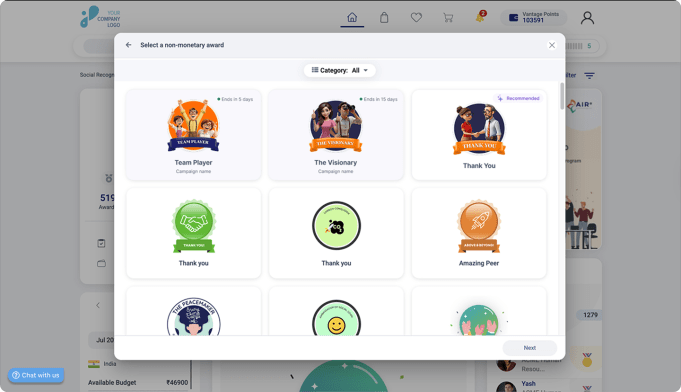
Non-monetary incentives carry no cost per instance. Badges, eCards, a named mention in a company meeting. Because they cost nothing, they have no approval step, and no frequency ceiling.
That asymmetry is the single most useful thing to take from this question. Monetary rewards buy significance. Non-monetary rewards buy frequency. A program that funds only the first is significant on the handful of occasions it fires, and absent for the rest of the year.
Timing: When Was It Promised?
Either the employee knew the reward was coming, or they did not. That turns out to be the sharpest practical distinction of the four, and the one most programs get backwards.
The CIPD's 2022 evidence review on incentives and recognition puts it precisely: incentives are forward-looking, set in advance on a condition, while rewards are retrospective, meaning employees do not know what they will be beforehand.
That difference changes what each one can do.
An incentive shapes a behavior you can specify ahead of time. Hit the number, close the ticket, complete the certification. It works well when the task is clear and the output is countable.
A retrospective reward shapes behaviors you could not have written down in advance. Helping a colleague who was struggling. Catching a problem nobody had flagged. You cannot incentivize judgment, because you cannot specify it in a rule.
77% of high-effectiveness programs choose award recipients mainly on observed behaviors, compared with 27% of other programs, according to The State of Recognition & Rewards 2025 (Vantage Circle).
Most programs over-invest in the first and under-invest in the second, then wonder why employees optimize for the metric.
Relationship: What Does It Leave Behind?
A reward either closes an exchange or leaves something standing. This is the answer that predicts whether its effect outlasts the moment it was given.
The CIPD describes total reward as covering the tangible and intangible aspects of work that people value. Transactional rewards are the tangible side. Pay, benefits, points. They are an exchange, and when the exchange completes, the obligation closes.
Relational rewards are the intangible side. Development, trust, visibility, a manager who defends your work in a room you are not in. They do not close. They accumulate.
Gallup's longitudinal research found that well-recognized employees were 45% less likely to have changed organizations two years later. The effect was still measurable two years on, long after any individual reward had been spent. For more on the rewards that carry no price tag at all, see intangible rewards.
The 6 Reward Types US Programs Actually Run
Six operational reward types cover almost everything a US recognition program delivers in practice. They are not a rival taxonomy. Each one is a particular set of answers to the four questions above, which is exactly why they overlap.
| Reward type | How it answers the four | Who delivers it | Budget | Best for |
|---|---|---|---|---|
| Values-aligned recognition | Intrinsic, non-monetary, retrospective, relational | Peers, managers, leaders | None | Making culture legible |
| Monetary awards and points | Extrinsic, monetary, either timing, transactional | Managers, HR, leadership | Yes | High-stakes moments |
| Social and symbolic recognition | Extrinsic form, intrinsic value, retrospective, relational | Anyone | None | Daily frequency and visibility |
| Peer-to-peer recognition | Non-monetary, retrospective, relational | Peers | None or low | Reaching work that managers cannot see |
| Service milestone awards | Extrinsic, monetary, forward-looking, transactional | System-triggered | Yes | Tenure and retention moments |
| Experiential and choice-based | Extrinsic, monetary, retrospective, relational | HR-funded, employee-chosen | Yes | Personalization at scale |
1. Values-Aligned Recognition
Values-aligned recognition ties each appreciation to a named company value, which converts a compliment into a record of what the organization actually rewards.
The mechanism is simple. Instead of "great job on the launch," the recognition reads "great job on the launch, tagged to Customer Obsession." Multiply that by a year and you have data on which values are lived and which only appear on a wall.
That data is already sitting in the platform and costs nothing extra to pull. It is one of the cheaper diagnostics available to an HR team.
2. Monetary Awards and Points
Monetary awards convert contribution into spendable value, and points-based systems do it while preserving employee choice over the outcome.
This category covers SPOT Awards, named award programs and points with a redemption catalog. Points matter because they answer the currency question oddly. They cost the company money, so they are monetary. But the employee picks what the points become, so they behave like a choice-based reward.
Harvard Business School research found that more than 80% of American employees say they do not feel recognized or rewarded, while US companies spend more than a fifth of their budgets on wages. The money is already being spent. It is the recognition layer that is missing.
One design note for multi-country teams. A points award only feels equivalent across geographies if its value is adjusted for local purchasing power. Without that adjustment, the same award reads as generous in one market and insulting in another.
3. Social and Symbolic Recognition
Social recognition makes appreciation public, which is what separates it from a private thank-you and gives it a second audience.
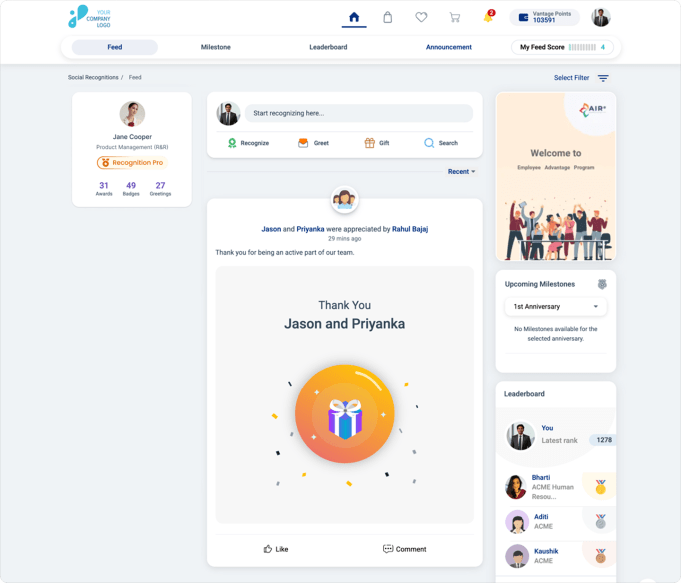
Badges, eCards, recognition feeds and shout-outs in company meetings all sit here. The reward is not the badge. The reward is that other people saw it.
That second audience is the whole point. Public appreciation teaches everyone watching what gets noticed, and that is the mechanism behind symbolic recognition. A badge carries no cash value. It carries information, and the information is what travels.
4. Peer-to-Peer Recognition
Peer recognition lets any employee appreciate a colleague without manager approval, which removes the bottleneck that limits how often recognition can happen.
The structural argument is stronger than the sentimental one. A manager sees a fraction of what their team does. Peers see a good deal of what the manager misses. A program that routes all recognition through managers is capped by the manager's field of view, not by how much good work occurred.
Removing the approval step is what makes volume possible. It also changes what gets recognized, because peers notice different things than managers do.
Manager recognition still carries weight that peer appreciation cannot replicate. The strongest programs run both and expect different things from each.
5. Service Milestone Awards
Service milestones are automated tenure awards that fire on a date, which is what keeps anniversary recognition reliable once headcount passes the point where anyone can track it by hand.
Manual anniversary tracking fails quietly. One missed five-year milestone is worse than no program, because the employee knows the program exists and knows it skipped them.
Over 75% of US companies run service or tenure awards, but only 55% have monthly, quarterly or annual awards, according to the AIRe Benchmarking Report USA 2023-24 (Vantage Circle).
Read that gap carefully. More US companies run years of service awards than run anything on a regular cycle. Most programs are built to recognize you on your anniversary and stay quiet in between.
Milestone awards are the one reward type that is forward-looking without being an incentive. The employee knows it is coming, but it is not conditional on performance. It is conditional on staying.
6. Experiential and Choice-Based Rewards
Choice-based rewards let the employee select the outcome, which raises perceived value without raising the cost to the company.
Gift cards, curated experiences, merchandise and marketplace redemption all belong here. The behavioral logic is that a reward someone chose is worth more to them than a reward of equal cost that someone else chose.
Experiences add something objects do not. A team trip or a shared event builds relationships alongside the reward, which pushes its answer to the relationship question toward relational. For a deeper look at this category, see experiential rewards. For a wider set of concrete options, see these employee reward examples.
How the 4 Questions Map to Total Rewards Models
Total rewards models describe the scope of what an organization offers, while the four questions describe how any single reward behaves. They answer different questions, which is why using one in place of the other causes confusion.
WorldatWork's Total Rewards model names five elements: compensation, benefits, well-being, careers and recognition. That is a scope model. It tells you which categories of investment belong in the package.
It does not tell you whether your recognition element is transactional or relational, or whether your well-being element is an incentive or a reward. The four questions do.
Use both. The five elements tell you what to budget for. The four questions tell you what each line item will actually change. If you are building the package rather than classifying it, start with total rewards strategy.
Which Reward Types US Programs Underuse
US recognition programs consistently over-build on money and milestones, and under-build on frequency, coverage and behavioral reinforcement.
The benchmark data makes the pattern specific.
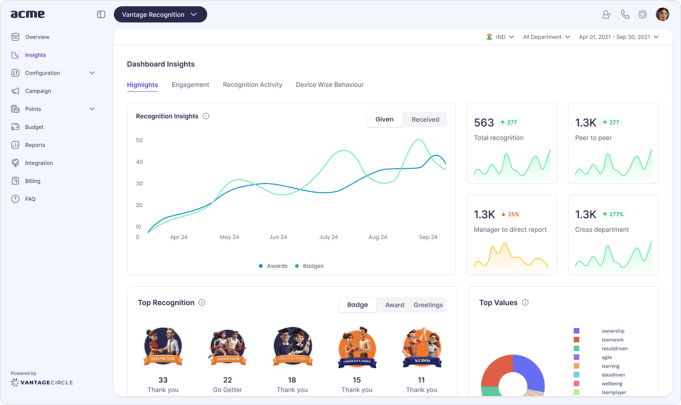
Fewer than 20% of US employees are recognized every quarter, according to the AIRe Benchmarking Report USA 2023-24 (Vantage Circle).
Only 31% of US recognition programs cover contract workers, and just under 25% exclude blue-collar workers, according to the AIRe Benchmarking Report USA 2023-24 (Vantage Circle).
54% of US companies have no defined approach to recognizing employees who repeatedly demonstrate the right behaviors or results, according to the AIRe Benchmarking Report USA 2023-24 (Vantage Circle).
| Design element | What the US data shows | What it exposes |
|---|---|---|
| Recognition frequency | Fewer than 20% of employees recognized quarterly | Currency: too much monetary, not enough non-monetary |
| Workforce coverage | Only 31% of programs cover contract workers | Eligibility drawn at the payroll boundary, not the contribution boundary |
| Repeat behaviors | 54% have no defined approach to recognizing them | Timing: retrospective rewards are unmanaged |
| Periodic awards | Only 55% run monthly, quarterly or annual awards | Timing: milestone-heavy, cadence-light |
There is a wider version of this problem. Vantage Circle's analysis with Mercer of sixteen traditional total rewards components found a consistent structural gap.
75% of traditional total rewards components (12 of 16) demonstrate low or no impact on behavioral specificity, missing opportunities to shape daily performance, according to The Future of Total Rewards whitepaper (Vantage Circle with Mercer).
Most of what sits in a total rewards package was never designed to shape daily behavior. It was designed to be competitive at the point of hire. Recognition is the component that can operate at a daily cadence, which is what makes its share of the budget worth checking.
US engagement numbers set the backdrop. Gallup reports that engagement fell to its lowest level in a decade in 2024, with 31% of US employees engaged. Recognition is not the only lever on that number. But a reward portfolio that fires a handful of times a year gives itself very few chances to be one.
How to Design a Reward Program Around the 4 Questions
Designing this way means answering each of the four questions deliberately for your own program, rather than picking reward types off a list.
| Step | Action | The question to answer |
|---|---|---|
| 1. Name the behavior | Define the specific behavior or outcome the program exists to increase | What do we want more of, stated concretely? |
| 2. Answer the timing question first | Decide whether that behavior can be specified in advance | Is this an incentive problem or a recognition problem? |
| 3. Set the frequency floor | Decide the minimum cadence, then pick the currency that supports it | How often must this happen to count? |
| 4. Check coverage before spend | Confirm who is eligible, including contract and frontline workers | Who does our program currently not reach? |
| 5. Balance the relationship answer | Pair every transactional reward with a relational one | What does this leave behind after it is spent? |
Step two is the one most programs skip, and skipping it is expensive. A team puts a bonus behind a behavior that cannot be specified in advance. The bonus fails to move it. The conclusion drawn is that recognition does not work, when the real problem was a reward chosen without answering the timing question.
Execution discipline matters as much as structure. Three principles carry most of the weight.
- Recognize close to the behavior. Timing beats size. Recognition delivered the same week reinforces the behavior. The same reward three months later is a payment.
- Be specific about what you are recognizing. Generic praise does not register. Naming the decision or the outcome is what makes it repeatable.
- Make it visible. Recognition nobody sees teaches nobody anything.
A fourth principle shows up in the benchmark data rather than in practitioner advice. Reinforce repetition, not just the first instance.
60% of high-effectiveness programs use escalating rewards, badges or titles for employees who repeatedly show desired behaviors, compared with 13% of other programs, according to The State of Recognition & Rewards 2025 (Vantage Circle).
These principles map onto the AIRe Framework, Vantage Circle's behavioral science methodology for recognition program design, which assesses programs across Appreciation, Incentivization, Reinforcement and eMotional Connect. The four questions describe what a reward is. AIRe describes whether the program built from them holds together.
Running all six reward types from separate tools is what makes this kind of design fail in practice. Vantage Recognition, Vantage Circle's employee recognition platform, runs monetary, non-monetary, peer and milestone rewards from one system, which is what makes cadence and coverage measurable rather than assumed.
If you are starting from scratch rather than fixing an existing program, the sequencing is covered in building a reward program. If yours is already running and underperforming, the diagnostic patterns in high-impact recognition programs are the faster read.
Summing It Up
The number of reward types is not a fact to be looked up. It is an artifact of which question the source happened to answer.
Four questions do the real work. Origin tells you what you can administer. Currency tells you how often you can afford to. Timing tells you which behaviors you can shape. Relationship tells you what survives the spend.
Run your current program against those four. If it comes back monetary, transactional and occasional, that is a reasonable description of a bonus scheme and a poor description of a recognition culture.
Pick the question your program answers worst. Fix that one first.
Book a demo to see how a reward program built on all four runs in practice.
Frequently Asked Questions
What are the four types of rewards?
The most common four-type split is monetary, non-monetary, assistance and recognition rewards. Other sources use intrinsic, extrinsic, tangible and intangible. Both are valid, and they are not the same four, because each one answers a different question rather than describing a settled taxonomy.
What are the three types of rewards?
A frequent three-type model is intrinsic non-monetary, extrinsic non-monetary and extrinsic monetary rewards. It combines the origin question with the currency question, which is why it produces three categories instead of four. It is a useful cut because most rewards fit cleanly into one of the three.
What type of rewards are most effective?
No single reward type is most effective, because effectiveness depends on the behavior you are trying to influence. Forward-looking incentives work for behaviors you can specify in advance. Retrospective, non-monetary recognition works for judgment and collaboration, which cannot be written into a rule beforehand.
What are some examples of rewards?
Common examples include points-based awards, gift cards, SPOT awards, digital badges, eCards, public shout-outs, service anniversary awards, curated experiences, extra time off and development opportunities. Each one answers the origin, currency, timing and relationship questions differently.
What are the 5 pillars of total rewards?
WorldatWork's Total Rewards model names five elements: compensation, benefits, well-being, careers and recognition. These describe the scope of what an organization offers, not how individual rewards behave. A total rewards model tells you what to budget for, while the four questions tell you what each investment will actually change.

Nilotpal M Saharia is an Assistant Manager, Content Marketing at Vantage Circle and a recognition-and-rewards (R&R) strategist with 9 years of experience spanning Marketing, HR, and content strategy. He helps HR leaders turn employee recognition and leadership research into practical workplace programs.
Connect with Nilotpal on LinkedIn.