
Most engagement strategies fail because they try to fix everything at once. Seven years of watching programs succeed and stall taught me that much. The 5 Cs is the framework I've kept coming back to, mostly because it forces you to pick your battles.
The 5 Cs of employee engagement are Connection, Communication, Congratulate, Collaboration, and Care. Together they form a practitioner framework. Employees stay engaged when they feel connected to the organization, informed through two-way communication, and recognized for their work, and when they're able to collaborate and genuinely cared for.
Key Takeaways
- Each of the five Cs explained in practice, with strategies you can run this quarter.
- The major versions of the 5 Cs compared, and why ours centers recognition.
- Where the framework fits among the broader drivers of employee engagement.
What Are the 5 Cs of Employee Engagement?
Each C names something an employee needs to feel, not something HR needs to publish. That distinction matters. Engagement doesn't live in the handbook. It lives in the Tuesday afternoon interactions between a manager and their team.
1. Connection
Connection is the sense that the people around you know you and want you there. Not names on an org chart. Camaraderie, trust, and the kind of employee satisfaction that surveys can't manufacture.
A connected team is load-bearing infrastructure. Remove it and everything else sags, no matter how generous the benefits package looks on paper.
Building connection takes deliberate effort:
- Invest in team-building activities that people actually want to attend. Group outings, workshops, and retreats work when they match your team's energy, not when they're mandated fun.
- Common spaces do quiet work. Lounges and shared areas give relationships room to form without an agenda, and they don't need a budget line to justify them.
- Pair new hires with experienced colleagues. Buddy and mentorship programs shortcut the loneliest phase of any job: the first ninety days.
For remote and hybrid teams, connection needs scaffolding it used to get for free from hallways and lunch tables. Virtual coffee chats feel forced at first. They stop feeling forced around week six.
2. Communication
Broadcasting updates is not communication. It's wallpaper.
What actually moves engagement is the return channel, the part where an employee says something and the organization audibly changes course because of it, and that loop's rarer than most leadership teams want to admit. Transparent, consistent communication keeps people in the loop about where the company is heading. Being trusted with the truth changes how employees talk about their employer. It radiates.
Channel choice does quieter work. Face-to-face for complex or sensitive discussions. Email when documentation matters. Instant messaging for coordination, video for dispersed teams, anonymous tools for the things nobody will say with their name attached.
Town halls and feedback sessions collapse into theater the moment employees notice their input vanishing into a void. Active listening has to be followed by visible action, or it doesn't count as listening.
3. Congratulate
Recognition tells people what the organization actually values. Not the poster in reception. The real list.
I learned this watching a colleague quietly fix a broken editorial workflow that had been burning hours every week. Nobody said anything for a month. Then her manager called it out in a team meeting, specifically and by name, and the shift in her energy was visible within days. That's the entire mechanism of this C compressed into one moment: ideas, effort, and achievements get acknowledged, or your best people start wondering whether anyone is watching.
The data backs the anecdote. Gallup's 2024 Q12 meta-analysis found that top-quartile teams on engagement deliver 23% higher profitability and 18% higher productivity than bottom-quartile teams, and recognition is one of the twelve conditions that analysis measures. I'd push back slightly on treating that as a pure recognition number, since engagement bundles many conditions together.
Our own research isolates the recognition variable specifically. Vantage Circle's 2025 study with Great Place to Work® India found that 92% of employees in high-recognition cultures express an intent to stay, and 91% report feeling motivated.
92% of employees in high-recognition cultures express an intent to stay.
Vantage Circle x Great Place to Work® India, 2025Recognition is one of the levers Gallup itself flags as weakening in recent years, which makes it the cheapest one to fix.
Recognition takes whatever shape you give it, from public shout-outs and peer appreciation to monetary rewards and badges. What matters is that it lands fast, names the specific work, and happens where other people can see it.
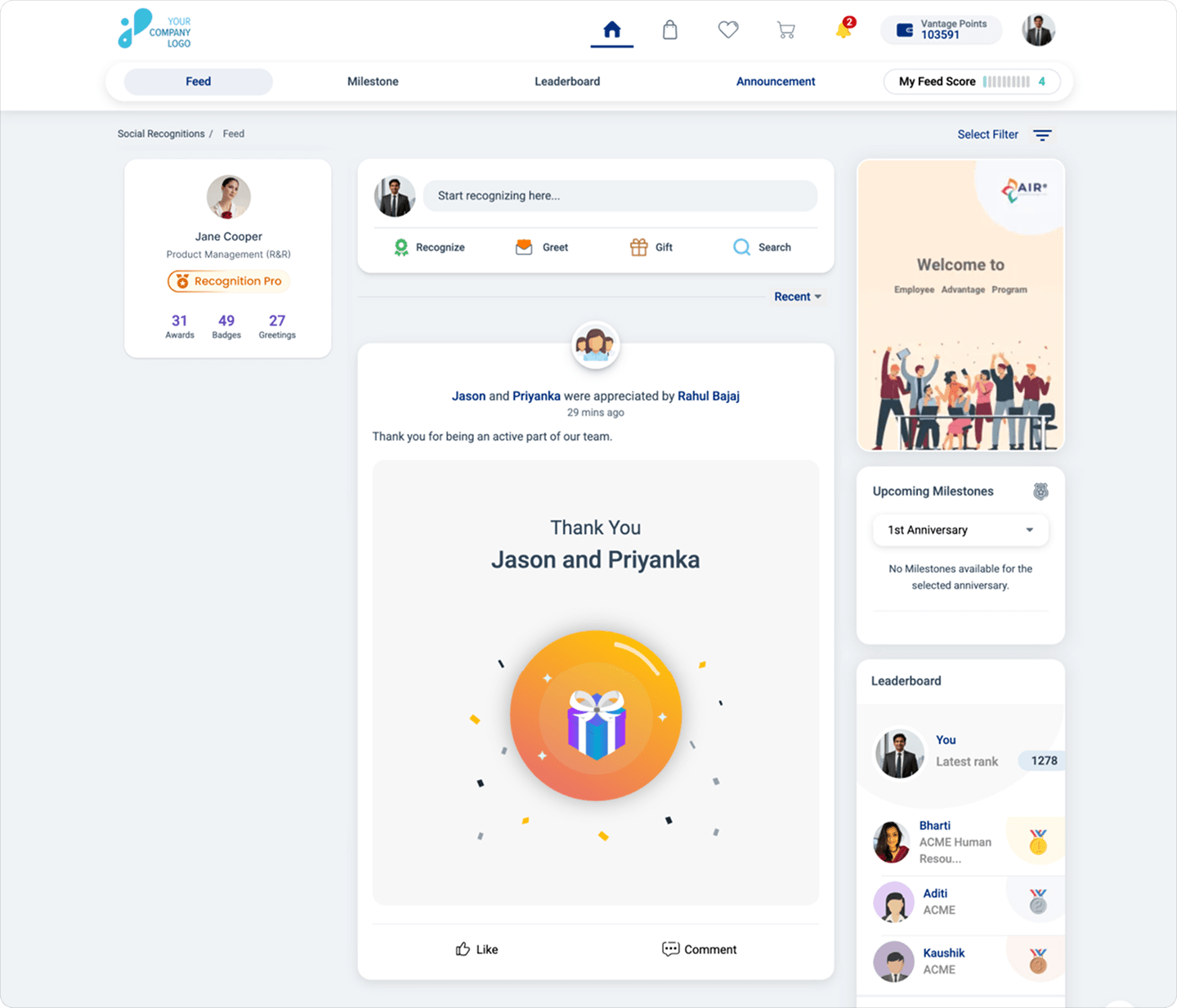
(Source: Vantage Recognition)
Tools like Vantage Circle's Rewards and Recognition platform handle the visibility part well, putting recognition on a social feed where the whole workplace piles on with comments and badges until a private thank-you becomes a cultural signal.
Frequency does most of the work in employee recognition, which is why a once-a-year ceremony doesn't build the habit. Annual awards are dessert. Weekly recognition is the meal.
4. Collaboration
Putting people on the same project is not collaboration. Real collaboration in the workplace means knowledge moves freely and results feel collectively owned. Problems get attacked from more angles than any one person holds.
The engagement link is simple. People disengage when they feel like interchangeable parts, and they engage when they contribute to something a single person cannot build alone.
Creating that environment starts with goals that require collaboration to hit. Shared targets force shared work; culture memos don't. Then reduce the friction: shared spaces, physical and digital, where interaction costs nothing. Protect dissent while you're at it. Diverse opinions only show up where disagreement feels safe, and that safety evaporates faster than most leaders realize. Punish one person visibly for speaking up and you've bought a year of silence. If silos are your problem, cross-team projects break them down faster than another recurring meeting ever will.
Slack, Microsoft Teams, and Google Workspace will handle the logistics from anywhere, and they're so smooth that teams start mistaking tool adoption for culture change. It isn't. A team that hoards information in person will hoard it in channels.
5. Care
Care is the easiest C to fake and the most expensive to fake badly. A wellness webinar during a burnout crisis reads as decorative, and employees keep score on this one.
The genuine version means paying attention to the wellbeing and growth of the people around you, then acting on what you notice. Sometimes that's covering for someone who's struggling before they ask. Flexibility when life intervenes, without making people confess first. In practice it's a comprehensive employee assistance program that covers counseling and wellness, honest conversations about goals, and a manager who remembers that somebody's kid starts school this week.
Do this for years and you end up with the kind of retention no counteroffer beats, because people who feel cared for reciprocate. It's that unglamorous.

Other Versions of the 5 Cs (and Why Ours Is Built for Practitioners)
There is no single canonical 5 Cs of employee engagement. Different organizations define the framework differently, and pretending otherwise does readers a disservice. Here's how the major versions compare:
| Version | The five Cs | Emphasis |
|---|---|---|
| Vantage Circle | Connection, Communication, Congratulate, Collaboration, Care | Day-to-day manager behaviors, recognition-centered |
| Horton International | Care, Connect, Coach, Contribute, Congratulate | Leadership coaching |
| Gallup (team blueprint) | Common purpose, Connection, Communication, Collaboration, Celebration | Team management |
| TalentHR | Clarity, Connection, Contribution, Communication, Commitment | Goal alignment |
| HONO | Communication, Connection, Culture, Contribution, Career Development | HR systems and culture |
The overlap tells you what's universal: nearly every version includes connection and communication in some form. The differences? They tell you what each author sells. Coaching firms emphasize Coach. Goal-alignment platforms emphasize Clarity.
Our version centers Congratulate and Care deliberately. Recognition and wellbeing are the two elements every engagement strategy talks about and almost none operationalize. They're also the two a rewards and recognition platform exists to make systematic instead of sporadic. That's our bias, stated plainly. Judge the framework by whether it changes what your managers do on a Tuesday.
Why the 5 Cs Matter for Organizational Success
Engagement is falling, which makes a working framework more valuable, not less. Gallup's State of the Global Workplace 2026 report found engagement declined for the second year running, slipping to 20% in 2025.
Low engagement now drains roughly $10 trillion a year from the world economy — about 9% of global GDP.
Gallup, State of the Global Workplace 2026The slide keeps tracing back to managers, whose engagement fell from 27% to 22% while individual contributors barely moved.
That manager finding is the case for the 5 Cs in miniature. Engagement isn't lost in strategy decks. It's lost in daily interactions, which is exactly the level the five Cs operate at. Strong engagement also cuts employee turnover and compounds into a healthier company culture. People rarely quit workplaces where they feel genuinely cared for.
Our own Global Industry Report on employee engagement and DEI found that organizations supporting diversity, equity, and inclusion have 3.2 times more engaged employees. Engagement and inclusion feed each other. Neither survives alone.
Where the 5 Cs Fit Among Engagement Drivers
The 5 Cs are a focusing tool, not the full map. Zoom out and the research names a wider set of drivers, starting with leadership quality: Gallup's 2025 data found more than half of managers worldwide haven't received any management training. Meaningful work matters too, along with employee benefits and growth opportunities. So does psychological safety, the sense that people can speak up without it costing them, inside whatever physical work environment they're doing it in.
We've mapped all of these in our guide to the drivers of employee engagement. Start there if you're building a strategy from scratch. The 5 Cs are where you act once you know the terrain.
Conclusion
Every organization says engagement matters. Far fewer can name what they're doing about it this month. The 5 Cs solve that gap by turning an abstraction into five concrete commitments. Connect people and communicate both ways. Congratulate real work. Enable collaboration, and care visibly enough that nobody's guessing.
The framework only works when it escapes the leadership offsite and lands with the people who run standups, give feedback, and notice when a teammate goes quiet. Everyone from managers to individual contributors needs to hold a piece of it. It's built at the level of daily behavior, or it isn't built at all.
Pick the C your organization is weakest at. Start there this quarter.
FAQ
1. What are the 5 C's in the workplace?
A. The 5 Cs in the workplace are Connection, Communication, Congratulate, Collaboration, and Care. Each one's a condition employees need to stay engaged, from strong relationships and open information flow through recognition and teamwork to genuine concern for wellbeing.
2. What are the 5 C's of HR?
A. Usually the same engagement framework: Connection, Communication, Congratulate, Collaboration, and Care. Some HR models swap in Clarity, Culture, Commitment, or Career Development instead.
3. What are the 4 pillars of employee engagement?
A. Wellbeing, connection, recognition, and growth. The 5 Cs cover the same ground in more operational detail. They don't fold communication and collaboration into broader pillars; each gets treated as its own actionable component.
4. What does the 5 Cs model for team engagement include?
A. Gallup's team management blueprint defines the 5 Cs as common purpose, connection, communication, collaboration, and celebration. It's aimed at managers building team cultures, and the overlap with the workplace 5 Cs is heavy. Common purpose and celebration stand in for care and congratulate.
5. How do the 5 Cs of employee engagement help an organization?
A. Better performance, stronger retention, and a workplace where appreciation feels normal instead of rare. There's a hard number behind that too, since Gallup's 2024 Q12 meta-analysis links top-quartile engagement to 23% higher profitability.
6. How can leaders foster a culture of Connection among remote teams?
A. Remote connection grows out of small repeated interactions, so a ten-minute weekly ritual beats a quarterly virtual offsite every time. Virtual team-building helps, and so do informal channels where nobody's talking about work. Leaders just have to keep showing up, because consistency matters more than the format does.

He has worked in the human resources environment and has elevated recognition and rewards through his insightful and detailed writing. He aims to enhance the practice of Recognition in the workplace with new ideas and innovation that will help shape the work culture. For any related queries, contact editor@vantagecircle.com