
Your engagement scores went up last year. So did the number of people who left.
That combination is more common than it sounds, and it is not a measurement error. It is what happens when an organization measures two different things and reads them as one.
Employee engagement measures how committed employees feel to their work and their organization. Employee retention measures how many of them stay. The two move together often enough to be confused, but they are separate constructs, and the cases where they come apart are the ones that cost organizations the most.
Most content on this topic asserts the connection and stops there. Engagement drives retention, so raise engagement. That advice is not wrong, exactly. It is just incomplete in a way that leaves HR leaders unable to explain their own data when the two numbers move in opposite directions.
So this post does something different. It starts with the divergence, because understanding what employee engagement actually measures is less useful than understanding when that measurement stops predicting behavior.
What is Employee Engagement and Retention?
Employee engagement is the degree of commitment and involvement an employee feels toward their work and their employer. Employee retention is an organization's ability to keep its people over time. One is a psychological state. The other is a headcount outcome.
That distinction matters more than it appears. Engagement is something an employee feels. Retention is something an organization observes. You can measure the first only by asking, and the second only by counting.
The two are related. Higher engagement does, on average, reduce turnover. But "on average" is doing a lot of work in that sentence, and the exceptions are not rare edge cases. They are the normal condition in most organizations, sitting inside the average and invisible to it.
Understanding what drives engagement tells you how to move the first number. It does not automatically tell you how to move the second.
Where Engagement and Retention Come Apart
Engagement and retention diverge in two directions. People stay without being engaged, and people leave despite being engaged. Both are common, and most organizations have both happening at once in different parts of the business.
Plotting the two against each other gives four conditions. Only one is the case anyone wants, and even that one needs checking.
| Combination | What it looks like | What it usually means | What to look at first |
|---|---|---|---|
| High engagement, high retention | Scores are strong and turnover is low. | The program is working, or the labor market is frozen and you cannot yet tell which. | Check whether retention held when the market was last hot. |
| High engagement, low retention | People like the work, rate their manager well, and resign anyway. | Employees are engaged with the job but not with the organization. | Career pathways, internal mobility, and whether growth is visible. |
| Low engagement, high retention | Scores are flat, turnover is low, and nothing moves. | People are embedded rather than committed. They stay because leaving is costly. | Absenteeism, discretionary effort, and internal application rates. |
| Low engagement, low retention | Both numbers are bad. | The clearest signal, and the only quadrant most organizations act on. | Manager capability before anything else. |
Which quadrant is your organization in, and do your current metrics let you tell the difference between the second and the third?
When People Stay Without Being Engaged
Disengaged employees often stay, and the reason has a name in the research literature. It is called job embeddedness, and it predicts staying better than satisfaction does.
The construct comes from Mitchell, Holtom, Lee, Sablynski and Erez (2001), published in the Academy of Management Journal. They proposed that people stay for three reasons that have nothing to do with how they feel about the work itself:
- Links. The formal and informal connections between a person and other people, teams and institutions.
- Fit. How well the job and the community match the rest of their life.
- Sacrifice. What they would give up by leaving, especially if leaving means relocating.
Each of those operates both on the job and in the wider community. A long-tenured employee with a mortgage, a working spouse, children in local schools and a decade of accumulated internal relationships is heavily embedded. Their engagement score can sit near the bottom of the distribution and they will still be there next year.
The paper's finding is the part worth holding onto. Job embeddedness predicted both intent to leave and actual voluntary turnover, and it did so over and above job satisfaction, organizational commitment, job alternatives and job search. In other words, it explained staying that the standard engagement measures could not.
Vantage Circle's own US benchmarking data shows how common one sacrifice-shaped instrument already is. Over 75% of US companies run service or tenure awards, but only 55% have monthly, quarterly or annual awards, according to AIRe Benchmarking Report USA 2023-24 (Vantage Circle).
Read against Mitchell's three dimensions, a tenure award is a sacrifice instrument. It raises what an employee would give up by leaving. It does not change how engaged they feel while they stay. That is a legitimate thing for a program to do, but it is worth being clear about which lever is being pulled, because the reporting on both looks identical.
So a low-turnover number can mean the program is working. It can also mean your workforce is stuck. Those are very different situations and the retention rate reports them identically.
When Engaged People Leave Anyway
The reverse case is less intuitive and more expensive. Employees who rate their work highly still resign, and the reason is that engagement is not one thing.
Alan Saks (2006), writing in the Journal of Managerial Psychology, separated employee engagement into two distinct constructs: job engagement and organization engagement. The first is how absorbed someone is in the work itself. The second is how connected they feel to the employer as an entity.
Three findings from that line of research matter here:
- Organization engagement is negatively related to intention to quit.
- Organization engagement scores tend to run lower than job engagement scores in the same population.
- The two have meaningfully different antecedents, which means they respond to different interventions.
Put those together and a familiar pattern resolves. An employee can love the work, respect their team, score well on a general engagement survey, and still leave, because what they lack is attachment to the organization rather than attachment to the job. A survey that averages both into one number cannot see the gap.
This is the case almost no one writes about, and it is the one that makes engagement dashboards look unreliable to the executives reading them.
Why Targeting Retention Directly Does Not Work
Programs built around retention tend to underperform programs built around engagement. Two findings in Vantage Circle's own benchmarking data point that way, and the result is counterintuitive enough to be worth setting out carefully.
In the Global AIRe Benchmark Report 2022-23, recognition programs were scored across the four AIRe dimensions and then grouped by their stated primary objective. Programs whose sole primary goal was increasing loyalty and retention scored only marginally higher than programs with no defined objective at all.
Separately, programs whose primary objective was driving engagement scored higher than those built around performance and productivity. When organizations pursued both engagement and performance together, scores rose significantly.
Neither finding compares retention-led and engagement-led programs head to head, and the data does not rank every objective against every other. What it does establish is narrower and still damaging: naming retention as the sole objective produced almost no advantage over naming no objective at all. The retention goal behaves, on the benchmark, as though it were not a goal.
The reading is straightforward once you accept the divergence. Retention is an outcome, not a lever. Pulling directly on an outcome does very little, because the thing you are trying to move is downstream of everything that actually produces it. Programs designed around retention tend to reach for retention-shaped instruments, such as tenure bonuses and stay incentives, which raise the sacrifice component of embeddedness without touching engagement at all. You end up buying the low-engagement, high-retention quadrant and calling it success.
There is a gap between what programs say they are for and how they are built. Over 80% of US companies name employee engagement as a key objective of their recognition program, according to the same benchmarking work. Stating engagement as the objective and designing for retention are different acts, and the benchmark scores track the design rather than the stated intent.
Recognition programs built solely to increase loyalty and retention scored barely better on the AIRe benchmark than programs with no stated objective whatsoever.
What the Research Establishes About the Link
The connection between engagement and retention is real, well-evidenced and conditional. The best evidence for it comes from Gallup's long-running meta-analysis of its Q12 instrument.
The 2020 iteration was Gallup's tenth meta-analysis, pooling 456 studies across 276 organizations in 54 industries and 96 countries, covering 112,312 work units and 2.7 million employees. Comparing top-quartile and bottom-quartile business units, it found a 43% difference in turnover for low-turnover organizations and an 18% difference for high-turnover organizations.
That qualifier is usually dropped when the figure gets quoted, and dropping it inverts the practical meaning. Engagement does the most for turnover where turnover is already low. In high-churn environments, the same engagement gap moves the number far less. Gallup does not say why, though it is reasonable to suspect that the drivers of leaving in those settings are more often structural than psychological.
The same body of work found that managers account for 70% of the variance in team-level engagement. It is the most directly actionable figure in this post, and we will come back to it.
For scale, Gallup's State of the Global Workplace reporting put global engagement at 20% in 2025, down from the prior year. In the United States specifically, Gallup has estimated the cost of disengagement at roughly $1.9 trillion in lost productivity nationally.
Turnover was only one of eleven outcomes in that meta-analysis, which is a separate argument for measuring engagement properly rather than treating it as a retention instrument. The relationship between engagement and performance rests on the same body of work.
How to Measure Each One Separately
Measure engagement with instruments that ask, and retention with instruments that count. Collapsing them into a single dashboard number is what produces the confusion this post is about.
Every metric below is useful. Every one of them also has a blind spot, and knowing the blind spot is what keeps a number from being over-read.
| Metric | What it captures | What it misses |
|---|---|---|
| Engagement survey score | Overall commitment and involvement at a point in time. | Blends job engagement and organization engagement into one figure, hiding the gap between them. |
| eNPS | Willingness to recommend the employer, which leans toward organization engagement. | A single question. Gallup notes that narrow instruments like eNPS do not reveal the full picture of a workforce. |
| Participation rate | Whether people engage with the program itself. | Activity, not commitment. High participation can be compliance. |
| Intent-to-stay question | Stated intention, which correlates with but is not the same as behavior. | Survey sentiment, not measured turnover. Never report it as a retention rate. |
| Turnover rate | Actual leaving behavior, counted. | Treats a disengaged stayer and a committed one identically. |
| Regrettable attrition | Departures the organization did not want, which is the number that matters commercially. | Requires a judgment call on every exit, so it is only as good as the discipline behind it. |
Two practices close most of the gap. First, split the engagement survey so job-level and organization-level items can be read separately. Second, pair every engagement reading with a behavioral one, so sentiment never travels alone.
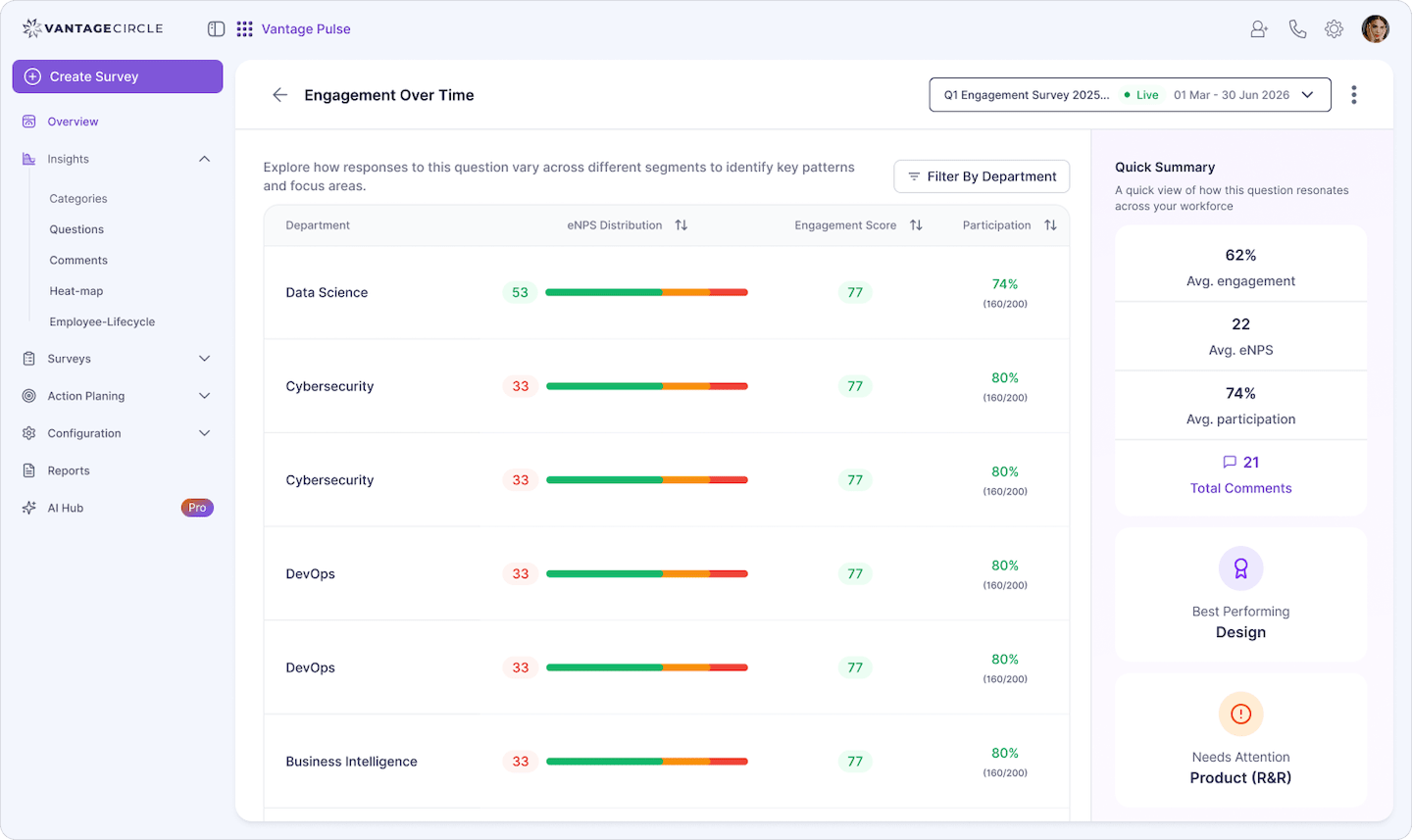
eNPS is a reasonable starting point for the organization-level signal, provided it is treated as one input rather than the answer. Vantage Pulse, Vantage Circle's employee engagement and pulse survey tool, collects it anonymously and segments the result by department, which is where the variation actually lives. Well-constructed stay interview questions cover the ground exit interviews reach too late to be useful.
The Manager is the Shared Lever
Managers are the one input that moves engagement and retention at the same time, which makes manager capability the highest-return intervention available to most organizations.
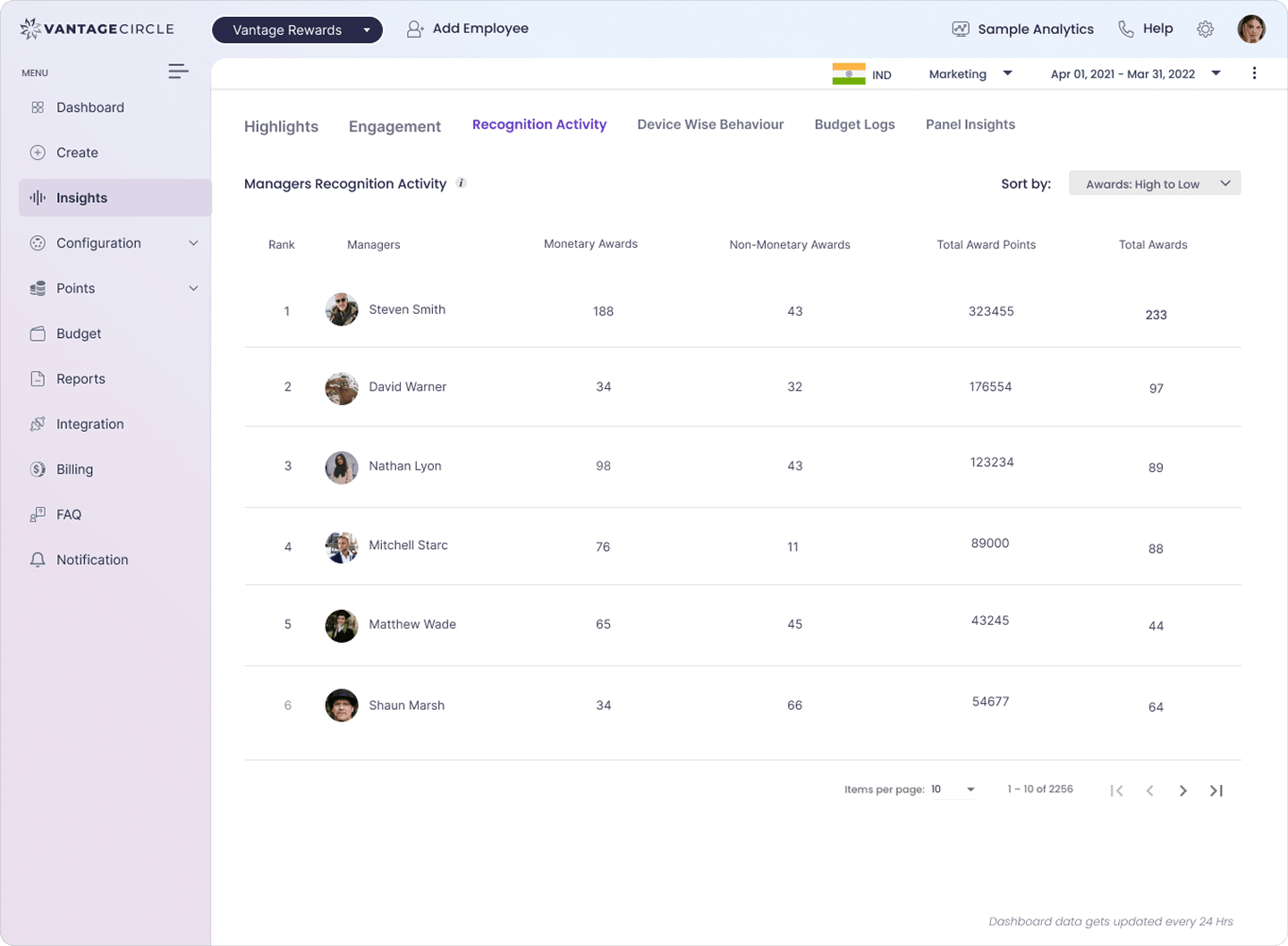
Recall the Gallup finding: managers account for 70% of the variance in team-level engagement. More than any other role, the manager determines whether an employee is engaged. Brandon Hall Group reaches a similar conclusion in its 2026 analyst report on recognition and rewards platforms, identifying managers as central to recognition quality, employee development, communication and well-being outcomes.
The manager also sits on both sides of the divergence described earlier. They shape job engagement through the work they assign and the feedback they give. They shape organization engagement by being, for most employees, the organization's most visible representative. An employee's relationship with their employer is largely mediated by one person.
HR sits on the other side of that arrangement, held accountable for an outcome that is largely outside its control.

Vantage Influencers Podcast
"We're responsible for about 5% of someone's engagement. The other 95% has to do with their manager relationship, other talent practices, how well we... reward them and recognize them for their efforts."
— Ben Eubanks, Chief Research Officer, Lighthouse Research and Advisory
Listen to the EpisodeYet in most programs there is very little recognition for a manager to work with. The same US benchmarking data found that fewer than 20% of US employees are recognized every quarter. Recognition arriving less than four times a year is an event, not a habit, and events are difficult for a manager to build a team practice around.
The picture is similar when employees are asked specifically about their own manager. 22.1% of employees rarely or never receive recognition from their immediate manager or supervisor, according to the Global AIRe Benchmark Report 2022-23. More than one in five people are not being recognized by the one person best positioned to do it.
That gap is specific and fixable. It is also measurable, which matters more than it sounds, because an organization-wide engagement average hides exactly the variation that manager-level reporting exposes. The 5 C's of employee engagement offer a practical frame for what managers should actually be doing week to week.
A Maturity Path from Program to Culture
Engagement capability develops in stages, and knowing which stage you are at prevents the common mistake of applying a late-stage intervention to an early-stage problem.
Brandon Hall Group's Engagement Maturity Framework, set out in its 2026 analyst report licensed to Vantage Circle, describes five levels:
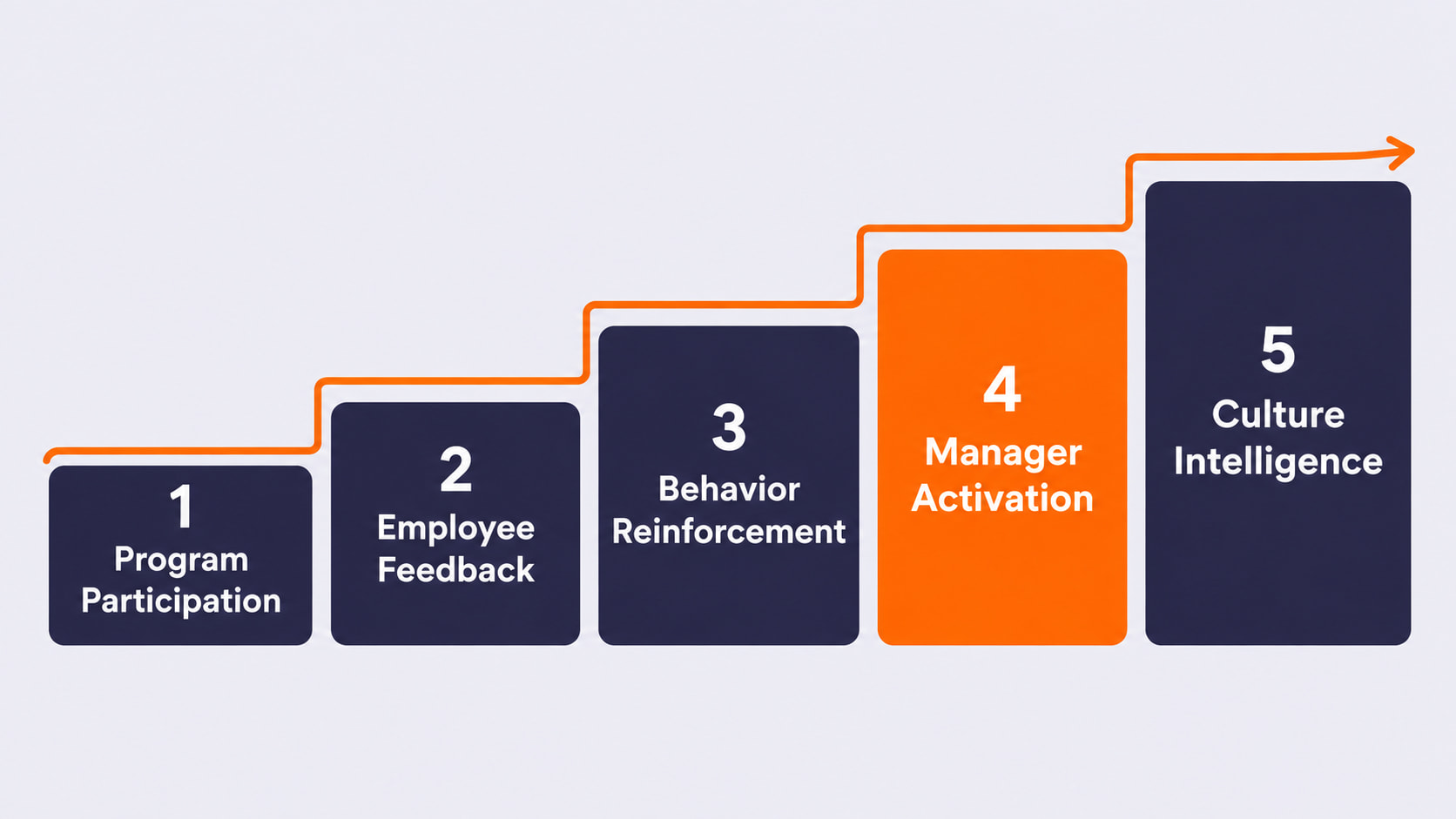
- Program Participation. People use the program. Activity is the measure.
- Employee Feedback. The organization starts listening systematically.
- Behavior Reinforcement. Recognition and feedback begin shaping what people actually do.
- Manager Activation. Managers own engagement rather than receiving reports about it.
- Culture Intelligence. Engagement data informs how the business is run.
The common failure is to operate at level one or two while buying tooling built for level five. A dashboard at level two measures participation and calls it culture, which is how a program can look healthy for two years while the underlying behavior never changes.
The sequence matters for retention because of where manager activation sits in it. Levels one and two raise visibility. Level three starts changing behavior. Level four is the point at which managers own engagement, and given how much of the variance in engagement sits with them, that is the level worth reaching before the analytics layer. Skipping to level five produces better reporting on an unchanged problem.
Where Recognition Fits
Recognition acts on the emotional dimension that engagement and retention share, which is why it shows up in both literatures rather than only one.
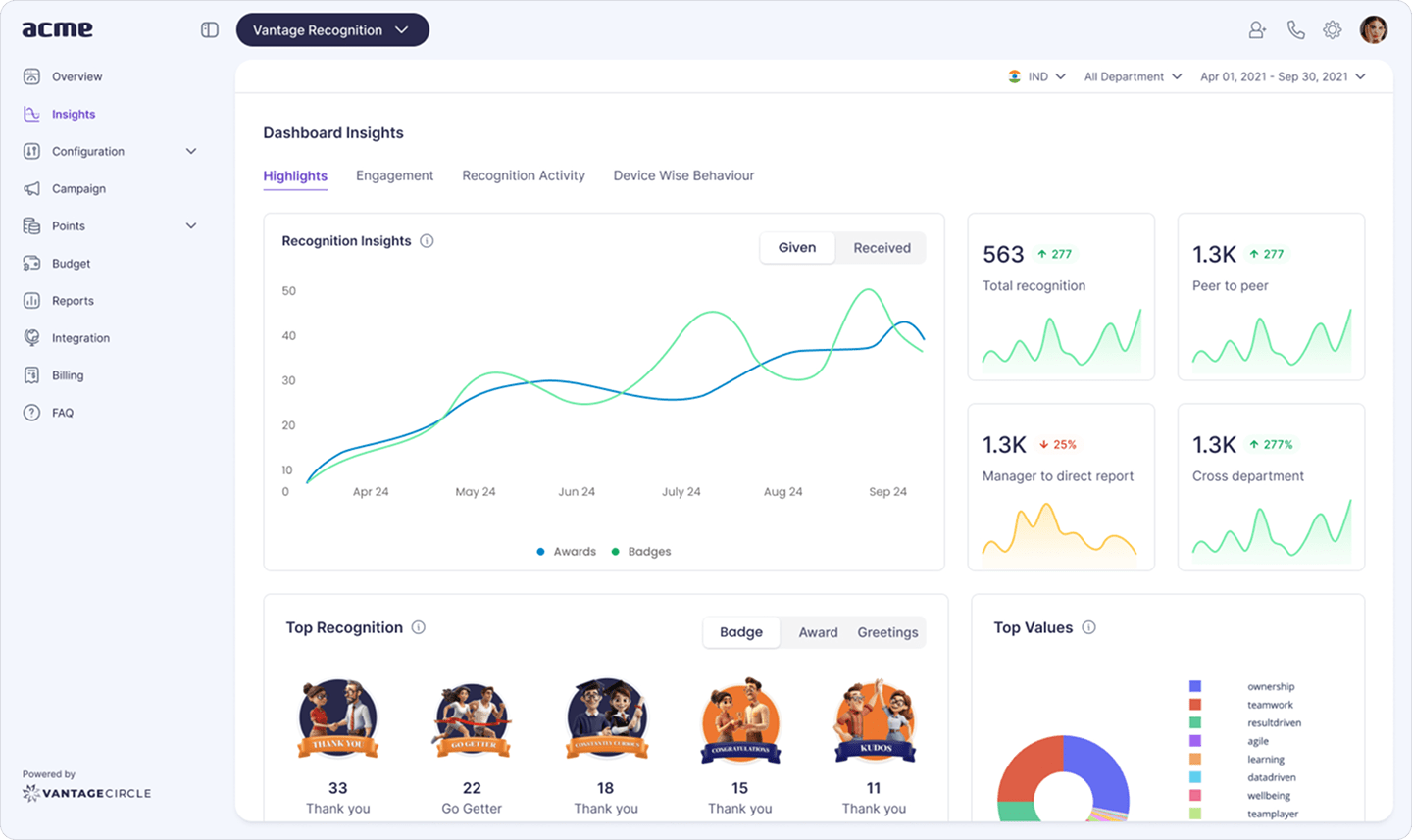
The Behavioral Engagement Framework, described in that same analyst report, identifies four interconnected dimensions of sustainable engagement: Appreciation, Incentivization, Reinforcement and eMotional Connect. Those are the same four dimensions that structure the AIRe framework used in the benchmarking data cited earlier.
Neither framework was built to be read against the other, but laying them side by side is a useful exercise. Appreciation and eMotional Connect are directed at the employee's relationship with the organization. Incentivization and Reinforcement are directed at the work itself and the behaviors in it. If that reading holds, a program weighted heavily toward one pair is acting on only one half of what keeps people in place.
Vantage Recognition, Vantage Circle's employee recognition platform, is built around those four dimensions. Its analytics report Receiver Coverage and Giver Coverage by department, and give managers a team-level view showing when each person was last recognized. That breakdown is the practical part. An organization-wide recognition rate can look healthy while whole teams receive nothing, and the teams receiving nothing are where attrition starts.
None of this replaces the structural work. Compensation, workload and career pathways remain the foundation, and no amount of recognition compensates for a broken one. Broader retention strategies have to run alongside, not behind.
See how recognition data maps to engagement and retention. Book a demo.
Summing It Up
Engagement and retention are connected, but they are not the same measurement, and the gap between them is where the useful information sits.
Three things are worth carrying out of this. Low turnover does not prove engagement, because embedded employees stay for reasons that have nothing to do with commitment. High engagement does not prevent resignation, because job engagement and organization engagement are different constructs and only one of them predicts quitting. And programs aimed directly at retention underperform programs aimed at engagement, because retention is an outcome rather than a lever.
Start by separating the two in your own reporting. Most organizations discover they have been reading one number and drawing conclusions about the other.
FAQs: Employee Engagement and Retention
What is employee engagement and retention?
Employee engagement is how committed and involved employees feel toward their work and their organization. Employee retention is the organization's ability to keep those employees over time. Engagement is a psychological state measured by asking. Retention is a behavioral outcome measured by counting.
What are the 5 C's of employee engagement?
The 5 C's are a practitioner framework for what drives engagement, most commonly given as Care, Connect, Coach, Contribute and Congratulate. Different versions circulate, so the specific list matters less than the underlying point: engagement is built through consistent managerial behaviors, not annual initiatives.
What are the 5 C's of employee retention?
The 5 C's of retention are usually given as Compensation, Culture, Career, Communication and Connection. Unlike the engagement version, this framework has no single authoritative source, and the lists vary between practitioners. Treat it as a checklist for coverage rather than a validated model.
What are the three R's of employee retention?
The three R's are most often listed as Respect, Recognition and Reward. The sequence is the useful part. Respect is a baseline condition, recognition is the ongoing behavior, and reward is the tangible reinforcement. Programs that start at reward and work backward tend to produce compliance rather than commitment.
Does high retention mean employees are engaged?
No. Employees frequently stay while disengaged, a pattern the research literature explains through job embeddedness. Links to colleagues, fit with the community and the sacrifice involved in leaving all keep people in place regardless of how they feel about the work. A low turnover rate can indicate a healthy culture or a stuck workforce, and the rate alone cannot distinguish them.
Can an engaged employee still leave?
Yes, and it is common. Research separates job engagement from organization engagement, and it is organization engagement that is negatively related to intention to quit. An employee can be absorbed in the work and well regarded by their team while feeling little attachment to the employer. Blended survey scores hide this, which is why engaged resignations so often look like surprises.

Nilotpal M Saharia is an Assistant Manager, Content Marketing at Vantage Circle and a recognition-and-rewards (R&R) strategist with 9 years of experience spanning Marketing, HR, and content strategy. He helps HR leaders turn employee recognition and leadership research into practical workplace programs.
Connect with Nilotpal on LinkedIn.