
No industry is perfect. But the Banking, Financial Services and Insurance (or BFSI) have an infamous reputation for being tough and challenging- more so for its employees.
And it makes sense.
Such intense work conditions make workers feel nervous, anxious, and vulnerable to burnout. When people go through this at work, it creates a sense of disengagement.
By disengagement, we mean when people feel demotivated, detached, or unhappy at work.
All in all, it's bad news for you because disengagement has the power to hurt your business's bottom line.
Don’t believe us? Let’s look at some numbers to cement our point.
Did you know that the BFSI industry has a dismal employee engagement rate of just 33%? And it is not improving: attrition across the BFSI sector now runs as high as 30 to 40%, with the worst churn concentrated in frontline sales and service roles.
Leading (or even managing) people in the BFSI industry is not for the faint of heart. These HR leaders don’t get enough accolades for how hard it is to do it well.
If you are in such a leadership position right now, here are a few tips on engaging your people better:
What is employee engagement in the BFSI sector?
Employee engagement in BFSI is the degree to which banking, financial services, and insurance employees feel committed to their institution and motivated to perform. It is the emotional and rational connection that keeps a teller, a claims adjuster, or a loan officer invested in doing careful, accurate work under pressure, rather than simply clocking in.
What makes engagement in BFSI different from other sectors comes down to three forces:
- Regulation: People here work under strict compliance rules, audits, and accountability, so the margin for error is thin and the stress is constant.
- Targets: Sales quotas, collection goals, and cross-sell pressure follow employees every quarter, which can quickly tip motivation into burnout.
- Frontline pressure: Branch staff, contact-center agents, and field sales teams absorb customer frustration daily, often with limited authority to fix problems on the spot.
Due to these forces, engagement strategies that work in tech or retail rarely transfer cleanly. A BFSI leader has to engage people while protecting compliance, hitting numbers, and shielding the frontline from chronic stress, all at once.
Banking vs. Insurance vs. NBFC: Engagement at a Glance
| Segment | Biggest engagement pressure | Lever that moves the needle |
|---|---|---|
| Banking | Compliance load and branch-level targets | Clear career paths and wellbeing support |
| Insurance | Commission-driven roles and agent churn | Recognition and meaningful incentives |
| NBFC | Fast growth, field and collections stress, high turnover | Mentoring and a sense of stability |
Segment: Banking
Biggest engagement pressure: Compliance load and branch-level targets
Lever that moves the needle: Clear career paths and wellbeing support
Segment: Insurance
Biggest engagement pressure: Commission-driven roles and agent churn
Lever that moves the needle: Recognition and meaningful incentives
Segment: NBFC
Biggest engagement pressure: Fast growth, field and collections stress, high turnover
Lever that moves the needle: Mentoring and a sense of stability
Why employee engagement matters in BFSI (the attrition cost)
Engagement matters in BFSI because the sector runs some of the highest attrition in India, and disengagement drives both turnover and mis-selling risk.
The regulator has taken notice. The RBI's Report on Trend and Progress of Banking in India 2023-24 found attrition in private sector banks running at around 25%, high enough that it flagged the churn as an operational risk in its own right. Insurance is tougher still, with frontline and agent attrition reported at 60 to 70% in parts of the sector.
Every one of those exits carries a bill HR pays twice. First comes the direct cost: rehiring, re-licensing, and months of ramp-up before a new banker or advisor is productive again. Then comes the hidden cost. A disengaged, thinly trained frontline is far more likely to cut corners, misread a compliance rule, or mis-sell a product, and in a regulated industry that is a governance risk, not just a morale problem. Because BFSI is ultimately a trust business, the employee who is halfway out the door is often the same one sitting across from your customer at the branch counter or on the claims call.
Recognition is one of the few levers with hard evidence behind it in this exact sector.
According to The Recognition Effect (Great Place To Work India and Vantage Circle, 2025), BFSI organizations with high-recognition cultures are 3.2 times more likely to be seen as great workplaces, and 3.2 times more likely to have motivated employees, than those with only an emerging recognition culture.
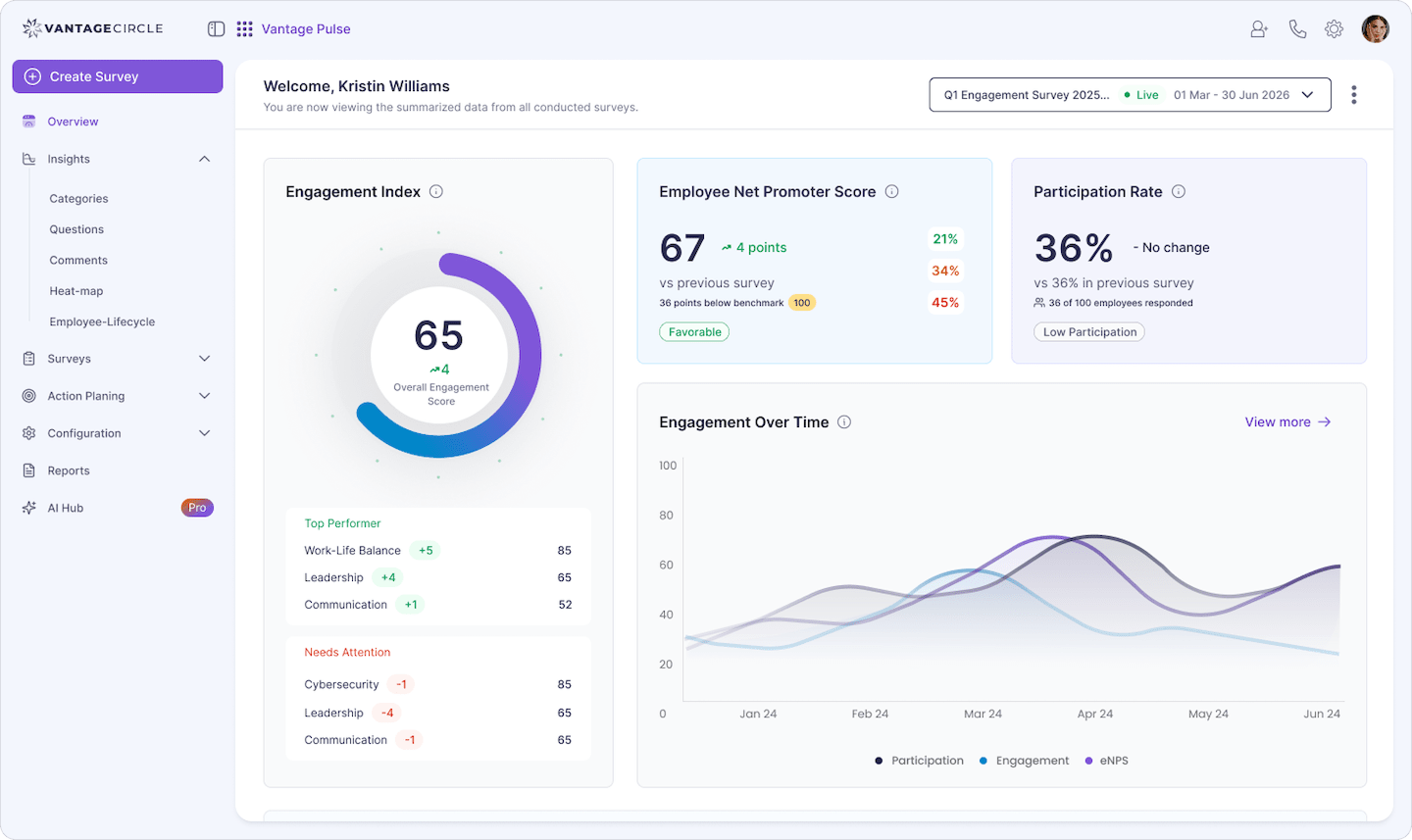
You cannot improve what you do not measure. An eNPS-based pulse survey turns a vague sense of "morale" into a number you can track every quarter and act on before good people walk.
Source: Vantage Pulse
What drives (and breaks) engagement in BFSI?
The fundamentals of BFSI engagement aren't a mystery: career growth, fair performance management, recognition, manager quality, and work-life balance. Most industries share this list. What sets BFSI apart is how fast each one can flip from a driver into a risk. Here is how each one plays out:
| Driver | When it works | When it breaks down |
|---|---|---|
| Career Growth | Ambitious employees stay and grow | They leave for the next title elsewhere |
| Performance Management | Builds trust, rewards genuine outcomes | Pushes staff toward mis-selling and burnout |
| Recognition | Tells frontline staff their careful work is seen | Signals only the loudest closers matter |
| Manager Quality | The single biggest reason people stay | The fastest route to the exit |
| Work-Life Balance | Keeps people sustainable long-term | First thing to erode, hardest to win back |
Driver: Career Growth
When it works: Ambitious employees stay and grow
When it breaks down: They leave for the next title elsewhere
Driver: Performance Management
When it works: Builds trust, rewards genuine outcomes
When it breaks down: Pushes staff toward mis-selling and burnout
Driver: Recognition
When it works: Tells frontline staff their careful work is seen
When it breaks down: Signals only the loudest closers matter
Driver: Manager Quality
When it works: The single biggest reason people stay
When it breaks down: The fastest route to the exit
Driver: Work-Life Balance
When it works: Keeps people sustainable long-term
When it breaks down: First thing to erode, hardest to win back
The pattern is the same every time. Get it right, and people stay, perform responsibly, and advocate for the institution. Get it wrong, and the very same drivers become the top reasons they quit.
These Are The Best Employee Engagement Strategies For The Banking, Financial Services and Insurance (BFSI) Sector
1. Corporate Social Responsibility (CSR) Initiatives
PwC found that:
61% of millennials in BFSI actively seek employers whose CSR values align with their own.
The above data speaks for itself.
To truly engage your people, a leader in the BFSI sector should not underestimate the power of giving.
In layman's terms, CSR, or corporate social responsibility, is when companies take serious steps to make a difference in society.
A typical day of a regular BFSI employee would be very hectic, stressed-filled, and heavy. Such actions can have a profoundly negative effect on the employees' minds.
To combat such feelings of unworthiness, loneliness, and anxiousness- CSR just might be the answer.
Today’s employees are more morally conscious about their social responsibilities. Being able to help others in need leads to their happiness and induces meaning in their lives.
Here are some examples of how leaders can further CSR initiatives:
- Forming meaningful relationships with the local community
- Contributing to social causes such as child drug abuse, homelessness, and many more.
- Extending support to international and local NGOs
- Establishing green HRM initiatives
- Rewarding and recognizing employees for taking up CSR initiatives
- While progressive companies saw how CSR influenced their millennial workforce, most are unaware of it.
By 2025, almost 75% of your workforce will consist of millennials.
Until companies re-focus on strong CSR efforts, they would find themselves dealing with an unhappy workforce.
2. Employee Wellness
BFSI jobs come with real perks, strong pay, a steep learning curve, and talented peers. But the pressure that comes with the territory is just as real.
High targets, long hours, and an always-on culture make burnout a genuine risk in this sector. And when burnout sets in, engagement, performance, and retention all take a hit.
The data reflects this. A 2024 report by Deloitte found that 77% of financial services employees have experienced burnout at their current job, one of the highest rates across industries.
This is why wellness can't be an afterthought in BFSI. It has to be built into the culture.
A good example of this is Deutsche Bank, which treats employee wellbeing as one of its four core pillars of business success, covering mental, physical, financial, and social wellness. It's a holistic approach, and it sets a strong benchmark for the industry.
Here's what meaningful wellness support looks like in practice:
- Mental health first: Offer access to counselors, therapy platforms, or mindfulness apps. Normalize conversations around stress and burnout at the leadership level.
- Physical wellbeing: Health coverage, fitness reimbursements, and workplace wellness challenges go a long way in building healthy habits.
- Financial wellness: Often overlooked in an industry that handles money all day. Financial planning support, debt counseling, and savings programs matter to employees too.
- Flexible work: Where possible, offer flexibility in hours or location. In a sector known for long hours, even small adjustments signal that the organization respects boundaries.
Do Give a Read: The New Rules Of Engagement: Well-being As A Strategic Advantage
3. Involve Employees In Decision Making
People working in the BFSI sector are highly skilled, value-based, and driven. These employees are highly career-oriented. They are always on the lookout to learn something new or gain new skills.
To engage such employees, leaders should consider decentralizing specific decision-making tasks. It means leaders can delegate part of their decision-making duties to competent employees instead.
When employees get the chance to make critical decisions, it makes them feel valued. It also means that they see themselves as part of the company's journey, which creates loyalty.
The simplicity of this strategy is that even the company reaps the benefits. Here’s how:
- When some new diverse people pitch in, it puts forward a set of ideas that you might not have thought of before.
- Employees grow more independent and confident. Creativity and innovation will flourish. Meanwhile, business processes will turn more efficient.
- It creates a sense of empowerment in people. Higher empowerment equals better engagement.
4. Mentoring

You must enter the mentoring system.
In other industries, it is a good engagement initiative. In the BFSI industry, it is potent.
Having a mentor with industry experience and advice on dealing with tough circumstances can be quite valuable for a mentee. Very often, the mentor becomes more than a professional guide. The mentee sees them as a life coach.
Engaging people is easier when they develop strong bonds with the people they work with.
A regular BFSI employee would greatly benefit from having a personal mentor to help them navigate their options, career path, and work. This initiative alone will reduce the amount of stress taken on by employees.
Also, let’s address another factor. Excellent mentors create good leaders.
If you ask any successful leader what their key to success is, they will almost always attribute it to their mentors. That is the extent to which the mentoring system can be successful.
5. Harnessing The Power Of Digitalization
Digital is 10% tech and 90% human. Organizations talk about digital as if it is 90% tech and 10% human.
~ Lucia Adams
AI tools have transformed how HR teams work, making it easier to manage engagement, performance, and productivity at scale, even across remote and global teams. And with most companies now working remotely, the challenge isn't just keeping employees engaged, it's doing it without the benefit of face-to-face connection. The good news? It doesn't have to be complicated or costly. A solid digital engagement tool can cover the essentials:
- Rewards and recognition
- Employee benefits
- Employee surveys
- Employee wellbeing
A more cost-effective option would be to find an all-in-one engagement platform like Vantage Circle.
Recommended Read: AI In Employee Engagement: Transforming Workplace Dynamics
6. Recognition and Rewards
In a sector where the frontline absorbs constant pressure and targets, being seen matters. Recognition is one of the fastest, most cost-effective levers a BFSI leader has to make people feel that their careful, compliant work counts, not just the biggest sales numbers.
The problem is that recognition in BFSI often flows only to the loudest closers. A branch officer who quietly stops a fraud, a claims adjuster who handles a hard case with empathy, or an operations analyst who catches a costly error rarely gets the same applause as a top salesperson. Over time, that gap pushes dependable performers to disengage.

VANTAGE INFLUENCERS PODCAST
"Many businesses implement employee appreciation programs only to fail, not because they lack the budget, but because they are still holding on to outdated ideas about how recognition actually works."
— Christopher Littlefield, Employee Appreciation and Workplace Culture Expert
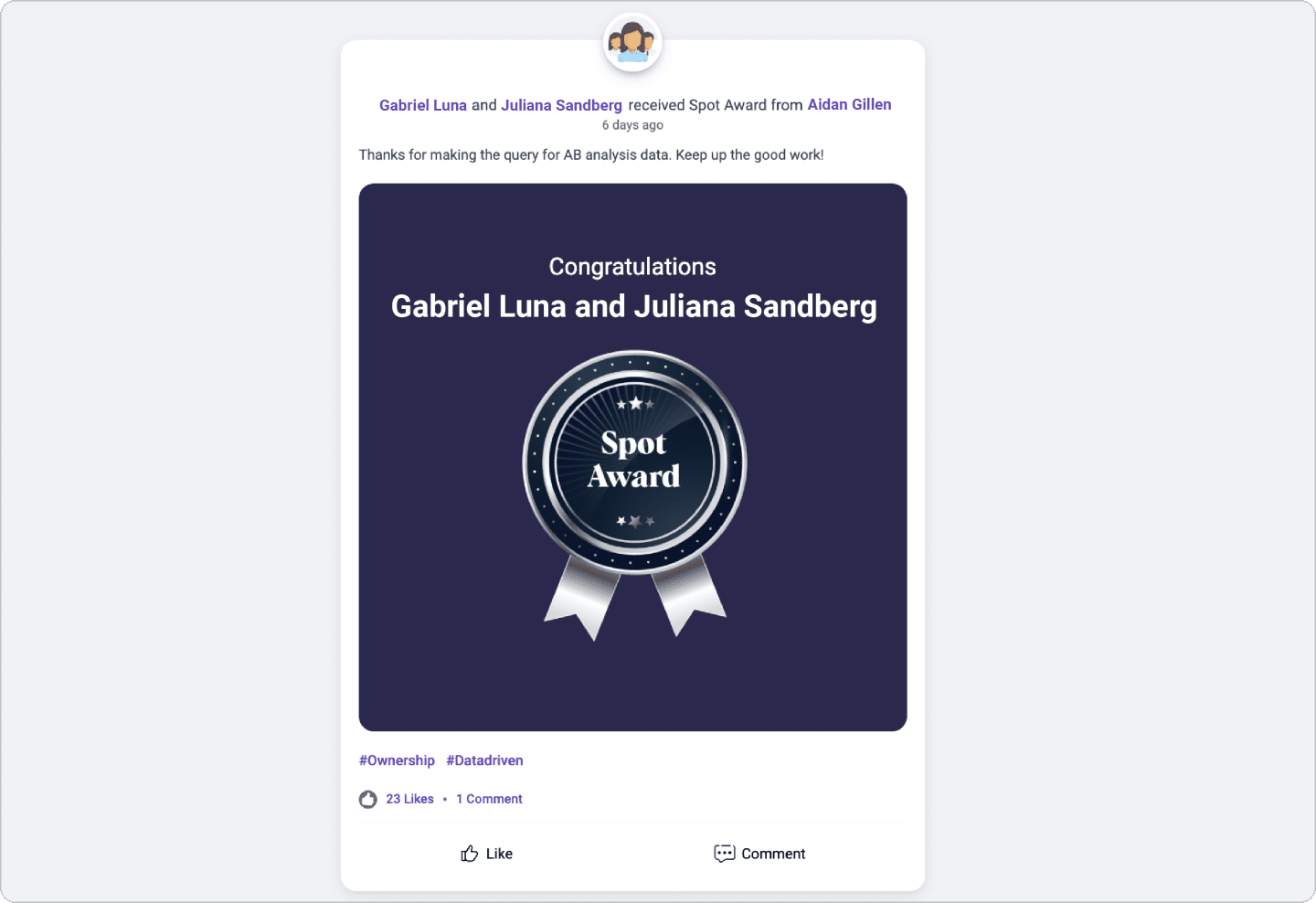
Listen to the EpisodeA structured recognition program built for financial services fixes this by making appreciation frequent, visible, and tied to the behaviors you actually want. A few principles that work well in BFSI:
- Make it peer-to-peer, so recognition is not stuck flowing only top-down.
- Reward compliance and customer-first behavior, not just sales volume.
- Tie rewards and recognition to service milestones and long tenures, which carry extra weight in a high-attrition sector.
Recognition becoming part of the daily rhythm rather than an annual event, that's when engagement and retention tend to follow.
Source: Vantage Recognition
7. Career Growth and Continuous Learning
BFSI employees are ambitious and career-oriented, as the point on decision-making noted earlier. They join for a clear path to bigger roles, and they leave the moment that path goes quiet. Career growth is consistently one of the strongest engagement drivers in the sector, and one of the easiest to neglect when quarterly targets dominate everyone's attention.
The sector is also changing fast. AI, digital lending, and shifting regulation mean the skills that mattered five years ago are not the skills that will matter next year. Employees know this, and they stay with employers who invest in keeping them relevant.
Two moves make the biggest difference:
- Build visible, individual employee development plans so people can see where they are headed and what it takes to get there.
- Embed continuous learning into the workflow through certifications, cross-functional projects, and access to upskilling on the regulatory and digital changes reshaping BFSI.
Growth opportunities signal that the institution is investing in the person, not just extracting output. In a sector fighting some of the highest attrition in India, that signal is often what keeps good people from walking.
Common mistakes BFSI employers make with engagement
The most common mistake is running an annual survey and never acting on it, which erodes trust faster than no survey at all. When employees answer honestly and see nothing change, they stop responding, and you lose the one early-warning signal you had.
A few other traps show up again and again in BFSI:
- Treating recognition as a sales-only reward: Celebrating just the top closers tells compliance, operations, and service staff that their careful work does not count.
- Confusing incentives with engagement: Bonuses drive short-term activity, but they do not build the loyalty that carries people through a tough quarter.
- Copying tech-company perks: Ping-pong tables and free lunches do little for a frontline drowning in targets and regulatory pressure.
- Ignoring the manager layer: Rolling out engagement programs while leaving poor managers in place quietly undoes everything else.
The fix is not more initiatives. It is closing the loop: listen, act visibly on what you hear, and recognize the specific behaviors you want to see more of. In a high-attrition sector, consistency beats novelty every time.
Frequently Asked Questions (FAQs)
1. What is employee engagement in the BFSI sector?
Employee engagement in BFSI is how committed and motivated banking, financial services, and insurance employees feel toward their institution and their work. It goes beyond satisfaction: an engaged employee does careful, compliant work under pressure and stays, rather than simply clocking in until a better offer arrives.
2. Why is employee engagement important in BFSI?
Engagement matters because BFSI runs some of the highest attrition in India, and disengaged staff are both costly and risky. Beyond the expense of turnover, a disengaged, thinly trained frontline is more likely to cut corners or mis-sell products, turning a morale issue into a compliance and governance problem.
3. What are the main types of employee engagement in BFSI?
Engagement generally spans three types: emotional (pride and belonging), cognitive (focus and belief in the work), and behavioral (discretionary effort). In BFSI, behavioral engagement is often decisive, since it drives whether a stressed frontline employee handles a compliance check or a customer complaint with full care or the bare minimum.
4. What causes high attrition in the BFSI industry?
High attrition comes mainly from relentless targets, long hours, and limited career visibility, especially in frontline sales and collections roles. The RBI has flagged private-bank attrition near 25%, while sector-wide churn runs as high as 30 to 40%. Poor managers and weak recognition accelerate the exits.
5. How do you measure employee engagement in banks and insurance?
The most practical measure is eNPS (employee Net Promoter Score), captured through short, regular pulse surveys rather than one annual survey. Track the score over time, segment it by branch, function, and tenure, then pair it with attrition and internal-mobility data to see which teams are quietly disengaging.
6. How can BFSI companies improve employee engagement?
Start by measuring engagement with regular pulse surveys, then act visibly on what you hear. From there, focus on the levers that move the needle in this sector: recognize careful, compliant work and not just top sales, build visible career paths, invest in wellbeing to counter burnout, and pair employees with strong mentors. In a high-attrition sector, consistency beats novelty, so closing the loop matters more than launching new initiatives.
7. What role does recognition play in engagement in BFSI?
Recognition is one of the fastest and most cost-effective levers a BFSI leader has, especially for a frontline that absorbs constant pressure and targets. When appreciation is frequent, peer-to-peer, and tied to compliant, customer-first behavior rather than sales volume alone, dependable performers stay engaged.
What’s Next?
Engaging your employees is no easy feat. That is why we are here to help.
Vantage Circle brings you a cost-effective yet powerful AI-driven employee engagement platform with 4 targeted solutions. Be it rewards and recognition, employee benefits, pulse surveys, or employee wellbeing- we have a solution for you.

Sanjeevani Saikia is a Senior Content Strategist at Vantage Circle, where she leads end-to-end content strategy across SEO, thought leadership, brand storytelling, podcasts, and video. She is also the host of the Vantage Influencers Podcast, where she brings conversations with HR and business leaders from top global organisations, including Fortune 500 companies.
Connect with Sanjeevani on LinkedIn.