
An employee recognition strategy is a documented plan for how, when, and why your organization appreciates its people. It defines the goals, the behaviors worth recognizing, the budget, and the way you will measure results. In short, it turns scattered "good job" moments into a system that supports business outcomes.
Most companies run employee recognition programs. Far fewer run them from a strategy. That gap is why so much recognition feels random, and why it rarely moves retention or engagement. A strategy is what connects everyday appreciation to employee recognition that actually changes how people feel about their work.
Here is the cost of getting it wrong. According to Gallup, only about 1 in 3 employees strongly agree they received recognition for good work in the past seven days. Employees who do not feel adequately recognized are twice as likely to say they will quit within the year.
In this guide, we will cover what a recognition strategy is, why it matters now, the three approaches that anchor it, a six-step framework to build one, and the metrics that prove it worked.
So, let's dive in.
Key Takeaways
- What an employee recognition strategy is, and how it differs from a program
- Why a recognition strategy matters for retention, engagement, and culture
- The three approaches: day-to-day, informal, and formal recognition
- A six-step framework to build your strategy from scratch
- The metrics that prove your recognition strategy is working
What is an Employee Recognition Strategy?
An employee recognition strategy is a deliberate plan that defines how your organization acknowledges and rewards employee contributions in a way that aligns with company values and business goals. It answers four questions: what you recognize, who recognizes whom, how often, and how you measure the impact.
That last part matters. Recognition without a strategy tends to be sporadic and unequal. Some teams celebrate everything. Others celebrate nothing. A strategy makes appreciation consistent, fair, and tied to outcomes you care about.
Strategy vs. Program: The Difference That Trips People Up
A recognition program is the mechanism. Think peer-to-peer shoutouts, service awards, or a points-based rewards catalog. A recognition strategy is the thinking behind it. It is the why, the goals, and the plan to measure success.
You can launch a program without a strategy. Plenty of companies do. But a program without a strategy is a tool without a purpose. It runs for a few months, participation drops, and leadership starts asking what the budget actually bought.
The strategy is what keeps a program alive past month three.
Why a Strategy Beats Ad-Hoc Recognition
Intentional recognition compounds. When employees know what earns appreciation and trust that it is applied fairly, recognition starts to shape behavior. It reinforces the values you want repeated.
Ad-hoc recognition does the opposite. It feels like favoritism, fades quickly, and sends mixed signals about what the company actually values.
Why an Employee Recognition Strategy Matters in 2026
A recognition strategy directly affects the three outcomes every HR leader is measured on: retention, engagement, and culture. The data here is consistent and hard to ignore.
Retention and the Cost of Turnover
Recognition is one of the cheapest retention levers available, and one of the most underused. Employees who feel appreciated are far more likely to stay.
Our joint 2025 study with Great Place to Work, The Recognition Effect, found that when employees feel appreciated, accepted, validated, and accomplished, 97% intend to stay with their organization. Intent to stay climbs 16 percentage points in high-recognition cultures compared to low-recognition ones.
The financial case is just as direct. Gallup estimates that replacing an employee can cost from one-half to two times their annual salary. A recognition strategy that nudges turnover down a few points pays for itself many times over. You can see the full picture in our roundup of employee recognition statistics.
Engagement and Performance
Recognition activates motivation. When effort gets noticed, people repeat the behavior and raise their output.
Gallup's State of the Global Workplace: 2025 Report found that highly engaged teams show 23% higher profitability, 18% higher productivity, and 51% lower turnover. Recognition is one of the strongest, most controllable drivers of that engagement.
Yet the supply falls short. Our Recognition Effect study found that, on average, just 55% of employees feel truly recognized at work. The need is high and the practice is inconsistent. That gap is the opportunity.
Culture and Belonging
Recognition is how workplace culture becomes visible. Every time you celebrate a behavior, you tell the rest of the company what good looks like.
That signal builds belonging. That same research found that employees who experience recognition's full impact are overwhelmingly positive about where they work, with 98% reporting strong workplace sentiment. Appreciation, done consistently, is what turns a group of employees into a team that wants to be there.
The 3 Approaches to Recognition: Day-to-Day, Informal, and Formal
A strong recognition strategy uses three approaches together. Day-to-day, informal, and formal recognition each serve a different purpose, and the mix is what makes appreciation feel constant rather than occasional.
1. Day-to-Day Recognition
Day-to-day recognition acknowledges the small, everyday contributions that keep work moving. It is the most frequent and the most overlooked.
It can be as simple as:
- Saying "thank you" with specifics,
- Giving a shoutout in a team meeting,
- Sending a quick note of appreciation.
These gestures cost nothing and take seconds. Their power is in the frequency. Done daily, they make appreciation a normal part of how the team works.
2. Informal Recognition
Informal recognition sits between everyday praise and official awards. It marks a milestone without the structure of a formal program.
Think spot awards for solving a tough problem, a team lunch after a launch, or a small gift to celebrate a deadline met. It is flexible, personal, and works for both individuals and teams.
3. Formal Recognition
Formal recognition is the structured tier. It includes employee of the month, annual performance awards, and service milestones, delivered through a clear process with defined criteria.
Formal recognition carries weight because it is public and intentional. To work, it needs transparent rules so it feels earned, not arbitrary.
Tangible vs. Intangible: A Useful Lens
Cutting across all three approaches is a simple distinction. Tangible recognition has material value, like gift cards, bonuses, or experiential rewards. Intangible recognition is verbal or written praise, more responsibility, or development opportunities.
Both matter. Intangible recognition often drives culture more than the gift itself. A thoughtful tangible reward makes the moment memorable. The best strategies blend the two. For a deeper breakdown, see the different types of employee recognition.
How to Build an Employee Recognition Strategy: A 6-Step Framework
Building a recognition strategy follows six steps, from assessing where you stand today to measuring results over time. Work through them in order, and you will end with a plan you can defend to leadership and act on this quarter.
1. Assess Your Current State of Recognition
Start by understanding how recognition works in your organization right now. You cannot improve what you have not measured.
Gather honest input through:
- Employee surveys,
- Focus groups,
- One-on-one conversations.
Find out what employees value, where recognition is missing, and which teams are thriving or struggling. This baseline tells you what to fix and gives you a point of comparison later.
2. Build a Recognition Framework
Next, design the framework that defines how recognition happens. It should cover a balanced mix of the three approaches and tie every type of recognition to a company value.
A useful framework spells out:
- Immediate thanks for daily contributions,
- Informal rewards for milestones,
- Formal awards for major achievements.
When recognition maps to values, it stops being random. It starts reinforcing the exact behaviors that drive your business.
3. Set Clear Objectives and a Budget
Now attach measurable goals. Decide what the strategy should achieve, whether that is higher engagement, lower turnover, or stronger cross-team collaboration.
Then fund it realistically. Your budget should account for technology, rewards, and any event costs. A clear budget keeps the program sustainable and gives you a number to measure ROI against. For help sizing this, see our guide to setting an employee recognition budget.
4. Choose a Recognition System
Pick the system that lets recognition flow in every direction. Leaders should be able to recognize employees, and employees should be able to recognize each other.
This is where a dedicated platform earns its place. Vantage Recognition, Vantage Circle's employee recognition platform, lets peers send social shoutouts and award points that employees redeem from a global rewards catalog. The result is recognition that happens in the flow of work, not once a quarter.
The proof is in the adoption. At Wipro, a Vantage Circle program drives one recognition every 1.2 minutes and reached 57% employee coverage. At LTTS, the program hit 93% participation. Frequency at that scale is what cultural adoption looks like.
You can also plan recognition around the calendar with dedicated employee recognition events to give your efforts a visible rhythm.
5. Communicate and Launch the Program
A great program fails if no one knows how it works. Effective communication is what drives participation from day one.
Your launch plan should clearly explain three things:
- The purpose of the program,
- How it works,
- How employees can take part.
Use all-hands meetings, newsletters, and your intranet to build awareness. Clear, repeated messaging is what turns a launch into a habit.
Related: Employee Recognition and 6 Powerful Ways To Implement It
6. Measure, Report, and Iterate
Finally, treat your strategy as a living system. Track results against the objectives you set in step three, collect ongoing feedback, and adjust.
This step is important enough to deserve its own section. Here is how to do it well.
Want to hear how this works in practice? This episode of the Vantage Influencers Podcast breaks down how to design a recognition strategy that lasts.

Vantage Influencers Podcast
Designing a Winning Employee Recognition Strategy
Timely recognition, consistent communication, and aligning recognition with company values.
Listen to the EpisodeHow to Measure Your Employee Recognition Strategy
You measure a recognition strategy by tracking participation, frequency, and the business outcomes it is meant to influence. Launching the program is the start. Proving it works is what keeps it funded.
Establish a baseline before launch, then watch these metrics over time.
| Metric | What it tells you | Healthy target |
|---|---|---|
| Receiver coverage | % of employees who received recognition | 80% or higher |
| Giver coverage | % of managers and peers who gave recognition | 60% or higher |
| Recognition frequency | How often recognition happens | Rising quarter over quarter |
| Engagement / eNPS delta | Change in engagement after launch | Upward trend vs. baseline |
| Voluntary turnover delta | Change in regretted attrition | Downward trend vs. baseline |
| Cost of turnover saved | Retention gains in dollars | Positive ROI vs. budget |
Coverage is the metric most teams miss. A program where the same 10% of people get recognized over and over is not working, even if the total count looks high. Aim for receiver coverage above 80% and giver coverage above 60%, so appreciation reaches the whole organization.
Review these numbers quarterly, not annually. Recognition habits drift fast, and a quarterly cadence lets you correct course before momentum is lost.
A quick gut-check: Can you tell your board what percentage of employees gave recognition last quarter? If you can't, you have a program, not a strategy.
Recognition Strategy by Source: Peer, Manager, Company-Wide, and AI
A complete strategy draws recognition from every direction. Each source reaches employees in a way the others cannot, and the combination is what builds a recognition-rich culture.
Peer-to-Peer Recognition
Peer recognition lets colleagues acknowledge each other directly. It is powerful because peers see the daily work managers might miss.
Tools that support real-time, peer-to-peer recognition make appreciation immediate and inclusive. It democratizes recognition, so contributions at every level get seen.
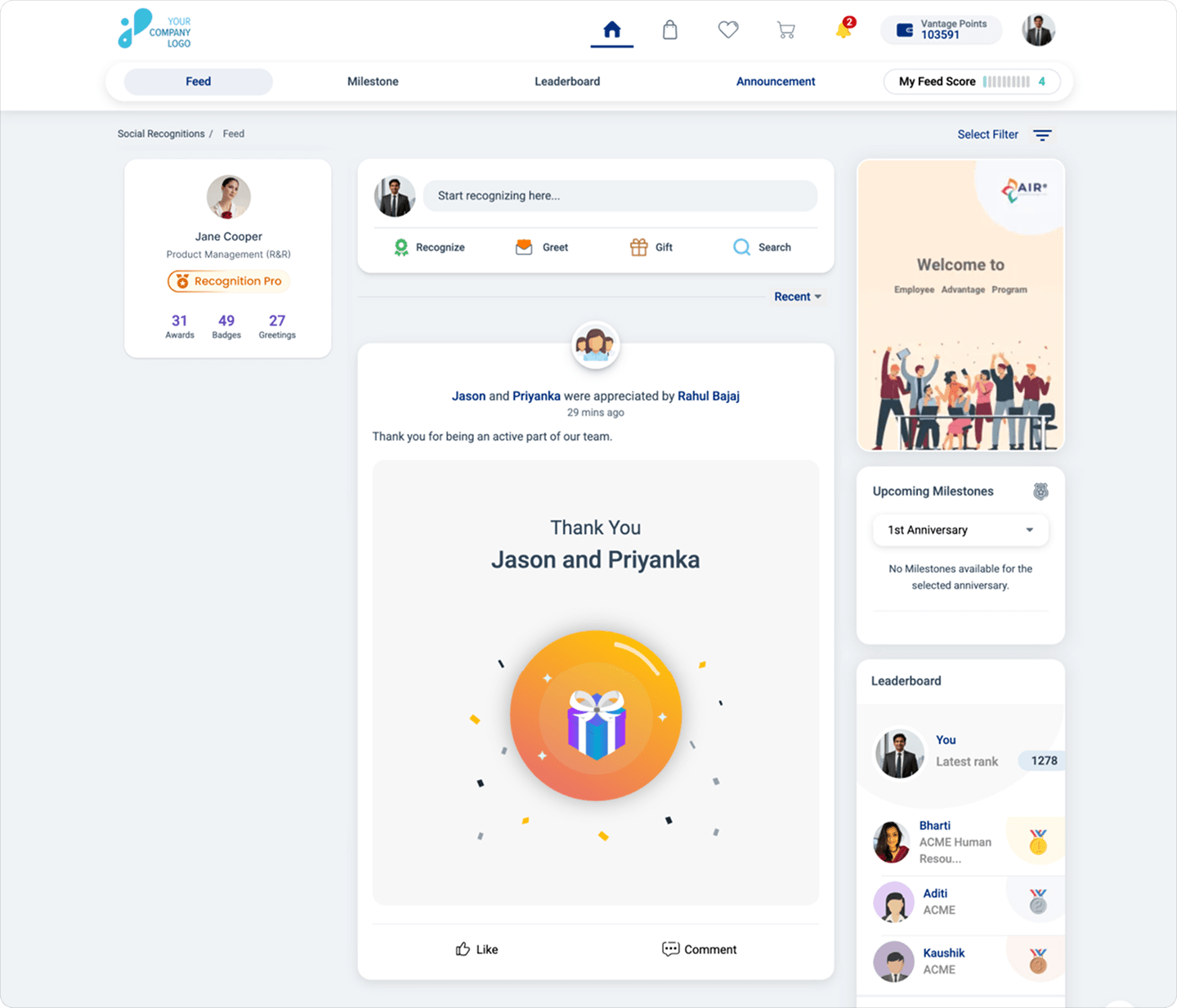
Social Recognition
Public, visible appreciation amplifies the impact of any single moment. Social recognition on a company feed lets the whole organization celebrate a win, which reinforces the behavior for everyone watching.
Managerial Recognition
Managers carry outsized weight in recognition. Personalized feedback, a one-on-one thank you, or a handwritten note from a manager strengthens the relationship and signals real attention.
This is high-value recognition because it is specific and personal. It also gives employees a clear read on their progress and growth.
Company-Wide Initiatives
Company-wide recognition celebrates achievements across the whole organization. Awards ceremonies, team outings, and milestone celebrations build a shared sense of purpose and community.
AI-Assisted Recognition
The newest source is AI. It can prompt managers when someone is due for recognition, suggest specific wording, and surface contributions that would otherwise go unnoticed. Used well, AI in employee recognition closes the consistency gap that trips up most programs.
Employee Recognition Strategy Best Practices
These best practices turn a functional program into a culture. Apply them across all three approaches and every recognition source.
1. Timeliness Matters
Recognize achievements quickly. Immediate recognition reinforces the behavior while it is fresh and shows employees their work is noticed in real time.
2. Specificity Is Key
Skip generic praise. Name the exact action and why it mattered. Specific recognition feels sincere and tells people precisely what to repeat.
3. Inclusiveness Counts
Make recognition reachable for everyone, across roles, levels, and locations. A program that only celebrates a few visible stars breeds resentment, not belonging.
4. Celebrate Wins Publicly
Share success stories across the company. Public celebration multiplies the impact and inspires others by showing what good work looks like.
5. Address Challenges Honestly
Budget limits are real, but they are not a reason to skip recognition. Low-cost and no-cost recognition can be just as meaningful when it is genuine and specific.
6. Account for Generational Differences
Today's workforce spans four generations, and each tends to value recognition differently. Some prefer public praise, others a private note or a growth opportunity. Offer a range of recognition types so the strategy resonates across your whole team.
Common Employee Recognition Strategy Mistakes (and How to Avoid Them)
Most recognition strategies fail for the same handful of reasons. Knowing them upfront is the easiest way to avoid them.
- Inconsistency. Recognition that runs hot then cold trains employees to ignore it. Fix it with a frequency target and a system that makes giving easy.
- Low coverage. When the same people always get praised, everyone else disengages. Track receiver and giver coverage, not just total volume.
- No measurement. A strategy you cannot measure is a guess. Set a baseline and review quarterly.
- Treating it as one-and-done. The biggest gap is frequency. This is the heart of the recognition gap, the distance between how often employees want recognition and how often they get it. Close it with daily, low-friction recognition.
Avoid these four, and you are already ahead of most organizations.
Summing It Up
An employee recognition strategy turns scattered appreciation into a system that drives retention, engagement, and culture. The difference between a strategy and a program is intent. One has goals and metrics. The other just runs until the budget dries up.
Start with your current state. Build a framework tied to values, fund it, choose a system that lets recognition flow everywhere, launch it clearly, and measure it every quarter.
Do that, and recognition stops being a nice gesture. It becomes one of the most reliable levers you have for building a workplace people do not want to leave.
Frequently Asked Questions
What are some effective employee recognition strategies?
Effective recognition strategies combine day-to-day, informal, and formal recognition, tie appreciation to company values, and enable recognition from peers, managers, and leadership. The most effective ones are timely, specific, inclusive, and measured against clear goals like engagement and retention.
What are the 5 C's of employee retention?
The 5 C's of employee retention are commonly listed as Compensation, Culture, Connection, Career, and Caring. Recognition strengthens nearly all five, especially Culture, Connection, and Caring, by making employees feel seen and valued for their contributions.
What are the 4 types of recognition in the workplace?
The four common types of workplace recognition are public recognition, private recognition, monetary recognition, and promotion or growth-based recognition. Many strategies also group recognition by source: peer-to-peer, manager-to-employee, and company-wide.
What are the best employee recognition ideas?
The best recognition ideas range from simple to structured: specific verbal thank-yous, peer shoutouts, spot awards, handwritten notes, points-based rewards, service milestones, and public celebration of wins. The best idea is the one that fits how each employee prefers to be recognized.
What are the 3 C's in the workplace?
The 3 C's in the workplace are commonly defined as Communication, Collaboration, and Coordination. In a recognition context, they are sometimes framed as Care, Connect, and Celebrate, which describe how appreciation should feel, build relationships, and mark achievements.

Nilotpal M Saharia is an Assistant Manager, Content Marketing at Vantage Circle and a recognition-and-rewards (R&R) strategist with 9 years of experience spanning Marketing, HR, and content strategy. He helps HR leaders turn employee recognition and leadership research into practical workplace programs.
Connect with Nilotpal on LinkedIn.