
Sit in on any team huddle in 2026 and you can spot the recognition gap under three minutes. The manager says "great work this week, team," lingers for half a beat, and moves to the next agenda item. The room nods. An hour later, no one can tell you which behavior was being recognized or why it mattered. Technically, employee recognition was delivered. But none of it stuck.
That gap between recognition sent and recognition felt is the central problem of every employee recognition program we have audited. The volume is usually fine. The delivery is not. Managers do not skip recognition because they do not care. They do it badly because the moment is generic, the timing is late, and the words are never tied to a behavior the organization actually wants more of. The reframe that changes everything: giving recognition at work is not a personality trait. It is a delivery skill, with a framework, a script library, and a weekly cadence anyone can run.
What follows is a delivery system, not another idea list. You will leave with a five-step framework, twelve manager-tested ways sorted by effort, eight occasion-specific scripts, a 60-second self-audit, and the latest research on what recognition actually changes.
The 60-Second Recognition Diagnostic
Pull up the last recognition you sent. Score it on five checks, one point each:
- Does it name a specific situation, with a date or project attached?
- Does it describe an observable behavior, not a feeling?
- Does it connect the behavior to a downstream impact?
- Did it land within a week of the moment?
- Does it reference one of your organization's stated values?
Three points or fewer means your recognition is being read as appreciation, not recognition.
What Does Giving Recognition at Work Mean?
Giving recognition at work means acknowledging an employee's specific contribution in a way that is timely, behavior-linked, and tied to a value the organization wants to reinforce. The form can be private or public, monetary or verbal, formal or in-the-moment. The substance is always the same. You name what the person did. You explain why it mattered. You signal what behavior you want more of.
That is not the same thing as appreciation, and it is not the same as a reward. The three get conflated, which is one reason most programs underperform. Worth pulling apart before we go any further.
| Dimension | Appreciation | Recognition | Rewards |
|---|---|---|---|
| What it acknowledges | The person | A specific behavior or outcome | A milestone or threshold |
| Trigger | Anytime ("glad you are on this team") | A named event or behavior | Hitting a defined target |
| Frequency | High, ongoing | Medium, behavior-driven | Lower, milestone-driven |
| Cost | Zero | Usually zero, optionally points | Points, cash, experiences |
| Example | "Thanks for being you, the team is better with you in it." | "The way you handled the escalation on Tuesday saved us a customer." | 500 reward points for closing the quarter target |
If you only do appreciation, employees feel liked but not seen. If you only do rewards, you create transactional behavior. Recognition is the middle layer that converts effort into culture, and it is the one most programs under-invest in. For the deeper read, see our piece on the psychology of employee recognition.
How Big Is the Recognition Delivery Gap?
The scale of this problem is worth naming up front, because it changes how you read everything that follows. Three independent data sets, all from the last two years, line up on the same diagnosis.
The baseline first. Gallup's Q12 research finds that only 3 in 10 US employees strongly agree they received any recognition or praise for good work in the past seven days. That works out to roughly one weekly recognition for every three employees, organization-wide. The other two finish the week with nothing named about their work.
Engagement is sliding in parallel. Gallup's 2024 measurement of 79,000 US employees found only 31% are engaged, the lowest level in a decade. Recognition is one of the few daily manager behaviors known to bend that line, which is why it shows up in every retention conversation we walk into.
The recognition that does happen matters more than most leaders realize. Gallup research tracking nearly 3,500 employees from 2022 to 2024 found well-recognized employees were 45% less likely to have left after two years, while only 22% of employees say they receive the right amount of recognition. The recognition that lands changes retention dramatically. The recognition most employees actually get does not land.
The pattern is not US-only. Research from the Recognition Effect study by Vantage Circle and Great Place to Work India, which surveyed 5.7 million employees across 2,000 organizations, found that only 55% of employees feel truly recognized at work. When employees experience all four recognition signals, appreciated, accepted, validated, and accomplished, 97% report an intent to stay. The retention dividend is concentrated in cultures where recognition lands consistently, not occasionally.
The manager-side picture closes the loop. A Gartner 2024 survey of 805 HR leaders found 75% say managers are overwhelmed by expanding responsibilities, and 69% say managers are not equipped to lead change. McKinsey Health Institute research flags middle managers as one of the most exhausted populations at work.
Stack the findings and the picture is uncomfortable. Managers are your single biggest recognition lever and your most overloaded population. Telling overloaded people to "recognize more" without giving them a script and a 30-second workflow is how you end up with the same generic "great job" messages on a longer schedule. For the deeper data, see our full employee recognition statistics library.
| Source / Year | The Number | Where It Hits Delivery |
|---|---|---|
| Gallup, Q12 research | Only 3 in 10 US employees got recognition in past 7 days | The delivery gap is the rule, not the exception. Even one weekly recognition would put a team in the top tier |
| Gallup, 2024 US workforce | Only 31% of employees engaged, a 10-year low | The macro trend is declining. Manager-led recognition is one of the few proven reversers |
| Gallup, recognition retention study 2022 to 2024 | Well-recognized employees 45% less likely to have left after 2 years | Recognition done well is a measurable retention instrument, not a soft skill |
| Gallup, recognition retention study 2022 to 2024 | Only 22% say they receive the right amount of recognition | Most of the retention loss in recognition cultures is a delivery gap, not a budget gap |
| Gartner, 2024 HR Leader Survey (805 HR leaders) | 75% say managers are overwhelmed, 69% say managers are not equipped to lead change | Skill plus time pressure stack. Give managers a framework and a cadence, not another reminder |
| McKinsey Health Institute | Middle managers are among the most burnout-exposed segments at work | The biggest recognition lever is also the most exhausted. Design the workflow accordingly |
| Recognition Effect, Vantage Circle x GPTW India, 2025 (5.7M employees, 2,000 orgs) | Only 55% feel truly recognized; 97% intent to stay when all four recognition signals are present | The retention upside is concentrated where recognition is consistent. Inconsistency is the gap, not absence |
The 5-Step SBI+T Framework for Giving Recognition That Lands
Here is the part most managers miss. The reason a "great job" message feels hollow is that managers compress four pieces of information into two words. The behavior gets praised. The reason the behavior mattered does not. The next time the same situation comes up, the employee has no memory of what exactly worked, which means they cannot repeat it on purpose. Recognition stops being a culture instrument and starts being noise.
SBI is a feedback framework borrowed from coaching research. Add T for Timing, and it becomes a 30-second recognition script that works in your team chat tool, in person, or on a recognition platform. The structure is the same every time, which is exactly why managers can run it without writer's block.
1. Situation (Name the Moment)
Start with the specific moment. Not "this week." Not "lately." The exact situation, with a day or a project attached. "On Tuesday, when the client escalated about the API outage..."
This grounds the recognition in a shared memory. The employee knows immediately which moment you are talking about. Generic praise gets remembered as generic. Specific praise gets replayed.
2. Behavior (Name the Action)
Describe what the person actually did. Not how they made you feel. "...you stayed on the call for an extra forty minutes, walked the client through the root cause, and committed to a fix by Friday."
This is the part most managers skip. Behavior is observable. Behavior is repeatable. When you name the action precisely, you signal that you are paying attention and that the doing, not the personality, is what mattered.
3. Impact (Name the Outcome)
Connect the behavior to a downstream outcome. "...the client renewed for two more years instead of going to RFP. That is roughly $300K in annual recurring revenue we keep on the books."
Impact is the part that turns a thank-you into a culture moment. The employee sees that their work is connected to something the organization values. Peers, if the recognition is public, see the same line of sight. The behavior becomes the standard the team measures itself by.
4. Timing (Within a Week, Ideally 24 Hours)
The half-life of recognition is shorter than most managers think. A shout-out three weeks after the event lands at maybe 20% strength. The same shout-out within 24 hours lands at full intensity. The Gallup retention study cited above found that frequency and timeliness were two of the five pillars predicting whether recognition translated into staying.
5. Format (Public, Private, or Both)
Not everyone wants the stage. Some employees do their best work in quiet and feel exposed when called out in a town hall. Others draw energy from public moments. The default in 2026 is a private message with the SBI script, plus a one-line public version in your team channel if the employee is comfortable with it. Ask once. Remember the answer.
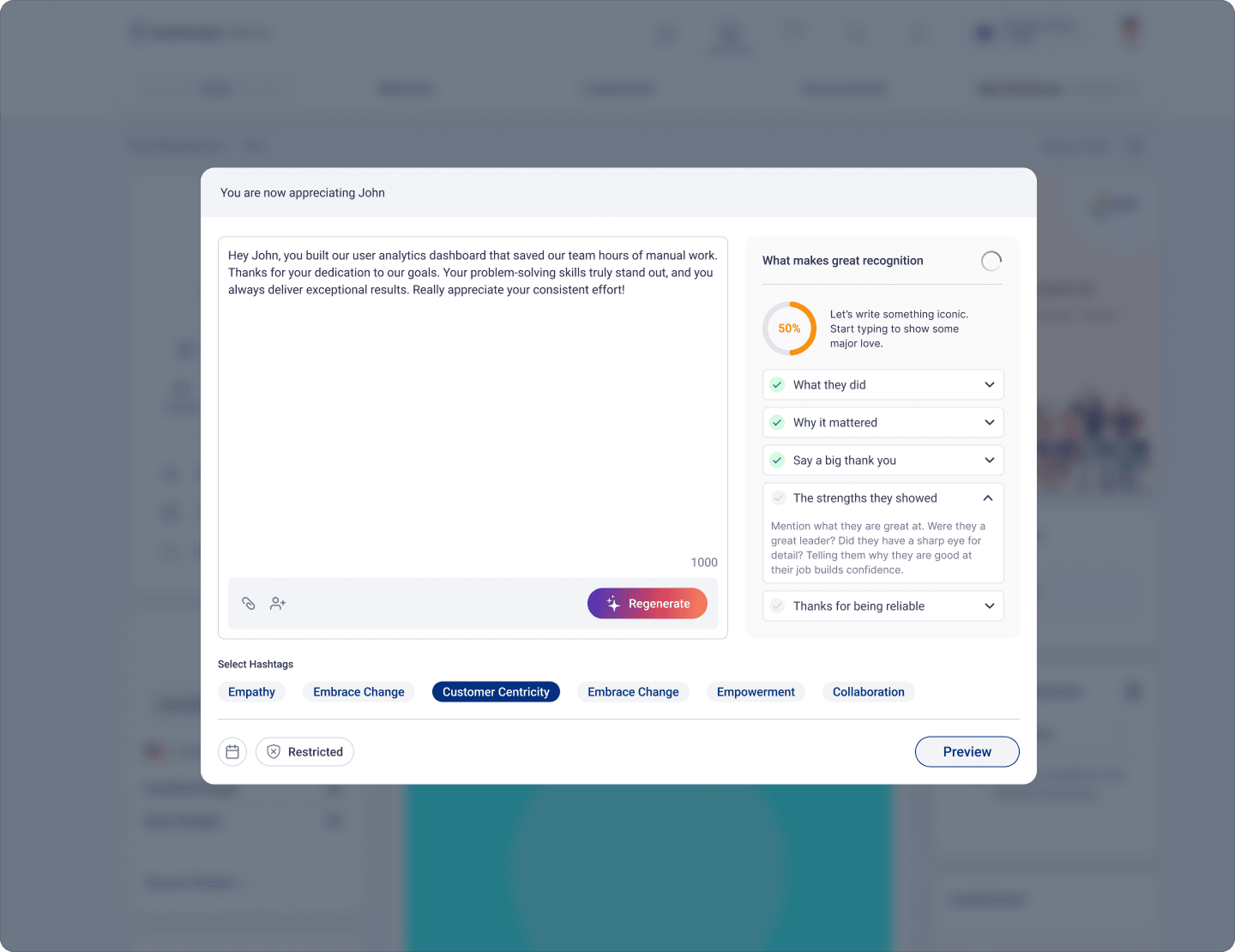
Weak vs strong recognition, same situation
Weak: "Hey, great work on the client thing this week."
Strong: "On Tuesday when the client escalated about the API outage, you stayed on the call for an extra forty minutes, walked them through the root cause, and committed to a fix by Friday. They renewed for two more years instead of going to RFP. That kind of pressure-handling is exactly the customer trust we want our culture known for."
12 Manager-Tested Ways to Give Recognition at Work
Talk to people managers about recognition and one objection comes up more than any other. "I know it matters. I have no idea when to fit it into my week." The honest fix is to stop treating recognition as one large activity and start treating it as twelve smaller ones, sorted by how long they take. The first four take 30 seconds each. The next four take five minutes. The last four are recurring rituals that live on the team calendar. Make the cost match the moment, and recognition stops competing for time it was never going to win.
30-Second Moments (Items 1 to 4)
1. The Real-Time Team-Channel Shout-Out. As soon as you see the behavior, post in your team chat channel (Slack, Microsoft Teams, or whichever tool your team uses) using SBI. Three sentences. Tag the person. Done before the moment cools. The most underrated recognition format in 2026.
2. The Specific Verbal Thank-You. In your next 1:1 or hallway pass, deliver the SBI script in person. No screen, no template. Sixty seconds, eye contact, and out.
3. The Manager-to-Manager Hand-Off. Someone outside your team helped you ship something. Send their manager a direct message on Slack or Microsoft Teams with the SBI script and copy the employee. The employee gets praise from two managers in one moment. The other manager gets a story for their next performance review cycle.
4. The Skip-Level Brag. When the behavior is exceptional, escalate it upward. Send your manager or your CHRO a short note. "I want you to know what Priya did this week. [SBI]. This is the kind of work we should be naming publicly."
5-Minute Investments (Items 5 to 8)
5. The Hand-Written Note. Yes, on paper. Three sentences. Mail it or leave it on the desk. The same Gallup retention study found 42% of senior leaders strongly agreed recognition was valuable in 2024, compared to 28% in 2022. The handwritten note is the leadership behavior that closes that perception gap fastest.
6. The Public Channel Post With a Specific Behavior Quote. Same as item 1, but in a company-wide channel, not just your team's. Pull a one-line quote from a peer or a customer. Tag the value the behavior expressed. Other managers learn the format by reading yours.
7. The Peer Shout-Out Nomination. Use your peer-to-peer recognition platform to nominate someone for a peer award. Add the SBI script as the nomination text, not just "great work this quarter."
8. The Customer Quote Forward. When a customer praises the team, forward the message with the SBI translation written below it. "When you read this, notice the specific behavior the customer named. That is the standard we are operating at."
Recurring Rituals (Items 9 to 12)
9. The Weekly Spot Awards Round. Block 10 minutes every Friday. Review the week. Identify two behaviors worth spotlighting. Send Spot Awards through the recognition platform with SBI text. Over a quarter that is roughly 24 named behaviors per manager, which is enough volume to shift team culture.
10. The Core Values Recognition Tag. Tag every recognition moment to one of your organization's values. Over 90 days the dashboard will show you which values are getting reinforced and which are quietly going un-celebrated. That insight is more useful than another engagement survey.
11. The Quarterly Story Award. Every quarter, pick one recognition story per team and turn it into a longer write-up. Three paragraphs. Publish in the company newsletter or all-hands deck. The behavior gets reinforced. The story becomes part of the org's living folklore.
12. The Service Anniversary Personalization. Service awards are the most-skipped recognition format because they are usually generic. Spend ten minutes before each anniversary writing two paragraphs that name a specific project or contribution from each year. The cost is the same as a templated award. The signal is dramatically different.
| # | Method | Effort | Audience | Best For |
|---|---|---|---|---|
| 1 | Real-time team-channel shout-out | 30 sec | Team | Behavior you saw this morning |
| 2 | Specific verbal thank-you | 1 min | Private | Quiet performers, 1:1 settings |
| 3 | Manager-to-manager hand-off | 2 min | Two teams | Cross-team contribution |
| 4 | Skip-level brag | 3 min | Executive | Exceptional, career-shaping work |
| 5 | Hand-written note | 5 min | Private | Leadership-tier moments |
| 6 | Public channel post | 5 min | Company-wide | Behaviors others should copy |
| 7 | Peer shout-out nomination | 5 min | Team or company | Recognition between peers |
| 8 | Customer quote forward | 5 min | Team | External validation moments |
| 9 | Weekly Spot Awards round | 10 min/week | Team | Building habit and volume |
| 10 | Core values tag | 0 marginal time | Team | Connecting recognition to culture |
| 11 | Quarterly story award | 30 min/quarter | Company-wide | Long-form behavior storytelling |
| 12 | Service anniversary personalization | 10 min/event | Private or team | Milestones, retention moments |
Recognition by Occasion: What to Say When
Generic praise fails because the words do not match the moment. A "great work" line that follows a routine task and one that follows a high-stakes save sound identical to the recipient, which means neither carries weight. The fix is to keep a short mental library of SBI scripts for the eight occasions that come up most often. Once you have the patterns, you can adapt in under a minute.
| Occasion | Sample SBI Script | Recommended Format |
|---|---|---|
| Project shipped on time | "You closed out the migration on Friday two days ahead of schedule. The way you re-sequenced the data validation step is what bought that time. The team has a working playbook now." | Public channel post |
| Sale closed | "You closed the enterprise renewal with the procurement team that pushed back hardest in our pipeline. The two extra discovery calls you ran in week three are what got us there. Worth a hundred templated decks." | Skip-level brag plus Spot Award |
| Late-night save | "You picked up the on-call page at 11 pm Tuesday, ran the rollback in twenty minutes, and wrote the postmortem before the morning standup. Customers never noticed. That is the operational steadiness we want associated with this team." | Real-time team-channel shout-out plus handwritten note |
| Peer help or collaboration | "When Anjali asked for help on the campaign brief, you walked her through your framework instead of just sharing the deck. She shipped her own version on Monday and credited you. That is how knowledge becomes culture instead of staying with one person." | Peer shout-out nomination |
| Work anniversary | "Three years. The thing I keep coming back to is the customer-onboarding redesign you led in year two. We still use the seven-step model. New hires still meet it on their first week. That is durable work." | Service anniversary personalization |
| Promotion | "You earned this. The signal moment for me was how you ran the cross-functional review last quarter. You took feedback from three skeptical directors and turned it into a sharper proposal in 48 hours. That is the operating level the new role requires." | Public announcement plus one-on-one note |
| Failed but bold attempt | "The pitch did not land, and we both know why. What I want to name is that you put the rough version in front of real customers in week two instead of polishing for six. We lost a deal. We learned more in three weeks than we would have in three months." | Private SBI message |
| Onboarding milestone (30 / 60 / 90 day) | "You hit your first solo customer call on day forty-two, two weeks ahead of the curve. The note you wrote up afterward is going into the onboarding library. New hires will benefit from your first six weeks for years." | Public channel post plus manager DM |
If you build the habit of writing recognition this way, the time cost drops to under a minute per occasion. For more ready-to-use language, see our library of rewards and recognition ideas.
Formal vs Informal Recognition: When to Use Each
Most organizations over-invest in formal recognition and under-invest in informal. They run a quarterly awards program with a stage and a trophy and assume that covers it. It does not. Formal and informal recognition do different jobs, and the strongest cultures use both deliberately, in a cadence that supports the other.
| Dimension | Formal Recognition | Informal Recognition |
|---|---|---|
| Trigger | Pre-defined milestone or nomination cycle | Observed behavior in the flow of work |
| Frequency | Quarterly or annual | Daily to weekly |
| Owner | HR or program lead | The manager and peers in the room |
| Cost | Plaque, points, prize money, time off | Usually zero |
| Example | "Employee of the Quarter" award at all-hands | Team-chat thank-you the day a behavior happens |
| Best for | Signaling what the org formally values | Sustaining behavior between formal moments |
Used together they form a cycle. Informal recognition shapes weekly behavior. Formal recognition crowns the pattern and broadcasts it. Most programs we audit are heavy on formal and starved on informal, which is why participation craters between award cycles. For more on the structural choices, see our piece on the types of recognition of employee contribution.
The 5 Recognition Mistakes Most Managers Make
Look at recognition platform data across a few dozen mid-to-large programs and five mistakes show up over and over. None of them are about intent. All of them are about delivery, which is the good news here. Delivery is a skill that responds to training inside a single quarter. Intent is much harder to move.
1. Generic Praise Without a Specific Behavior (The Most Common One)
The "great job" message that names nothing. The employee cannot identify which behavior worked, so they cannot repeat it on purpose. Peers cannot learn the pattern, so the recognition does not scale beyond one person. The fix is the B in SBI. Always name the action. If you cannot, you do not yet have enough information to recognize. Get the information first.
2. Waiting Until the Performance Review (The Cold Recognition Problem)
A behavior in March that gets called out in November is no longer recognition. It is documentation. The behavior has cooled, the context is gone, and the moment cannot reinforce anything. Recognition needs the T in SBI+T. Within 24 hours is the gold standard. Within a week is acceptable. Within a quarter does not count.

VANTAGE INFLUENCERS PODCAST
"Management is in the real time today. It's not what you do at the end of the year or the end of the quarter. It's what you do today and tomorrow."
— Dr. Bob Nelson, leading authority on employee recognition and bestselling author of 1501 Ways to Reward Employees
Listen to the Episode3. Public Recognition for Someone Who Prefers Private (The Format Mismatch)
Recognition fails when the format ignores the recipient. The introvert who gets pulled onto a town-hall stage usually leaves the moment feeling exposed, not appreciated. Ask once. Remember the answer. Most recognition platforms now let you flag preferences in the employee profile, which removes the load from your memory.
4. Manager-Only Recognition With No Peer or Skip-Level Sources (The Single-Source Problem)
When the only recognition employees ever receive is from their direct manager, recognition feels political. Add peer recognition. Add skip-level moments. Gallup's State of the American Manager finds managers account for at least 70% of the variance in team engagement scores, which means managers are critical, but recognition that only flows through them creates a chokepoint and a perceived bias.
5. Recognition Untied to a Company Value (The Floating Compliment)
A "thanks for working late" message is a thank-you, not recognition. Recognition gains weight when it is linked back to a stated value. "This is exactly the customer trust we want this team known for." The value gets reinforced. The behavior becomes repeatable. The story becomes shareable across teams that were not in the room when it happened.
The 60-second self-audit, scored
Go back to the last three recognitions you sent. For each one, check whether it named a Situation, described a Behavior, showed an Impact, landed within a week, and referenced a value. Score five points per yes. Below 60 out of 75 total, your delivery is the bottleneck, not your intent.
How to Build a System So Recognition Does Not Depend on Memory
Recognition that runs on manager memory fails predictably. The willing managers send a few each month. The overloaded managers send none. The new managers do not know where to start. Three months in, participation looks like a power law and HR is back to running campaigns to fix what is really a systems problem. For the diagnostic that names the four gaps behind most stalled programs, see our companion read on why managers don't participate in your recognition program.
The fix is to take the load off memory. Four steps, in order.
- Weekly review of who has not been recognized. Block 10 minutes every Friday. Pull the list of direct reports who have received zero recognitions in the past 30 days. Decide whether the absence is real or a gap you missed. Send one this afternoon if it is the latter.
- Recognition prompts tied to values. Most recognition platforms can suggest a prompt when a behavior is logged. Use them. The friction drops from "what should I say" to "do I want to send this." Two very different cognitive loads.
- Manager dashboard. Recognition coverage by team, by direct report, by value. Look at it once a quarter. Patterns jump out fast, and so do the people quietly going unrecognized.
- A public feed. Recognition that lives in private DMs reinforces one relationship. Recognition that lives in a feed reinforces the whole team. The feed is the cultural artifact that compounds.
Vantage Circle has built recognition systems for more than 700 organizations and 3.2 million employees. The programs that compound show up in the numbers. Wipro reached 57% recognition coverage and one recognition every 1.2 minutes. LTTS hit 93% employee participation. Tata Communications saw a 185% surge in peer-to-peer recognition. Three different industries, three different scales, one shared design principle. The platform owns the cadence. The manager owns the words. The system handles the prompts, the dashboards, the coverage gaps, and the visibility. The manager only has to bring the situation, behavior, and impact to the keyboard. For a deeper look at why most programs fail this split, see our manager recognition gap read.

Source: Vantage Recognition
Summing It Up
Back to the team huddle scene we opened with. The director who says "great work this week, team" and moves on is not lazy or uncaring. They are running an unstructured workflow on a calendar that has nothing structured about it. Give the same director the SBI+T framework, twelve sorted options for the week, eight occasion scripts they can adapt in under a minute, and a Friday self-audit, and the recognition starts landing inside two months. Not because the director changed. Because the system around them did.
Three patterns separate the recognition cultures that compound from the ones that plateau. They train the framework first and the platform second, in that order. They build the informal cadence before they layer on the formal program, because formal recognition without an informal base is just a quarterly ceremony. And they move the cadence load off manager memory and onto the system, so participation survives bad weeks, reorgs, and quiet quarters.
If you want to see how Vantage Recognition runs that system at scale, with SBI prompts, values tagging, social feeds, and coverage dashboards, book a Vantage Recognition demo. Most first conversations start with us looking at your current recognition data together. The dashboard usually shows the gap clearly in the first ten minutes.
FAQ
How do you give someone recognition at work?
Use the SBI+T framework. Name the Situation, describe the Behavior, show the Impact, and deliver it within a week of the moment, with 24 hours as the gold standard. Choose the format that fits the person, a private message for some and a public channel post for others, and reference one of your organization's stated values where it fits. The structure works for managers, peers, and skip-level recognition alike, which is why it scales.
How do I ask for recognition at work without sounding desperate?
Frame the request around visibility, not validation. In your next 1:1, tell your manager which projects you would like to be known for and ask which audiences your behavior should be visible to. That could be their manager, the cross-functional team, or the customer. You are not asking for praise. You are asking for the right audience to see the work. Most managers are happy to do this, and the request itself signals ambition rather than insecurity.
What is the best way to recognize employees for a job well done?
Within 24 hours of the behavior, in writing, with a specific named action and a downstream impact attached. Combine it with a small reward or points if your platform supports it. Avoid the deferred quarterly award as your primary mechanism, because it is too far from the moment to reinforce anything. The best recognition is the recognition that lands while the behavior is still fresh in everyone's memory, including the person who did it.
How do you recognize employees who go above and beyond?
Match the recognition to the size of the behavior. A one-time bold attempt deserves a public channel post and a Spot Award. A pattern of above-and-beyond behavior over a quarter deserves a story-award write-up and a skip-level brag to the next layer up. The most common mistake is to use the same format for both, which flattens the signal. Above-and-beyond recognition is most credible when it reads as proportional to the work.
How do you give specific recognition without sounding scripted?
Talk in the language of the work, not the language of HR. Quote a customer. Name the actual project. Reference the exact day. Avoid words like "leverage," "synergy," and "value-add," which signal a template rather than a thought. The closer your recognition sounds to how the team actually talks about the work, the more it lands as real.

Nilotpal M Saharia is an Assistant Manager, Content Marketing at Vantage Circle and a recognition-and-rewards (R&R) strategist with 9 years of experience spanning Marketing, HR, and content strategy. He helps HR leaders turn employee recognition and leadership research into practical workplace programs.
Connect with Nilotpal on LinkedIn.