89% of new hire failures were due to poor soft skills, not technical shortcomings.
Soft skills in the workplace are hard to hire for and even harder to prove impact on. A candidate can clear every technical interview and still struggle to collaborate, communicate, or manage conflict on the job. That gap shows up in the 89% failure rate above.
For HR teams, soft skills are already agreed on. The harder task is building them into hiring, training, performance reviews, and recognition consistently and measurably, not just a line on a values poster.
What are Soft Skills?
Soft skills are the behavioral and interpersonal abilities that shape how someone works with others: communication, self-awareness, empathy, adaptability, and similar traits. Unlike hard skills, which are taught through training or certification, soft skills develop through experience, feedback, and repeated practice.
That difference matters for HR: it changes how each skill gets built and measured, as the table shows.
Soft Skills vs. Hard Skills
| Soft Skills | Hard Skills |
|---|---|
| Built through experience and self-awareness (communication, empathy, adaptability) | Built through training or education (coding, accounting, machine operation) |
| Measured through observation, feedback, and behavior over time | Measured through tests, certifications, and completed tasks |
| Transfer across roles and industries | Often role- or tool-specific |
| Harder to quantify on a resume | Easy to list and verify (degrees, certifications, tools) |
| Shape how work gets done: collaboration, trust, adaptability | Shape what work gets done: output, technical execution |
Why are Soft Skills Important in the Workplace?
A team can be full of technically strong people and still underperform if they can't communicate, collaborate, or handle conflict. Soft skills turn individual expertise into work that moves forward: a data analyst's findings only help the business decide when people outside analytics can understand them. The same is true of a technical hire who can't take feedback, or a manager who can diagnose a problem but can't get buy-in to fix it.
For HR, that's why soft skills show up so consistently in hiring criteria and performance reviews: they predict how well someone works with a team, not just whether they can do the job alone.
Ninety-three percent of employers say soft skills play a critical role in hiring decisions. (Ian Siegel, CEO of ZipRecruiter, 2022 Job Outlook Report)
That gap also has a price tag. Poor workplace communication alone costs U.S. businesses an estimated $1.2 trillion a year in lost productivity, rework, and turnover (Grammarly x Harris Poll, State of Business Communication). That's the cost of just one item on this list, left to chance.
17 Soft Skills in the Workplace HR Leaders Mustn't Ignore
Building all 17 at once isn't realistic for most budgets. Start with what makes everything else possible, then layer in what's specific to each role.
| Priority | Skills | Who needs them first |
|---|---|---|
| Foundational | Communication, Emotional Intelligence, Teamwork and Collaboration | Everyone, before anything else |
| Role-specific | Time Management, Attention to Detail, Digital Literacy, Customer Service Orientation | New hires and individual contributors |
| Role-specific | Leadership, Conflict Management, Negotiation and Persuasion, Recognizing Skills | Managers and team leads |
| Role-specific | Presentation and Advisory Skills, Resilience, Creativity, Adaptability | Senior leaders and executives |
| Reinforcement | Professionalism, Problem-solving, Networking | Ongoing, all levels |
Communication, Emotional Intelligence, Teamwork and Collaboration
Who needs them first: Everyone, before anything else
Time Management, Attention to Detail, Digital Literacy, Customer Service Orientation
Who needs them first: New hires and individual contributors
Leadership, Conflict Management, Negotiation and Persuasion, Recognizing Skills
Who needs them first: Managers and team leads
Presentation and Advisory Skills, Resilience, Creativity, Adaptability
Who needs them first: Senior leaders and executives
Professionalism, Problem-solving, Networking
Who needs them first: Ongoing, all levels
Execution also depends on size. At a few hundred employees, this usually sits with managers coaching directly, no formal program required. Past a few thousand, it needs a dedicated L&D calendar, tracked completion, and a way to check whether behavior actually changed, not just whether people attended.
Here's what each skill looks like in practice, and how HR can build it.
1. Communication skills
Someone with strong communication skills can walk a stakeholder through a delayed project without the conversation turning defensive, and can write a status update that answers questions before they're asked. Good communication skills in the workplace cut down the back-and-forth that slows projects down. HR can enhance this by:
- standardizing a status-update template that forces clarity before it reaches a stakeholder,
- pairing less confident communicators with strong ones for high-stakes meetings and
- building structured feedback into 1:1s, not just annual reviews.
2. Teamwork and Collaboration
Teamwork shows up in the details: covering for a teammate during a crunch, flagging a blocker before it becomes a fire drill, sharing credit instead of hoarding it. Building better teamwork means fewer duplicated efforts and faster handoffs between functions. HR can foster this by:
- arranging team-building activities that build relationships across functions, not just within one team,
- auditing handoff points between teams to catch where collaboration breaks down and
- recognizing team wins publicly, not just individual ones.
3. Problem-solving and Critical Thinking
An employee with strong problem-solving skills brings a recommendation to a meeting, not just a problem. They weigh two or three options, flag the tradeoffs, and make a call instead of escalating everything upward. HR can support this by:
- requiring a recommendation, not just a flagged problem, in escalations and status updates,
- running case studies built from real, anonymized company situations instead of generic scenarios and
- giving employees room to make and learn from decisions before they're client-facing.
4. Leadership
Leadership is on display any time someone steps up before being asked to: a junior employee organizing a stalled project, or a manager who owns a missed deadline in front of the team. Leadership skills every manager needs start with the ability to communicate a plan and hold people accountable to it.
HR can nurture leadership qualities by:
- giving high-potential employees a small team or project to lead before a formal promotion,
- pairing emerging leaders with a manager for real-time coaching, not just a training module and
- building accountability checkpoints into leadership development, not only skill-building.
5. Adaptability and Flexibility
Adaptable employees regroup quickly after a reorg, a new tool rollout, or a sudden shift in priorities, and get back to productive work without needing three meetings to process the change. HR can promote this by:
- explaining the reasoning behind a change, not just announcing it,
- rotating employees through different projects periodically so shifting priorities feel normal and
- recognizing people who adapt well during a transition, not just those who deliver results afterward.
Read our blog on: Flexibility In The Workplace - What Employees Look Forward To In 2024
6. Time Management and Organizational Skills
Strong time management shows up as knowing what to tackle first when everything feels urgent, protecting focus time, and rarely missing a deadline by surprise. HR can aid this by:
- auditing meeting load and protecting blocks of uninterrupted focus time,
- teaching prioritization frameworks tied to actual role goals, not generic productivity tips and
- treating missed deadlines as a coaching conversation, not just a compliance flag.
7. Emotional Intelligence
Emotional intelligence in the workplace lets someone read a tense meeting and adjust their tone, or notice a teammate is overwhelmed before it becomes a resignation. Most of the other skills on this list depend on it. HR can develop this by:
- training managers first, since emotional intelligence gaps at the manager level cascade fastest,
- building regular pulse checks so strain gets caught before it becomes attrition and
- normalizing conversations about workload and stress in 1:1s.
8. Professionalism
Professionalism is visible in the small, repeated things: showing up prepared, owning a mistake without excuses, and treating a junior colleague with the same respect as a senior one. HR can emphasize professionalism through:
- modeling it visibly at the leadership level, not just covering it in onboarding,
- setting expectations tied to real examples, not abstract values language and
- addressing lapses privately and consistently, regardless of seniority.
9. Digital Literacy
Digital literacy today means moving comfortably between collaboration tools, understanding what a dashboard is showing, and knowing when to loop in IT versus troubleshoot solo. Teams that lack it create bottlenecks for everyone around them. HR can promote digital literacy by:
- segmenting training by tool and role instead of running one generic session company-wide,
- flagging digital literacy gaps during performance reviews, not just at onboarding and
- building internal how-to documentation employees can self-serve instead of routing everything through IT.
10. Negotiation and Persuasion
These skills show up in getting buy-in for a budget request, talking a client down from an unrealistic deadline, or settling a resourcing disagreement without anyone walking away resentful. HR can enhance these by:
- practicing on real scenarios, like a budget ask or client pushback, instead of negotiation theory,
- pairing less experienced employees with strong negotiators for live practice and
- debriefing actual negotiations afterward to extract what worked.
11. Resilience
Resilient employees treat a failed launch as information, not a verdict on their ability. Resilient leadership starts at the top: when managers model how to recover from setbacks, teams follow their lead. HR can support resilience by:
- modeling recovery from setbacks visibly at the leadership level,
- running post-mortems as learning exercises, not blame exercises and
- recognizing resilience explicitly when it shows up, not just the result that followed.
12. Attention to Detail
This is the person who catches the typo in a client deck, the formula error in a forecast, or the missing step in a handover before it becomes someone else's problem. HR can foster this by:
- building review checkpoints into workflows instead of relying on individual diligence alone,
- giving specific, example-based feedback when something slips through and
- calling out when someone catches a problem before it reaches a client or an executive.
13. Networking and Customer Service Orientation
Strong networkers build relationships before they need them, so a cross-team favor doesn't require starting from zero on trust. Customer service orientation is the same instinct aimed outward: understanding what a client needs, not just what they asked for. HR can develop these skills by:
- creating structured cross-team introductions instead of leaving relationship-building to chance,
- training customer-facing teams on real, anonymized service scenarios and
- rewarding relationships that pay off months later, not just immediate wins.
14. Creativity
Workplace creativity most often shows up as connecting two unrelated pieces of information to unstick a problem the team has been circling for weeks. HR can encourage this by:
- protecting time for people to explore ideas outside their immediate task list,
- bringing in perspectives from outside the immediate team when a problem is stuck and
- recognizing ideas that actually got used, even from an unexpected source.
Read our blog on: 10 Moves To Unleash Creativity At Work For Better Output
15. Conflict Management
Good conflict management means naming a disagreement directly, before it turns into side conversations, then mediating two strong opinions toward a decision the team can live with. HR can aid in developing these skills by:
- training managers specifically in mediation, since most conflict lands on them first,
- setting clear escalation paths so disagreements don't fester unresolved and
- addressing tension early and directly instead of letting it become a pattern.
A must read: A Quick Guide To Conflict Resolution In The Workplace
16. Presentation and Advisory Skills
Strong presenters walk a room of executives through a complex recommendation in five minutes instead of thirty, and advise teams outside their own function with enough credibility that people act on it. HR can enhance these skills through:
- giving people real opportunities to present to senior stakeholders, with coaching beforehand,
- pairing emerging talent with a mentor who presents well, for direct observation and
- debriefing presentations with specific feedback, not just "good job."
17. Recognizing Skills
Recognizing skills means noticing what someone is genuinely good at, whether that's precise attention to detail, calm conflict resolution, or explaining complex work simply, and naming it out loud. Doing this consistently leads to more effective team dynamics and higher morale.
HR can build this skill by training managers and team leaders in talent recognition techniques.
This includes:
- training managers to name a specific strength out loud, instead of a generic "good job,"
- running regular skills assessments so strengths get identified before someone else notices them first and
- empowering the workforce with peer-to-peer recognition, so recognition doesn't wait on a manager's calendar.
When employees know a specific strength gets noticed, they keep putting it to use. Recognition turns a one-time compliment into a habit.
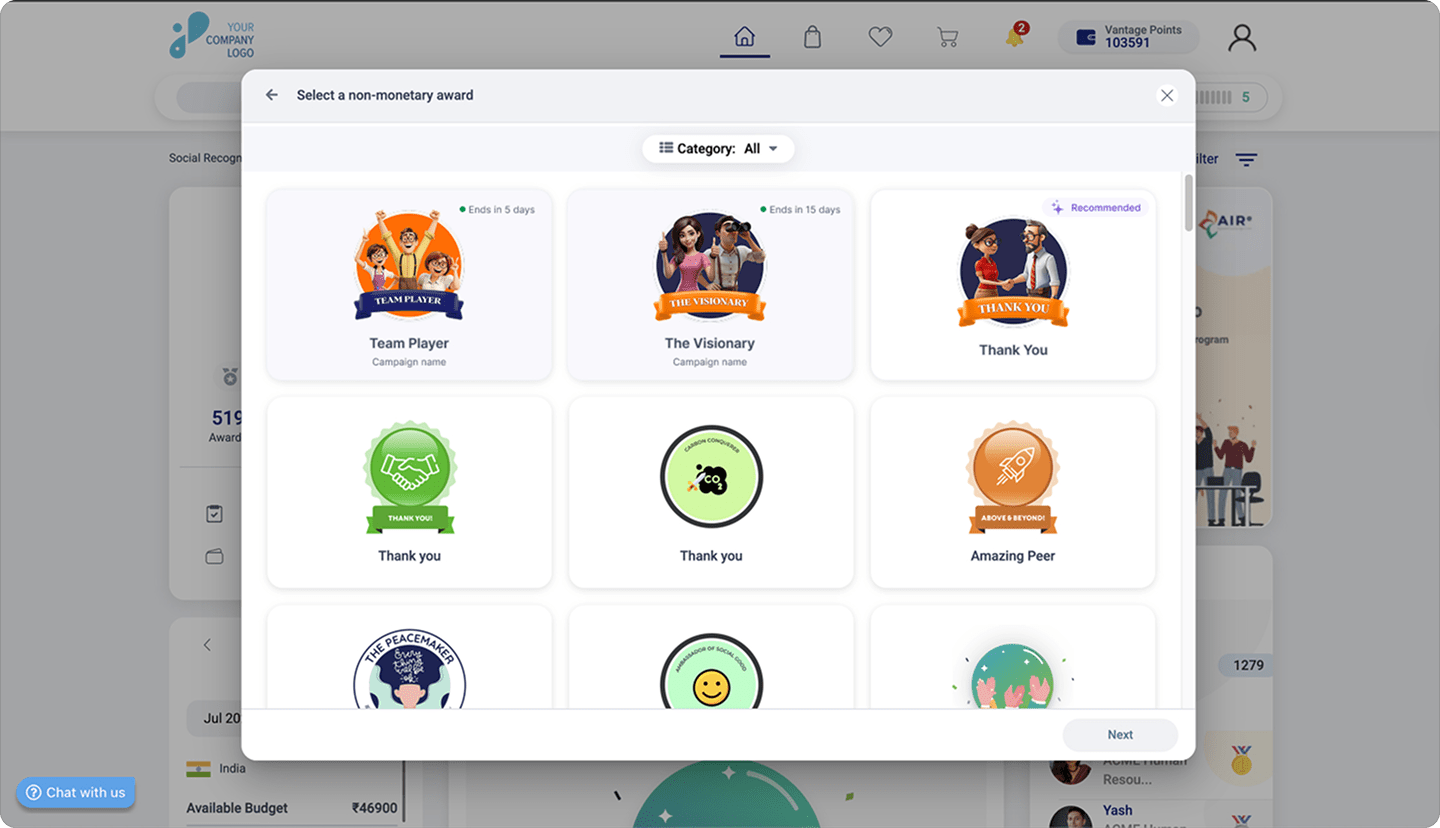
Platforms like Vantage Recognition let managers tie recognition to specific skills and values through badges, so the skill being reinforced is visible, not just the fact that someone did good work. When a peer calls out someone's problem-solving or communication skills by name, that behavior becomes something the rest of the team can see and learn from.
See how skill-based recognition works: Book a Vantage Recognition demo
How to Measure Soft Skills in the Workplace
Measuring soft skills is harder than measuring output, but a few structured methods make it manageable. HR teams that get this right combine a few, rather than relying on one.
| Method | What It Captures | Best For |
|---|---|---|
| 360-degree feedback | How peers, managers, and direct reports perceive an employee's communication, collaboration, and leadership | Mid-level and senior employees, promotion decisions |
| Performance reviews with soft skill competencies | Manager-rated progress against defined behaviors, tracked over review cycles | Ongoing development conversations |
| Behavior observation | How someone handles conflict, ambiguity, or a live client situation | Roles with high customer or team interaction |
| Peer recognition data | Which soft skills colleagues call out most often, and for whom | Spotting informal leaders and team strengths at scale |
| Employee training and development tracking | Whether skill-building activities translate into measurable behavior change | Validating the ROI of soft skills programs |
None of these methods work as a one-time audit. HR teams that recheck them quarterly catch a drop in participation or morale before it shows up in attrition numbers.
Frequently Asked Questions
1. What are the most important soft skills in the workplace?
Communication, teamwork, problem-solving, adaptability, and emotional intelligence are the ones employers cite most often, which is why they sit in the foundational tier of the priority table above: they affect every role, regardless of function or seniority. Leadership and time management follow closely for anyone managing people or juggling competing deadlines.
2. How can HR measure soft skills in employees?
HR can combine 360-degree feedback, performance reviews, behavior observation, and peer recognition data. No single method captures the full picture, so combining two or three gives the most reliable read.
3. Can soft skills be taught in the workplace?
Yes. Some people start with a natural edge, but every skill on this list develops through repeated practice in real situations, not a single training session. That's why the interventions above are built around ongoing coaching and feedback loops, not one-off workshops.
4. What is the difference between soft skills and hard skills?
Hard skills are technical and verified through tests or certifications, like coding or financial modeling. Soft skills are behavioral, like communication or adaptability, and are assessed through observation and feedback over time.
5. Why do soft skills matter more as roles change faster?
As tools, processes, and team structures change more frequently, adaptability, communication, and problem-solving determine how quickly an employee can adjust to a new way of working. Technical skills teach someone how to do a job; soft skills determine how well they handle it changing.
Conclusion
A 2019 LinkedIn Global Talent Trends report found that 92% of talent professionals and hiring managers see candidates with strong soft skills as increasingly important. A separate Monster survey found employers value integrity, reliability, and teamwork over technical ability.
Treat soft skills with the same ongoing investment as any hard skill: structured development, consistent measurement, and recognition in practice. Start with the foundational three, build out the rest by role, and revisit the priority table each budget cycle.

Susmita Sarma is a Digital Marketer at Vantage Circle, making employee recognition less of a checkbox and more meaningful - helping organizations say we value our people and truly mean it.
Connect with Susmita on LinkedIn.