
Most leadership teams can describe their strategy. Far fewer can say whether the people expected to carry it out understand it, believe in it or have the skills to deliver it. That gap is where strategic leadership lives.
It is not a title or a personality type. It is the work of setting a long-term direction, turning it into a few clear priorities, and keeping people aligned as conditions change. This guide covers what strategic leaders do at every level, the traits that set them apart, real examples and how to build the skill. If you are new to the wider topic, start with our guide to leadership.
What Is Strategic Leadership?
Definition
Strategic leadership is the ability to set a long-term direction for an organisation, turn it into priorities people understand, and keep teams aligned as conditions change. Strategic leaders balance today's operations with tomorrow's position, make trade-offs under uncertainty, and build the systems and people that carry the strategy out.
Stephanie Bown, a business performance specialist, puts it in terms of teams rather than titles.

Vantage Influencers Podcast
"What strategic leadership is about is harnessing the collective intelligence of teams to align on a plan and execute with confidence."
Stephanie Bown · Business Performance Specialist
Listen to the EpisodeThe need is easy to see in the research. In their Harvard Business Review article, Mankins and Steele cite research by the consultancy Marakon Associates suggesting that companies on average deliver only 63% of the financial performance their strategies promise. The loss happens between the plan and the people who have to carry it out.
Is strategic leadership a leadership style? Not really. It is better treated as a set of responsibilities that any style can carry. For the style catalogue, see our guide to leadership styles.
Why Strategic Leadership Matters
Strategic leadership matters because strategies succeed or fail on whether people can and will execute them, and strategic leaders are the ones who connect the plan to the people.
Dr. Sarmistha Roychowdhury, a CHRO, put it plainly on our podcast.
Vantage Influencers Podcast
"Behind every strategic decision, whether it is a digital transformation, or expansion into new markets, mergers and acquisitions, or even ESG, there is one common factor, and that is people. Strategy succeeds or fails not only because the right structures are in place, but because people are willing or able to execute it."
Dr. Sarmistha Roychowdhury · CHRO, Group Head HR, and Principal HR Advisor, Vform Tecnopacks Limited
Listen to the EpisodeShe also described a company that got the technology right and still missed its goals: "the technology worked perfectly, but the adoption didn't." When strategic leadership is working, three things show up.
- Direction everyone can repeat: people in different teams describe the priorities in much the same words.
- Faster adaptation: when conditions change, teams adjust without waiting for instructions from the top.
- Capability built ahead of need: the skills a strategy will demand are developed before the strategy demands them.
What Does a Strategic Leader Do? 6 Core Responsibilities
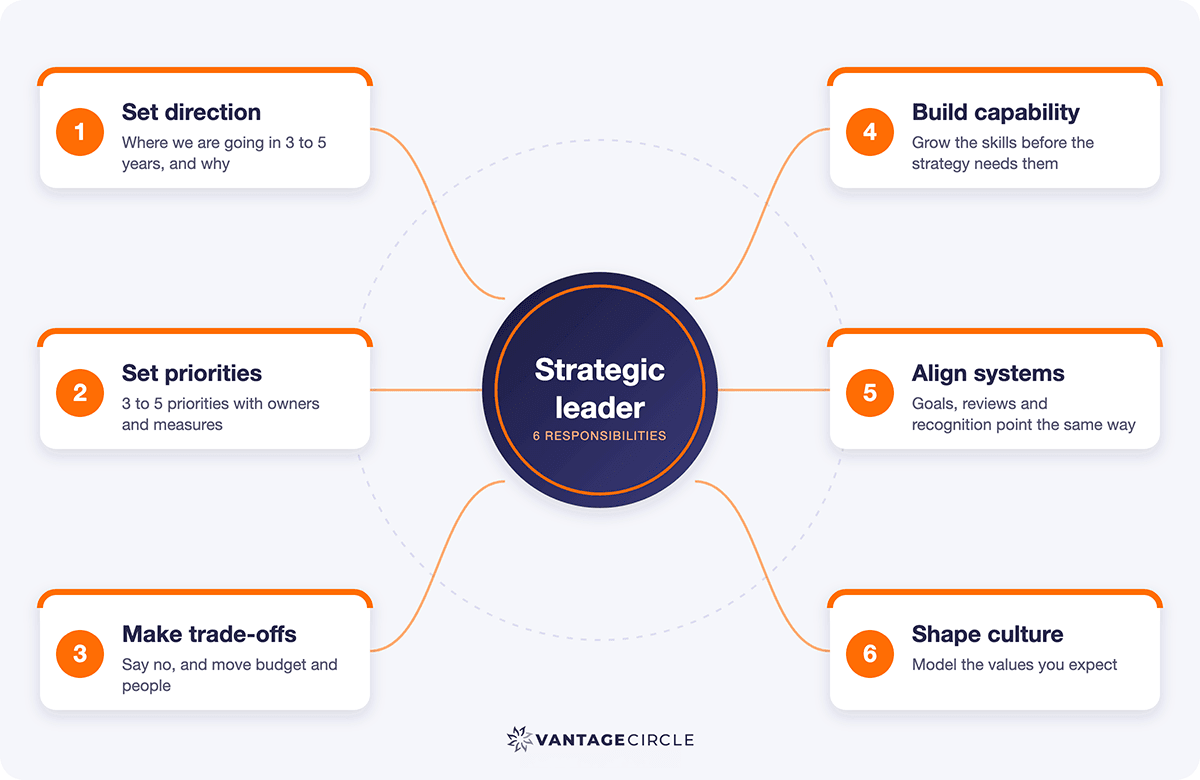
Strategic leaders carry six responsibilities: they set direction, turn it into priorities, allocate resources, build capability, align systems and shape culture.
1. Set a clear long-term direction
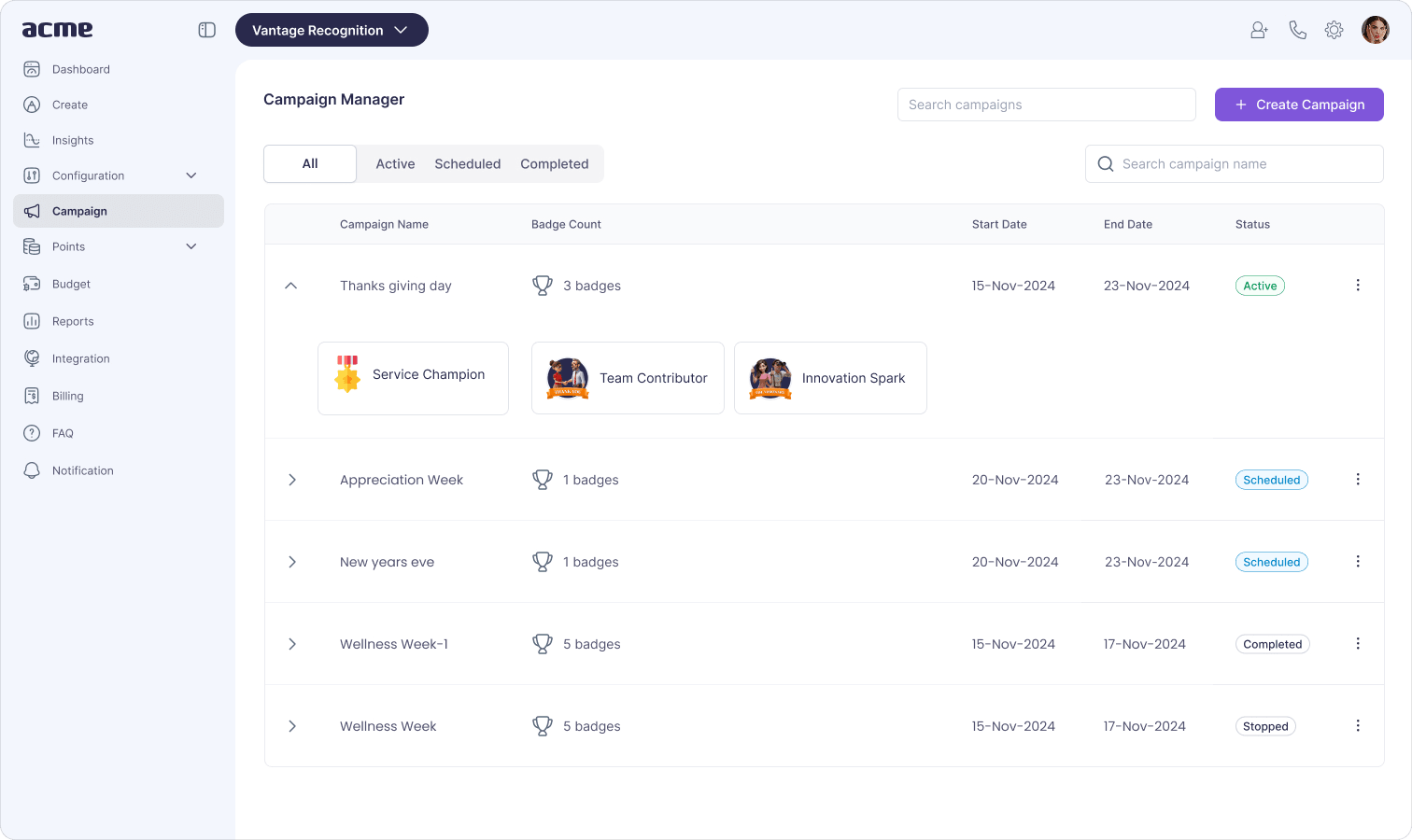
A strategic leader defines where the organisation is going in three to five years, and why, in words every team can repeat. A time-bound recognition campaign can make a new push visible, because it shows which behaviours the push depends on and celebrates the first people to show them.
2. Turn the direction into a few priorities
Strategic leaders cut a strategy into three to five priorities, each with an owner and a measure. A common format is OKRs (objectives and key results), where one objective is paired with two or three measurable results.
3. Make trade-offs and allocate resources
Saying no is the core strategic act. Strategic leaders move budget and people away from work that no longer fits the direction, even when that work is comfortable or popular. A useful test: what did you stop doing this quarter? If the answer is nothing, the strategy was only added on top.
4. Build the capability the strategy needs
Strategic leaders invest in skills before the strategy demands them. If the plan needs data skills or managers who can coach, the training has to start before the launch, and learning benefits such as those in Vantage Perks let employees build skills on their own schedule. Our guide to training and development covers how to plan it.
5. Align systems and rewards with the strategy
Strategic leaders make sure goals, performance reviews and recognition reward the behaviours the strategy depends on. A strategy that asks for collaboration but rewards only individual targets sends a mixed signal, and people follow the reward.
In Vantage Circle's AIRe Benchmarking Report India 2024-25, only 38% of organisations target the behaviours business leaders prioritise. In other words, the programme and the priorities often point in different directions.
Wells Fargo shows how costly that can get. In 2016 the US Consumer Financial Protection Bureau found that employees had opened unauthorised accounts to meet sales goals. Its consent order says the bank's own analysis found 1,534,280 deposit accounts that may not have been authorised. The target was clear, but what it rewarded was not what the bank wanted.
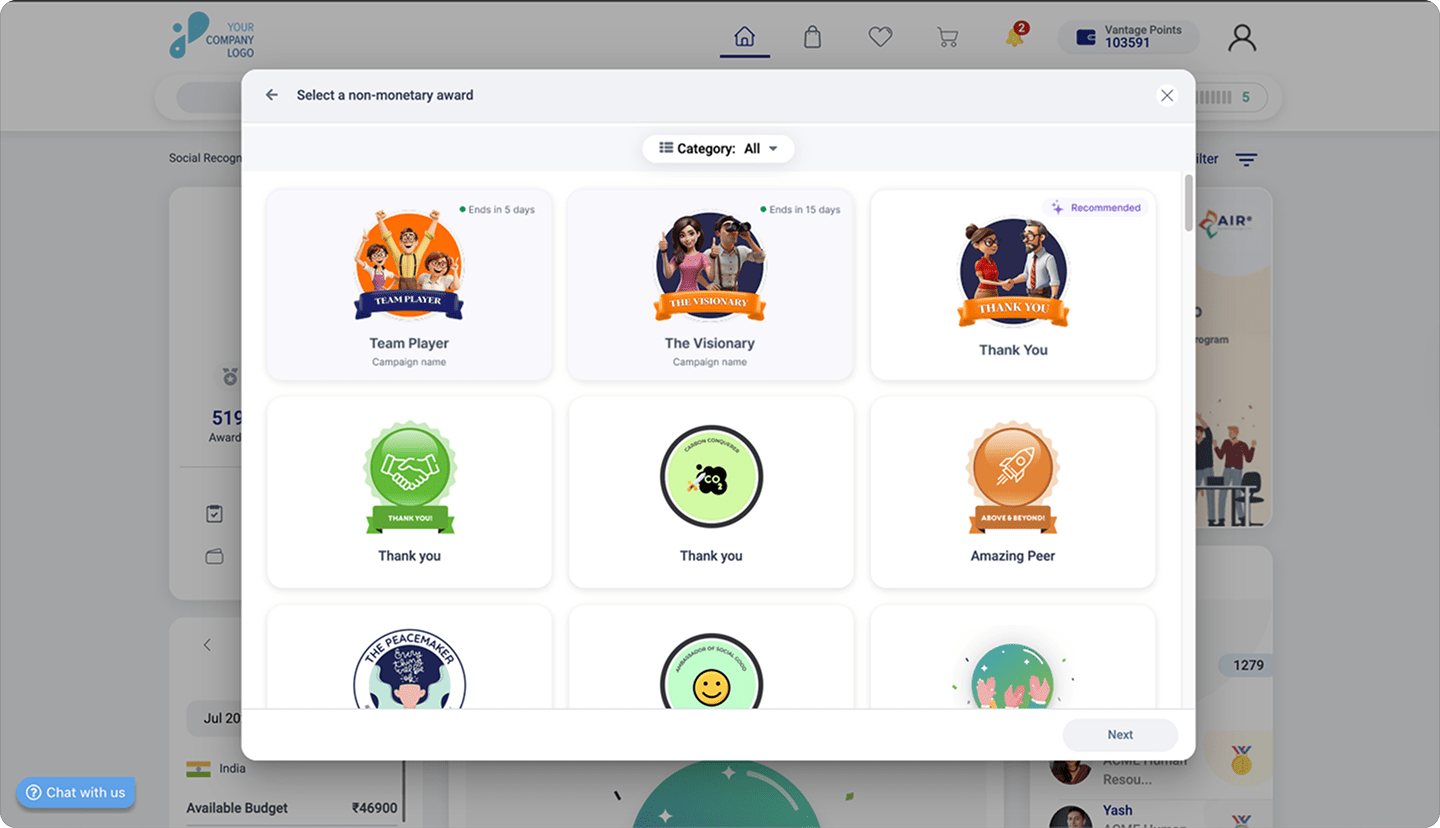
Tagging every recognition to a company value turns the strategy into examples people see each week. That is what values alignment in Vantage Recognition does. Our guide to strategic recognition goes deeper.
6. Shape culture and model ethics
Culture decides how a strategy is carried out when no one is watching, so strategic leaders model the values they expect. If leaders talk about candour and then punish bad news, people learn quickly which one is real. Read more on organisational culture and how it forms.
7 Defining Characteristics of Strategic Leaders
The 7 defining characteristics of strategic leaders are that they anticipate change, challenge assumptions, interpret ambiguous information, decide under uncertainty, align stakeholders, learn from results, and communicate direction simply.
The first six come from Schoemaker, Krupp and Howland, who describe the abilities to anticipate, challenge, interpret, decide, align, and learn in Harvard Business Review. The seventh, communication, is our own addition, because a direction nobody can repeat does not travel.
| Characteristic | What it looks like at work | Question to test yourself |
|---|---|---|
| Anticipate change | Scans the market, customers and technology on a regular schedule and spots weak signals early | What changed in our market in the last 90 days that we have not discussed? |
| Challenge assumptions | Asks why the current approach exists and invites people to disagree | Which belief about our business have we not questioned in a year? |
| Interpret ambiguous information | Sees patterns in mixed data and does not wait for a perfect answer | Can I explain what the evidence says, and what it does not say? |
| Decide under uncertainty | Chooses with incomplete information and sets a review date | What would make me change this decision, and when will I check? |
| Align stakeholders | Gets leaders, teams and partners pulling the same way | Could each stakeholder name our top three priorities? |
| Learn from results | Reviews outcomes honestly and shares what went wrong | When did I last change a plan because of what we learned? |
| Communicate direction simply | Explains the strategy in plain words, repeatedly, to every level | Can a new joiner repeat our direction after a month? |
Use the last column as a quick self-check. Rate yourself from 1 to 5 on each and pick the two lowest to work on first. For a wider view of what good looks like, see our guides to leadership competencies and leadership qualities.
Free download: Strategic Leadership Self-Assessment (PDF)
A one-page scoring sheet built from the table above. Rate yourself from 1 to 5, add it up and pick your two lowest to work on.
Download the PDFStrategic Leadership Frameworks at a Glance
Three framings come up most often, and they overlap more than they differ.
| Framing | What it covers | Source |
|---|---|---|
| Six skills | Anticipate, challenge, interpret, decide, align and learn | Schoemaker, Krupp and Howland, Harvard Business Review, 2013 |
| Strategy system | Create a clear strategy, cascade it and align teams, then review performance | Stephanie Bown, Vantage Influencers Podcast |
| Five pillars | Vision, strategy, alignment, execution and learning | A common framing, not a standard model |
Use whichever helps your team talk about the work. The six responsibilities above cover the same ground in the order a leader usually meets it.
Strategic Leadership vs Traditional Management
Traditional management keeps today's operation running to plan, while strategic leadership decides what the plan should be next and gets people to own it. Both are needed. The difference is where the thinking happens.
Stephanie Bown draws the line this way.
Vantage Influencers Podcast
"In those styles of organizations, strategic thinking, creativity, and innovation happen at the top of the organizational tree, and the doing and execution happen at the bottom. They separate strategic thinking from execution."
Stephanie Bown · Business Performance Specialist
Listen to the Episode| Dimension | Traditional / operational management | Strategic leadership |
|---|---|---|
| Time horizon | This quarter or this year | Three to five years, with checkpoints |
| Main question | How do we run this well? | What should we be running, and why? |
| How decisions are made | By rule, precedent and approval chains | By weighing options and trade-offs under uncertainty |
| Who thinks, who executes | Leaders think, teams execute | Everyone thinks inside a shared direction |
| How success is measured | Efficiency, cost and delivery to plan | Progress on priorities and the ability to adapt |
| Response to change | Protect the process | Adjust the plan and bring people with it |
How does it differ from transformational leadership? Transformational leadership is a style built on inspiring people to change. Strategic leadership is the discipline of deciding where to go and aligning the organisation to get there, and the two work well together. Our guide to transformational leadership covers the style in full.
Who Are Strategic Leaders? Strategic Leadership at Every Level
Strategic leaders are not only CEOs. Anyone who sets direction for a team and makes trade-offs about where its time goes is practising strategic leadership.
| Level | Strategic focus | Example decision |
|---|---|---|
| Executive team and board | Long-term direction, markets, capital and the culture that carries the strategy | Enter a new market, or exit a product line that no longer fits |
| Senior and middle managers | Translating direction into priorities, resourcing and cross-team alignment | Move two people from a legacy project to a new priority |
| Team leads | Connecting daily work to the bigger direction and protecting focus | Drop a low-value report to free time for the team's top goal |
The executive row is often called the TMT (top management team) in research. The idea is the same in every row: choose, explain and follow through. Team leads practise it when they link daily work to the direction, and recognising a contribution "because it moves our priority forward" makes that link explicit. That is what manager recognition tools are built for. For the people skills involved, see our guide to leadership skills for managers.
How Strategic Leaders Make Decisions
Strategic decision-making means choosing between long-term options under uncertainty, and strategic leaders follow five steps: frame the question, gather evidence, generate options, weigh trade-offs, and commit with a review date.
The review date matters most. It turns a decision into an experiment you can learn from rather than a verdict you have to defend. Typical strategic decisions are entering a market, merging or partnering, restructuring, investing in a capability and exiting a product line.
This page gives the overview. For the models and the biases to watch for, read our guide to decision-making models.
How HR Enables Strategic Leaders
HR enables strategic leadership by making sure the people, the skills and the reward systems are ready for the strategy. Leaders set the direction, and HR builds the conditions that let it work.
In practice that comes down to four things.
- Plan the skills: find the capability gaps before the plan is announced.
- Align the systems: check that goals, performance reviews and recognition point at the same priorities.
- Support adoption: help managers explain the change and track who is on board.
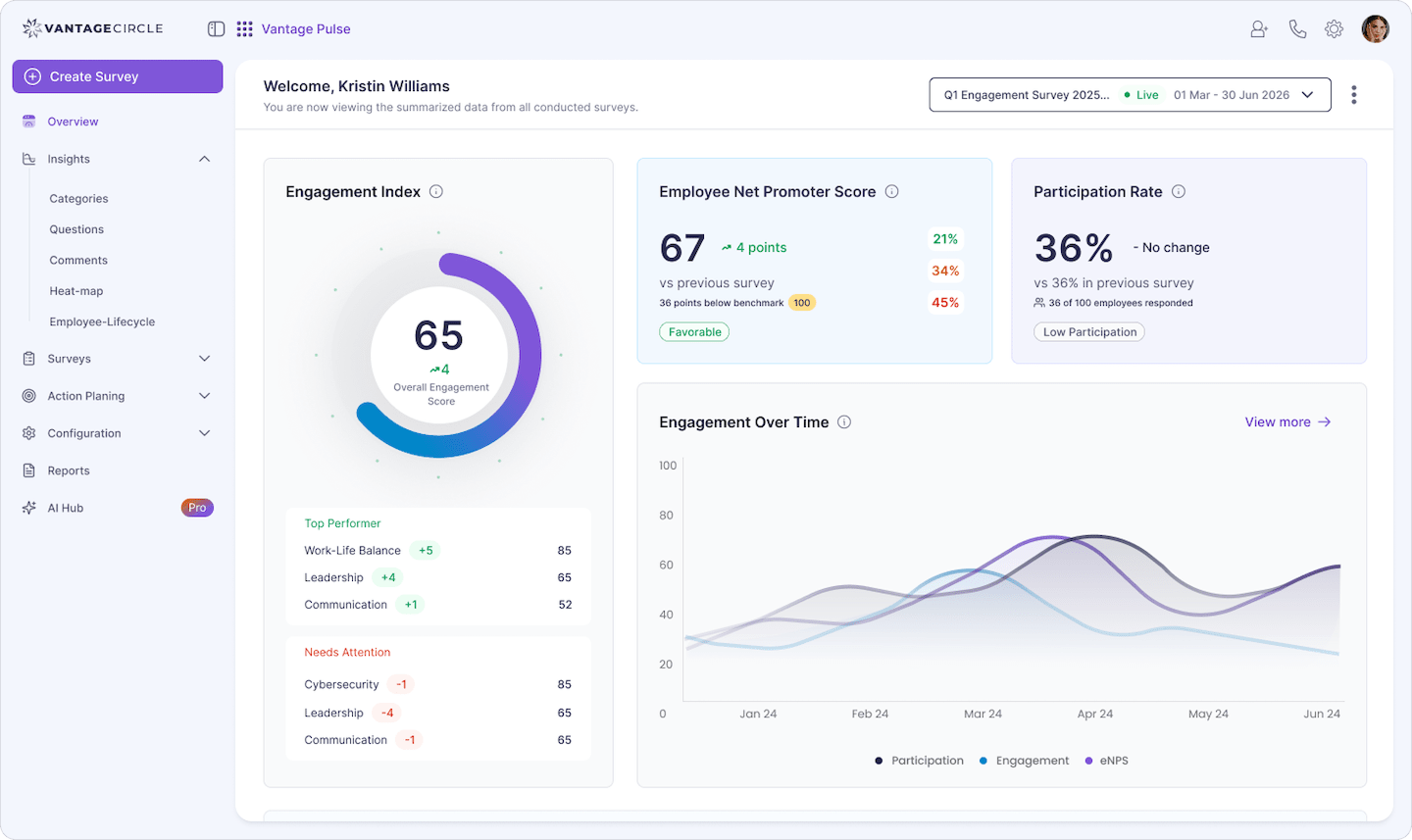
- Listen early: use pulse surveys to see where the strategy is not landing.
4 Strategic Leadership Examples
The clearest strategic leadership examples are pivots where leaders read a shift early and moved people and resources to meet it. In each one below, note what was decided and what changed.
Swisse Wellness: following customers into a new market
Stephanie Bown worked at Swisse Wellness from 2014 to 2016, and she describes this on the podcast first-hand. The team noticed small cross-border resellers buying Swisse products in Australia and selling them into China. Instead of ignoring the channel, the company chose to supply it. By her account, that gave the brand access to the Chinese market, grew it there and raised its market value, which attracted the eventual buyer. She also says revenue grew from 300 million to 750 million over her years there and that the company sold to Biostime for 1.7 billion. Those are her figures, and she does not claim the channel alone explains them.
An Australian retailer: funding growth by changing the business model
Stephanie Bown also describes an Australian retail brand that started by making its own electronics and whitegoods. Overseas manufacturing meant long lead times that tied up cash, and the business needed cash reserves to grow. The leaders decided to resell major brands' electronics at competitive prices, which generated the cash their own products needed. They later added wholesale services such as mobile and insurance offerings.
Microsoft under Satya Nadella: culture as strategy
When Satya Nadella became CEO, he did two things that most strategies skip. He told the whole company where it was going, and he named the culture that would get it there.
On the first, he opened fiscal 2015 with an email to employees saying Microsoft would "reinvent productivity to empower every person and every organization on the planet to do more and achieve more". It is a sentence a sales rep and an engineer can both repeat. On the second, an excerpt from his book Hit Refresh says he urged employees to adopt a "learn-it-all" curiosity instead of a "know-it-all" worldview.
The takeaway is the pairing: direction for where to go, culture for how to work on the way. I have not linked it to a business result, because the sources I checked do not support one.
Netflix: moving from DVDs to streaming
In January 2007, Netflix introduced a feature that let members watch movies and television series instantly on their computers. It launched with about 1,000 titles, against more than 70,000 on DVD, and rolled out to all subscribers by the end of June. The leaders chose to start the shift early, while the DVD business was still the main one.
4 Common Strategic Leadership Mistakes
The most common strategic leadership mistakes are keeping strategy at the top, chasing too many priorities, ignoring adoption, and misreading how the strategy feels lower down.
Keeping the strategy in the boardroom
A strategy only a few people understand cannot be executed by the many. Compare it with the Nadella example above, where the direction went to every employee in a single sentence.
Test it: ask three people from different teams to explain the strategy. Three different answers mean it is still in the boardroom. Share the direction, the reasons and the trade-offs in plain words, then ask each team what it means for them.
Chasing too many priorities at once
When everything is a priority, teams quietly pick their own. Stephanie Bown makes the cost clear: goals determine how everyone else prioritises their time, so in her words, "wrong goals equal wasted effort and stalled performance."
Keep to three to five priorities and say what you are pausing.
Treating adoption as someone else's job
Adoption shows up in behaviour, so it has to be watched like any other result. Dr. Roychowdhury describes organisations that invested heavily in technology and still missed the expected outcomes, because employees were not ready for the change or the organisation had not made them ready.
Run a simple adoption check at 30, 60 and 90 days: who is doing the new thing, who is not, and what is in their way. Recognition data shows which teams are already acting on the new priorities, so leaders know where to spend their time.
Assuming the view from the top is the view everywhere
Senior leaders often experience the organisation differently from the people executing the strategy, so their read of morale and clarity runs high. The Recognition Effect, a 2025 study by Great Place To Work® India and Vantage Circle covering 5.7 million employees in India, shows what that gap can look like. Recognition rises with rank, with 78% of senior leaders against 66% of non-supervisory employees.
The fix is to ask. Skip-level conversations and short employee surveys show where the strategy is understood and where it has not landed. Team-level results are the useful part, because an average hides the teams that are lost.

How to Develop Strategic Leadership Skills: 6 Practical Habits
You build strategic leadership by practising six habits: scanning trends weekly, asking second-order questions, inviting challenge, writing decisions down, reviewing results and stepping back from daily firefighting on a schedule.
- Scan trends weekly: spend 30 minutes on your market, customers and technology, and note one thing that could matter in a year.
- Ask second-order questions: after "what happens if we do this?", ask "and then what?" at least twice.
- Invite challenge: ask one person who disagrees with you to argue the other side before you decide.
- Write decisions down: record what you chose, why and what you expected.
- Review results: compare outcomes with expectations every month or quarter.
- Step back on a schedule: block a recurring hour for thinking and protect it.
For a 90-day plan and the difference between strategic thinking and planning, read our guide to strategic planning skills.
Conclusion
Strategic leadership is direction plus alignment plus follow-through. A leader needs all three, because a sharp plan nobody understands and a well-run team with no direction both lose value.
One practical way to keep strategy in view is recognition tied to strategic values. When people see colleagues recognised for the behaviours the strategy needs, the strategy stops being a slide and becomes something they can copy. Vantage Recognition supports this with values-based recognition and campaigns.
Frequently Asked Questions
Can you provide some examples of strategic leadership?
Yes. Examples include Swisse Wellness supplying cross-border resellers to reach the Chinese market, an Australian retailer reselling major brands to fund its own products, Microsoft under Satya Nadella treating a learn-it-all culture as strategy, and Netflix moving early from DVDs to streaming.
What are the 5 key characteristics of strategic leaders?
A short version is that strategic leaders anticipate change, challenge assumptions, decide under uncertainty, align people and learn from results. The full list of 7 above adds interpreting ambiguous information and communicating direction simply.
What are the five pillars of strategic leadership?
There is no single standard model. One common framing uses vision, strategy, alignment, execution and learning. Treat it as a useful way to organise the work, not an official list.
What are the 7 C's of strategic management?
Different sources list different 7 C's, so there is no single authoritative version. If you come across one, check who published it and use it as a checklist rather than a rule.

Lupamudra is a content marketing specialist at Vantage Circle, where she has written 50+ articles on employee recognition, rewards, and workplace culture, alongside employee engagement, diversity and inclusion, and HR compliance topics, including how India's tax rules apply to recognition and rewards programs.
Connect with Lupamudra on LinkedIn.