
Every company has run a team-building exercise that changed nothing. The trust fall didn't build trust. The escape room was fun for an afternoon and forgotten by the next stand-up. Usually the problem isn't effort. It's picking an activity because it looked fun, not because it solved what was actually broken.
Team building falls into 6 types: activity-based, communication-based, skills-based, personality-based, problem-solving-based, and value-based. Grouped more broadly, the 4 main types are communication, problem-solving, trust and personality, and social or activity-based, and picking between them comes down to the problem your team is actually solving.
This guide breaks down all 6 types with a simple table for choosing between them, maps each one to a real team building activity bank, and covers the frameworks leaders ask about most: the 5 C's, Tuckman's stages, and the 4 types of teams.
What Is Team Building?
Team building is the deliberate practice of designing activities, exercises, and structures that improve how a team communicates, trusts, and solves problems together. It's distinct from a one-off party or an annual offsite. Teams don't become cohesive by default; putting people on the same org chart doesn't automatically teach them to collaborate under pressure.
The practice sits inside the broader discipline of teamwork and team building, which covers both the ongoing behaviors that make a team function day to day (teamwork) and the deliberate interventions that build those behaviors (team building). A single trust exercise won't fix a team that has never discussed how it makes decisions, which is why the 6 types below exist, each solving a different, specific gap.
Most team-building efforts fail for the same reason: they treat the 6 types as interchangeable. A new team of strangers needs something different from a skilled team that has stopped trusting each other, and picking the wrong type wastes a budget line without fixing the actual problem.
The 6 Types of Team Building
The 6 types are activity-based, communication-based, skills-based, personality-based, problem-solving-based, and value-based, and no two solve the same problem. The table below breaks down what each one is actually built to fix, one example to try, and how much effort it takes to run.
| Type | Best For | Example Activity | Effort Level |
|---|---|---|---|
| Activity-based | Breaking routine and building rapport fast | Scavenger hunt or team outing | Low to medium |
| Communication-based | New teams that need an icebreaker | Truths and lies | Low |
| Skills-based | Building job-relevant capability together | Leadership or negotiation workshop | Medium to high |
| Personality-based | Understanding how teammates think and work | MBTI-style personality mapping | Low |
| Problem-solving-based | Teams stuck in repeated conflict or silos | Escape room or scenario challenge | Medium |
| Value-based | Aligning a team around shared purpose | Charity volunteering or CSR project | Medium to high |
1. Activity-Based Team Building
An activity-based type of team building gives your employees a break from the daily routine and helps the team step out of its comfort zone, together, through shared mental or physical activities carried out indoors and outdoors.
Organizing team lunches and company outings enhances communication among team members and uncovers hidden traits. Outdoor activities aren't always feasible, so indoor games such as a Foosball tournament or a scavenger hunt make an excellent mood booster too. It doesn't need an in-person offsite either: a step or wellness challenge through Vantage Fit turns a distributed team into a competing, cheering group without anyone leaving home. For a full activity bank to adapt to your team's size and budget, see team building activities for work.
2. Communication-Based Team Building
The key to any social networking is communication, which is what makes a communication-based approach the right first move for a new team with all-new members.
Perfect as an ice breaker, it lets the team get to know colleagues a little better and share a personal bond, breaking communication barriers, improving interpersonal skills, and building trust among employees. There are various communication-based activities your organization can adopt irrespective of team size:
- The barter puzzle: Divide the members into smaller groups. Each group gets a jigsaw puzzle with some missing pieces, and has to find the missing parts by negotiating with the other teams.
- Truths and lies: Every team member writes down two truths and a lie about themselves. The rest of the team has to identify the lie among the three, a great way to get to know teammates better.
3. Skills-Based Team Building
Skills-based team building enhances the specific skills team members need for their jobs while still functioning as a bonding exercise. Are you thinking of a team bonding experience that's fun and productive at the same time?
This improves the team's overall performance through training and development workshops covering leadership skills, managerial skills, negotiation, conflict management, and creative thinking.
Managers can also combine skills-based workshops with something more playful. One of the more enjoyable skills-based activities is the "back of the napkin" challenge, which aims to promote creative thinking and teamwork: give the team a napkin and a pen, hand them a problem, and have them sketch a solution as a flowchart or diagram. The team with the clearest solution wins.
Related: 5 Reasons To Promote Employee Training And Development
Don't Forget to Read Our Article on 38 Quick and Easy Team Building Activities Your Employees Will Love (+How to Play). Click Here to Read!
4. Personality-Based Team Building
A workplace is a mix and match of all sorts of personalities, which is why personality-based team building exists to help managers identify and nurture the various personality types on a team.
Team leaders can carry out a personality test, such as the Myers-Briggs Type Indicator (MBTI) or a DISC profile, and coordinate tasks accordingly to bring out the best in all group members, leading to better understanding and effectiveness across the team. It helps employees know their coworkers on an individual level, appreciating the uniqueness everyone brings to the table. Some may perform better working with a large group of people, while others may prefer small groups.
5. Problem-Solving-Based Team Building
Challenges are inevitable in every team dynamic, and problem-solving-based team building exists because clashes are bound to occur once a large number of people are involved. CPP Inc.'s 2008 Global Human Capital Report, surveying employees across nine countries, found they spend an average of 2.1 hours a week involved in some form of workplace conflict (Pollack Peacebuilding).
Problem-solving activities improve communication and interpersonal relationships, mending differences to reach a common goal. The team leader identifies the problem and determines the best course of action, and you can make the process enjoyable with fun games or exercises for the team.
Team members should take part with an open mindset, assessing different ideas to build a deeper understanding of the team's strengths and weaknesses. Have a look at these effective problem-solving activities that can help your team.
6. Value-Based Team Building
Value-based team building ties a bonding experience to a cause bigger than the team itself. Millennials and Gen Z employees believe in social welfare. They believe in giving back to society, which is what makes a value-based team-building activity a win-win for both the organization and its people. Organizations can merge their CSR goals with team bonding experiences, giving employees a meaningful way to contribute to society and positively impact the lives of those in need.
The activities can range from environmental, philanthropic, human rights, or economic responsibility. Events like charity cycling, cooking for a cause, and volunteering boost employee engagement, employee morale, and job satisfaction, and can act as a key factor in attracting young talent to the company.
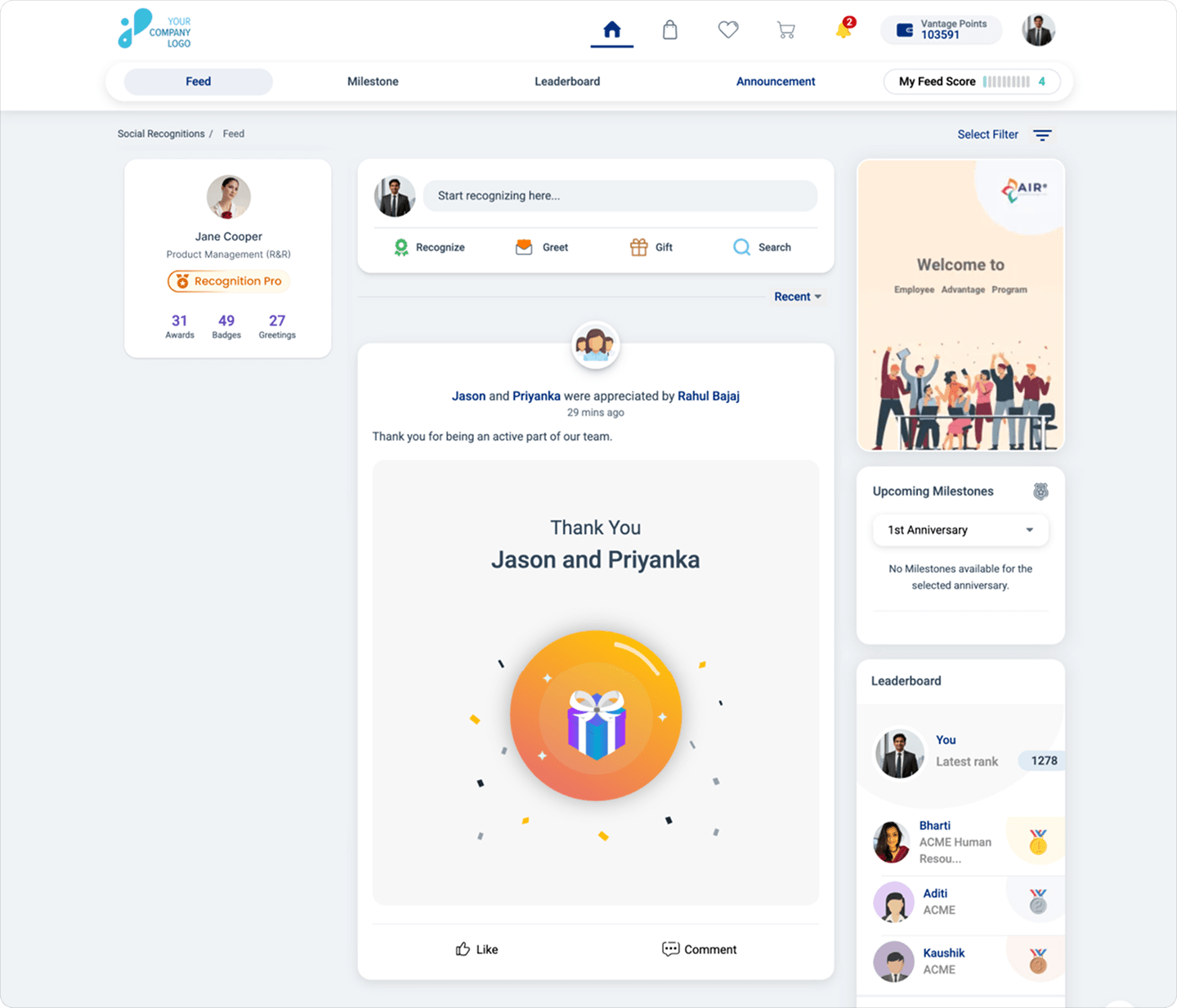
Value-based team building sticks when values show up in daily recognition, not just at an annual volunteering day. Tagging everyday recognition to a specific company value in Vantage Recognition keeps the exercise alive year-round instead of fading the week after the event ends.
For the deep end of this type specifically, virtual team building activities covers how to run value-based and activity-based exercises with a fully remote team.
Which Type of Team Building Does Your Team Need?
Most team-building budgets get spent on whichever activity looked most appealing in a vendor's brochure, not on what the team's actual problem is. The matrix below flips that: match the problem first, then pick the type.
| Team Problem | Recommended Type |
|---|---|
| New team, mostly strangers | Communication-based or activity-based |
| Team has stopped trusting each other after a conflict | Personality-based or problem-solving-based |
| Departments or functions working in silos | Problem-solving-based |
| Skilled team that underperforms together | Skills-based |
| Team lacks a shared sense of purpose | Value-based |
| Distributed team losing cohesion | Activity-based (virtual) or communication-based |
Cadence beats intensity. A quarterly rhythm of small team-building moments consistently outperforms one big annual offsite. The offsite creates a spike in goodwill that decays within weeks; a recurring, lower-effort cadence keeps those behaviors alive instead of resetting to zero every year.
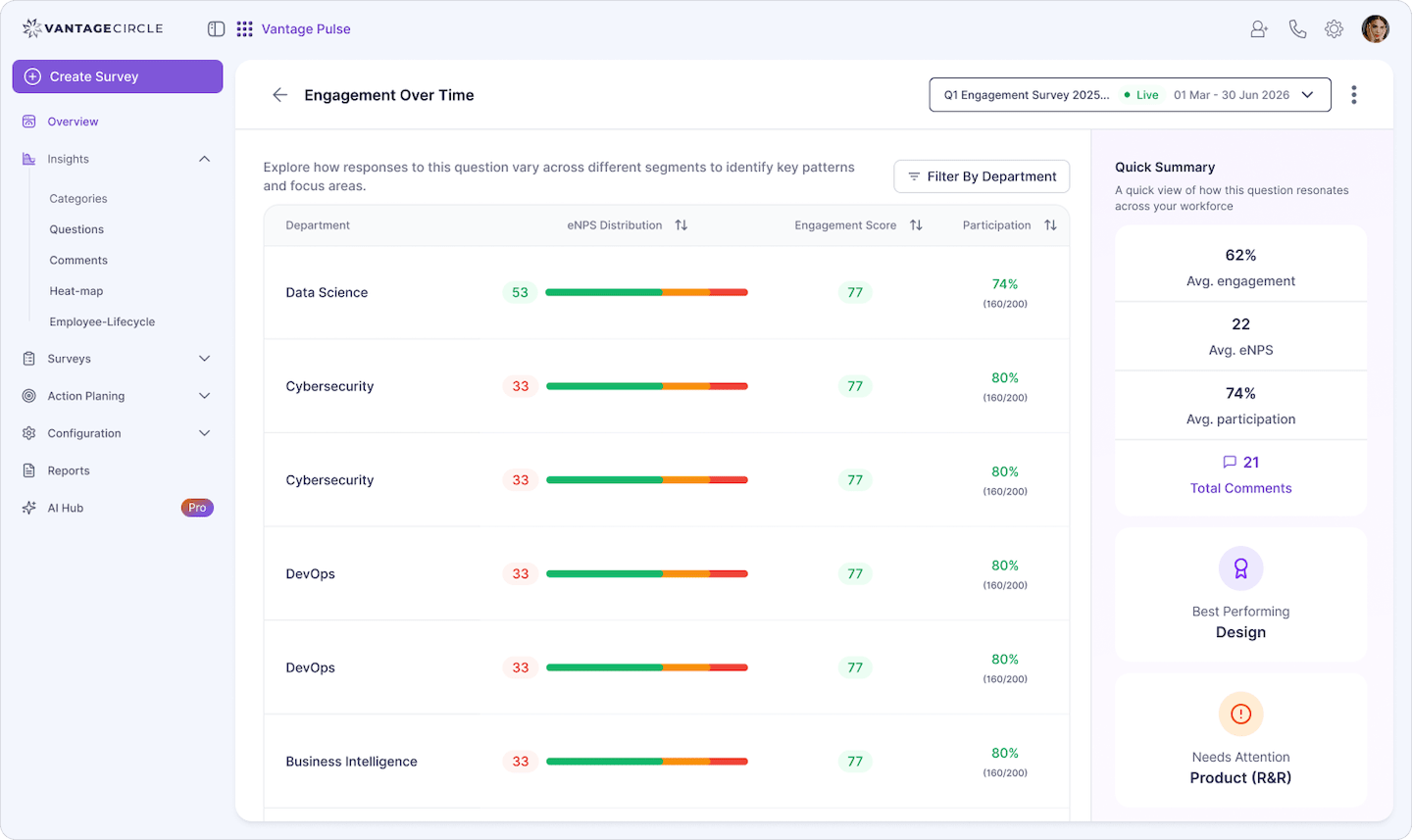
The one-off-event trap is the most common mistake teams make here. A single well-run offsite feels productive in the room and changes nothing three weeks later, because habits reset unless something between events reinforces the shift. Guessing which type a team needs also wastes budget outright. Department-wise data from Vantage Pulse shows exactly where trust, communication, or clarity is lowest in a specific team, pointing straight to the type it actually needs instead of the one leadership assumes.
Types of Teams (and Why It Changes Your Approach)
The 4 types of teams are functional, cross-functional, self-managed, and virtual, and which one you're running changes which team-building type actually lands. A functional team, one department reporting to one manager, usually needs less trust-building than a cross-functional team pulled together from departments that rarely interact.
Functional teams sit inside a single department with a shared manager, so most members already know how to work together before any team building starts. Cross-functional teams combine people from different departments toward one shared goal and need more communication-based and problem-solving-based work, since members share no manager or built-in trust. Self-managed teams run without a single designated leader, which makes personality-based and value-based team building useful for surfacing how decisions actually get made. Virtual teams span locations and time zones and need team building designed for asynchronous participation, not an in-person format online.
Knowing your team type before picking a team-building type prevents the most common mismatch: a trust exercise built for a stable functional team, run on a cross-functional group that has never worked together.
Key Team-Building Frameworks Leaders Ask About
Beyond the 6 types, three named frameworks come up constantly when leaders research team building: the 5 C's, Tuckman's stages of development, and the 4 pillars.
The 5 C's of Team Building
The 5 C's of team building are Communication, Camaraderie, Commitment, Confidence, and Coachability. Communication is the baseline that holds every other C together. Camaraderie builds the trust that makes hard conversations survivable. Commitment is the time and effort a team puts toward a shared goal. Confidence lets members take risks without fear of looking foolish. Coachability, the C most teams skip, is the willingness to take feedback and adjust.
The 4 Stages of Team Development (Tuckman)
The 4 stages of team development, first described by psychologist Bruce Tuckman in 1965, are Forming, Storming, Norming, and Performing. Forming is the polite, cautious stage where a new team is still feeling out roles. Storming is where real disagreement surfaces, over process, priorities, or authority, and skipping it rather than working through it is what leaves teams stuck for years. Norming is where the team settles into shared expectations, and Performing is where it executes with minimal friction because trust is already established. Most team-building efforts are really an attempt to move a team through Storming faster.
The 4 Pillars of Team Building
Practitioner frameworks for the 4 pillars of team building vary, but most converge on the same four: trust, communication, collaboration, and accountability. Trust is the precondition everything else depends on. Communication keeps information moving in every direction, not just top-down. Collaboration is trust and communication put into practice, and accountability closes the loop by making sure commitments actually show up in the work afterward.
How to Reinforce Team Building Year-Round
Team building fails when it's treated as a single event instead of a habit. Gallup's research on collaboration at work found that employees with at least one strong collaborative relationship are 29% more likely to say they'll stay with their company for the next year, and 42% more likely to intend to stay for their entire career (Gallup).
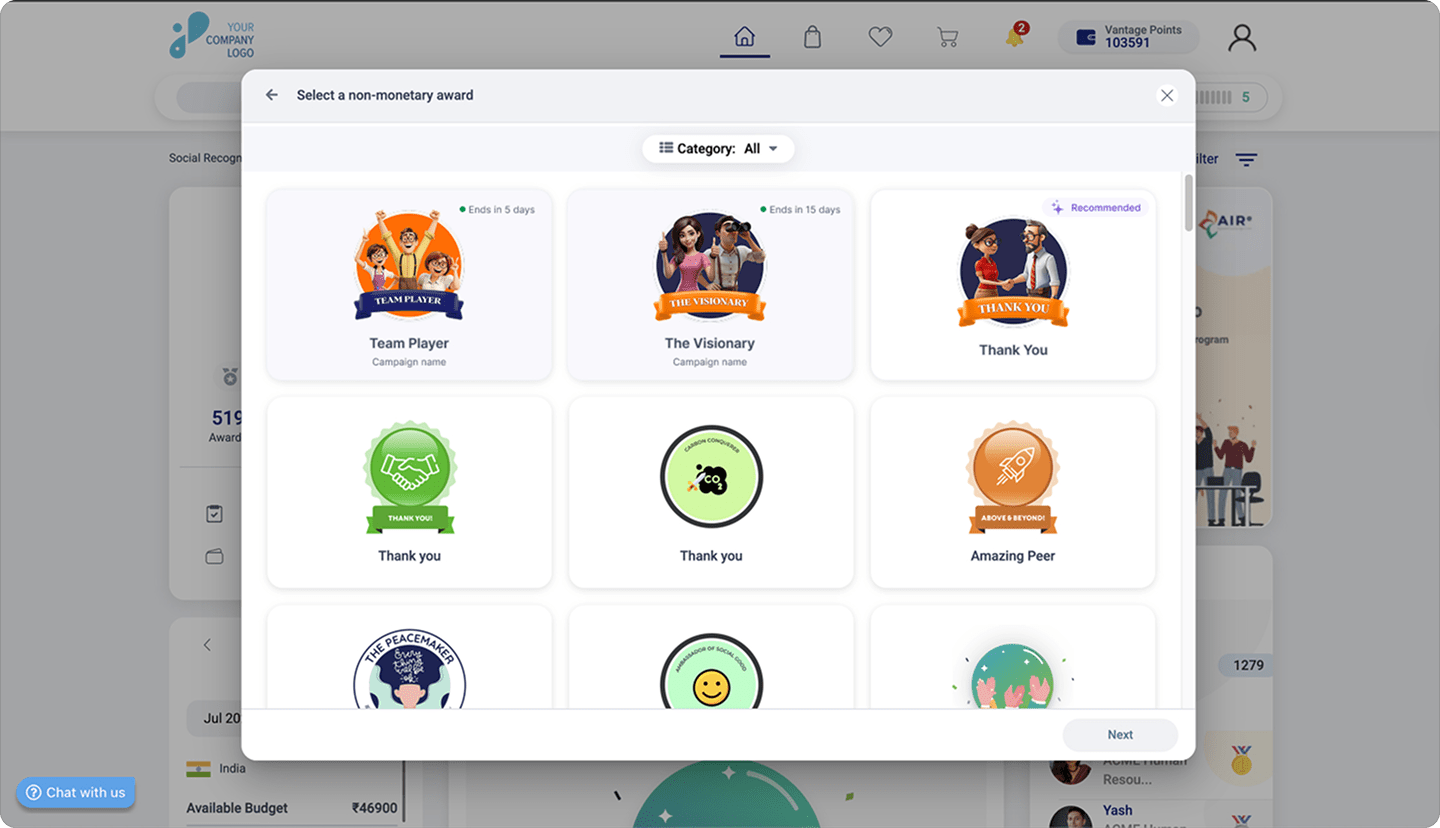
A team-building event creates a spark. Recognition keeps it lit. When the collaboration built at an offsite gets publicly recognized the following week in Vantage Recognition, the bond outlasts the day it started, because the behavior gets named and reinforced instead of fading into memory.
None of this replaces the event itself. It just means the offsite is the beginning of a cadence, not the whole strategy. Pair a quarterly team-building rhythm with a weekly recognition habit, and the gap between "we did a fun activity" and "our team actually works better together" starts to close.
FAQ
What are the four main types of team building?
The four main types of team building are communication, problem-solving, trust and personality, and social or activity-based. These are broader groupings of the 6 specific types: communication-based team building falls under communication, problem-solving-based falls under problem-solving, personality-based falls under trust and personality, and activity-based and value-based both fall under social or activity-based.
What are the 5 C's of team building?
The 5 C's of team building are Communication, Camaraderie, Commitment, Confidence, and Coachability. Together they describe what a functioning team needs beyond a single event: clear communication, genuine goodwill between members, shared commitment to a goal, the confidence to take risks, and the coachability to keep improving after feedback.
What are the 4 levels of team building?
The 4 levels of team building, based on Tuckman's 1965 model, are Forming, Storming, Norming, and Performing. Forming is a new team feeling out roles, Storming is where real disagreement surfaces, Norming is where shared expectations settle, and Performing is where the team executes with minimal friction because trust is already established.
What are the 4 types of teams?
The 4 types of teams are functional, cross-functional, self-managed, and virtual. Functional teams sit within one department, cross-functional teams combine people across departments, self-managed teams operate without a single designated leader, and virtual teams work across locations and time zones.
What are the categories of team building?
The categories of team building are usually described as the 6 types (activity-based, communication-based, skills-based, personality-based, problem-solving-based, and value-based) or the 4 broader main types (communication, problem-solving, trust and personality, and social or activity-based). Which grouping you use depends on whether you need a specific exercise or a general strategy.
Summing It Up
Team-building exercises shouldn't just be a "fun time" in the office. They should act as building blocks that bring people and business goals together, chosen for the specific problem a team is facing. There's no universal rule for how often to run one; it depends on your team's stage, structure, and the gap you're actually trying to close.
Regardless of which type you choose, stay open to feedback from the team itself, and measure whether the investment actually moved the needle on how well people work together.


Lupamudra is a content marketing specialist at Vantage Circle, where she has written 50+ articles on employee recognition, rewards, and workplace culture, alongside employee engagement, diversity and inclusion, and HR compliance topics, including how India's tax rules apply to recognition and rewards programs.
Connect with Lupamudra on LinkedIn.


