
Your team just had a great call. Everyone was on, ideas flew, decisions got made. Then it ended and silence.
No hallway debrief. No "hey, real quick." Just 40 open tabs and a Slack that's somehow both overwhelming and isolating. That's the paradox no one warned you about: your team can be perfectly coordinated and profoundly disconnected at the same time.
Buffer's State of Remote Work report has consistently ranked loneliness among the top struggles remote workers face and it's not just a feelings problem. Disconnected employees are far more likely to quietly disengage before they ever formally resign.
Most companies responded by digitizing their office habits. Zoom meetings, Slack watercoolers and called it culture. It isn't.
Without proximity, connection doesn't happen by accident. It has to be designed.
This guide gives you 25 proven virtual engagement ideas across 4 categories team connection, recognition, learning, and wellbeing. So you can match the right fix to the right problem and run something this week.
What exactly is employee engagement?
Employee engagement is nothing more but the process of making employees feel happy, satisfied, and loyal towards their place of work. Its signficance increases especially looking at the dynamic trends at work.
Today’s workers want more than just their salary. They want to feel appreciated, valued, and develop- all the while pursuing their careers. If you fail to make them feel like your company is helping them be better, live better, and work better, they are most probably going to quit.
But that's not all! Greater levels of engagement have been linked to greater productivity, performance, and satisfaction among workers.
Simply put, happier employees really do tend to drive profits and business results. That makes virtual employee engagement ideas a critical business practice to focus on.
Why Virtual Employee Engagement Matters in 2026
Virtual employee engagement matters because remote workers report measurably higher loneliness and lower belonging than in-office peers, and disengagement correlates directly with attrition and lost productivity.
That's not a soft claim. The data has been consistent for years. And few latest reports from the most trusted sources in workforce research confirm it's getting harder to ignore.
Gallup's 2025 State of the Global Workplace puts global employee engagement at just 23%. That means more than three in four employees worldwide are either not engaged or are actively working against their organization's interests. For remote teams operating without the informal connective tissue of office life, the spontaneous conversations, the visible camaraderie, that number is even harder to move.
Owl Labs' 2025 State of Hybrid Work adds the retention angle: companies that actively support flexible and remote workers with intentional engagement practices see meaningfully higher retention than those that don't. The difference isn't perks. It's whether employees feel connected to their team and their purpose on a day-to-day basis.
Together, these reports point to the same conclusion: virtual engagement is the thing standing between a team that quietly exits and one that stays, performs, and pulls others in.
The good news is that connection at a distance is a solvable problem. It just requires the right mix of activities, cadence, and intention which is exactly what the rest of this guide gives you.

VANTAGE INFLUENCERS PODCAST
"Relationships drive happiness, and happiness drives engagement. That's the social psychology behind why connection isn't optional for any team — virtual or otherwise."
— Mark Edgar, People-First Culture Leader
Listen to the EpisodeThe Recognition Effect: What Great Workplaces Do Differently
Discover how recognition shapes workplace culture — insights from a joint study with Great Place To Work® on what sets top employers apart.
Download the ReportHow to Pick the Right Virtual Engagement Idea: 4 Filters
The right virtual engagement idea depends on four filters: your goal, the time available, your budget, and your group size — and running the wrong activity for the wrong context is worse than running nothing at all.
Most managers pick engagement activities based on what sounds fun or what they've seen work somewhere else. That's how you end up with a trivia night for a team that's burned out and needs recognition, or a values workshop for a group that just needs to laugh together. The activity wasn't wrong — the filter was missing.
Before you scroll through the 25 ideas below, run your situation through these four questions. They'll cut the list down to three or four ideas that actually fit.
| Filter | Question to Ask | Match to Section Below |
|---|---|---|
| Goal | What outcome are you trying to drive: connection, recognition, skill-building, or wellbeing? | Use the category headers to go straight to the right group of ideas |
| Time | How long can your team realistically commit: 15 minutes, an hour, or a half-day? | Each idea includes a time estimate so you can match it to your calendar |
| Cost | Do you have a budget, or does this need to cost nothing? | Free ideas are marked; paid options note typical spend |
| Group size | Are you working with a small team (under 10), a mid-size group (10–50), or an all-hands (50+)? | Some activities break down at scale; others only work with larger groups |
Once you've answered these four questions, you'll have a shortlist rather than an overwhelming menu. That's when picking becomes easy.
One more thing worth saying: the best engagement activities are the ones you actually run. A perfectly optimized activity that never gets scheduled does nothing. Start with whatever passes all four filters and is easiest to set up this week. You can optimize later.
25 Unique Virtual Employee Engagement Ideas
Category 1: Virtual Icebreakers (10–15 Minutes)
Virtual icebreakers are short, low-stakes activities that warm up a remote meeting and lower the social cost of speaking up. The best ones require zero prep, work in any video tool, and take under 15 minutes, so you can drop one into any existing meeting without needing a separate calendar block. Run one at the start of your next all-hands, team standup, or onboarding call and watch the energy shift before the actual agenda even begins.
1. Two Truths and a Lie
Each person shares three statements about themselves (two true, one false) and the group guesses which is the lie. It works in any meeting tool, needs zero prep, and reliably produces surprising reveals that become conversation starters. Use it at the top of team meetings, new hire orientations, or kick-off calls. The format is fast, inclusive, and scales from a team of 4 to a group of 40 with breakout rooms. It’s the icebreaker that never gets old because the content is always different.
2. Virtual Scavenger Hunt
Give everyone 90 seconds to find a specific item in their home: something red, something older than they are, something that brings them joy. They return to camera holding it and share a 10-second story. No app needed, no prep beyond a list of prompts. The movement breaks the sitting-in-a-box monotony, and the brief personal stories that follow are exactly the kind of low-stakes disclosure that builds real familiarity. Works best in meetings under 20 people.
3. “This or That” Polls
Launch a quick poll (coffee or tea, mountains or beach, async or real-time) and let people vote before discussing the results. Tools like Mentimeter, Slido, or native Teams/Zoom polls work perfectly. The activity takes two minutes, invites instant participation, and gives introverts a safe entry point into group conversation. You can tie prompts to current work (“planning or shipping? deep work or collaboration?”) to make it feel relevant rather than just filler.
4. Show and Tell
Ask team members to bring one item from their desk, home, or weekend to the next meeting and spend 60 seconds on it: a book they’re reading, a photo, a hobby project, or a mug with a story. Show and Tell creates moment-to-moment visibility into who people are outside of their job title. Rotate a few people each week rather than everyone at once to keep it brief and prevent it from feeling like homework.
5. Lightning Q&A Round
Pose a single unexpected question at the start of a meeting and go around quickly, no more than 15 seconds per person. “What’s a skill you learned in the last year?” “What’s something you’re bad at that you fully own?” Keeping it fast removes pressure and keeps the energy up. It works even in large meetings because brevity is baked in. Collect the answers over time and you’ll also pick up informal data on your team’s interests, learning habits, and morale.
6. Pet/Plant Cameo
Invite people to introduce a pet or a houseplant on camera at the start of a call. It sounds small. The effect really isn’t. Pets and plants are humanizing in a way that’s hard to manufacture through structured activities. The five minutes spent on cameos consistently produces more warmth and connection than a 30-minute team activity that feels forced. It also gives quieter team members a natural entry point. Most people will happily talk about their dog.
Category 2: Virtual Team-Building Games (30–60 Minutes)
Virtual team-building games create shared experiences that translate into stronger collaboration during real work. Unlike icebreakers, these need a dedicated block of time, usually 30 to 60 minutes, and they work best when scheduled as standalone events rather than tacked onto existing meetings. The investment pays off. Teams that play together regularly tend to report higher trust, better communication under pressure, and more willingness to ask each other for help.
7. Virtual Escape Room
A facilitator-led or self-directed puzzle experience where teams solve clues and complete challenges together within a time limit. Platforms like Teambuilding.com, Escapely, and Enchambered offer purpose-built remote sessions. The format directly exercises skills that matter in real work: communication under pressure, dividing and integrating information, and trusting teammates’ judgment. Works best with groups of 5–15. For larger teams, run parallel rooms and compare results. The post-game debrief is often where the most useful team dynamics conversations happen.
8. Online Trivia (Kahoot, Quizizz)
A host-driven quiz on a shared topic: company history, industry trends, general knowledge, or pop culture. Kahoot and Quizizz both support live multiplayer sessions that run natively in any browser, no download required. The competitive scoring mechanic keeps energy high, and the humor from wrong answers or close finishes builds some real team levity. Keep rounds to 15–20 questions and vary the category mix to avoid the same people winning every time. Monthly trivia sessions become a reliable calendar anchor for remote teams.
9. Pictionary on Skribbl.io
Skribbl.io is a free, browser-based drawing game where one player draws a word and the rest guess. It requires no account, no setup, and runs over any video call as a parallel tab. The game is genuinely funny regardless of artistic ability. Honestly, it’s funnier when people can’t draw. The laughter it generates tends to carry into the rest of the workday. Run it as a 20-minute wind-down on Fridays or as a warm-up before a strategy session.
10. Murder Mystery Night
A structured storytelling game where participants take on characters in an unfolding crime scenario and must identify the culprit through dialogue and deduction. Companies like Mystery Dinner Theater and Whodunit offer fully facilitated virtual sessions with pre-written scripts and character packs. It plays to social skills, lateral thinking, and storytelling in a way few other games do. Best run as a standalone team event rather than bolted onto a regular meeting. Ideal group size is 8–20 people.
Read This Blog: 22 Best Virtual Team Building Activities for Remote Employees
11. Collaborative Whiteboard Challenge (Miro/FigJam)
Teams are given a creative constraint (design the worst product possible, map a city for aliens, build the best onboarding in five sticky notes) and 20 minutes on a shared digital canvas. The challenge strips away role hierarchy and invites people to think visually and playfully together. Miro and FigJam both support real-time multiplayer sessions with no training required. The deliverable matters less than the process, specifically how people build on each other’s ideas when the stakes are low.
12. “10 Things in Common” Breakout Game
Randomly assign breakout groups of 3–5 and give them 10 minutes to find 10 things they all have in common. The more specific, the better. (“We’ve all lived in more than one country” beats “we all drink coffee.”) Teams report back and share their most surprising commonality. The activity consistently surfaces unexpected connections between people who’ve worked together for years. It also works really well as an onboarding tool for new hires joining an established team.
Category 3: Social and Wellness Activities (Ongoing)
Social and wellness activities sustain engagement between the big team-building moments and prevent the slow drift of remote isolation. Unlike events that require scheduling and coordination, the best ones run passively or on a recurring low-effort cadence, and that’s exactly what makes them work. The goal is ambient connection: small, consistent signals that remind remote employees they belong to something beyond their individual task list.
13. Virtual Coffee Roulette
Use a tool like Donut (for Slack) or a simple spreadsheet to randomly pair teammates for a 15-minute virtual coffee each week. No agenda, no deliverables. Just conversation. The randomness is actually the feature: it creates cross-functional connections that don’t happen organically in siloed remote work. Research consistently shows that weak-tie relationships correlate with broader information flow and higher reported belonging. A pairing program costs nothing to run and pays off in ways that are genuinely hard to manufacture any other way.
Resist the urge to let people opt back into their usual cliques. The value is in the unexpected pairing. If two people already talk every day, re-roll them.
14. Virtual Cooking or Cocktail Class
Book a live, instructor-led cooking or cocktail session through a platform like Cozymeal or The Chef & The Dish. Everyone logs in with their own ingredients at home and follows along in real time. The shared experience of trying (and sometimes failing) to make the same dish creates authentic, unscripted moments that structured meetings rarely produce. It also sends a clear signal that the company is willing to invest in the human side of remote work.
15. Wellness Step Challenge
Run a company-wide or team step challenge using a platform like Vantage Fit, Strava, or a simple shared spreadsheet. Participants track daily steps or workout minutes over 4–8 weeks, with optional leaderboards and milestone rewards. Physical activity challenges improve mood and energy, which directly affects engagement, while the social layer of checking in on each other’s progress creates low-pressure, ongoing connection between remote peers. Keep participation opt-in and the tone supportive rather than competitive.
16. Meditation or Yoga Sessions
Schedule a 20-minute virtual session at the start of a workday, led by an instructor via Zoom or a platform like Calm for Business or Headspace for Work. The value is as much about shared routine as the practice itself. Remote employees who start a session together share a small moment of synchrony that tethers them to the team before the day splits into individual task lists. Offering it once a week rather than daily keeps uptake high and prevents it from feeling like just another obligation.
17. Themed Days (Pet Day, Costume Day)
Dedicate one video call a month to a theme: bring your pet, dress as your favorite fictional character, wear your most embarrassing holiday sweater. Themed days break the visual monotony of identical video grids and give people a good reason to show more of their personality at work. They work particularly well for remote-first teams that lack the ambient cultural texture of a physical office. Keep participation low-pressure. The people who lean in set the tone for those who just watch.
18. Virtual Book or Podcast Club
Create a recurring opt-in group (monthly or bi-weekly) where a small team reads the same book or listens to the same podcast episode and discusses it in a 30-minute call. The format builds intellectual connection and gives people a shared reference point outside of work deliverables. It also surfaces who on the team is curious about what, which tends to improve cross-functional collaboration and trust. Start with something directly relevant to work so attendance feels worthwhile right away.
Category 4: Recognition and Appreciation
Recognition is the single highest-leverage virtual engagement activity because it requires no scheduling and works asynchronously across time zones. A well-timed, specific piece of recognition costs nothing and lands right away. No calendar coordination required. For remote teams where contributions are often invisible and praise rarely happens in passing, building deliberate recognition practices isn’t optional. It’s the difference between a team that feels seen and one that quietly stops trying.
19. Daily Shout-out Channel (Slack/Teams)
Create a dedicated #kudos or #shout-out channel and make it a standing practice for managers to post one recognition per day. The public nature matters: when recognition is visible to the whole team, it sets a cultural norm and gives others permission to do the same. Peer adoption typically follows manager behavior within a few weeks. Keep the channel separate from general chat so recognition doesn’t get buried in noise. Pin the most meaningful posts monthly to create a running record of what the team values.
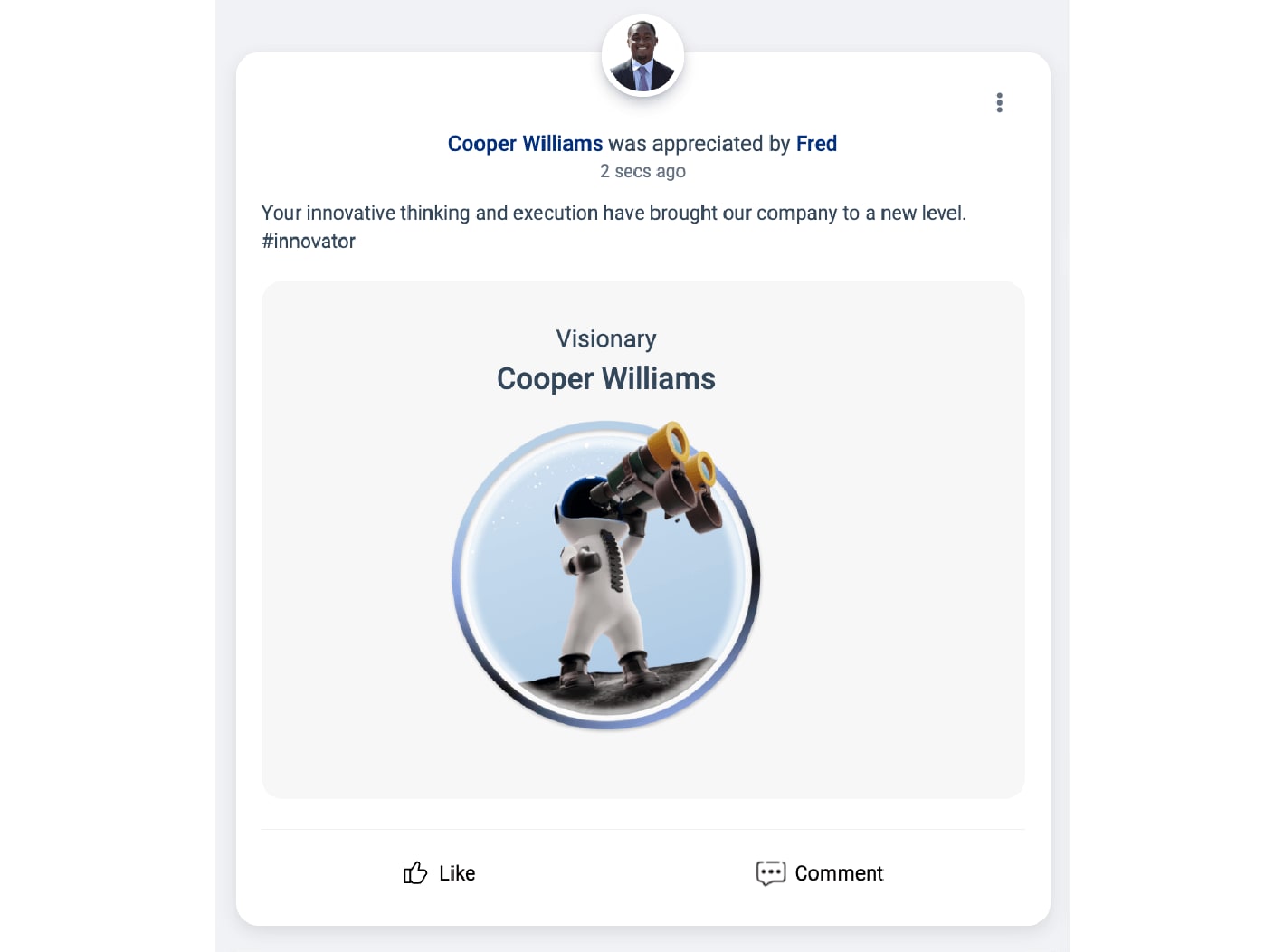
20. Peer-to-Peer Recognition Platform
Tools like Vantage Recognition give employees the ability to recognize each other with points, badges, and social feeds, all independent of management. Peer recognition lands differently than top-down recognition: it signals that the team itself sees and values the contribution, not just the hierarchy. Platforms that integrate natively with Slack or Teams reduce the friction that kills adoption. The data generated (who’s recognizing whom and for what behaviors) also gives HR a real-time engagement signal more nuanced than survey scores.
Seed the platform in week one. Have managers post 2–3 recognitions before anyone else is asked to. Adoption follows behavior, and behavior follows permission.
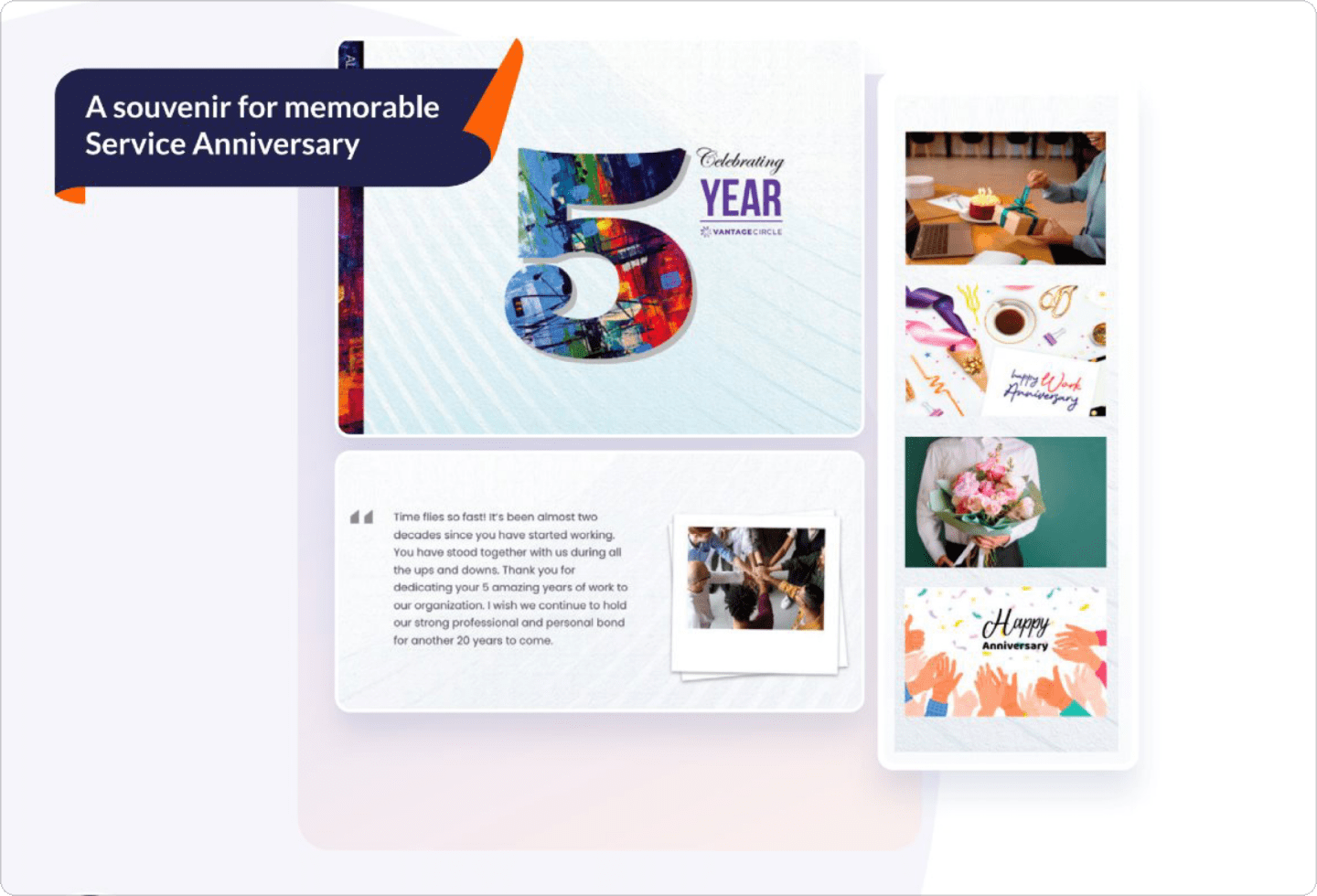
21. Virtual Service Yearbook for Milestones
When a team member hits a work anniversary or major milestone, build them a collaborative digital memory board using a tool like Kudoboard or Miro. Teammates add notes, photos, GIFs, and inside jokes over a few days before the reveal call. The effort signals that the milestone matters, and honestly, it’s the kind of artifact people actually keep. Remote work erases many of the informal rituals that mark tenure. A virtual yearbook is a deliberate replacement that often lands harder than the original.
22. Gratitude Wall (Miro Board)
Maintain a persistent Miro or FigJam board where anyone can add a sticky note of appreciation at any time: for a teammate, a manager, a vendor, or just the week in general. Open it at the start of monthly meetings for a 3-minute read-through. The wall creates an ambient record of what people appreciate about working together and serves as a tangible counterweight to the negativity bias that tends to dominate retrospectives and feedback sessions.
Related Read: Employee Recognition Wall: How to Build One That Actually Works
23. Surprise Reward Drops
Send unexpected, personalized rewards (a gift card, a curated care package, a handwritten note) to team members who delivered without being asked to. The surprise mechanism matters. Predictable recognition loses its signal value over time. Surprise drops communicate that someone was watching and noticed, which is precisely what remote workers most often say they miss. Keep the reward modest but the gesture specific. “I noticed you stayed late to help the new hire” lands harder than any bonus tied to a performance cycle.
24. Virtual Employee Appreciation Day
Employee Appreciation Day falls on the first Friday of March each year. For remote teams, the event requires deliberate planning rather than an office-wide gesture. Build a half-day program: a personal video message from leadership, a peer recognition showcase, a team game, and a tangible reward sent to every employee’s home address. The combination of acknowledgment, play, and something physical creates a multi-layered experience that’s genuinely hard to dismiss. Start planning 6 weeks out so logistics don’t crater the event.
25. Manager-Led Weekly Recognition Ritual
Every manager closes the week with a 2-minute team message, whether in a channel, on a call, or in a recorded video, naming one thing the team did well and one person who made it better. The ritual removes the ”I should recognize more” intention gap by making it structural. Teams report that the ritual changes how managers observe their people during the week. When you know you’ll be naming someone on Friday, you start noticing on Monday. Consistency matters more than eloquence.
Always name a specific person, not just “the whole team.” Vague recognition lands like no recognition. One name, one reason, every Friday.
How to Run a Virtual Engagement Activity Without It Feeling Forced
The fastest way to undermine remote team collaboration is to run an engagement activity that feels like a mandatory work obligation in disguise. It doesn't matter how well-designed the activity is. If people arrive resentful or disengaged before it starts, it won't land. Here's how to make sure it does.
1. Pick one activity and scope it down
Don't try to run a comprehensive engagement program in a single session. Pick one activity, set a clear start and end time, and do it well. A 15-minute icebreaker that lands is worth more than a 90-minute program that meanders. If you're not sure where to start, go back to the 4-filter picker above and choose whatever scores highest on ease of setup this week. You can build from there.
2. Make it genuinely opt-in
Send the invite with enough lead time and make the optional nature explicit. "Join if you can, no pressure" is not weakness. It's the thing that makes people actually want to show up. Forced fun is the most recognizable form of fake culture, and remote employees who spend all day on video calls are especially good at spotting it.
3. Assign a host before the calendar invite goes out
Every engagement activity needs one person who owns the energy in the room. Not necessarily a manager, just someone who has agreed to hold the structure, start on time, keep things moving, and end before people check out. Hostless activities drift. A hosted session, even a simple one, has shape.
4. Be honest about the time commitment
If it's 20 minutes, don't schedule 45. If it needs 45, don't advertise 20. Remote employees' time is fragmented and closely guarded. An activity that runs over its stated time will be remembered longer than one that didn't land perfectly. Respect the clock and you'll get more goodwill than any icebreaker can generate.
5. Close with one sentence, not a survey
End the session with a single verbal question to the group: "What's one word for how that felt?" Go around quickly and wrap up. Don't send a follow-up survey unless something genuinely needs measuring. A light, fast close reinforces that the activity was for the team, not for the metrics deck.
Frequently Asked Questions (FAQs)
1. What are virtual employee engagement ideas?
Virtual employee engagement ideas are activities, strategies, and practices designed to keep remote or work-from-home employees connected, motivated, and productive — without requiring in-person interactions. These range from virtual team-building games and online recognition programs to mental health initiatives, themed days, and digital communication tools.
2. Why is virtual employee engagement important?
Remote workers are more prone to feeling isolated, disconnected, and disengaged. Engaged remote employees are more productive, perform better, and are significantly less likely to leave the organization. As remote work becomes the global norm, companies that invest in virtual engagement strategies are better positioned to retain top talent and sustain strong business results.
3. How can you measure virtual employee engagement?
You can measure virtual employee engagement through regular pulse surveys, one-on-one check-ins, participation rates in virtual events, and tracking productivity metrics. Tools like [Vantage Pulse](https://www.vantagecircle.com/products/employee-survey/) help HR teams collect real-time employee sentiment through concise, multi-device-friendly surveys — giving leaders actionable data to improve engagement continuously.
4. What are the most effective virtual employee engagement activities?
Some of the most effective activities include virtual team-building games (like murder mystery or puzzle challenges), virtual rewards and recognition programs, themed days, virtual water cooler conversations, and virtual employee appreciation events. The most impactful approach combines fun activities with meaningful recognition and consistent, open communication.
5. How do you keep remote employees motivated?
To keep remote employees motivated, avoid micromanaging and instead set clear, measurable goals using frameworks like OKRs and KPIs. Regular recognition, time off for personal milestones, access to mental health resources, encouraged breaks, and reliable communication tools all play a critical role in sustaining long-term motivation among remote teams.
Finally
Virtual employee engagement ideas are crucial to engage your remote workers and enhance their levels of satisfaction, productivity, and happiness. It is merely about understanding the factors that influence an employee’s sense of worth.
Do you have any additional virtual employee engagement ideas or virtual employee engagement activities that you love? Drop us a mail and let us know!

Sanjeevani Saikia is a Senior Content Strategist at Vantage Circle, where she leads end-to-end content strategy across SEO, thought leadership, brand storytelling, podcasts, and video. She is also the host of the Vantage Influencers Podcast, where she brings conversations with HR and business leaders from top global organisations, including Fortune 500 companies.
Connect with Sanjeevani on LinkedIn.