
Picture two people on the same team opening the same email on a Monday morning. A client escalation, nobody's fault, needs fixing by Thursday. The first person reads it, sighs, and forwards it upward with a "let me know how you'd like me to proceed." The second has already pulled the ticket history, found where things broke, and blocked two hours to fix it. Before anyone asked.
Same role. Same pay. Same email. The gap between those two reactions is engagement.
An engaged employee is emotionally committed to their work and their organization, and takes ownership of outcomes without waiting to be told. Gallup's 2025 data says just 31% of U.S. workers operate like that second person. This guide breaks down what engagement actually looks like in a real human being: 20 characteristics, 7 signs a manager can spot in a normal week, and 3 practical ways to measure it. No jargon. Just what to look for.
What Is an Engaged Employee?
An engaged employee is someone who cares how the work turns out, not just whether the paycheck clears. The salary matters, of course. It's just not the thing making them push.
Strip away the research language and it comes down to this: engaged employees treat the company's problems as their problems. A missed target bothers them. A broken process nags at them until somebody fixes it, and that somebody is usually them.
The idea does have an academic root. William Kahn's 1990 study described engagement as people bringing their whole selves to work. Hands, head, and heart. Gallup says the same thing in plainer words: engaged employees act like owners of the business, not renters passing through.
I've spent seven years writing about and watching workplaces, and here is the pattern that holds: engagement is not a personality type. It's a state. The same person who coasts at one company becomes the one staying late to fix a broken process at another. Which means the traits below are less about hiring the "right people" and more about whether your environment produces them.
One clarification before the characteristics, because HR teams conflate these constantly.
Engaged Employees vs. Satisfied Employees
Satisfaction means someone is content enough to stay. Engagement means they're invested enough to build. A satisfied employee has no complaints worth acting on, likes the pay, tolerates the commute, gets along with the manager. Fine. An engaged one is actively pushing the organization somewhere.
Here's why the distinction matters: satisfaction can be bought. Better perks, better coffee, a raise, and the satisfaction score climbs while output sits exactly where it was. Engagement doesn't respond to that lever. It moves when people find purpose and ownership in the work itself, and when someone notices what they did. A satisfied employee attends the meeting. The engaged one is the person questioning why the meeting exists.
Engaged vs. Disengaged vs. Actively Disengaged Employees
Gallup's 2025 research splits any workforce three ways. The engaged. The not engaged. And the actively disengaged, who are working against you whether they mean to or not. Roughly a third of U.S. employees land in the first bucket. About half sleepwalk through the middle.
That middle group is the expensive one, and almost nobody budgets for it. Actively disengaged employees at least get noticed. The quiet majority is harder to see. They do the minimum, nothing dramatic, and the cost of disengagement buries itself in places no one audits. A deadline slips here. A customer gets a flat, forgettable interaction there. Some project ships late and nobody can point to a single reason why. Gallup tried putting a number on all this in its State of the Global Workplace 2026 and landed on more than $10 trillion in annual lost productivity, roughly 9% of global GDP. Honestly? Probably an undercount. No figure captures the ideas people never bothered raising.
So what separates the three groups in practice? An engaged employee treats company goals as personal ones. Initiative, appetite for harder problems, teammates who get helped before they ask. And the effect compounds, because that energy is contagious in a way spreadsheets never show. The not-engaged employee isn't hostile. They're absent while present. Instructions get waited for, ownership gets sidestepped, the clock gets watched, and other people quietly absorb the discretionary load. Then there's the actively disengaged employee, whose unmet needs have curdled into something visible. Complaints. Resistance to any change. Negativity strong enough to drag a whole unit down, and it travels: more errors, more sick days, resignations that trigger other resignations. Gallup's 2025 breakdown, for the record, lands at 31% engaged, 52% not engaged, and 17% actively disengaged in the U.S.
| Engaged | Not Engaged | Actively Disengaged | |
|---|---|---|---|
| Definition | Emotionally committed; treats company goals as their own | Psychologically checked out; does the job, nothing more | Resentful; unmet needs turn into visible negativity |
| Behavior at work | Takes initiative, seeks challenges, helps teammates | Waits for instructions, avoids ownership, watches the clock | Complains, resists change, undermines morale |
| Effect on team | Raises the bar; energy is contagious | Neutral drag; others carry the discretionary load | Corrosive; one person can pull down a whole unit |
| Cost or contribution | Drives profitability, retention, and innovation | Silent productivity leak, the largest hidden cost | Direct damage: errors, absenteeism, turnover contagion |
| Share of U.S. workforce (Gallup, 2025) | 31% | 52% | 17% |
Sit with that middle number. It's most of your workforce.
20 Key Characteristics of Highly Engaged Employees
The 20 traits sort into 5 clusters. Performance-driven. Behavioral. Team and culture. Growth-oriented. And brand and loyalty, the one most companies forget to look for. No single trait proves anything. Stacked together, though, they're unmistakable.
Before the full breakdown, the short version of what highly engaged people consistently do:
- Discretionary effort. Going past the job description without being asked, mostly because "good enough" genuinely bothers them.
- Ownership and accountability. When something breaks on their watch, they say so. Mistakes get treated as tuition, not something to hide from.
- Values alignment. The work feels purposeful instead of transactional, and the reason is simple enough: their personal goals and the company mission happen to point the same direction.
- Resilience and adaptability. A new system or a shifted priority reads as growth. Not a threat to be survived.
- Open collaboration. Clear communication, support for a struggling teammate, mentoring juniors nobody assigned them.
- Growth orientation. They chase feedback and training instead of waiting for it to show up in a development plan.
👆 Click a category to explore its traits · click any trait for the full description
Focused on Work Outcomes
One of the most important traits or signs of an engaged employee is that they are focused on what they do.
They are attentive and are keen to take up challenges. On top of that, they are enthusiastic and are more eager to learn new things which will keep them on top of their game. This is because they feel it is the perfect work environment for them and that they are acknowledged for their work.
Takes Ownership and Accountability
Ownership is about taking responsibility of the work that one is assigned.
Employees that are engaged stand by their decisions and actions, embracing both praise and blame, when things go wrong. They view mistakes as chances for growth and are dedicated to doing things right. Doing so enables them to become better individuals and improve their skills in the long run. Moreover, it also assists the organization to create a workforce that is dependable and trustable.
Low Error Rates
Employees with high levels of engagement are more likely to grasp their work and job responsibilities quickly.
This allows them to focus more on details, comprehend the procedures involved, and ultimately reduce error. With lower errors, they produce high-quality work which positively impacts the organizational bottom-line.
Seeks Challenges
Challenges aren't deterrents for engaged employees; they're opportunities.
They embrace challenging activities with excitement, seeing them as opportunities to demonstrate their abilities, contribute effectively, and advance in their positions.
Goes the Extra Mile
"Good enough" is never good enough for engaged employees. They want more than that.
It's not about longer hours.
It's about caring enough to make things right.
This separates average from exceptional.
They see what's required to complete the job and do the needful without any reminders. On top of that they help struggling teammates to finish projects and find better solutions.
Positive Attitude
Engaged employees bring energy to work. They don't complain constantly and drag the team down.
Instead, they tackle problems with optimism. Bad days happen and challenges arise but their default isn't negativity. This attitude is contagious. Teams with engaged employees simply feel different. They have better morale and instill stronger collaboration along with resilience.
Self-Confidence
Engaged employees have a clear understanding of what their job requires from them.
They acknowledge their strengths and try to work on their weaknesses. These employees are skilled and capable that gives them the confidence to perform exceptionally. Moreover, they have a positive attitude and approach while starting any project or task. They strategize well and have a firm belief that things will work out in their favor. This allows them to motivate themselves and others as well to attain organizational goals.
Disciplined
A significant sign of an engaged employee is that they are disciplined in every aspect of their work.
They have a proper attitude, respect others, maintain their schedule, and complete their work in the given time frame. When your employees are disciplined, it becomes easier for a manager to delegate a task without any hassle. They know what is expected of them and how they can help the organization excel in the present market.
Adaptable to Change 2026 INSIGHT
Change doesn't scare engaged employees.
New systems? They learn them.
Shifting priorities? They adjust.
Unexpected problems? They pivot.
They see change as growth, not disruption. While others resist, they adapt. In 2026, this matters more than ever. Markets shift fast. Technology evolves constantly. Companies need people who can keep up. Engaged employees don't just keep up. They help others navigate change too.
Curious and Asks Questions
Employees who are engaged are often curious about newer developments and have a positive lookout.
They raise questions that help them assess the situation in a better way. This gives them the opportunity to come up with new ideas and enhance their skills with the growing changes.
Communicates Effectively
Highly engaged employees communicate effectively to make the best use of time.
They collaborate with others and provide clear cut information so that there is always a smooth flow of work. Moreover, they listen to others and respect their viewpoint. When there is a clear flow of communication among employees, there are fewer conflicts and increased productivity. It is because every employee understands what their role is and have a clear vision of what they need to do. Thus, enhancing engagement and boosting morale in the long run.
Collaborates Openly
Employees that are engaged are always open to collaborating with others.
They believe in teamwork and desire to achieve success without any shortcomings. With the help and assistance of different people, these employees help increase the workforce's productivity and performance. Moreover, collaboration makes it possible for employees to experiment with new ideas. People from different backgrounds will provide a broader perspective on things that need to unfold. This further helps them to innovate and develop processes to accomplish their objectives.
Builds Strong Relationships
Employees who are engaged realize the value of networking and collaboration.
They aggressively seek connections with their peers, supervisors, and even colleagues from other departments. This isn't simply for personal gain; by developing strong professional ties, they may collaborate more efficiently to achieve mutual goals.
Supports Teammates
Employees who are engaged are not only concerned with their work, but they help others as well.
For them, the prime objective is to achieve success for the organization. And when they see someone struggling with their work, they provide a helping hand. This not only boosts employee morale but also increases team bonding. Hence, creating a positive work culture where employees look out for each other.
Mentors Others
Employees that are engaged look for opportunities to give back.
They accomplish this in part by mentoring less experienced colleagues, sharing their knowledge, and providing assistance. Moreover, this enables them to become good leaders and help new employees get acquainted in the new work setting. This benefits not only the mentee but also the team and organization.
Always Learning and Developing
Employees that are engaged have the eagerness to learn every day, and they take training seriously.
They don't wait for growth to come to them.
They chase it.
They make it a habit to learn and relearn new things continuously, and they encourage others to discover new ways to work. They ask for feedback and volunteer for new projects to upskill themselves. Stagnation isn't in their vocabulary. It's a two-way street: companies invest in development, and employees invest back with better performance. These are the people attending workshops, reading industry articles, and asking how to improve.
Aligns Personal & Professional Goals
Employees with high levels of engagement can align their personal and professional goals.
They know how to balance their work without reducing productivity. Their main goal is to achieve all the targets without wasting time. Moreover, aligning their goals lets them see a clear picture of what they want to achieve in the future. When they understand their main objective, they start planning and take steps to accomplish them. And as a leader, you need to support and guide them. With your mentorship, they will be able to pave the correct path and achieve good satisfaction levels.
Advocates for the Company
Engaged employees often act as brand ambassadors for the company.
They advocate for the company and talk positively about the workplace on social media platforms. This enables the company to attract promising candidates and cultivate a strong brand image within its desired audience.
Celebrates Achievements
Engaged employees are always willing to push others to do well in their job responsibilities.
They celebrate every little accomplishment which works as a great morale booster. In the long run, it helps in enhancing the productivity of the workforce and creates good camaraderie among each other.
Stays Longer with the Organization
Engaged employees stick around because they love their job and the organization they work for.
High turnover kills teams.
Engaged employees build them instead.
They're not constantly browsing job boards or updating their resumes every few months. They're building careers, not just filling time. With lower turnover rates, there are fewer recruitment costs, less training time, and retention of institutional knowledge. These employees stay because they're valued and because the work matters to them. Moreover, they see a future worth investing in which is crucial for their growth.
One honest caveat on trait lists, including this one. Nobody exhibits all 20 at once. A quiet employee showing six of them deeply beats a loud one performing twelve, every single time, and I've hired against this instinct before and regretted it. So treat the clusters as a lens, not a scorecard. Patterns over months. Not grades in a Tuesday one-on-one.
How to Tell If an Employee Is Engaged: 7 Observable Signs
Seven behaviors give engagement away. Volunteering before anyone asks. The "why" questions. Work that finishes without reminders, problems that surface early, help that arrives unprompted, recognition flowing in both directions, and the word "we" doing quiet work in how they talk about the company.
What didn't make that list matters just as much. Enthusiasm in meetings. Long hours. Saying yes to everything. Those measure visibility, not engagement, and managers who confuse the two end up systematically overlooking their quietest strong performers. I've watched it happen more times than I'd like.
Each sign is something you can watch for over a normal month, no survey required.
- They volunteer first. New project, awkward client, messy handover. Their hand goes up.
- They ask "why" questions. Disengaged people ask what to do. Engaged people want to know why it matters, because they plan on making judgment calls later without you.
- Work finishes without reminders. Deadlines hold. Delegation feels safe. You stop double-checking.
- Problems surface early. They flag risk while it's still cheap to fix. The detached ones let you find out in the postmortem.
- Help arrives unprompted. A struggling teammate gets support before the manager even registers the struggle.
- Recognition flows through them. Both directions, giving and receiving.
- They say "we." Listen to pronouns for a week. "We missed the target" and "they changed the policy" come from two very different psychological places.
The sixth sign deserves a closer look, because it's the only one that leaves a data trail.
The recognition signal
Engaged employees appear on both sides of the recognition ledger. On a social recognition feed like the one in Vantage Rewards, they show up appreciating colleagues and being appreciated, and that two-way pattern is one of the most reliable behavioral markers of engagement a manager can observe without running a survey. Recognition Analytics turns the pattern into something trackable. Who gives. Who receives. How often.
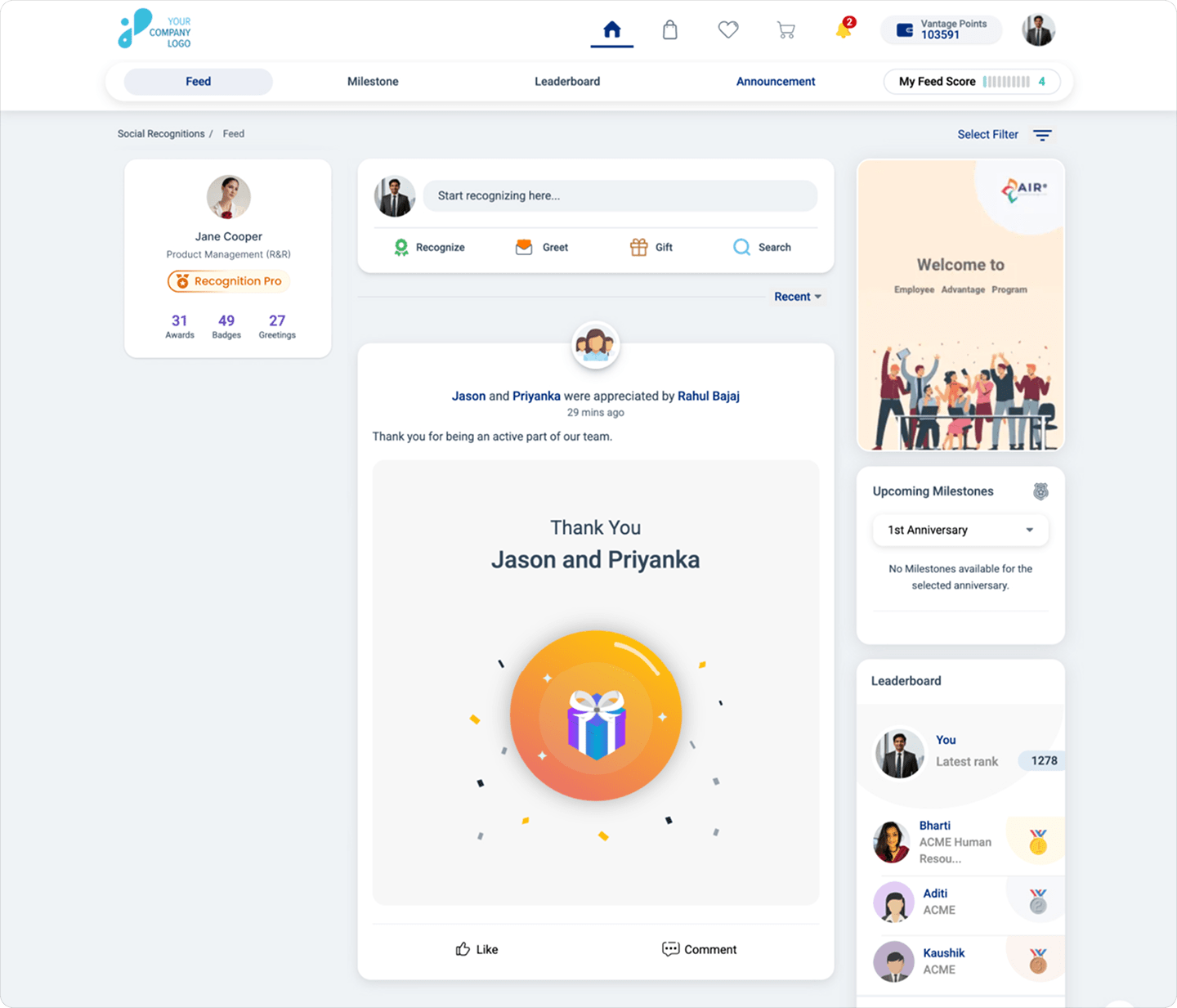
Figure: The social recognition feed where appreciation posts, badges, and comments flow in both directions.
(Source: Vantage Rewards)
Why Engaged Employees Matter: 6 Measurable Business Outcomes
Six outcomes move when engagement moves. Profitability and productivity, first and most obviously. Then retention, wellbeing, safety, and advocacy, which take longer to show up but stick around longer too. None of this is soft culture talk. Gallup ran the comparison in its 2024 meta-analysis, top quartile against bottom, across 183,806 business units, so the sample size argument is settled.
The headline numbers? Profitability runs 23% higher in top-quartile teams. Sales productivity, 18%. Turnover drops too, by as much as 51% in low-turnover organizations. Wellbeing runs up to 70% higher on strongly engaged teams, with 63% fewer safety incidents as well. Same meta-analysis, same year, all of it.
| Outcome | Evidence |
|---|---|
| Profitability | 23% higher in top-quartile engagement teams (Gallup Q12 Meta-Analysis, 11th ed., 2024) |
| Productivity | 18% higher sales productivity (Gallup, 2024, same meta-analysis) |
| Retention | Up to 51% lower turnover in low-turnover organizations (Gallup, 2024) |
| Wellbeing | Up to 70% higher reported wellbeing (Gallup, 2024) |
| Safety | 63% fewer safety incidents (Gallup, 2024) |
| Advocacy | Engaged employees become promoters: they refer strong candidates and recommend the workplace unprompted, which is exactly the behavior eNPS was built to measure |
I'd push back slightly on how the profitability number usually gets framed. The 23% is real, but engagement is not a lever you pull for margin. It is the condition under which every other investment, in training, in tooling, in employee recognition, actually holds. Chase the profit figure directly and you get engagement theater. Build the conditions and the figure follows.
How to Measure Employee Engagement
Three instruments do the real measurement work: eNPS surveys, pulse surveys, and behavioral analytics. Annual engagement surveys still exist, sure. But by the time an annual survey catches a problem, the resignation letter is usually drafted.
The trick is combining instruments. Surveys capture what people say. Behavioral data captures what they do. The gap between the two is where the interesting findings live.
eNPS and Pulse Surveys
The employee Net Promoter Score, eNPS, boils down to one question: how likely are you to recommend this workplace to someone you know? Subtract detractors from promoters and you've got a single number worth tracking. Our eNPS calculator handles the math in seconds if you want to skip the spreadsheet.
The score itself matters less than its movement, though. A stable eNPS of 20 is healthier than a 40 that used to be 60.
Run it quarterly through short pulse surveys instead of annual reviews and you catch engagement shifts while there's still time to do something about them, which is exactly the job an employee survey platform like Vantage Pulse was built for. Two features do the heavy lifting: anonymous responses raise honesty (disengagement hides where feedback feels risky), and department-wise insights show whether a dip is company-wide or one team's manager problem. Those are different diagnoses with different treatments.
Behavioral Signals: Recognition and Participation Data
Survey data has a flaw nobody likes admitting: people answer surveys the way they answer the question "how are you?" Behavioral data does not perform.
Recognition frequency, survey participation rates, voluntary program involvement. All of it is engagement evidence generated passively, as a byproduct of daily work rather than a quarterly interruption to it.
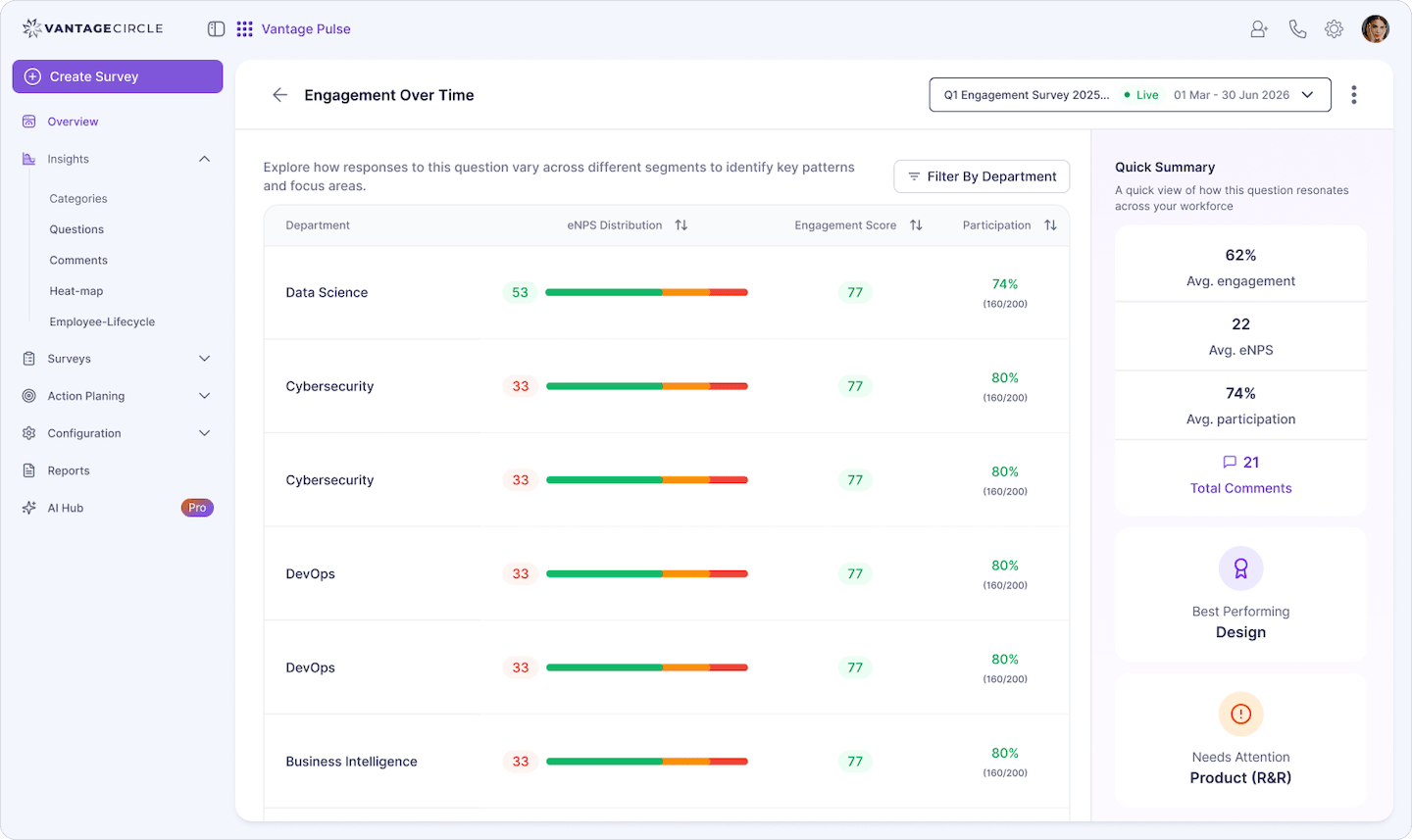
Figure: Department-wise insights showing whether an engagement dip is company-wide or one team's problem.
(Source: Vantage Pulse)
How to Keep Employees Engaged: 5 Proven Drivers
Recognition, growth opportunities, manager quality, purpose, employee voice. Every credible study on drivers of employee engagement lands on some version of those five, and Gallup's 2025 research found employees with a strong sense of purpose at work are 5.6 times more likely to be engaged.
What I've seen repeatedly is that companies invest in these drivers in exactly the wrong order. They start with purpose statements and culture decks, the cheapest to produce and slowest to work. Meanwhile recognition and manager quality, which move the needle fastest, sit at the back of the budget queue.
Recognition works because it closes the loop between effort and meaning. Tie it to specific company values and it does double duty, since the employee feels seen and the behavior you want repeated gets named out loud, publicly. That is how values migrate from a poster to a habit. Core-values-tagged recognition in Vantage Rewards exists for precisely this.
Growth keeps your best people from outgrowing you. Manager quality is the gate everything else passes through, or doesn't; Gallup has argued for years that the manager accounts for at least 70% of the variance in team engagement, and my experience says they're right. Purpose connects daily tasks to something worth caring about. And voice means feedback visibly changes decisions, because asking for input and then ignoring it is worse than never asking.
If you want tactical starting points, we keep a running list of employee engagement activities mapped to these drivers.
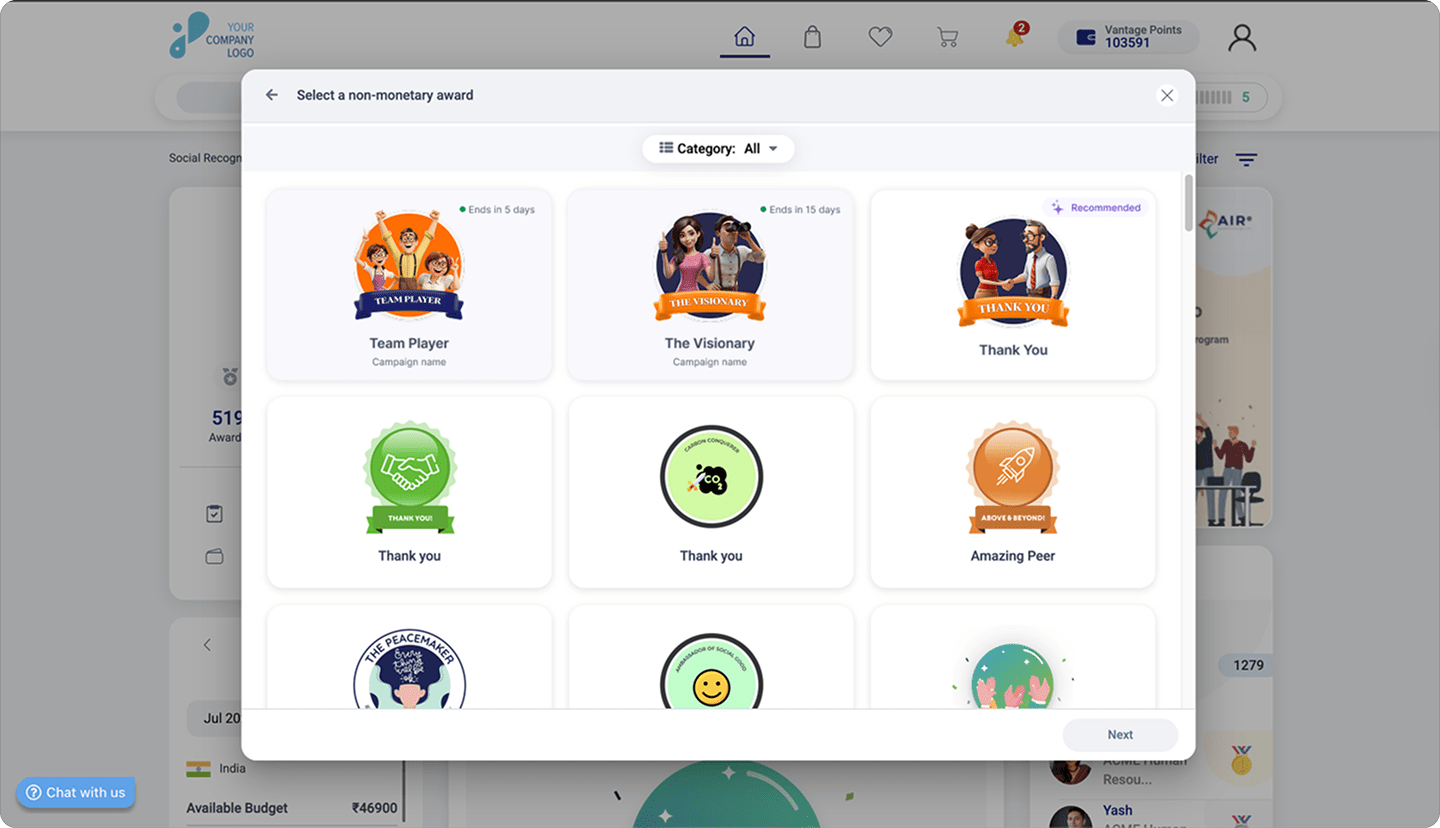
Figure: The badge catalog where recognition gets tied to specific values and behaviors.
(Source: Vantage Rewards)
One warning. Drivers compound slowly and collapse quickly. A year of recognition-building can be undone by one badly handled layoff round. Which is not a reason to skip the work. It is the reason the work never finishes.
Conclusion
Engaged employees are built, not born. The environment produces them, or fails to: purpose people can actually see, managers who coach, recognition that arrives on time, a voice that changes real outcomes.
The 20 characteristics in this guide are signals to watch, and the 7 observable signs are where managers should start on Monday. Spot who is already engaged. Protect them. Then build the conditions that turn the silent middle 52% into owners.
For where all this is heading next, our analysis of employee engagement trends covers what 2026 and beyond demand. Measurement and reinforcement work best as a single loop. Survey, act, recognize, re-survey. Run that loop consistently and you've got the whole game.
🏆 For managers who want to keep their best people
You've spotted your engaged employees. Now keep them.
Recognition that arrives on time is what turns the silent middle 52% into owners. See how Vantage Rewards makes appreciation a daily habit, not an annual event.
Explore Vantage Rewards →FAQs
What are the 5 C's of employee engagement?
The 5 C's of employee engagement are Care, Connect, Coach, Contribute, and Congratulate. Less a framework than a habit stack for managers, honestly. Care about the person, not just the role. Connect their work to something bigger. Coach rather than command. Make room for their ideas to actually land. And congratulate progress out loud, more often than feels natural.
What are the 4 types of employee engagement?
The 4 types of employee engagement are highly engaged, moderately engaged, barely engaged, and actively disengaged. The highly engaged advocate and overdeliver. Moderately engaged people perform fine but hold their discretionary effort in reserve. The barely engaged do the minimum, and the actively disengaged spread negativity that puts entire teams at risk.
What are the 7 factors of employee engagement?
The 7 factors of employee engagement are leadership trust, recognition, growth opportunities, purpose, autonomy, wellbeing, and workplace relationships. Researchers slice this differently depending on who you read. Still, those seven keep resurfacing, in Gallup's work, in SHRM's, in the academic models, and a company scoring well on even five of them tends to beat its peers on retention.
Are engaged employees more productive?
Yes, and measurably so. Top-quartile engagement teams delivered 18% higher sales productivity and 23% higher profitability in Gallup's 2024 meta-analysis. Why? Discretionary effort, mostly. Engaged people solve problems nobody assigned them. They make fewer errors. They stay longer, and that tenure compounds year over year in ways quarterly dashboards miss.
What is an example of employee engagement?
A clear example of employee engagement is an employee who spots a broken process, proposes a fix, and volunteers to implement it without being assigned. Smaller everyday versions count too. Mentoring a new hire unprompted. Publicly recognizing a colleague's work. Referring strong candidates because the recommendation is genuine.

He has worked in the human resources environment and has elevated recognition and rewards through his insightful and detailed writing. He aims to enhance the practice of Recognition in the workplace with new ideas and innovation that will help shape the work culture. For any related queries, contact editor@vantagecircle.com