Here is a composite of something I keep seeing. A manager inherits two teams in the same quarter. One has five senior engineers. The other has three new hires in their first month. She runs both the same way for six weeks, with weekly check-ins and decisions left to the group. The senior group ships without fuss. By week three the new hires have stalled. They wanted to be told what good looks like, and nobody told them.
Her style was fine. It was fitted to one team and worn on both. In week seven she changed one thing. She set the new hires' tasks herself for a month and told them why. The senior group kept its freedom. Both teams settled.
She was the same person in week seven. All she moved was one decision. Who makes the call on a piece of work is the part of effective management a manager can change by Monday.
Key Takeaways
- Your style shows in who decides and how closely the work gets checked.
- Five of the eight styles differ only in how much of a decision the manager holds on to.
- Managers with the best results switch styles by situation. Goleman's Hay/McBer data pointed the same way.
- Your team sees a different style from the one you think you run.
- Recognition looks different in every style. It is the easiest place to spot yours.
What Is a Management Style?
A management style is the way a manager makes decisions, delegates work, checks progress and communicates with the team. The most common types are autocratic, persuasive, consultative, democratic, laissez-faire, coaching, visionary and pacesetting. Most effective managers use more than one, choosing the style that fits the situation and the people involved.
People mix this up with leadership style all the time. I did for a long while. The cleanest split I know is about the object. A leadership style is aimed at people. You're trying to move them. Management style has a duller target, the work on the desk this week. That covers who signs off and how often you check. Feedback and thanks belong here too.
You'll see autocratic and democratic in both places. This guide stays on the operating side. For the influence view, read our guide to leadership styles.
Why Your Management Style Matters
I notice style most on ordinary days. Take a Tuesday with nothing on fire. A manager makes maybe forty small calls that week and forgets nearly all of them by Friday. The team doesn't forget. Each person knows whether they were asked or just informed.
Styles bend under pressure. Managers have plenty of it right now. One Gallup number worries me. Just 22% of managers worldwide were engaged at work in 2025. Three years earlier it was 31%. That is from the State of the Global Workplace 2026 report. The steepest single-year drop came between 2024 and 2025. In my experience a tired manager falls back on one default style and uses it for every decision.
The cost of that default lands on the people who go unnoticed.
30% of employees still feel unseen at work, according to The Recognition Effect (Great Place To Work® India × Vantage Circle, 2025).
When I see that number I look at the manager's default style first. On a busy week, style shows up first in who gets noticed.
The 8 Management Styles at a Glance
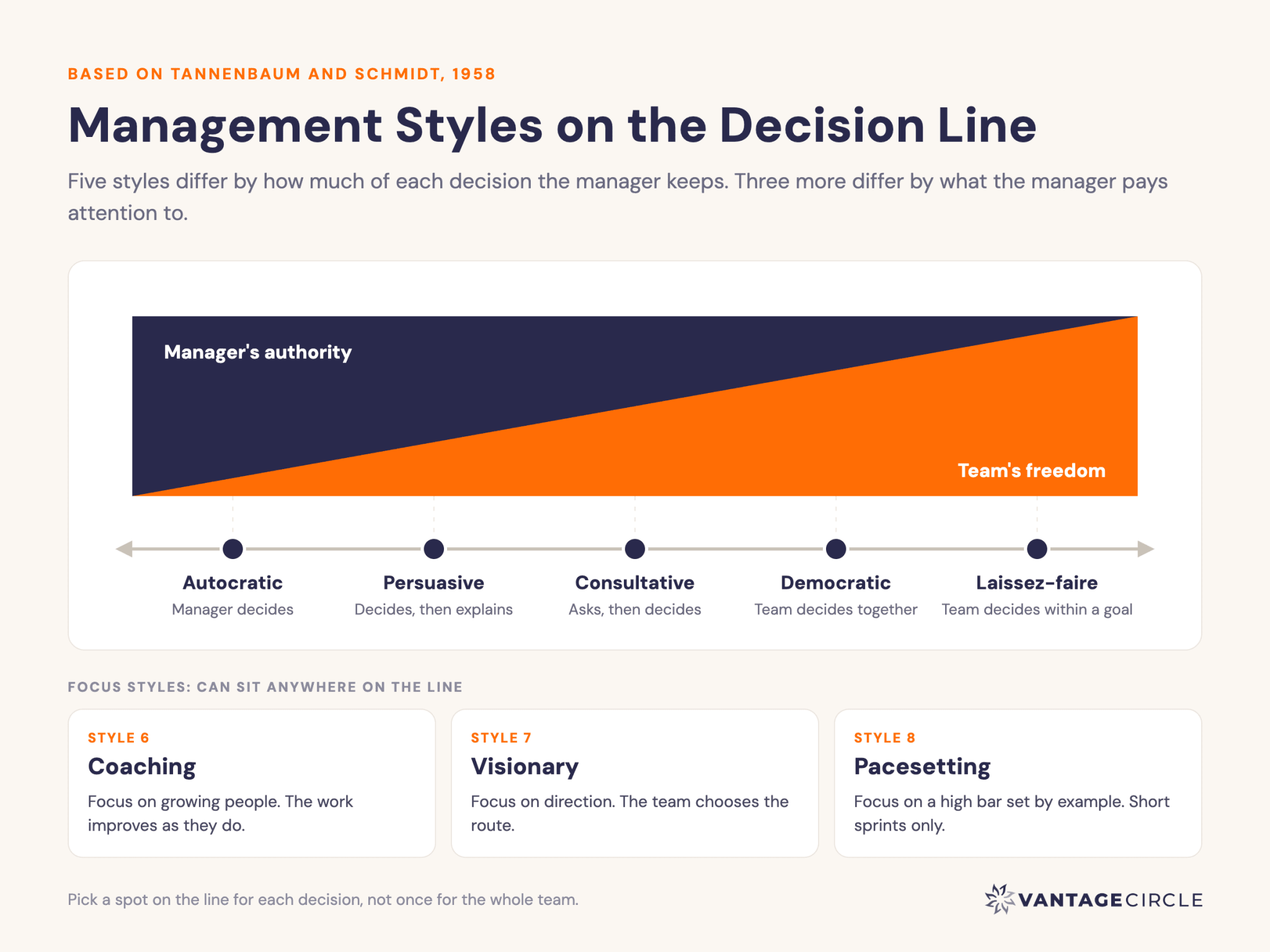
Five of these styles differ by how much of the decision the manager keeps. The other three differ by what the manager pays attention to. The table has all eight.
| Style | Who makes the call | Best for | Main risk |
|---|---|---|---|
| 1. Autocratic (directive) | The manager, alone | Crises and safety-critical work | Slides into micromanagement |
| 2. Persuasive | The manager, who then explains why | Decisions already fixed from above | Sounds like a sales pitch |
| 3. Consultative | The manager, after asking the team | Calls that need expert input | Input requested, then ignored |
| 4. Democratic (participative) | The team, by agreement | Choices people live with daily | Slow, and quiet voices lose out |
| 5. Laissez-faire (delegative) | Individuals, inside a set goal | Senior specialists | Drift, and people feeling invisible |
| 6. Coaching | Varies. Growth comes first | Capable people with room to grow | Too slow for a deadline week |
| 7. Visionary | Manager sets direction, team picks the route | Change and new teams | Falls flat without credibility |
| 8. Pacesetting | The manager, by example | Short sprints with a skilled team | Burnout |
Source: Vantage Circle
The line itself is an old idea. Robert Tannenbaum and Warren Schmidt drew it in How to Choose a Leadership Pattern, first published in Harvard Business Review in 1958. Their point holds up. A manager picks a spot on the line for each decision.
The 5 Decision-Based Management Styles
These five styles answer one question: who makes the call? Read them in order as the manager handing over a little more each time.
1. Autocratic (Directive) Management Style
The manager decides and the team carries it out. No vote, no round of opinions.
A payments service goes down at 2 a.m. on a Saturday. The on-call lead assigns three people by name. One rolls back the release and another watches the queue. Customer updates go out every 20 minutes from the third. Nobody debates it. Service is back by 3:10.
Emergencies and safety incidents. It also suits a new person on a risky task.
It stays the default after the emergency ends.
That default has a name. Most teams call it micromanagement, and I used to file it under personality. Kanu Priya changed my mind on an episode of the Vantage HR Influencers Podcast.
VANTAGE INFLUENCERS PODCAST
"Most people treat micromanagement as a personality flaw, as if it's a character trait. You're born with it. It's not. Micromanagement is almost always a symptom... either trust was never extended, or ownership was never truly transferred."
Kanu Priya, Chief People Officer - India & APAC, Credera
Listen to the EpisodeBoth causes are fixable on a Monday. Hand over one decision fully and say out loud that it belongs to them.
Directive managers tend to thank people in the corridor, quickly and privately. That suits the moment. Once the incident is closed, a short public award in Vantage Rewards shows the whole team what held the plan together.
2. Persuasive Management Style
The manager still decides. The difference is the ten minutes spent explaining why.
Say head office has fixed the new shift pattern. The call is made. The manager books 30 minutes on Thursday. He shows the overtime numbers behind the change and answers every question, the angry ones included. Nobody leaves happy, but most of the room can repeat the reason back.
Decisions that are already settled above you.
A pitch for something the team had real grounds to oppose. I think this style gets used as theatre more often than managers admit.
Recognition here goes to the person who asked the hard question in the room. Thank them where everyone hears it.
3. Consultative Management Style
The manager asks for input and then makes the call.
A team lead needs to pick a monitoring vendor by Friday. She asks her three most senior engineers for a written view by Wednesday. Two favour one tool. She picks the other and explains the cost reason in a short note.
Decisions where the team knows something you don't.
Asking when your mind is already made up. People spot that by the second time.
Credit matters more in this style than in any other on the list. When someone's input changes your decision, name them and say what changed.
4. Democratic (Participative) Management Style
Here the team makes the decision as a group. The manager's part is running the discussion.
Eight designers need a new sprint length. Their manager lays out two options and the constraints. The group talks for 40 minutes and votes. Two weeks wins, six to two. From there the manager's job is to hold everyone to it.
Choices the team has to live with daily.
It is slow. The majority also sidelines people who speak less.
That second risk is the one I'd watch. The person who reshaped the proposal in a side comment rarely gets the credit. Peer-to-peer recognition helps here. Colleagues saw it happen, and in Vantage Rewards anyone can thank anyone without waiting for a manager's approval.

Source: Vantage Rewards
5. Laissez-Faire (Delegative) Management Style
The manager sets the goal and hands over the decisions.
Four senior data analysts get one objective for the quarter. Cut report turnaround from five days to two. How they do it is theirs. Their manager checks in every second Thursday and clears blockers. This is close to how management by objectives works on a good day.
Experts with a clear target.
Drift, plus people who feel nobody is watching their work at all.
One piece of research made me more careful with this style. Handing over a decision does not always feel like trust to the person receiving it. Hayley Blunden and Mary Steffel ran studies with 2,478 participants and wrote them up for Harvard Business Review in 2024. People who were handed a decision rated the request as less fair than being asked for advice. Some saw it as a burden. I'd still delegate. I'd also say why this decision is theirs.
Hands-off managers miss wins too. Nobody reports them upward. Recognition analytics in Vantage Rewards lists who on the team has received no recognition this month. Start there.
3 Focus-Based Management Styles
These three styles describe what the manager pays most attention to. Each one can sit anywhere on the decision line.
I went back and forth on including them. All three come from Daniel Goleman's research on leadership styles. This is a management guide. They stay because managers use them as operating habits every week. A coaching manager can still be consultative on Thursday's decision.
6. Coaching Management Style
The manager's main job is growing the people. The work improves as they do.
In practice it sounds like questions. A coaching manager reviewing a weak draft asks what the writer would change first. Rewriting it herself would save 20 minutes. The next draft arrives better.

VANTAGE INFLUENCERS PODCAST
"It taught me how important is self-awareness. It taught me about how important to listen deeply to people and to ask powerful questions, which can transform relationships. That shift from managing to partnering has impacted me a lot."
Aline Khoury, HR Senior Business Partner for the Middle East and Africa, AVEVA
Listen to the EpisodeSomeone good at the job who wants the next one.
It is slow. Skip it in a deadline week.
Few managers have seen it modelled. Only 18% of companies give coaching to their managers and leaders. The Josh Bersin Company reported that in a 2023 study of more than 1,000 companies. The same study put executive mentoring at 11%.
Recognise progress as well as results. A first clean release deserves a mention even when the quarter's number is still short.
7. Visionary Management Style
The manager sets a clear direction and lets people choose the route.
Goleman called this style authoritative. A new head of support tells the team one thing in week one. Every ticket gets a human reply inside four hours by June. She leaves the rota and the tooling to them.
Periods of change and teams that have lost the thread.
It falls flat when the team knows the work better than the manager does.
It sits close to transformational leadership on the influence side. On the operating side, the habit to build is tying recognition to the goal. Core values alignment in Vantage Rewards tags each shout-out to a company value. The direction then shows up as real examples, one at a time.
8. Pacesetting Management Style
The manager sets a high bar by example and expects the team to match it.
It works for about two weeks. A launch sprint with six strong engineers and a lead who ships alongside them is a fair use. Month four of the same pace is something else.
Goleman's data is blunt on this. In his 2000 Harvard Business Review article, pacesetting was one of two styles with a negative effect on team climate. Coercive was the other.
There is a quieter version too. Middle managers in a McKinsey survey spent more time on individual-contributor work than on any other area. Under a third of their time went to managing people. McKinsey published the survey in 2023, with 706 middle managers. A manager doing the team's work is pacesetting whether they mean to or not.
A two-week push with people who already know the work.
Burnout, then a team that leaves every fix to the lead.
Recognition runs thin under this style. The bar keeps moving. Thank people for the standard they hit before you raise it.
Which Management Style Should You Use?
Pick the style for the situation in front of you, and for the people in it. The matrix below maps eight common situations to a style.
Goleman's study covered 3,871 executives. Leaders who had mastered four or more styles had the best climate and business performance. The sample was senior executives. I think the finding travels to a team of six, with less certainty.
| Situation | Style that fits | Style to avoid |
|---|---|---|
| Crisis or safety incident | Autocratic | Democratic |
| New hire in week one | Autocratic, easing into coaching | Laissez-faire |
| Expert team on a clear goal | Laissez-faire | Autocratic |
| Team that has lost trust | Consultative | Persuasive |
| Missed targets two quarters running | Coaching, with tighter check-ins | Pacesetting |
| Big change or reorg | Visionary | Laissez-faire |
| Creative or open-ended work | Democratic | Autocratic |
| Steady, well-run team | Coaching | Pacesetting |
Paul Hersey and Ken Blanchard took this down to the individual in their situational leadership model. A first-week hire gets close direction. Someone who has done the task fifty times gets left alone.
Your Style Looks Different From Below
Your team experiences a different style from the one you think you run.
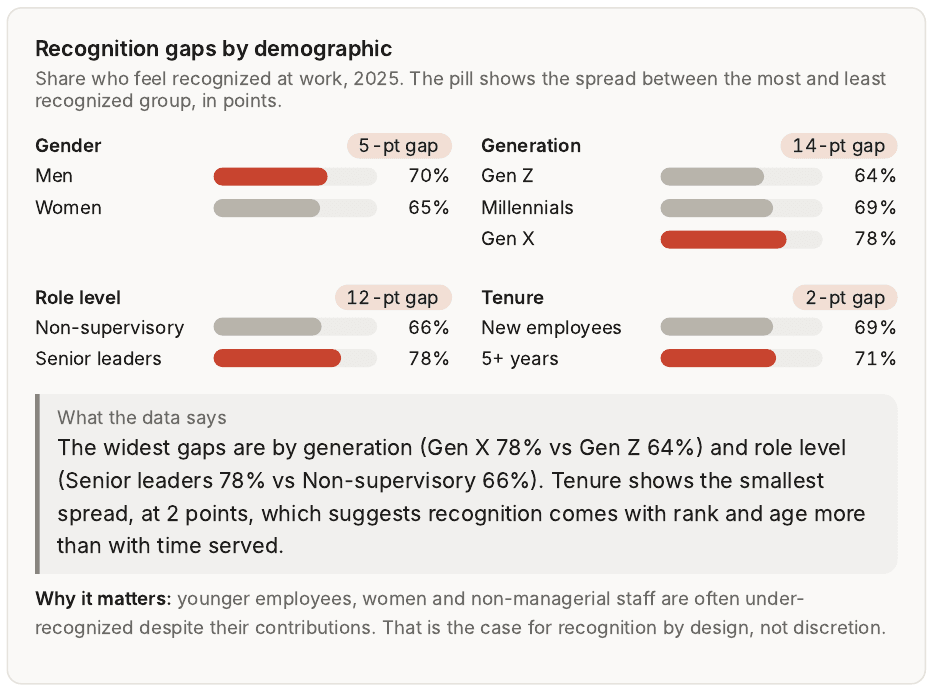
Recognition is where the gap shows most clearly in our own data.
Hierarchy effect: recognition rises with rank, 78% for senior leaders versus 66% for non-supervisory employees, according to The Recognition Effect (Great Place To Work® India × Vantage Circle, 2025).
Source: The Recognition Effect 2025
The pattern tracks with seniority. It does not prove any style caused it. Still, think about one team. A manager believes she runs a democratic team. Her two quietest people have not been credited for anything since spring. From their seats it is closer to autocratic.
Gartner asked employees directly. Just 41% said their manager helps them prioritise work. On clear developmental feedback it was 39%. The Gartner survey ran in late 2025 with 2,947 employees and managers. Managers answered too. Of them, 72% called a positive employee experience their primary responsibility.
The check costs two questions a quarter. Keep them anonymous and split the answers by team.
- "I can disagree with my manager openly."
- "My manager knows what I've worked on this month."
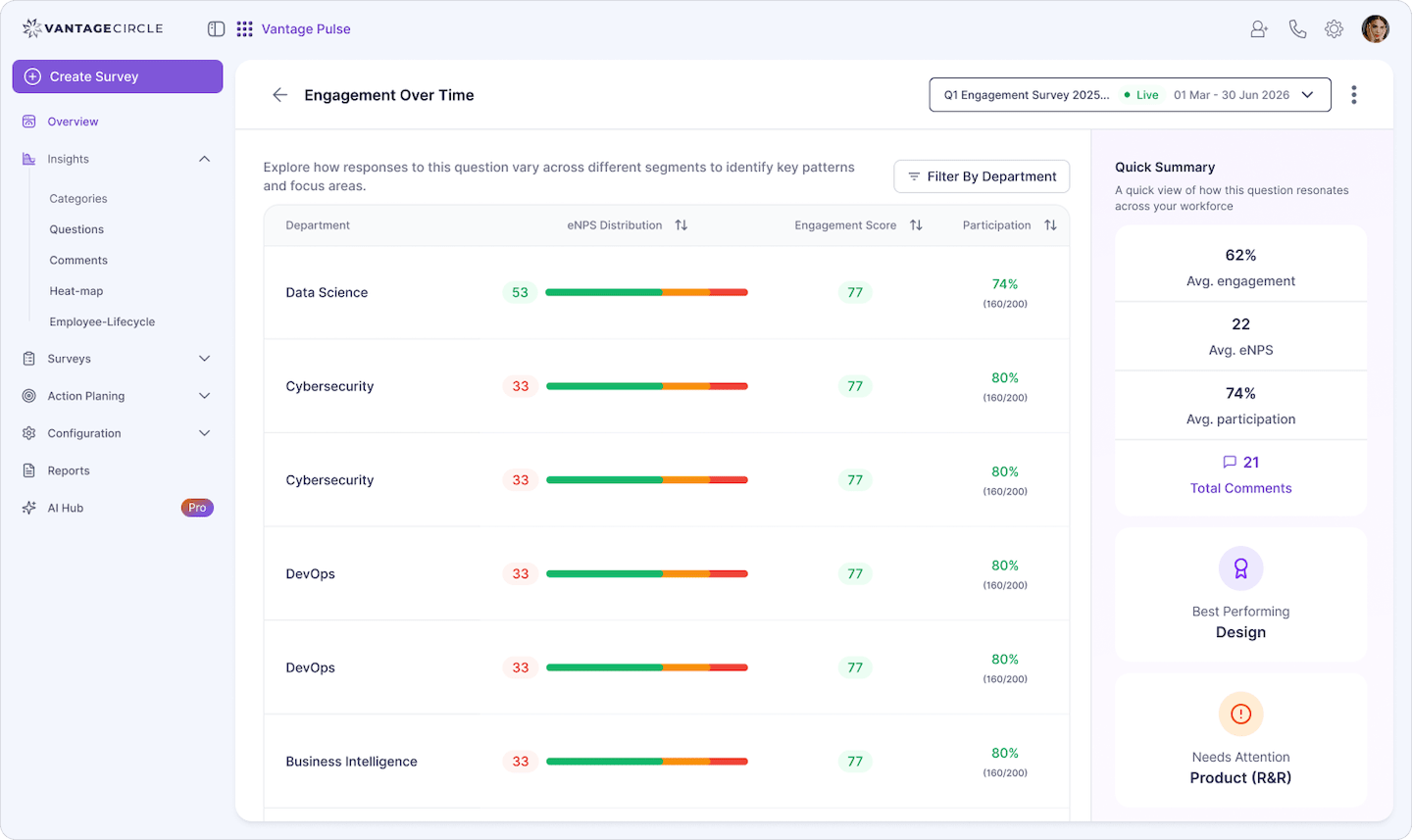
Vantage Pulse keeps responses anonymous and shows department-wise results side by side. Nobody's name sits next to a low score. A drop on one team is your prompt to look at manager effectiveness there.
Source: Vantage Pulse
How to Find Your Management Style
Pull up the last three decisions your team made. Write a name next to each. I trust that list more than any quiz.
A 6-question self-check
A yes points toward the style named after each question.
- When a deadline slips, do I fix the work myself? Pacesetting
- Did the team pick the last tool we bought? Democratic
- Did I ask for views last week and then decide alone? Consultative
- Was my last explanation given after the decision was final? Persuasive
- Can I name one skill each person is working on? Coaching
- Has anyone gone a month without hearing from me? Laissez-faire
Next, hand the six questions to two of your direct reports and have them answer about you. Their sheet and yours won't match on every line. Whichever line differs is where to begin.
How to Answer "What Is Your Management Style?" in an Interview
Give your default style in a sentence, then one decision that shows it. After that, a time you switched.
The interviewer wants to hear that you know how you operate. Any label works if the example is real. Three steps cover it.
- Your default. One sentence, plain words.
- One example. A real decision, and who made the call.
- The switch. A time you used a different style, with the reason.
A sample answer of about 70 words:
"My default is consultative. I ask the people closest to the work first. The decision is still mine and I explain it. Last year I had to choose between two vendors. I asked three senior engineers for written views and went with the cheaper tool. I told them the cost reason directly. During an outage in March I switched. I assigned tasks by name. We did the review the next morning."
Skip the answer where you adapt to everyone. It reads as a dodge.
Conclusion
No style on this list is wrong everywhere. Most trouble comes from using one of them on every decision.
This week you'll hit at least one row of that matrix. Maybe it's the new hire, maybe the missed target. Choose the style on the way to the meeting.
After that, open last month's recognition and count the names that never appear. HR can see the same gap across teams in the manager recognition report in Vantage Rewards.
FAQs About Management Styles
What are the different types of management styles?
This guide counts eight. Most of them come down to who makes the decision. The remaining three, coaching among them, are about what the manager watches.
What are the 7 management styles?
There is no fixed seven. Lists run from four to fourteen depending on the author. This guide uses eight.
What is the best management style?
None wins everywhere. In Goleman's data the best results went to leaders who had mastered four or more.
What is the 30-60-90 rule for managers?
It's a plan for a new manager's first three months. Month one is for learning the team. By the third month you should be making changes of your own.
What are the four most common leadership styles?
Autocratic and democratic top most lists. Laissez-faire usually follows, with transformational fourth. Our guide to leadership styles covers nine.
What is the difference between a management style and a leadership style?
The target differs. A management style is about running the work, like who decides. Leadership style is about moving people.
Can you change your management style?
Yes. Take the weekly planning call, say, and let the team run it for a month.

He has worked in the human resources environment and has elevated recognition and rewards through his insightful and detailed writing. He aims to enhance the practice of Recognition in the workplace with new ideas and innovation that will help shape the work culture. For any related queries, contact editor@vantagecircle.com